
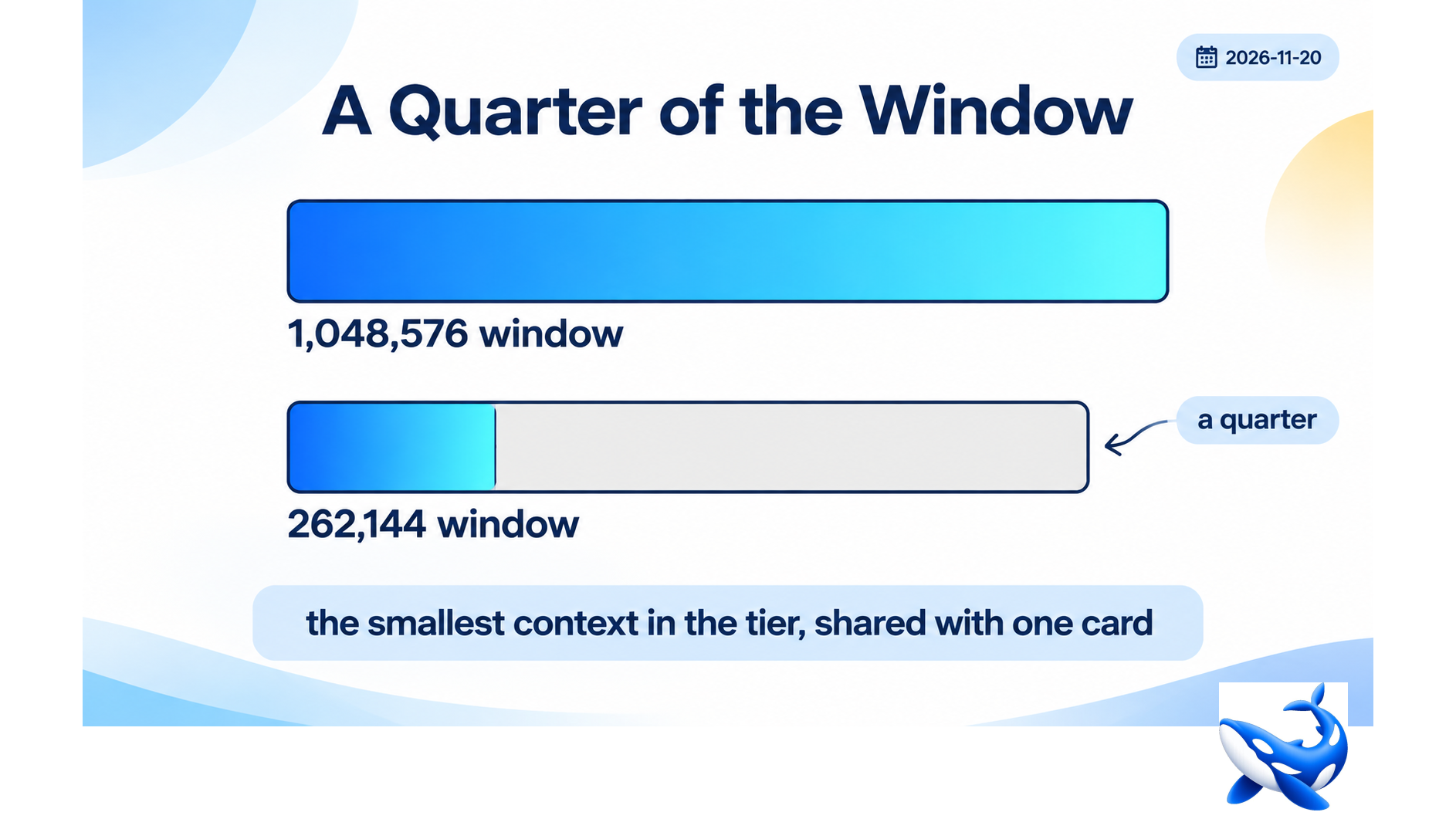
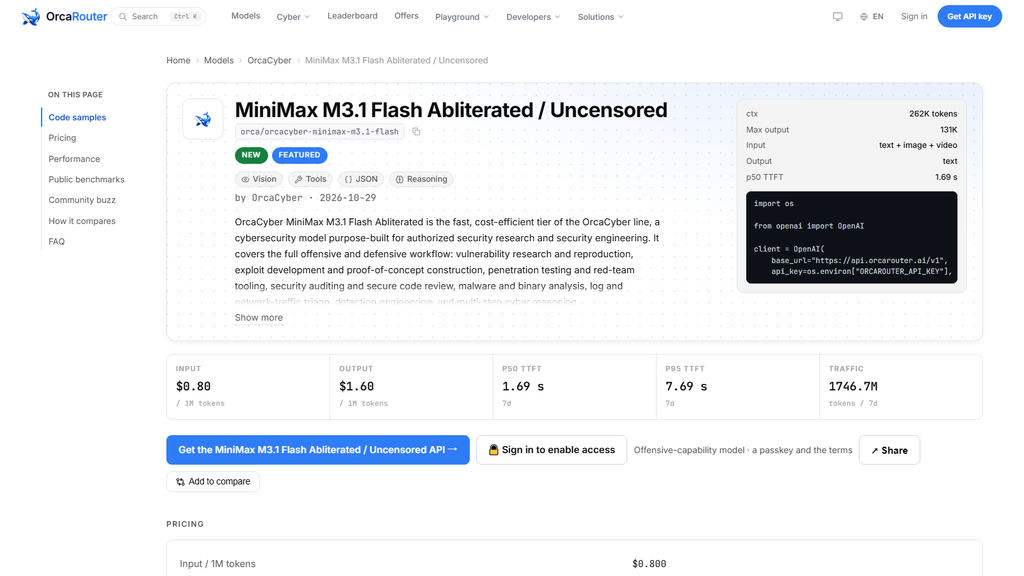
Two hundred sixty-two thousand tokens is a quarter of the window nine other cards in this tier offer, and it is the smallest piece of reading room here. OrcaRouter publishes the figure alongside a 131,072-token ceiling. Both are on OrcaCyber MiniMax M3.1 Flash context: a 262,144-token context against a maximum output of 131,072.
The window column
| card | context | max output | ratio |
| Flash 1.0 | 1,048,576 | 393,216 | 37.5 % |
| GLM 5.3 Flash | 1,048,576 | 131,072 | 12.5 % |
| Hy4 | 1,048,576 | 65,536 | 6.25 % |
| Hy4 Flash | 1,048,576 | 65,536 | 6.25 % |
| K3.1 Pro | 1,048,576 | 943,718 | 90.0 % |
| MiMo V2.6 Flash | 1,048,576 | 131,072 | 12.5 % |
| Ultra 1.0 | 1,048,576 | 131,072 | 12.5 % |
| GLM 5.3 | 1,000,000 | 128,000 | 12.8 % |
| Zero 1.0 | 1,000,000 | 128,000 | 12.8 % |
| Zero 1.5 | 1,000,000 | 128,000 | 12.8 % |
| MiniMax M3.1 Flash | 262,144 | 131,072 | 50.0 % |
| Qwen3.8 Flash Next | 262,144 | 131,072 | 50.0 % |
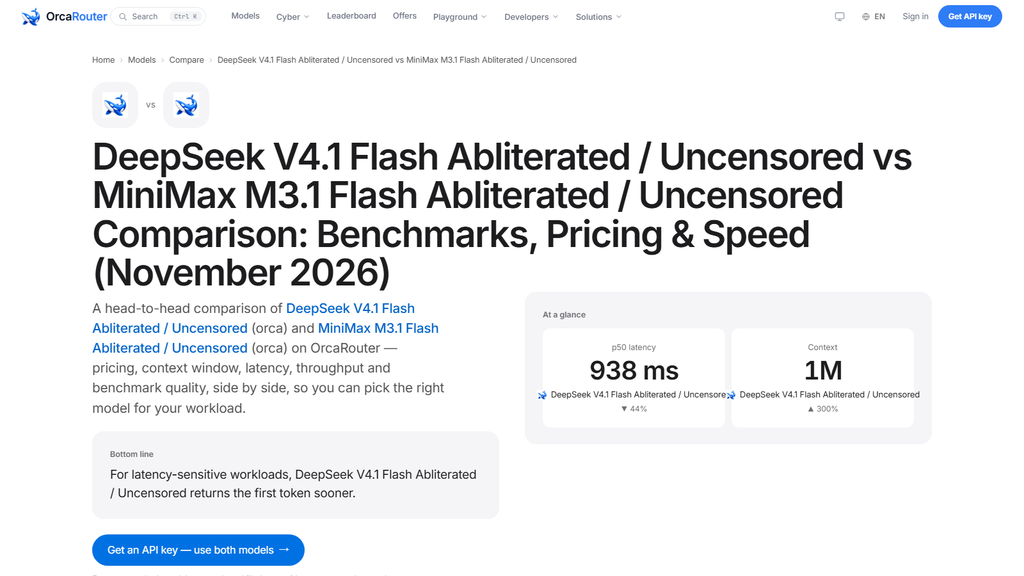
Ten cards read a million tokens or more. Two read a quarter of that, and this is one of them.
The ceiling is not small. At 131,072 tokens it matches or exceeds eight cards in the tier. So the ratio is high — 50%, joint-highest among the cards with a million-token reading room excluded — but the reason is a short window, not a generous ceiling.
That distinction decides who the card is for. A pipeline whose inputs are under 262,144 tokens sees a normal card with a normal ceiling. A pipeline whose inputs are a full repository, a year of logs or a long video sees a hard stop at a quarter of the tier’s standard.
What 262,144 tokens holds
Two hundred sixty-two thousand tokens is roughly 190,000 words, or a large book, or a mid-sized repository, or about three hours of dense transcript.
| input | rough tokens | fits |
| a 400-page report | 200,000 | almost |
| a mid-sized repository | 150,000 – 400,000 | sometimes |
| a full incident bundle | 50,000 – 150,000 | yes |
| a five-hour video transcript | 60,000 – 90,000 | yes |
| a year of hourly logs | 500,000 + | no |
| a monorepo | 2,000,000 + | no |
The last two rows are the ones this card cannot serve, and they are exactly the rows the million-token cards were built for. That is the tier split, stated without judgement about which is better.
The alternative reading is that a quarter of a million tokens is a lot of context and covers most work. That is also true. Most security artefacts — a CVE advisory plus the vulnerable file, a packet capture summary, a build log, a policy document — fit with room to spare.
So the window is a constraint on a specific class of work rather than a general limitation, and the card’s published price reflects that: it sits on the $0.80/$1.60 band with five other cards.
The cost of splitting a large input
A pipeline that must read 1,048,576 tokens on this card has to chunk it four ways and reconcile four outputs. That is an engineering cost with a token cost beside it.
| this card | a million-window card | |
| input price | $0.80 / M | $0.80 / M |
| tokens to read | 1,048,576 | 1,048,576 |
| input cost | $0.8389 | $0.8389 |
| calls needed | 4 | 1 |
| output cost at 131,072 total | $0.2097 | $0.2097 |
| reconciliation | required | none |
The token cost is identical. The difference is entirely in the orchestration and in the quality risk of merging four partial answers.
That is worth stating because it is the one place where this card loses on something other than capability. A buyer comparing prices sees two cards at $0.80 in and $1.60 out and might conclude they are interchangeable on long input. They are not — one does it in one call and the other in four.
The chunk size is what changes the price, and chunking at 262,144 gives each call a quarter of the useful context. Four calls also mean four first-token waits, which on this card’s 1,691 ms median adds up to under seven seconds of pure latency.
What the card does well inside its window
Within 262,144 tokens the card is unremarkable in the good sense: a band price, a 131,072-token ceiling, 110.3 tokens a second, and an error rate of 0.18%.
| quantity | value |
| 7-day tokens | 1.71 B |
| 7-day bill | $1,710 |
| token share | 1.49 % |
| bill share | 0.66 % |
| error rate | 0.18 % |
| failed tokens | 3.1 M |
| failed cost per billion | $1,794 |
| ceiling fill | 19.8 min |
| $/M/s | $0.01450 |
One point seven one billion tokens a week is not the shape of a card that is being avoided. It is a modest, steady volume on a card whose window limits it to mid-sized work.
The $/M/s figure of $0.01450 is fourth-cheapest in the tier, which makes the combination of a band price and 110 tokens a second the card’s real selling point. A buyer who never exceeds 262,144 tokens gets a fast, cheap, mid-sized card and never meets the constraint.
The constraint only binds above that line, and above that line the answer is another card rather than a workaround.
Where a quarter of a million tokens is plenty
The 262,144-token window is a constraint on a class of work, and the class is narrower than “long input” suggests.
| security artefact | typical tokens | fits |
| a CVE advisory plus its vulnerable file | 12,000 | yes |
| a build log with failures | 90,000 | yes |
| a packet capture summary | 5,000 | yes |
| a policy set for comparison | 60,000 | yes |
| an incident timeline with raw events | 180,000 | almost |
| a full application repository | 400,000 | no |
| a year of audit logs | 900,000 | no |
Four comfortable, one tight, two impossible. The two impossible rows are exactly what a million-token card exists for, and they are also the two that produce the largest reports.
The tight row is the interesting one. An incident timeline at 180,000 tokens is 69% of this card’s window, leaving 82,000 tokens for the question and the answer. That is workable and leaves no room for a second artefact in the same call.
So the window’s boundary sits near the top of the realistic single-artefact range rather than above it. A pipeline handling one artefact at a time fits; one that combines two before asking does not.
That is a narrower limitation than the raw comparison to 1,048,576 suggests, and it is the reason the card sits on the band price with five siblings rather than being priced as a small-context compromise.
One more field sits beside the window. The card’s published modalities are text, image and video, and its parameter surface is twenty, so the short window is not accompanied by a narrow API. A buyer gets a wide capability set inside a smaller reading room, which is the opposite trade from the text-only cards at the top of the price range.
OrcaCyber MiniMax M3.1 Flash reads 262,144 tokens — a quarter of the million-plus window that ten cards in the tier offer — while matching or exceeding eight of them on a 131,072-token ceiling.
Inside that window it is a fast, cheap card: band prices, 110.3 tokens a second, $0.01450 per million per second and 19.8 minutes to fill the ceiling. A 1,048,576-token input costs the same in tokens here as on a million-window card and four times as many calls, plus the reconciliation.
Sourcing note: the context window, ceiling, price rows, cache rate, throughput, latency, error rate, token volume and parameter count are read from the OrcaCyber MiniMax M3.1 Flash model API and card page on orcarouter.ai on 2026-11-20, with traffic, latency and error rates being OrcaRouter production telemetry for the seven days to that date. The ratios, chunking arithmetic, fill times and failure figures are our own; input-size estimates are illustrative ranges rather than measurements. No competitor product is named or compared. Checked 2026-11-20.