Short direct answer
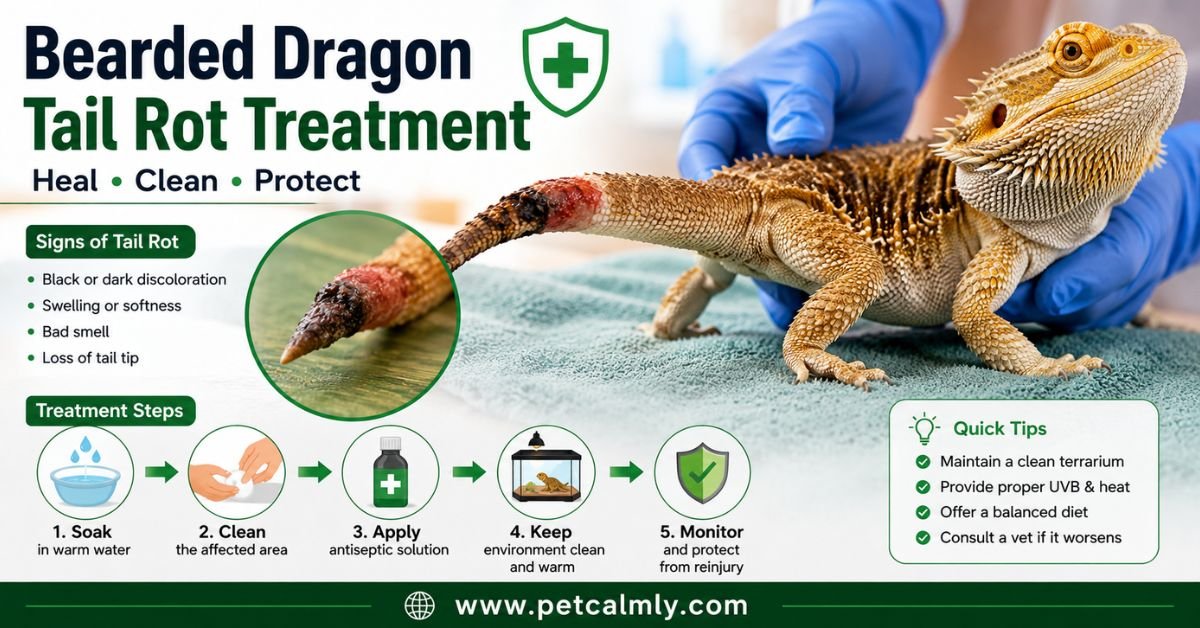
Mild tail rot in bearded dragons can often be managed at home with warm water soaks, a diluted antiseptic like chlorhexidine, and daily wound checks but only if the discoloration is limited to the very tip and hasn’t spread. If the black or discolored area is growing, smells bad, feels hard or dry, or reaches past the first inch of the tail, this is no longer a home-care situation. Bearded dragons don’t regrow lost tails, so waiting too long can mean permanent tail loss or a trip to the vet for amputation. When in doubt, a reptile-experienced vet should look at it within 24–48 hours.
That’s the short version. Now let’s get into the part that actually matters figuring out what you’re looking at, whether you can safely treat it yourself, and how to stop it from happening again.
What Tail Rot Actually Is (In Plain English)
Tail rot isn’t really one condition. It’s a description of what happens when part of a bearded dragon’s tail loses its blood supply and the tissue starts to die. Vets sometimes call this “necrosis,” which just means dead tissue. Once tissue dies, bacteria and fungi move in fast, and that’s when things go downhill.
Here’s the part a lot of first-time owners don’t realize: unlike leopard geckos, bearded dragons cannot regenerate a lost tail. Whatever dies stays dead, and whatever is amputated is gone for good. That’s why catching this early matters so much more than it might with other reptiles.
Most cases start small a discolored ring near the tip, sometimes no bigger than a grain of rice. It’s easy to miss during a quick glance, especially on darker-colored dragons. That’s usually the window where home treatment can still help.
What Causes Tail Rot in Bearded Dragons
Tail rot rarely has one single cause. Usually it’s a combination of husbandry gaps that quietly build up over weeks. The most common ones I see mentioned again and again by experienced keepers and reptile vets:
- Retained shed (dysecdysis). A thin ring of old skin gets stuck around the tail and doesn’t come off during a shed. As the tail keeps growing, that ring acts like a tourniquet, slowly cutting off blood flow to the tip.
- Low humidity. Bearded dragons come from arid environments, but too dry a habitat makes shedding incomplete and patchy, which increases the odds of retained shed around the tail and toes.
- Injury or trauma. Tail whips against tank decor, getting stepped on, being caught in a hide, or rough handling by another dragon (if housed together, which isn’t recommended) can damage tissue enough to trigger necrosis.
- Bacterial or fungal infection. Sometimes rot starts from an open wound that gets infected rather than from constriction.
- Substrate or enclosure hazards. Loose fibers from carpet-style liners, certain fabric hammocks, or stringy substrate can wrap around the tail the same way retained shed does.
- Poor circulation from cold temperatures. Tails are thin and lose heat fast. In an enclosure that’s too cool, especially at the cooler end, blood flow to the extremities can already be reduced before anything else goes wrong.
Most owners I’ve talked to about this find it’s rarely just one thing it’s usually a combination, like a slightly-too-dry tank and a missed shed and a loose thread from a hammock, all lining up at once.
Early Warning Signs Most Owners Miss
The earliest signs of tail rot are subtle enough that they’re easy to write off as “just a dark patch” or “probably just dirt.” Here’s what to actually look for during your regular handling or tank checks:
- A ring or band of discoloration grey, dark brown, or black usually starting at the very tip
- The area feels slightly cooler, drier, or harder than the rest of the tail when gently touched
- A faint but noticeable smell coming from the tail (healthy skin shouldn’t smell)
- Skin that looks shriveled or “pinched” rather than smooth
- Reduced tail movement, or your dragon reacting when the area is touched
- Visible retained shed wrapped around the tail like a thin plastic band
If you catch any of this early, you’re in a much better position. If the color has already gone fully black and dry over more than an inch of tail, or if you can see any exposed tissue, skip the home-treatment section below and go straight to “When You Need a Vet No Exceptions.”
Home Treatment for Mild Tail Rot
This section is for genuinely mild cases: a small, recent discoloration at the very tip, no smell, no swelling, and your dragon isn’t showing pain when it’s touched. If any of those aren’t true, please read the vet section further down instead treating a moderate case like a mild one is the single biggest mistake I see owners make.
Step 1: Soak the Tail in Warm Water
Fill a shallow container with lukewarm water — about the temperature of a baby’s bath, roughly 85–90°F. Let your dragon sit in it for 10–15 minutes, keeping the water level below the chest. This softens any retained shed and makes it much easier to remove without tearing skin.
Step 2: Gently Try to Remove Retained Shed
After soaking, use a soft, damp cotton swab or a very soft toothbrush to gently roll away any loose skin around the affected band. Never pick, peel, or force skin that isn’t ready to come off — this can tear healthy tissue and make things worse. If it doesn’t come away easily after a gentle attempt, stop and try again after tomorrow’s soak.
Step 3: Clean the Area
Once the tail is dry, dab the discolored area with a diluted chlorhexidine solution (a common reptile-safe antiseptic, available at most pet stores or from a vet) using a clean cotton swab. Avoid alcohol-based products or hydrogen peroxide they’re harsher than they need to be and can damage healthy tissue around the wound.
Step 4: Monitor Daily, Not Weekly
This is where a lot of home treatment quietly fails. Owners treat once, feel relieved the tail “looks a bit better,” and check again a week later by which point a mild case has become a serious one. Check the tail every single day. Take a photo from the same angle each day if you can; it’s much easier to spot spreading rot in photos than in memory.
What “Improvement” Actually Looks Like
- The discoloration isn’t spreading further up the tail
- No new smell has developed
- The area feels less dry and constricted after a few soaks
- Your dragon isn’t flinching when the tail is handled
If you see the opposite of any of these within 2–3 days, it’s time to call a vet rather than continue home care.
When You Need a Vet — No Exceptions
I want to be direct here, because this is where a calm, “let’s just monitor it” approach can genuinely cost a dragon its tail. See a reptile-experienced veterinarian promptly if you notice any of the following:
- The discoloration covers more than the very tip, or is clearly spreading
- The tail smells unpleasant or has any discharge
- You can see exposed muscle, bone, or an open wound
- The tail feels cold, hard, or “dead” compared to the rest of the body
- Your dragon seems lethargic, isn’t eating, or is guarding the tail from touch
- Home care hasn’t shown any improvement after 2–3 days
In these situations, a vet may need to surgically remove the dead portion of the tail before infection spreads further into healthy tissue sometimes this means a partial amputation. This isn’t a worst-case scenario to be scared of; it’s a fairly routine procedure for exotic vets, and dragons generally adapt well afterward. What matters most is not delaying it. Untreated necrotic tissue doesn’t heal on its own it can spread toward the body and, in severe cases, lead to systemic infection.
If you don’t already have a reptile-experienced vet, look specifically for an “exotic animal vet” rather than a general small-animal clinic tail necrosis in reptiles isn’t something every vet has direct experience treating.
Mild vs. Moderate vs. Severe Tail Rot: A Quick Comparison
| Stage | What You’ll See | What To Do |
|---|---|---|
| Mild | Small discolored ring at the very tip, no smell, no pain response | Home care: warm soaks, gentle shed removal, daily monitoring |
| Moderate | Discoloration spreading past the tip, slight smell, tail feels dry or hard | Vet visit within 24–48 hours; don’t wait it out at home |
| Severe | Black/dead tissue over a large section, foul smell, exposed tissue, dragon in visible discomfort | Emergency vet visit — surgical intervention is likely needed |
Preventing Tail Rot Before It Starts
Prevention is genuinely the easiest part of this whole topic, and it comes down to habitat basics most owners already know but don’t always keep consistent.
Keep humidity in the right range. Most bearded dragon enclosures should sit somewhere around 30–40% humidity, with a light misting during shed cycles to help skin come off cleanly. A cheap digital hygrometer makes this easy to track instead of guessing.
Check for retained shed weekly, especially around toes and the tail. Bearded dragons shed in patches rather than all at once, and tails are one of the easiest spots to miss because dragons often curl them.
Remove loose substrate and fabric hazards. Carpet-style liners with fraying edges, loose fibers, or thin fabric hammocks can catch a tail the same way retained shed does. Solid, snag-free surfaces are safer.
Maintain a proper temperature gradient. A basking spot around 95–105°F and a cooler side around 80–85°F keeps circulation healthy throughout the body, including the tail. A cold enclosure isn’t just uncomfortable — it genuinely affects blood flow to extremities.
Handle gently and house dragons separately. Cohabitating bearded dragons is one of the more common (and avoidable) causes of tail injuries, since dragons can be territorial and may bite or grab at each other’s tails.
5 Common Mistakes That Make Tail Rot Worse
A few habits show up again and again in cases that escalate from mild to serious, and most of them come from good intentions rather than neglect.
1: Waiting to “see if it clears up on its own.”
Retained shed and minor discoloration don’t resolve by themselves the way a scrape on human skin might. Without intervention, a constricting band of old skin keeps tightening as the tail grows, and the tissue underneath keeps losing circulation.
2: Forcing off skin that isn’t ready.
It’s tempting to just peel the stuck shed away in one go, especially if it looks close to coming off. But skin that hasn’t fully loosened can tear healthy tissue underneath, turning a minor shedding issue into an open wound that’s now vulnerable to infection.
3: Treating the tail but ignoring the enclosure.
Cleaning the wound without fixing the humidity, temperature, or substrate issue that caused it in the first place is a bit like bailing water out of a boat without patching the leak. The same conditions that caused retained shed once will likely cause it again.
4: Using the wrong products.
Human first-aid products like iodine at full strength, rubbing alcohol, or peroxide are often too harsh for reptile skin and can slow healing rather than help it. Reptile-safe, diluted antiseptics are a safer default.
5: Skipping the vet because “it’s just a tail.”
Because bearded dragons don’t need their tails to survive the way some animals do, it’s easy to underestimate how serious spreading necrosis can become. Left unchecked, infection can travel beyond the tail itself, which is a much bigger problem than the original wound.
How This Differs From Shedding Issues on Other Body Parts
Owners sometimes confuse tail rot with normal shedding difficulty on the toes or the tip of the tail, and the two do overlap. Retained shed on toes can cause a similar constriction injury, sometimes affecting circulation the same way it does on a tail. The core difference is severity and reversibility: a toe that loses circulation from retained shed can sometimes be saved with prompt soaking, while a tail that’s gone past mild discoloration usually needs more decisive care because of how much tissue is involved and how much harder it is to fully clean and monitor a narrow, tapering area like a tail tip.
If you’re also noticing shedding problems around the toes, face, or spine, it’s worth treating that as a separate but related concern — often pointing to the same root cause of low humidity or an incomplete shed cycle, rather than a coincidence.
A Quick Pre-Vet-Visit Checklist
If you’ve decided a vet visit is the right call, a little preparation makes the appointment more useful:
- Take clear, well-lit photos of the tail from multiple angles
- Note when you first noticed the discoloration and how it’s changed since
- Write down your current humidity and temperature readings (basking spot and cool side)
- Mention any recent shed problems, injuries, or changes in enclosure setup
- Note whether your dragon has been eating and behaving normally otherwise
- Bring a small water dish or your dragon’s usual carrier for a comfortable transport
Having this ready saves time during the exam and helps the vet rule things in or out faster.
A Realistic Example: How Mild Cases Usually Play Out
A fairly typical scenario looks like this: an owner notices a faint grey band near the very tip of the tail during a routine handling session. There’s no smell, the dragon doesn’t react to touch, and the rest of the tail looks completely normal. Over the next few days, warm soaks and gentle shed removal are enough to loosen and remove the retained skin, and the color underneath returns to normal within about a week.
Compare that to a case where the same grey band is missed for two or three weeks because the dragon wasn’t handled much during that stretch. By the time it’s noticed, the discoloration has spread an inch up the tail, there’s a faint smell, and the tip has gone from grey to solid black. That’s no longer something home care can fix it needs a vet, and depending on how far the necrosis has progressed, some amount of tail may need to be removed.
The difference between those two outcomes usually isn’t luck. It’s how often the tail gets checked.
What Pet Owners Should Do Right Now
If you’re reading this because you just noticed something on your dragon’s tail, here’s a simple order of operations:
- Look closely at the discoloration — size, color, smell, and whether it’s spreading
- Gently touch the area (without forcing anything) to check for pain response, hardness, or coldness
- If it’s small, recent, and painless — start warm soaks and daily monitoring
- If it’s spreading, smelly, or your dragon reacts to touch — contact an exotic vet today, not next week
- Either way, check humidity and temperature gradients in the enclosure and look for any physical hazards like loose substrate or fabric
Conclusion
Tail rot sounds alarming, and in its later stages, it genuinely is something to take seriously. But most cases start small and quiet a faint ring of discoloration that’s easy to catch if you’re checking your dragon’s tail regularly. The honest truth is that the outcome usually comes down to timing: mild cases respond well to simple home care, while cases left too long often need veterinary intervention. If you’re ever unsure which category you’re looking at, it’s always safer to have a reptile-experienced vet take a look than to assume it will resolve on its own.
Keep an eye on humidity, check for retained shed often, and handle your dragon regularly enough that you’d actually notice if something changed. That habit alone prevents most cases before they ever become a real problem.
More Information About Pets, Please Visit Our Website: Bearded Dragon Eye Problems
Heat Pad for Bearded Dragon at Night
Bearded Dragon Brumation or Dead?
Frequently Asked Questions
1: Can a bearded dragon’s tail grow back after tail rot?
No. Unlike some lizards, bearded dragons cannot regenerate lost tail tissue. If part of the tail dies or needs to be amputated, that portion is gone permanently, which is why early treatment matters so much.
2: Is tail rot painful for bearded dragons?
It can be, especially once the tissue has died and infection sets in. Dragons often show discomfort by flinching when the area is touched, moving the tail less, or becoming less active overall. Mild, early-stage discoloration typically doesn’t cause pain yet.
3: How long does it take for tail rot to heal at home?
Mild cases treated early with warm soaks and gentle cleaning often show improvement within a week. If there’s no visible improvement after 2–3 days of consistent care, it’s time to involve a vet rather than continuing to wait.
4: What does the beginning of tail rot look like?
Usually a small grey, brown, or black ring near the very tip of the tail, sometimes with slightly dry or shriveled-looking skin. It can be easy to miss unless you’re specifically checking the tail during handling.
5: Can I use human antiseptic like hydrogen peroxide on my bearded dragon’s tail?
It’s best avoided. Hydrogen peroxide and alcohol-based products can damage healthy tissue around the affected area. A diluted, reptile-safe antiseptic like chlorhexidine is the safer choice, and a vet can recommend the right concentration.
6: Will my bearded dragon be okay if it needs tail amputation?
Generally, yes. Partial tail amputation for necrosis is a fairly routine procedure for experienced exotic vets, and most dragons adjust well afterward, especially once the source of infection is removed. The tail won’t grow back, but overall health and quality of life are typically unaffected long-term.