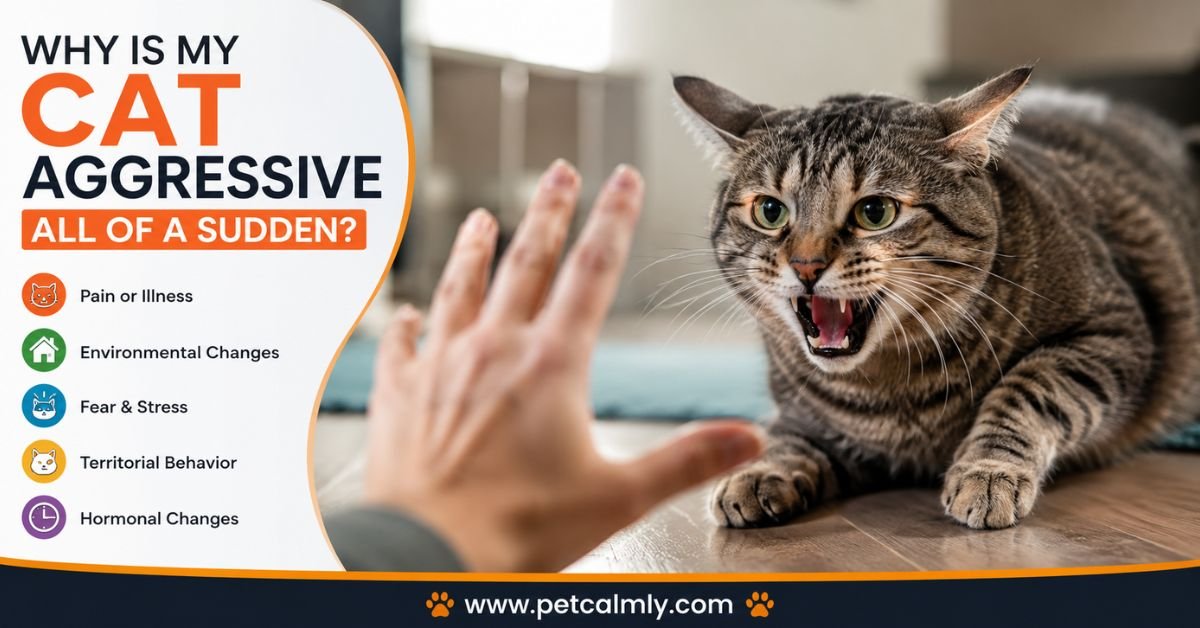
Short direct answer
Sudden cat aggression is almost never random. In most cases, it’s your cat’s way of communicating pain, fear, stress, or a change they can’t verbally explain. The most common triggers are an underlying medical issue (like dental pain, arthritis, or hyperthyroidism), a stressful change in the home, redirected aggression from something they saw or heard, or overstimulation during petting. The first step isn’t training it’s ruling out pain. A sudden personality shift is a signal, not “bad behavior.”
Why Sudden Aggression Feels So Confusing (And Why You’re Not Overreacting)
If your cuddly, easygoing cat has suddenly started hissing, swatting, or biting, you’re probably replaying the last few days in your head, trying to figure out what you did wrong.
You probably didn’t do anything wrong.
Cats are masters at hiding discomfort. It’s an instinct left over from their wild ancestors, who couldn’t afford to look weak or vulnerable in front of predators. So when something is off physically or emotionally a cat’s first move usually isn’t to slow down or act “sick.” It’s to protect itself. And to a cat, protecting itself can look like aggression.
That’s the piece a lot of pet owners miss. Aggression in cats is rarely about dominance or “attitude.” It’s almost always a response to something the cat is feeling: pain, fear, overstimulation, or a threat to their sense of safety.
The Most Common Reasons Cats Suddenly Become Aggressive
1. An Underlying Medical Problem
This is the single most important thing to rule out first, especially if the aggression came on quickly and your cat has never shown this behavior before.
Pain changes behavior fast. A cat that’s normally relaxed about being picked up may suddenly bite if their joints, teeth, or abdomen hurt. Conditions commonly linked to sudden behavioral changes include:
- Dental disease or a broken tooth
- Arthritis, especially in cats over seven years old
- Urinary tract infections or bladder stones
- Hyperthyroidism, which can cause irritability and restlessness
- Neurological issues, including seizures or cognitive decline in senior cats
- Internal pain from an injury that isn’t visible from the outside
According to the Cornell Feline Health Center, medical causes should always be considered first when a cat’s behavior changes abruptly, since pain and illness are among the most frequent triggers for new aggression.
If your cat flinches when touched in a specific spot, avoids being picked up, has stopped grooming certain areas, or seems “grumpier” overall, a vet visit should come before any behavior plan.
2. Redirected Aggression
This one catches a lot of owners off guard because the aggression seems to come out of nowhere and gets aimed at the wrong target.
Here’s how it usually plays out: your cat sees another cat outside the window, hears a loud noise, or gets startled by something they can’t reach or escape. Their body floods with adrenaline. Then you walk by, or you reach down to pet them, and all that pent-up arousal gets redirected onto you — the nearest available target.
Redirected aggression can last minutes or, in some cases, hours after the original trigger. This is why a cat can seem completely fine one moment and lash out with no obvious warning the next.
Real-world example: A cat spots a stray tomcat pacing on the porch. The owner, unaware anything happened, walks over ten minutes later to say hello — and gets swatted. The cat isn’t upset with the owner. It’s still physiologically “on alert” from the outdoor cat.
3. Fear or Stress From a Change in the Home
Cats are creatures of routine, and they notice change far more than most owners expect. Common stressors include:
- A new pet or baby in the household
- Moving to a new home
- Furniture rearrangement
- A change in litter box location or type
- New visitors or houseguests
- Loud construction or renovation noise
- A change in the owner’s schedule (for example, returning to an office after working from home)
Stress-related aggression often shows up gradually at first — hiding more, eating less, avoiding certain rooms — before it escalates into hissing or swatting. If you look back over the past two to four weeks, there’s often a change you can identify.
4. Overstimulation During Petting
This is one of the most common — and most misunderstood — causes of “sudden” aggression, because it looks like the cat “just snapped” for no reason during a friendly moment.
Cats have a threshold for physical affection, and that threshold isn’t fixed. It can shrink temporarily due to stress, pain, or overtiredness. A cat that normally tolerates ten minutes of petting might only be able to handle two minutes on a bad day. When the threshold is crossed, the cat may bite or swat — often with very little warning if the owner has missed the subtler cues.
Subtle warning signs before a bite include:
- Tail flicking or thumping
- Skin rippling along the back
- Ears rotating sideways or flattening
- A sudden stillness or “freezing”
- Dilated pupils
Learning to recognize these micro-signals is one of the fastest ways to prevent overstimulation bites before they happen.
5. Territorial Aggression
Territorial aggression often targets other animals in the home, but it can spill over onto humans too, especially during a dispute. This is common when:
- A new cat or pet has recently joined the household
- Two cats that previously got along have had a falling-out
- A cat feels their resources (food, litter box, favorite perch) are being threatened
If your cat is suddenly aggressive only around another pet, or only in certain rooms, territory is a likely factor.
6. Fear of a Specific Person, Object, or Situation
Sometimes the trigger is more specific than owners realize. A vet visit that went badly, a startling event (like being stepped on or having a door slam near them), or an association with a particular object (the carrier, a specific person’s cologne, a new vacuum) can create a fear response that looks like unprompted aggression.
Common Mistakes Owners Make When Dealing With Sudden Aggression
It’s natural to want to fix this quickly, but a few common reactions tend to make things worse instead of better:
- Punishing the behavior. Yelling, spraying water, or physically correcting a cat for aggression usually increases fear and can make future aggression worse, not better.
- Forcing interaction. Picking up or cornering an already stressed cat “to show them it’s okay” often escalates the situation.
- Assuming it’s just a phase. Sudden aggression with no identifiable trigger deserves a vet check, not a wait-and-see approach.
- Ignoring body language. Missing the early warning signs (tail flicking, ear position, freezing) means missing the chance to step back before a bite happens.
- Comparing to other cats. Every cat’s tolerance for handling, noise, and change is different. What one cat shrugs off, another finds genuinely threatening.
How to Respond in the Moment (Practical Guide)
When your cat is actively showing aggressive body language, the goal is de-escalation, not correction.
- Stop what you’re doing immediately. Don’t finish the pet, the pickup, or the interaction “just to end on a good note.”
- Back away slowly. Don’t make sudden movements or loud noises.
- Avoid direct eye contact. Prolonged staring can feel confrontational to a cat.
- Give them space and time. Let your cat choose when to re-approach, rather than approaching them again right away.
- Don’t punish or scold. This adds fear to an already heightened state.
- Note what happened just before. Write down the time, location, and any possible trigger (a sound, another animal, a specific type of touch). Patterns often reveal the cause.
Building a Longer-Term Plan to Reduce Aggression
Once you’ve ruled out a medical cause, the next step is reducing the stress and triggers behind the behavior.
Create Predictable Routines
Cats feel safer when feeding times, play sessions, and quiet time happen on a consistent schedule. Predictability lowers baseline stress, which in turn lowers the odds of an aggressive outburst.
Give Your Cat Control Over Interactions
Let your cat initiate physical contact when possible. Offer a hand for them to approach rather than reaching toward them first. This small shift respects their choice and reduces defensive reactions.
Watch the Clock During Petting Sessions
If overstimulation is a factor, keep sessions shorter than your cat’s usual threshold and stop at the first sign of tail flicking or skin rippling — before it escalates.
Add Vertical Space and Hiding Spots
Cat trees, shelves, and enclosed hiding spots give a stressed cat somewhere to retreat and decompress, which can reduce reactive behavior over time.
Use Play to Release Pent-Up Energy
A short, structured play session with a wand toy can help redirect built-up arousal into an appropriate outlet, especially useful for cats prone to redirected aggression.
Consider Feline Pheromone Products
Synthetic pheromone diffusers are commonly recommended by veterinary behaviorists as a low-risk way to help reduce stress-related behaviors in the home, alongside — not instead of — addressing the root cause.
When Should You Worry? Signs That Need a Vet, Not Just a Behavior Plan
Some situations call for professional attention rather than at-home management alone. Contact your veterinarian if:
- The aggression appeared suddenly with no clear behavioral trigger
- Your cat flinches, cries out, or resists being touched in a specific area
- There are changes in appetite, litter box habits, grooming, or energy alongside the aggression
- Your cat is a senior (7+) and showing new irritability or confusion
- The aggression is severe enough to cause injury
- Your cat seems disoriented, unsteady, or has had any seizure-like episodes
A veterinarian can rule out pain and illness through an exam and, if needed, bloodwork or imaging. This step matters even if you’re fairly confident the cause is behavioral, since pain-driven aggression is one of the most commonly missed causes according to feline behavior resources from the AAHA and Merck Veterinary Manual.
If the aggression is frequent, unpredictable, or directed at children or other vulnerable household members, ask your vet for a referral to a certified veterinary behaviorist. This isn’t a failure on your part — it’s the same step a good vet would take for any complex behavioral case.
What Pet Owners Should Do: A Simple Action Checklist
- Schedule a vet visit to rule out pain or illness
- Track when the aggression happens (time, location, what came before it)
- Identify any recent household changes in the past 2–4 weeks
- Learn your cat’s early warning signs (tail, ears, skin, pupils)
- Shorten petting sessions if overstimulation seems likely
- Reduce exposure to outdoor animal triggers (block window views if needed)
- Add safe retreat spaces around the home
- Avoid punishment or forced interaction
- Give the situation time most stress-based aggression improves with consistency, not quick fixes
Conclusion
Sudden aggression in a cat is unsettling, especially when it comes from an animal you thought you understood completely. But this kind of change is almost always a message, not a betrayal. Your cat isn’t turning against you they’re telling you something hurts, something feels unsafe, or something in their world has shifted.
Start with a vet visit to rule out pain. Then look at the pattern: when it happens, what came right before it, and what’s changed recently in your home. With a little patience and the right observation, most cats return to their old selves once the real cause is addressed.
More Information About Pets, Please Visit Our Website: How to Stop Dog Chewing
How to Stop Puppy Biting
Why Does My Dog Bark at Night for No Reason?
Frequently Asked Questions
1: Why did my cat suddenly start attacking me for no reason?
There’s almost always a reason, even if it isn’t obvious yet. The most common causes are underlying pain, redirected aggression from something the cat saw or heard, or overstimulation during handling. Start by ruling out a medical cause with your vet.
2: Can stress really cause a cat to become aggressive overnight?
Yes. Cats are highly sensitive to changes in routine, environment, and household dynamics. A new pet, a move, or even rearranged furniture can trigger a stress response that shows up as sudden aggression.
3: Is it normal for an older cat to become more aggressive with age?
New aggression in a senior cat is common but shouldn’t be dismissed as “just aging.” It’s frequently linked to arthritis, dental pain, hyperthyroidism, or cognitive changes, all of which are worth discussing with a veterinarian.
4: Should I punish my cat for aggressive behavior?
No. Punishment tends to increase fear and stress, which can make aggression worse over time. De-escalation, space, and identifying the root cause work far better than correction.
5: How do I know if my cat’s aggression is medical or behavioral?
You often can’t know for certain without a vet exam. A good rule of thumb: if the aggression appeared suddenly, is paired with other changes (appetite, grooming, litter habits), or involves flinching at touch, treat it as a possible medical issue first.
6: Will my cat’s aggressive behavior go away on its own?
Sometimes, if the trigger was temporary (like a one-time stressful event). But ongoing aggression usually needs a specific cause identified and addressed whether that’s pain management, reducing a stressor, or adjusting how you interact with your cat.