Short direct answer
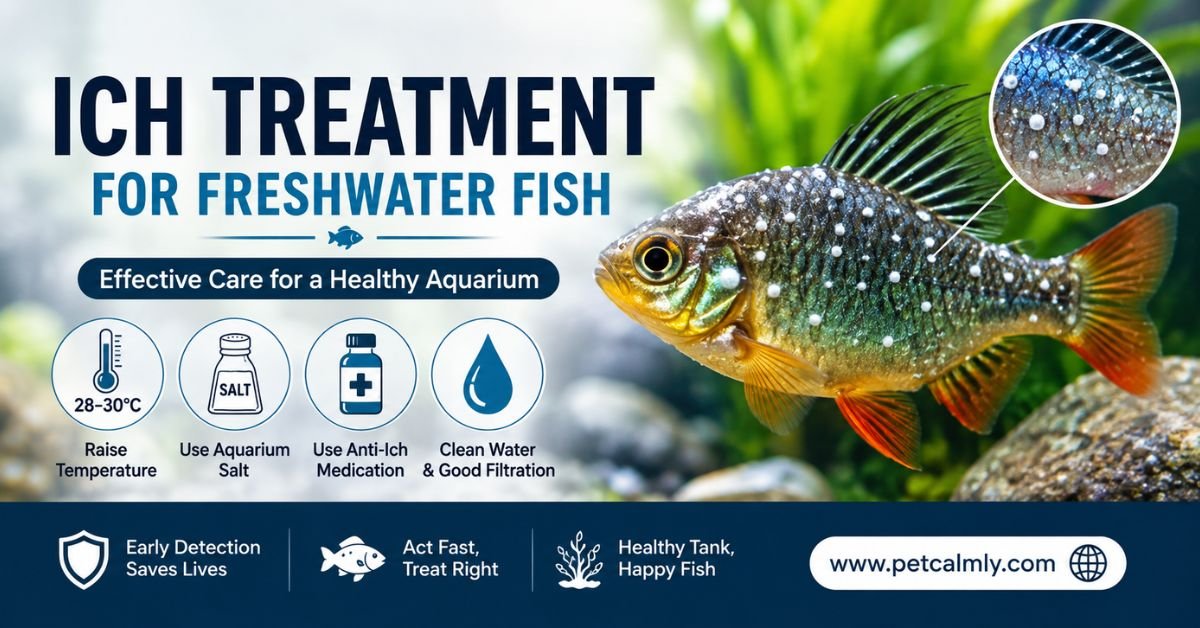
The most effective ich treatment for freshwater fish combines two things: raising the water temperature to around 82–86°F (28–30°C) to speed up the parasite’s life cycle, and applying a targeted treatment either aquarium salt, a formalin-based medication, or a commercial ich remedy to kill the free-swimming stage before it can reinfect your fish. Treatment must continue for at least 10–14 days after the last visible spot disappears, because Ich hides in a protected stage on your fish and in the substrate that medication can’t reach.
If you just spotted tiny white dots on your fish and your stomach dropped a little, take a breath. Ich is scary because it moves fast, but it’s also one of the most treatable diseases in freshwater fishkeeping once you understand what’s actually happening in the tank.
There’s no single “one and done” dose for Ich. It’s a process, not a quick fix and understanding why will make you far better at actually beating it.
What Is Ich, and Why Does It Spread So Fast?
Ich (pronounced “ick,” sometimes spelled “ick” or written out as ichthyophthiriasis) is caused by a parasite called Ichthyophthirius multifiliis. It’s a single-celled organism, but don’t let “single-celled” fool you into thinking it’s harmless. This parasite is aggressive, and it’s found in freshwater systems almost everywhere in the world.
What makes Ich so alarming to new fishkeepers is the math. A single parasite that drops off your fish can divide into hundreds of new offspring in one cycle. That’s why a tank that looked fine on Tuesday can have every fish covered in white spots by Friday. It isn’t bad luck it’s biology.
The Three Stages of the Ich Life Cycle
Understanding this life cycle is the single biggest factor in treating Ich successfully, because each stage responds to treatment differently.
- Trophont (the feeding stage): This is the visible white spot. The parasite has burrowed under your fish’s skin or gills and is feeding on tissue fluid. It’s protected by mucus and skin at this point, so medication mostly can’t touch it.
- Tomont (the reproducing stage): Once mature, the parasite drops off the fish and lands on the substrate, glass, or decorations. There, it forms a sticky cyst and divides sometimes into hundreds of new parasites — inside a protective shell that also resists most chemical treatment.
- Theront (the infective, free-swimming stage): This is the only stage that’s actually vulnerable to medication, salt, or heat. The theronts swim out looking for a new fish host. If they don’t find one within a day or two, they die on their own.
That last point explains everything about how ich treatment for freshwater fish actually works. You’re not trying to kill the spots you can see you’re trying to catch the invisible swimming stage before it finds a new host. This is also why single-dose “miracle cures” almost never work on their own.
How to Tell If Your Fish Has Ich
The classic sign is small white spots that look like someone sprinkled salt or sugar across your fish’s body and fins. But by the time spots are visible, the infection is already established, so it helps to know what comes before that.
Early Warning Signs Before the Spots Appear
Many owners notice behavior changes a day or two before any spots show up:
- Fish scratching or “flashing” against gravel, rocks, or decorations
- Clamped fins held tightly against the body
- Reduced appetite or fish hanging near the surface or filter outflow
- Increased mucus on the skin, giving fish a slightly cloudy appearance
- Rapid gill movement, which can signal Ich is affecting the gills even before skin spots appear
If your fish is only infected in the gills, you may never see white spots at all — just labored breathing and lethargy. This is one of the more dangerous presentations because owners sometimes miss it until the fish is in serious distress.
Conditions That Look Like Ich But Aren’t
A few other issues get mistaken for Ich, and treating the wrong problem wastes time your fish doesn’t have:
| Condition | How It Differs From Ich |
|---|---|
| Velvet disease | Spots are finer, gold or rust-colored, and often show best under a flashlight in a dark room |
| Columnaris | Appears as white or gray patches, often on the mouth or fins, rather than round dots |
| Fish lice or anchor worms | Visible parasites you can actually see moving or attached, not uniform dots |
| Slime coat stress response | A hazy film over the whole body, not distinct raised spots |
If you’re not sure which one you’re dealing with, treating for Ich when it’s actually columnaris (a bacterial infection) won’t help, and it can waste valuable time. When in doubt, a quick photo comparison against clear reference images, or a message to an aquatic veterinarian, is worth the extra ten minutes.
What Causes an Ich Outbreak in a Healthy Tank
Ich doesn’t appear out of nowhere. It’s almost always introduced by something new entering the tank — a new fish, live plants, decorations, or even a net or bucket that was used in another aquarium.
Stress is the other half of the equation. Ich parasites can exist at low levels without causing a full outbreak, kept in check by a fish’s immune system. Sudden temperature swings, overcrowding, poor water quality, or the stress of shipping and rehoming can all lower that immune defense enough for the parasite to take hold. This is exactly why a newly purchased fish, still adjusting to a new tank, is so often the first one to show spots.
A common real-world example: an owner adds two new tetras without quarantining them. Within a week, the tetras show spots, and within ten days, the whole community tank is affected. This isn’t a coincidence it’s the textbook pattern of how Ich moves through an aquarium, and it’s exactly why quarantine matters more than almost any other single habit in fishkeeping.
Step-by-Step Ich Treatment for Freshwater Fish
Here’s the practical process, broken into the order most aquarists actually follow it.
Step 1: Raise the Water Temperature Safely
Raising the temperature to 82–86°F (28–30°C) speeds up the parasite’s life cycle, which shortens the window before it enters that vulnerable, treatable swimming stage. Faster cycle, faster kill window.
Do this gradually about 1–2°F every eight to twelve hours rather than all at once, since a sudden jump can stress fish that are already weakened. Increase aeration as you raise the temperature, because warmer water holds less oxygen and sick fish need all the oxygen they can get.
Heat alone is not safe for every species. Goldfish, white cloud minnows, and other coldwater fish should not be pushed into the mid-80s. For those species, lean more heavily on medication and salt rather than heat.
Step 2: Add Aquarium Salt (When It’s Safe)
Aquarium salt (not table salt, which contains anti-caking additives) disrupts the parasite’s ability to regulate water balance during its free-swimming stage. A common dosing guideline is roughly one tablespoon of aquarium salt per five gallons, though many aquarists work from a target of 3–5 parts per thousand salinity for a stronger effect in dedicated hospital tanks.
Salt isn’t right for every tank. Scaleless fish corydoras catfish, loaches, and many other bottom-dwellers — are far more sensitive to salt, so use a reduced dose or skip it for those species. Live plants and invertebrates like snails and shrimp generally don’t tolerate added salt well either, which is one reason many owners choose to treat Ich in a separate hospital tank rather than the main display.
Step 3: Choose the Right Medication
For moderate to severe outbreaks, or in tanks where heat and salt aren’t practical, a targeted medication does the heavy lifting. Formalin-based and malachite-green-based products are the most commonly used options in the hobby, and they work by killing the free-swimming theronts before they can attach to a new host.
Because only that swimming stage is vulnerable, a single dose won’t finish the job. Repeated treatments, spaced according to the product’s instructions and your water temperature, are what actually break the cycle. In warmer water, the parasite’s cycle completes faster, so treatments are typically needed closer together; in cooler water, that cycle stretches out over weeks, and treatments are spaced further apart.
Always follow the product label exactly, and remove carbon filtration during medicated treatment, since carbon will strip the medication out of the water before it can work.
Step 4: Clean the Tank Daily During Treatment
This step gets skipped constantly, and it shouldn’t. Vacuuming the substrate and wiping down decorations during treatment physically removes tomont cysts before they can release new swimming parasites. Combined with medication, daily or every-other-day cleaning noticeably shortens how long an outbreak drags on.
Remove any fish that don’t survive as soon as you notice them. A dead fish releases its remaining parasites into the tank almost immediately, which can restart the cycle for everyone else.
Ich Treatment Mistakes That Make Outbreaks Worse
A few habits show up again and again in tanks where Ich just won’t clear:
- Stopping treatment as soon as the spots disappear. The spots vanishing means the visible trophonts have dropped off not that the parasite is gone. Treatment needs to continue for at least 10–14 days past the last spot.
- Combining multiple medications at once. Mixing products, or layering salt, heat, and three different remedies simultaneously, often stresses fish more than it helps and can cause dangerous interactions.
- Doing large water changes with untreated water mid-cycle. This can dilute medication below an effective dose without fully removing the parasite.
- Ignoring the gills. If breathing looks labored and spots haven’t shown up on the body, don’t wait for visible confirmation before starting treatment.
- Treating a planted tank the same as a bare hospital tank. Salt and some medications can damage live plants, so dosing needs to be adjusted or the fish moved to a separate tank.
Species That Need a Different Approach to Ich Treatment
Not every fish tolerates the standard heat-and-salt protocol, so it’s worth knowing where to be more careful:
- Goldfish and coldwater species: Avoid pushing temperatures into the mid-80s. Rely on gentler heat increases, salt (if tolerated), and medication instead.
- Scaleless fish (corydoras, loaches, some catfish): Use half-strength salt doses or skip salt altogether, and choose medications labeled safe for scaleless species.
- Betta fish: Bettas tolerate warmth well, which actually works in your favor, but keep an eye on ammonia if you’re treating in a small tank, since heat increases their metabolism and waste production.
- Shrimp and snail tanks: Most Ich medications and added salt are risky for invertebrates. If fish in a shrimp tank develop Ich, moving the fish to a separate hospital tank for treatment is usually the safer route.
How Long Does Ich Treatment Take?
Most outbreaks take somewhere between one and three weeks to fully resolve, depending on water temperature and how early treatment started. Warmer water shortens the parasite’s cycle, which sounds counterintuitive but actually works in your favor during treatment it means the vulnerable swimming stage shows up sooner and more often, giving your treatment more chances to catch it.
As a general guide, in warmer water (75–79°F), treatments are often applied every 1–2 days for a minimum of several rounds, while in cooler water, treatments may need to be spaced 3–5 days apart with a longer overall course. The safest approach is to keep treating for a minimum of ten to fourteen days after the very last spot disappears, not from when treatment started.
When Should You Worry? Signs Ich Is Becoming an Emergency
General ich treatment for freshwater fish at home is usually manageable, but a few signs mean the situation has moved beyond routine care:
- Fish are gasping at the surface or clustering near an air stone, suggesting the gills are heavily affected
- Multiple fish die within 24–48 hours despite treatment
- Spots are covering large areas of the body along with visible sores or reddened patches
- A fish stops eating entirely for more than two to three days
- You’re unsure whether it’s Ich at all, and symptoms are worsening rapidly
These situations call for guidance beyond general care. An aquatic veterinarian or a fish health specialist can confirm the diagnosis under a microscope and rule out a secondary bacterial infection, which commonly moves in on fish already weakened by Ich. This isn’t about creating alarm — it’s about recognizing when a home protocol needs backup.
What Should Pet Owners Do After Treatment Ends
Once spots are gone and you’ve held steady for the full 10–14 day tail-end period, ease the tank back to normal gradually rather than all at once.
- Lower the temperature slowly, about 1°F every few hours, back to your species’ normal range
- Reintroduce carbon filtration to clear any remaining medication from the water
- Resume normal water changes and monitor ammonia, nitrite, and nitrate, since heavy dosing and heat can stress your biological filter
- Watch fish closely for another one to two weeks for any signs of secondary infection, like frayed fins or cloudy patches, since a weakened immune system takes time to recover fully
- Feed a varied, high-quality diet to help fish rebuild condition after the stress of both the illness and the treatment
Fish that survive an Ich outbreak can sometimes carry low levels of the parasite without showing symptoms, acting as a quiet source of reinfection later. This is one more reason a full, complete treatment course matters more than stopping the moment things look better.
Preventing Ich From Coming Back
Prevention is genuinely the easiest part of dealing with Ich, and it comes down to a short list of habits:
- Quarantine every new fish for at least two to four weeks before adding them to your main tank. This single habit prevents the vast majority of outbreaks.
- Quarantine new plants and decorations too, since tomont cysts can hitch a ride on more than just fish.
- Avoid sudden temperature swings, especially during water changes in colder months, since rapid shifts stress fish and can trigger dormant infections.
- Don’t overcrowd the tank. Crowding raises stress and makes it easier for Ich to spread from fish to fish.
- Disinfect nets, siphons, and buckets between tanks rather than sharing equipment across different aquariums.
- Keep an eye on new arrivals for the first two to three weeks, since stress from shipping is one of the most common triggers for an outbreak to become visible.
If you’re setting up a dedicated quarantine tank for the first time, our guide to building a simple quarantine setup walks through everything you need without overcomplicating it.
Conclusion
Ich feels overwhelming the first time you see it, mostly because it moves fast and the advice online can be contradictory. But once you understand that you’re targeting a free-swimming stage rather than the visible spots themselves, the whole process makes a lot more sense. Raise the temperature carefully, choose a treatment appropriate for your fish species, keep the tank clean, and stay consistent for the full course even after the spots are gone. That consistency is what actually separates a resolved outbreak from one that keeps coming back every few months.
Your fish’s best chance comes from steady, informed care rather than panic-driven overtreatment. Take it one step at a time, and don’t hesitate to loop in an aquatic vet if something doesn’t add up.
More Information About Pets, Please Visit Our Website: Betta Fish Tank Setup
Frequently Asked Questions
Can Ich go away on its own without treatment?
It’s very unlikely, especially in an aquarium. In the wild, fish have more space to avoid reinfection, but in a closed tank system, the parasite’s rapid reproduction usually overwhelms fish faster than their immune system can clear it. Treatment is strongly recommended as soon as symptoms appear.
Is Ich contagious to other fish in the same tank?
Yes, extremely. Ich spreads directly from fish to fish through the water, without needing another host. If one fish shows spots, it’s safest to treat the entire tank rather than isolating just the visibly sick fish.
Can humans or other pets catch Ich from fish? No. Ichthyophthirius multifiliis is specific to fish and cannot infect humans, cats, dogs, or other pets. It’s safe to continue normal tank maintenance with basic hygiene like washing your hands afterward.
Will a UV sterilizer cure an active Ich outbreak?
A UV sterilizer can help reduce free-swimming parasites passing through the water column and may support recovery, but it isn’t considered a standalone cure. It works best as an added layer alongside heat, salt, or medication rather than a replacement for them.
Why do the white spots keep coming back after they disappear?
This usually means treatment stopped too early. Spots disappearing means the visible feeding stage has dropped off, not that the parasite is gone from the tank. Continuing treatment for the full 10–14 days after the last spot is what prevents this rebound.
Is it safe to treat Ich in a planted tank?
Some treatments, especially salt and certain medications, can harm sensitive live plants. Many aquarists move affected fish to a separate hospital tank for treatment to protect both the fish and the plants, then reintroduce fish once the outbreak has fully cleared.