Short direct answer
Freshwater fish diseases are usually caused by poor water quality, stress, overcrowding, or new fish introduced without quarantine. The most common ones ich (white spot disease), fin rot, fungal infections, dropsy, swim bladder disorder, and velvet disease almost always show early warning signs like clamped fins, loss of appetite, unusual spots, or erratic swimming. Catching these signs early and correcting water conditions resolves most cases before they become fatal.
If you’ve ever stood in front of your tank at 11 p.m., phone flashlight in hand, trying to figure out why your fish is suddenly hiding behind the filter or scratching against the gravel you’re not overreacting. Fish can’t tell you something’s wrong, so by the time you notice symptoms, the problem has usually been building for a few days already.
The good news is that freshwater fish diseases follow patterns. Once you know what to look for and why it happens, you stop guessing and start responding with confidence which is exactly what your fish needs from you.
This guide walks through the most common freshwater fish diseases, what actually causes them, how to tell them apart, and what to do (and not do) when you spot trouble.
What Causes Most Freshwater Fish Diseases?
Almost every disease outbreak in a home aquarium traces back to one of four root causes, often working together rather than alone.
- Poor water quality ammonia or nitrite spikes weaken a fish’s immune system and damage its gills and skin, making it easy for parasites, bacteria, and fungi to take hold.
- Stress overcrowding, aggressive tankmates, sudden temperature changes, or a tank that’s too small for the species keeps cortisol-like stress hormones elevated, which suppresses immunity.
- New arrivals without quarantine parasites and bacteria often hitch a ride on new fish, plants, or even decorations from the store.
- Poor diet overfeeding leads to water fouling, while nutritional deficiencies weaken a fish’s natural defenses over time.
Here’s the part beginner owners often miss: fish are almost never “just sick” out of nowhere. Something in the environment usually opened the door first. That’s why treating the disease without fixing the water is a bit like mopping the floor while the tap is still running.
The Most Common Freshwater Fish Diseases (And How to Recognize Each One)
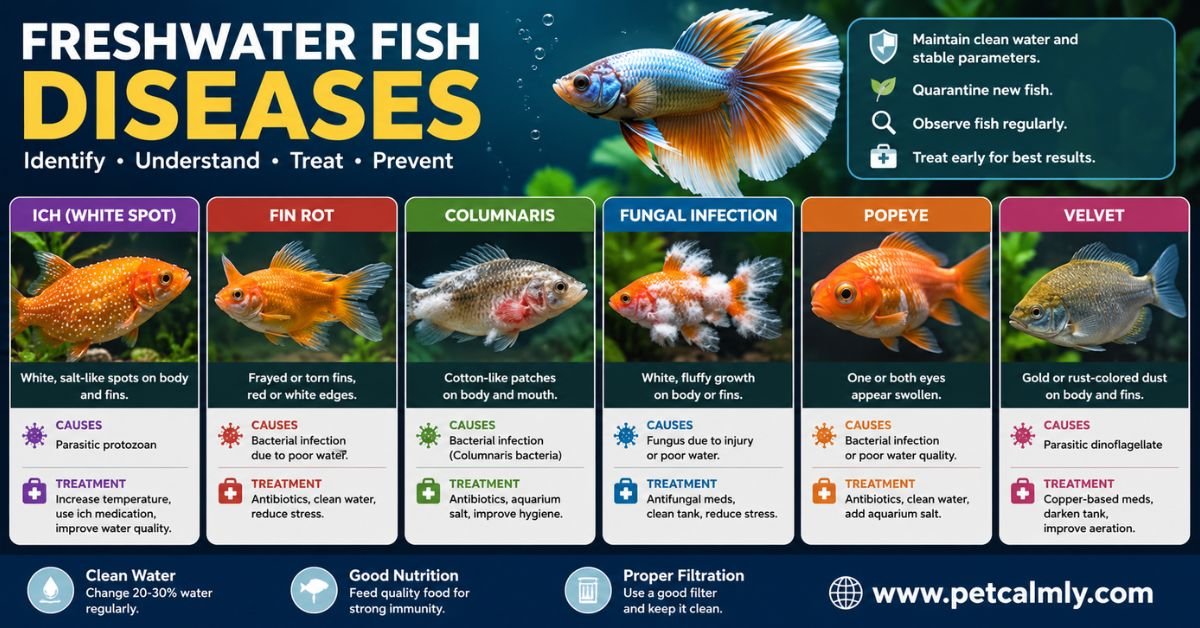
Ich (White Spot Disease)
Ich, caused by the parasite Ichthyophthirius multifiliis, is the single most common disease new aquarium owners encounter, and it’s often the first real test of whether a fishkeeping hobby survives its first year.
What it looks like: Tiny white dots resembling grains of salt scattered across the body and fins. Fish may also flash rubbing themselves against rocks, gravel, or decorations because the parasite irritates the skin.
Why it happens: Ich is often already present in low numbers in many tanks and takes hold when a fish’s immune system is weakened by stress or a temperature drop, such as during a water change with cooler water.
What helps: Raising the tank temperature gradually to around 78–82°F (check species tolerance first) speeds up the parasite’s life cycle, making medicated treatment more effective. Most aquarium stores carry ich-specific treatments, and consistent dosing over the full treatment cycle not just until symptoms disappear is what actually clears it.
Fin Rot
What it looks like: Ragged, frayed, or disintegrating fin edges, sometimes with a white or reddish tinge near the damage.
Why it happens: Fin rot is typically bacterial and thrives in tanks with elevated ammonia or nitrite, though it can also start after physical injury from fin-nipping tankmates or sharp decorations.
What helps: In early stages, a water change combined with improved filtration is often enough to stop progression. More advanced cases benefit from an antibacterial aquarium treatment, but water quality correction is the non-negotiable first step medication without clean water tends to just delay the problem.
Fungal Infections
What it looks like: Cotton-like, fuzzy white or gray growths, usually appearing on areas of existing injury or where fin rot has already damaged tissue.
Why it happens: Fungus is typically opportunistic — it moves in after something else, like a wound, parasite damage, or bacterial infection, has already compromised the fish’s protective slime coat.
What helps: Antifungal treatments work well when paired with addressing whatever caused the original injury. If fungus keeps returning in the same spot, that’s usually a sign of an underlying issue that hasn’t been resolved yet, such as rough decor or an aggressive tankmate.
Dropsy
What it looks like: A swollen, bloated body with scales that stick out like a pinecone. This is one of the more distressing symptoms to see and one owners search for most urgently.
Why it happens: Dropsy isn’t a single disease — it’s a symptom of internal organ failure, most often kidney dysfunction, usually linked to chronic poor water quality or long-term bacterial infection.
What helps: Realistically, dropsy has a low recovery rate once the pinecone appearance sets in, because internal damage is usually already significant. Isolating the fish, keeping water pristine, and offering supportive care gives the best chance, but owners should be prepared that this condition is often advanced by the time it’s visible from the outside.
Swim Bladder Disorder
What it looks like: A fish struggling to maintain normal swimming position — floating sideways, sinking to the bottom, or bobbing at the surface unable to control depth.
Why it happens: This is common in fancy goldfish and bettas and is frequently linked to overfeeding, constipation, or swallowed air from gulping food at the surface, though it can also result from infection or a congenital issue.
What helps: A short 24–48 hour fast, followed by feeding a skinned, cooked pea (for goldfish) or offering easily digestible food, resolves many diet-related cases within a few days. If the issue persists past a week, it’s worth considering an underlying infection rather than digestion alone.
Velvet Disease
What it looks like: A fine, gold or rust-colored dusting across the body, best seen when a flashlight is shone across the fish at an angle. Fish often clamp their fins and become lethargic.
Why it happens: Velvet is caused by a parasitic dinoflagellate that, similar to ich, tends to flare up when a fish is already immune-compromised by stress or poor conditions.
What helps: Dimming tank lighting slows the parasite’s photosynthetic life cycle, and copper-based or malachite green treatments are commonly used — though copper-based medications aren’t safe for invertebrates like shrimp and snails, so tank inhabitants matter when choosing treatment.
Columnaris (Cotton Wool Disease)
What it looks like: White or grayish patches, often around the mouth, that can look like cotton wool. It’s sometimes mistaken for fungus but is actually bacterial and spreads faster.
Why it happens: Columnaris thrives in warm water with poor circulation and often appears after a fish is stressed from transport, aggression, or sudden environmental changes.
What helps: Because it progresses quickly, early antibacterial treatment matters more here than with most other diseases. A fish showing mouth-area cotton-like patches with rapid deterioration should be treated as urgent rather than “wait and see.”
Freshwater Fish Disease Comparison Table
| Disease | Key Visual Sign | Usual Cause | Urgency Level |
|---|---|---|---|
| Ich | White salt-like spots | Stress, temperature swings | Moderate — treat within days |
| Fin Rot | Ragged, disintegrating fins | Poor water quality | Moderate |
| Fungal Infection | Cotton-like white/gray growth | Secondary to injury | Moderate |
| Dropsy | Pinecone scale swelling | Organ failure, chronic poor water | High — often advanced |
| Swim Bladder Disorder | Loss of buoyancy control | Overfeeding, constipation | Low to moderate |
| Velvet Disease | Gold/rust dust coating | Parasite, weak immunity | High — spreads fast |
| Columnaris | Cotton patches near mouth | Bacterial, stress-related | High — progresses quickly |
How to Set Up a Proper Quarantine Tank
Quarantine is the single most underused prevention tool in the hobby, mostly because it feels like extra work when you’re excited to add a new fish to your display tank right away.
A basic quarantine setup doesn’t need to be elaborate:
- A separate 10–20 gallon tank with a sponge filter (cycled if possible, or with daily water testing if not)
- A heater matched to the species’ needs
- Minimal decor — just enough to reduce stress, without hiding spots that make observation harder
- A 2–4 week observation period before introducing new fish to the main tank
New plants can also carry parasites like snails or hydra, so a brief rinse or a quarantine period for live plants isn’t overkill — it’s a habit experienced fishkeepers rarely skip.
Water Quality Checklist: The Foundation of Disease Prevention
Most disease prevention conversations skip straight to medication, but water parameters are where the real work happens.
- Ammonia and nitrite should read 0 ppm in a fully cycled tank
- Nitrate ideally stays under 20–40 ppm depending on species sensitivity
- Weekly partial water changes (25–30%) prevent waste buildup between full tests
- Temperature should stay stable, avoiding swings of more than 2–3°F in a day
- Filtration should be appropriately sized for the tank volume and stocking level
A simple liquid test kit, checked weekly even when everything seems fine, catches problems long before fish start showing symptoms which is exactly the window you want.
When Should You Worry?
Not every unusual behavior is an emergency, but certain signs mean it’s time to act quickly rather than wait and observe.
Treat as urgent if you see:
- Rapid breathing or gasping at the surface
- Multiple fish showing symptoms at once
- Sudden, severe lethargy or a fish lying on its side
- Rapid spread of visible lesions or discoloration within 24–48 hours
- Loss of appetite lasting more than 2–3 days in a normally active fish
Likely manageable at home:
- A single fish with mild fin fraying and otherwise normal behavior
- Occasional flashing without visible spots
- Mild bloating that resolves after a short fast
If a fish’s condition is worsening despite water changes and appropriate treatment, or if you’re dealing with a valuable or particularly sensitive species, consulting an aquatic veterinarian or a knowledgeable local fish store with a strong track record is a reasonable next step. Aquatic veterinary medicine is a smaller field than cat or dog care, but resources do exist, and some general veterinary practices now see fish patients as well.
What Should Pet Owners Do Right Now?
If you’re dealing with a sick fish today, here’s a practical order of operations:
- Test your water first. Before reaching for medication, confirm ammonia, nitrite, and nitrate levels this tells you whether the environment is the root cause.
- Isolate if possible. A hospital tank reduces stress on the sick fish and protects tankmates from contagious conditions.
- Identify the specific disease using visual symptoms rather than treating generically many over-the-counter “cure-all” products are less effective than disease-specific treatment.
- Follow the full treatment course, even after symptoms visibly improve, since stopping early is one of the most common reasons diseases return.
- Address the underlying cause whether that’s overstocking, an under-sized filter, or a tankmate that’s causing stress so the same disease doesn’t resurface in a few weeks.
Common Mistakes That Make Fish Diseases Worse
- Overmedicating dosing multiple treatments at once can stress fish further and sometimes causes more harm than the disease itself
- Doing large, sudden water changes during illness this can shock an already stressed fish; smaller, more frequent changes are gentler
- Ignoring the first symptom clamped fins or reduced appetite are early warnings, not “wait and see” signs
- Skipping quarantine for new fish this is the single biggest preventable cause of outbreaks in established tanks
- Blaming the fish store without checking home water parameters first sometimes the stress of transport just reveals a condition that was already developing
More Information About Pets, Please Visit Our Website: Ich Treatment for Freshwater Fish
Betta Fish Tank Setup
Frequently Asked Questions
1: Can freshwater fish diseases spread to other fish in the tank?
Yes, many freshwater fish diseases especially ich, velvet, and columnaris are contagious between tankmates, which is why isolating a visibly sick fish early is one of the most effective ways to protect the rest of the tank.
2: Can fish recover from disease without medication?
Mild cases caused primarily by stress or minor water quality dips sometimes resolve on their own once conditions improve, but bacterial, fungal, and parasitic infections usually need targeted treatment to fully clear.
3: How do I know if my fish is just stressed or actually sick?
Stress alone typically shows as clamped fins, hiding, or reduced appetite without visible spots, growths, or discoloration; if physical symptoms appear alongside behavior changes, it’s more likely an active disease process.
4: Is it safe to use the same net for a sick fish and healthy fish?
No using separate nets and equipment for a hospital tank prevents cross-contamination, since parasites and bacteria can survive briefly on wet equipment.
5: Why does my fish keep getting sick even after treatment?
Recurring illness almost always points back to an unresolved environmental issue, such as inconsistent water quality, overstocking, or a tank that never fully cycled, rather than the treatment itself failing.
6: Do all freshwater fish diseases require a vet visit?
No most common conditions like ich, mild fin rot, or swim bladder issues can be managed at home with water correction and appropriate treatment, but conditions like dropsy, rapid symptom spread, or repeated unexplained deaths warrant professional input if it’s accessible in your area.
Conclusion
Freshwater fish diseases can feel alarming the first time you encounter them, but they’re rarely random. Almost every case traces back to water quality, stress, or an unquarantined new arrival which means most outbreaks are preventable with a bit of consistency rather than luck.
The fishkeepers who deal with the fewest health crises aren’t the ones with the most expensive equipment. They’re the ones who test water weekly, quarantine new additions, and act on the first small sign clamped fins, a skipped meal, a bit of flashing instead of waiting for it to become obvious.
Your tank doesn’t need to be perfect. It just needs to be watched.