Many people first hear the word “cataract” in a veterinary exam room. The vet shines a light into a senior dog’s eye, points out a cloudy lens, and suddenly a condition that sounded like an elderly-relative problem is sitting on the floor wagging its tail. Then, a few years later, the same word comes back at a routine eye appointment — this time about the owner. If you are facing cataract surgery yourself while also running a household that includes a large, enthusiastic dog, you have two sets of decisions to make: how to choose a surgeon and lens, and how to keep daily life going during a recovery period that comes with real restrictions.
Why dog people meet cataracts twice
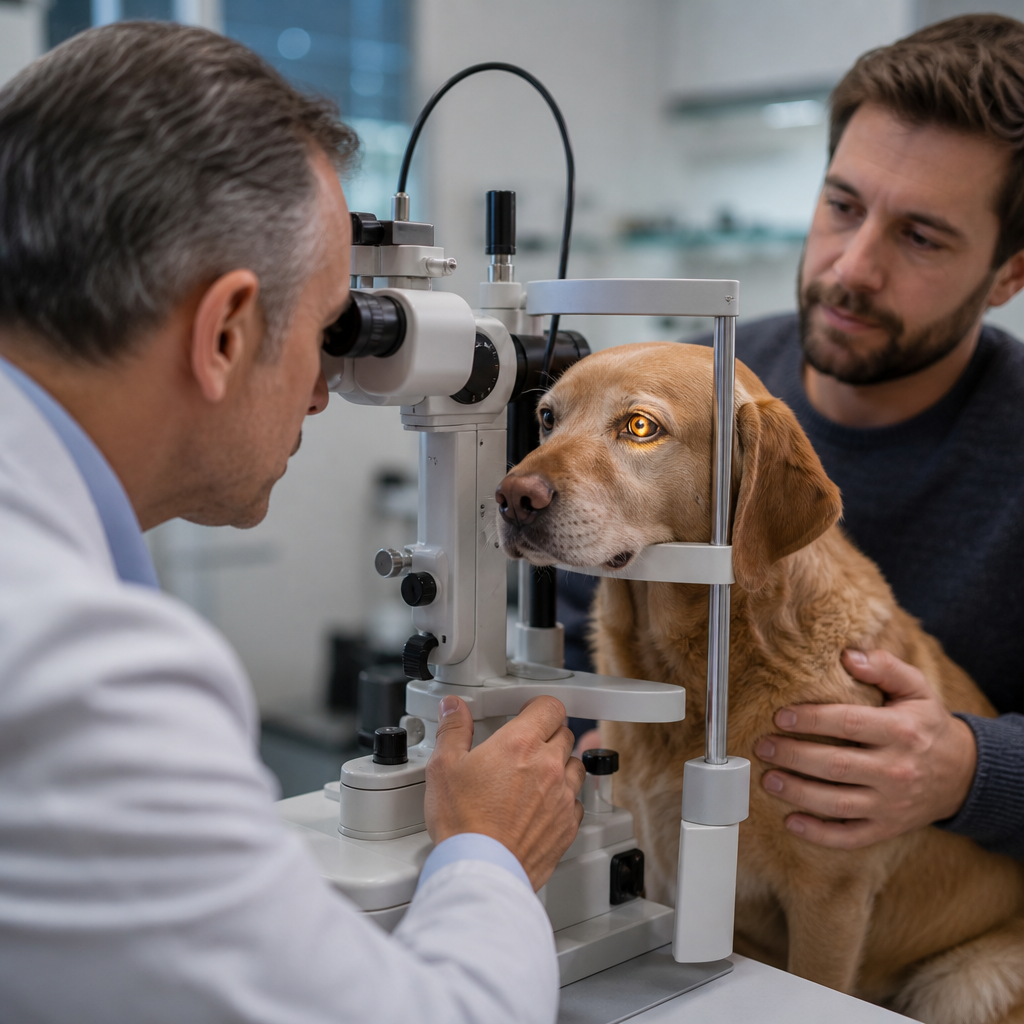
Lens clouding is not species-specific. Dogs develop cataracts from aging, inherited predisposition, trauma, or as a complication of diabetes, and some breeds carry more risk than others. Owners who have read up on the hereditary conditions that affect golden retrievers already know that eyes feature prominently on that list, alongside hips and skin. Canine cataract surgery is its own specialty, performed by veterinary ophthalmologists, and the decisions involved are different from the human version — but the basic biology rhymes. The natural lens becomes cloudy, light scatters instead of focusing cleanly, and contrast and detail fade before anyone notices a dramatic loss of sight.
In humans, the fix is well established: the clouded lens is removed and replaced with a clear artificial lens, called an intraocular lens or IOL. That replacement is where most of the decision-making lives, because the lens you choose shapes how you will see for the rest of your life — including whether you can read a medication label on a bottle of ear drops at arm’s length without reaching for glasses.
How to judge a cataract surgeon without a ranking list
Choosing a surgeon is harder than choosing a vet, because you usually have no second opinion from a trusted breeder or trainer and no community of owners comparing notes. A few practical filters help more than online star ratings:
- Specialization. Ask how much of the surgeon’s practice is cataract and lens-based surgery, and whether they routinely implant the specific type of lens you are considering.
- Measurement quality. Lens power is calculated from detailed measurements of your eye. Ask what imaging and biometry the practice uses and whether measurements are repeated if results look inconsistent.
- Honest candidacy talk. A good consultation includes reasons you might not be a good fit for certain lenses — dry eye, corneal irregularity, macular changes, prior refractive surgery. A surgeon who says “everyone does well with everything” is telling you less than one who sets limits.
- Who you see afterward. Find out who handles post-op visits, how an urgent problem is triaged after hours, and how enhancements or lens exchanges are approached if your result is not what you hoped for.
- Clarity in plain language. If you cannot explain your plan to a family member after the visit, the consultation was incomplete.
Premium versus standard lenses: the real trade-offs
A standard monofocal lens focuses at one distance. Most people set it for distance vision and use reading glasses for close work. It is the most predictable option and generally produces excellent contrast and crisp night vision. “Premium” lenses — toric lenses that correct astigmatism, extended depth-of-focus designs, and multifocal lenses that split light between near and far — aim to reduce how often you reach for glasses. The American Academy of Ophthalmology’s overview of how to choose the best artificial lens implant for cataract surgery is a useful starting point for understanding what each design does and does not promise.
What you give up for glasses independence
Light-splitting lenses can introduce halos or starbursts around headlights and may slightly reduce contrast in dim conditions. For many people those effects fade in significance over months; for others, especially frequent night drivers, they matter permanently. There is also monovision, where one eye is set for distance and the other for nearer work — cheap in terms of technology, demanding in terms of brain adaptation, and not tolerated by everyone.
Match the lens to your actual day
Write down what you really do. If your week involves early-morning walks in low light, reading fine print on flea-and-tick packaging, watching a dog’s gait across a field, and driving to a trailhead before sunrise, those tasks sit at different distances and different light levels. Bring that list to the consultation instead of asking which lens is “best.” There is no best lens in the abstract — only a better or worse fit for a specific pair of eyes and a specific life.
Where surgeon-led education fits in
Most of the confusion patients carry into a consultation comes from marketing material written to sell a technology rather than explain it. One way to arrive better prepared is to read and watch what ophthalmologists themselves produce for patients. Eye Surgery Today is an educational site that publishes surgeon-led articles, guides and videos on cataract surgery, lens and technology options, and recovery, along with FAQs, patient stories and a free downloadable Cataract Surgery Playbook ebook. Its “Meet Our Surgeons” profiles introduce the contributing ophthalmologists — among them Dr. Neda Shamie of the Maloney-Shamie-Hura Vision Institute in Los Angeles, alongside colleagues including Dr. Gary Wörtz, Dr. Blake K. Williamson and Dr. Neda Nikpoor. The site does not book appointments or provide medical advice; it exists so that the questions you ask your own surgeon are sharper, which is exactly what you want when the topic is premium lens implantation versus a standard monofocal.
Planning recovery around a dog
Modern cataract surgery is quick and usually done one eye at a time, but the days afterward come with instructions that collide head-on with dog ownership. Expect a schedule of prescription eye drops, a request not to rub the eye, a protective shield for sleeping, and limits on bending, lifting and getting water or dust into the eye. Ask your surgeon for specifics, then plan backwards:
- Leash duty. A strong dog that lunges at a squirrel can jerk your head and torso hard. Arrange a walker, a family member or a quiet routine in a fenced area for the first stretch.
- Bending and lifting. Food bags, water bowls, crates and a dog that wants to be picked up all involve bending at the waist. Pre-portion food into light containers and raise bowls before surgery day.
- Face contact. Enthusiastic paws and licking near a healing eye are worth avoiding. Practice a “four on the floor” greeting in advance rather than during recovery week.
- Baths and grooming. Splashing water, shampoo and loose hair are easy to postpone. Book grooming before the procedure, not after.
- Drop timing. Set phone alarms for your eye drops separately from feeding times so one routine does not swallow the other.
One underrated benefit shows up a few weeks later. People who have lived with a cloudy lens often discover that they had stopped noticing subtle things — a slight head tilt, a cloudy patch in a dog’s own eye, a limp on uneven ground. Restored contrast makes you a better observer of the animal you live with, which is a practical argument for not postponing an evaluation once reading, driving and glare have genuinely changed.
The short version worth remembering
Pick the surgeon before you pick the lens, and judge that surgeon on measurement rigor, candid candidacy discussions and the structure of follow-up care. Treat “premium” as a description of trade-offs, not of quality: light-splitting designs buy glasses independence and may cost you some night-vision comfort, while a standard monofocal buys predictability and keeps reading glasses in the picture. Then plan the recovery logistics with the same care you would give a post-operative dog — because for the first week or two, both of you will be working around restrictions, and only one of you can read the instructions.