
Short direct answer
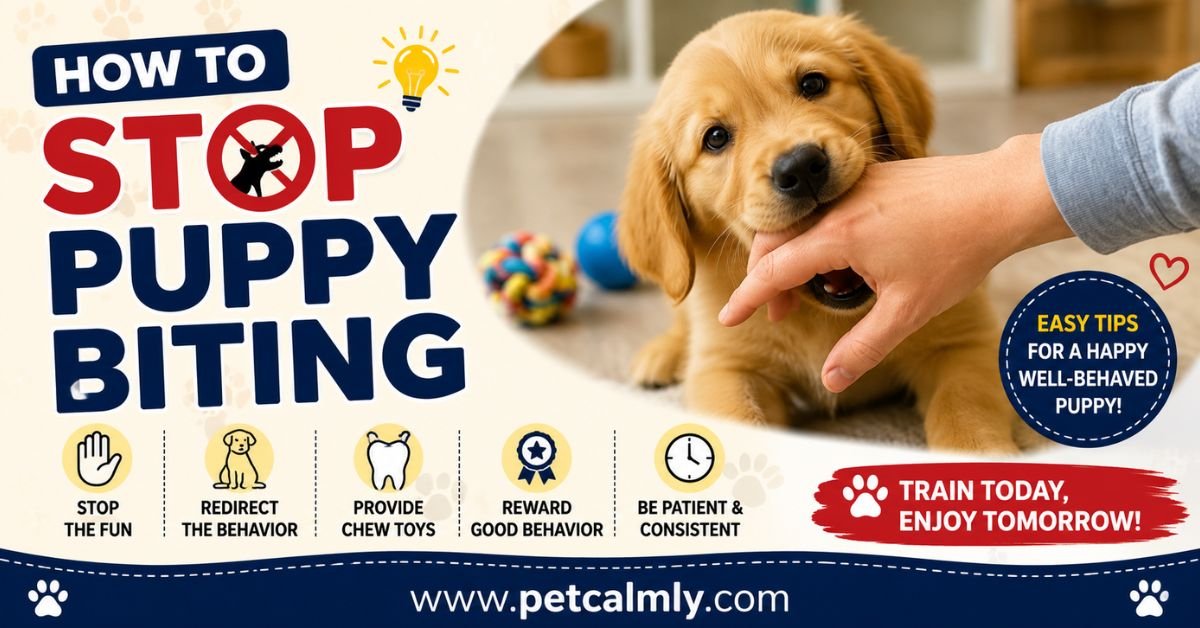
Puppy biting is normal but manageable. The most effective approach combines redirecting bites to toys, creating consistent boundaries, training the “leave it” command, and preventing boredom through play and exercise. Most puppies stop mouthy behavior by 4-6 months old when given proper training, though some breeds and individual puppies may need continued attention. Consistency from all family members is crucial never punish biting harshly, as this can increase fear or aggression.
Introduction
If you’ve got a puppy at home right now, you’ve probably experienced those sharp little teeth on your hands, arms, or clothing more times than you can count. Maybe you’re wondering if your puppy is aggressive, if something’s wrong, or if this phase ever ends. The good news: it does end, and what you’re seeing is completely normal.
But here’s what most puppy owners don’t realize: how you respond to biting in these early weeks literally shapes your dog’s behavior for life. It’s not just about managing the current problem it’s about teaching your puppy what’s acceptable and what isn’t.
This guide walks you through exactly why puppies bite, what works to reduce it, and how to tell the difference between normal puppy nipping and something that actually requires professional help. You’ll find practical strategies you can start using today, mistakes to avoid, and real-world examples that help you understand your specific situation.
Why Puppies Bite: Understanding the Root Causes
Before you can effectively address puppy biting, you need to understand why it’s happening in the first place. Puppies don’t bite to be mean or because they’re “bad dogs.” There are specific, developmental reasons behind every nip and chomp.
Teething and Oral Exploration
The primary reason puppies bite is simple: their mouths hurt. Puppy teething usually starts around 3-4 weeks of age and continues until about 6-7 months old, when all permanent teeth have come in. During this time, chewing and biting relieve the soreness and pressure in their gums.
Think of it like an adult with sore teeth wanting to massage their gums puppies are doing the same thing, except they don’t have hands. Everything goes in their mouth: your fingers, toys, furniture, shoelaces, you name it.
This isn’t a behavioral problem you need to “fix” it’s a biological need. However, you do need to redirect it toward appropriate items.
Play and Social Learning
Puppies also bite as part of normal play and social interaction. In the litter with their siblings, they’ve been wrestling, chewing, and nipping since they were a few weeks old. That’s how they learn bite inhibition (how soft their mouth should be) and social boundaries from their littermates.
When puppies leave their littermates at 8-12 weeks old, they transfer those play behaviors to you. In their mind, they’re doing exactly what they did with their siblings. Your job is to teach them that biting humans isn’t the same as biting puppies.
Attention-Seeking Behavior
Some puppies bite because they’ve learned it works. If your puppy nips at your hand and you immediately react—even if your reaction is “No!” or pushing them away you’ve given them attention. To a puppy, negative attention is still attention.
This is especially common in puppies that aren’t getting enough play, exercise, or interaction with their owners. A bored or under-stimulated puppy will often resort to biting to get a reaction and engage with you.
Frustration and Overstimulation
When puppies are excited, overstimulated, or frustrated, they bite. This looks like escalating nipping during play, getting mouthy when they can’t have something they want, or increased biting when they’re tired and cranky (kind of like toddlers who get grumpy before a nap).
Understanding this matters because the solution for an overstimulated puppy is different from the solution for a bored puppy or a teething puppy.
Understanding Puppy Biting vs. Dangerous Aggression
This is the question that worries new puppy owners most: “Is this normal nipping, or is my puppy aggressive?”
It’s an important distinction, and honestly, most puppy biting falls firmly into the “normal” category. But you should know how to tell the difference.
Characteristics of Normal Puppy Biting
Normal puppy biting has these characteristics:
- It happens during play or excitement. The puppy is wagging their tail, in a play bow (front legs stretched out, rear end up), or otherwise showing signs of happiness.
- The puppy stops when you yelp or pull away. Even briefly.
- It’s not focused or aggressive. The puppy is nipping at hands, arms, clothing—whatever they can reach—without seeming intent on causing harm.
- The puppy can be easily redirected. When you offer a toy, they switch to chewing the toy instead.
- Context matters. The biting happens after play, when the puppy is tired, during training sessions, or when they want attention or to play.
- The force is light to moderate. While puppy teeth are sharp, the bites don’t cause serious injury or bleeding.
Red Flags for Concerning Behavior
Talk to your veterinarian or a certified professional dog trainer if you notice:
- Bites with no obvious trigger. The puppy bites when you’re sitting quietly or doing nothing to provoke it.
- The puppy doesn’t stop biting when you yelp or pull away. This suggests they’re not learning inhibition.
- Stalking or fixation on your hands/feet. The puppy tracks your movements intently and pounces with focused aggression.
- Bites that break skin consistently or leave serious marks. Most normal puppy bites don’t, though sharp puppy teeth can accidentally break skin.
- Growling, stiffness, or other signs of aggression. Raised hackles, forward ears, stiff posture, or true growling (not play growling) alongside biting.
- Escalating severity. The bites are getting harder and more frequent instead of decreasing over time.
- Possession guarding. The puppy bites over toys, food, or other objects and shows tension rather than playfulness.
- The puppy is older than 5-6 months and behavior isn’t improving. While normal biting usually decreases naturally over time, concerning aggression often increases.
Most healthy puppies are not aggressive. They’re learning. But if you’re seeing these red flags, professional guidance isn’t optional it’s important. A certified professional dog trainer or veterinary behaviorist can assess your specific puppy and give you targeted advice.
How to Stop Puppy Biting: Proven Training Strategies That Work
The strategies that actually work for reducing puppy biting fall into a few clear categories. Most successful puppy owners use a combination of these approaches, adjusted for their specific puppy’s personality and situation.
Strategy 1: Redirect Bites to Appropriate Toys
Redirection is arguably the most effective single strategy for managing puppy biting. Instead of punishing the bite, you’re teaching the puppy what they should bite.
Here’s how to do it:
- Keep appropriate toys nearby. Have a few chew toys, ropes, and puzzle toys within arm’s reach in common areas where you spend time with your puppy.
- The moment your puppy bites you, say nothing and immediately offer a toy. Don’t make it complicated. Just swap your hand for the toy.
- Play with the toy briefly. Toss it, bounce it, play tug with it—make the toy more rewarding than biting your hand.
- Praise heavily when they engage with the toy. “Yes! Good boy! You’re chewing your toy!” This builds association: biting me = boring, chewing the toy = awesome.
Why this works: You’re not fighting the impulse to bite. You’re redirecting that impulse somewhere acceptable. Over time, the puppy learns that when they want to bite, toys are more fun than hands.
The key here is timing. You need to catch the behavior and redirect immediately. Within seconds is ideal. The longer you wait, the less the puppy connects their action to the redirection.
Strategy 2: Teach the “Leave It” and “Drop It” Commands
These commands give you a way to interrupt biting or mouthing and redirect attention without physical force.
Teaching “Leave It”:
- Hold a treat in your closed fist. Let your puppy investigate and try to get it.
- When they pull back or stop trying, say “Leave it!” and immediately give them a better treat from your other hand.
- Repeat this 5-10 times in short training sessions.
- Gradually increase difficulty: place the treat on the ground, cover it with your foot, etc.
- Eventually, practice with less valuable items (toys, chew sticks) instead of just treats.
Once your puppy understands “leave it,” you can use it during biting moments: “Leave it!” followed by offering an appropriate toy.
Teaching “Drop It”:
- Play with your puppy using a toy.
- When they have the toy, show them a treat they like even more.
- Say “Drop it!” as you show the treat.
- When they drop the toy to take the treat, say “Yes!” and reward immediately.
- Give the toy back and repeat.
This command is valuable because it teaches your puppy to release things on command, including during biting play.
Strategy 3: Create Consistent Boundaries and Rules
Puppies thrive with structure. Clear, consistent rules about what’s acceptable reduce confusion and frustration.
Establish these boundaries:
- Certain hands-on play is off-limits. Wrestling, rough play that escalates biting, and “let’s see how hard you can bite” games teach puppies that biting humans is fun. Avoid these entirely during the teething and nipping phase.
- Fingers are never toys. Don’t wiggle your fingers at your puppy to encourage biting or play. This directly teaches them that fingers are play objects.
- Consistency across all family members matters. If one family member plays roughly and allows biting while another doesn’t, you’re sending confusing signals. Everyone needs to follow the same rules.
- Timeouts work for chronic offenders. If your puppy has a specific person they love to bite, and redirection isn’t working, a brief timeout (2-3 minutes in a quiet space) can help. The idea isn’t punishment it’s a cool-down.
Strategy 4: Exercise and Mental Stimulation
An exhausted puppy is a less bitey puppy. Boredom and pent-up energy are major drivers of excessive biting and mouthing.
Each day, your puppy needs:
- Age-appropriate physical exercise. For young puppies (8-12 weeks), this means 3-5 short play sessions of 15-20 minutes each. For older puppies (3-6 months), increase to longer sessions with breaks.
- Mental stimulation. Training sessions, puzzle toys, scent games, and interactive play challenge their brain and tire them out mentally as well as physically.
- Scheduled nap time. Puppies need 18-20 hours of sleep per day. If your puppy isn’t napping enough, they’re more prone to overexcitement and biting. Create a quiet space where they can rest without constant stimulation.
The rule of thumb: a tired puppy is a well-behaved puppy. This doesn’t mean wearing them out to exhaustion—it means meeting their developmental need for activity and mental engagement.
Strategy 5: Use Bite Inhibition Training
This is about teaching your puppy to control the force of their bite, which is what littermates naturally teach each other through play.
Method: The Yelp Technique (with realistic expectations)
- During play, let your puppy bite you gently.
- The moment they bite too hard, yelp loudly (like “Ow!”) and immediately stop playing.
- Ignore the puppy for 10-15 seconds, then resume gentle play.
- Repeat: hard bite = game over. Soft bite = play continues.
This mimics what happens in a litter: if a puppy bites too hard during play, the play stops. The puppy learns that soft bites keep the fun going.
Important caveat: This doesn’t work for all puppies. Some puppies get more excited when you yelp, or they’ve already learned that big reactions from you are rewarding. If yelping makes biting worse, skip this method and stick with redirection.
6 Common Mistakes Puppy Owners Make When Addressing Biting
Understanding what not to do is just as important as knowing what to do. These mistakes are incredibly common, and they often make biting worse instead of better.
Mistake 1: Punishing the Bite Harshly
Yelling “No!” loudly, swatting the puppy’s nose, holding their mouth shut, or other harsh corrections don’t teach puppies not to bite. Instead, they teach puppies to fear your hands, or they make the puppy bite harder and more defensively.
Remember: puppies aren’t being defiant. They’re learning. Punishment creates fear, not understanding.
Mistake 2: Giving Attention to Biting Behavior
If you react emotionally to biting—yelling, chasing the puppy, engaging in a reaction—you’re rewarding the bite. From your puppy’s perspective, biting you = you finally pay attention and interact with them.
Even negative attention (yelling) is attention. Bored puppies will pursue it.
Mistake 3: Playing Rough Games That Encourage Biting
Tug-of-war, hand wrestling, encouraging the puppy to chase and bite your hands, and “teasing” play trains the puppy that biting humans is the game.
During the biting phase, these games need to stop. You can reintroduce structured tug-of-war later (once your puppy understands “drop it”), but right now, you’re working against yourself.
Mistake 4: Not Providing Appropriate Outlets for Chewing
If your puppy doesn’t have access to appropriate chew toys, they’ll default to your hands, furniture, and shoes. Make sure your puppy has:
- A variety of textures (rubber, rope, nylon, natural chews)
- Appropriate sizes (nothing small enough to swallow or choke on)
- Rotation (switch toys regularly to keep interest high)
- Frozen toys (especially helpful during teething cold helps sore gums)
Mistake 5: Expecting Immediate Results
Reducing biting takes time. You’re working against months of littermate play, teething pain, and the normal development stage your puppy is in. Most puppies show improvement within 2-4 weeks of consistent training, but full bite inhibition takes longer.
If you expect the biting to stop overnight, you’ll get frustrated and fall back on ineffective strategies.
Mistake 6: Ignoring Early Signs of Overstimulation
Biting often escalates when puppies are overstimulated. If you see your puppy starting to get mouthy, that’s the time to end the play session before it spirals. Give them a break, offer a chew toy, or create a calm-down period.
Early intervention prevents the behavior from escalating into hard biting.
Training Techniques for Different Biting Scenarios
Not all puppy biting is the same, and the most effective response depends on what’s triggering it.
Biting During Play Sessions
What’s happening: Your puppy is excited and their biting is escalating as play continues.
Best approach:
- Use the redirection strategy: swap your hand for a toy
- Keep play sessions moderate—don’t let them go on until your puppy is overexcited
- If play escalates into hard biting, stop immediately. “Playtime is over” isn’t fun for anyone.
- Resume play only when your puppy has calmed down
Mouthing Your Hands or Feet During Daily Life
What’s happening: Your puppy wants to interact, they’re bored, or they’re seeking attention.
Best approach:
- Redirect to a toy every single time
- If redirection isn’t working, it might mean your puppy needs a break or a bathroom break
- Ensure they’re getting enough exercise and mental stimulation throughout the day
- If this happens frequently, increase scheduled play and training sessions
Biting and Jumping Together
What’s happening: Excitement + overstimulation = chaos.
Best approach:
- Teach “sit” as an incompatible behavior (puppies can’t really bite effectively while sitting, and it gives them an alternative way to interact)
- When your puppy jumps and bites, ignore them completely—no eye contact, no touch, no words
- Once they’ve calmed down and all four paws are on the ground, engage with them
- Consistency is crucial here; everyone in your home needs to follow this rule
Biting During Training or When Frustrated
What’s happening: Your puppy wants something they can’t have, or they’re frustrated by a training exercise.
Best approach:
- Avoid situations that trigger frustration initially (don’t tease with toys you won’t give them)
- Use “leave it” or “drop it” commands to redirect
- Keep training sessions short and positive end on success, not frustration
- If your puppy is frustrated, simplify the task to something they can succeed at
Nighttime Biting or Mouthing
What’s happening: Your puppy might be tired, they’ve been in a crate too long, or they’re genuinely ready to sleep.
Best approach:
- This often signals it’s naptime. Put your puppy in their crate or quiet space for a scheduled nap
- Before naptime, offer a chew toy or frozen treat to keep them occupied
- Make sure they’ve had bathroom breaks and exercise before bed
When to Seek Help from a Professional
Most puppy biting is completely normal and manageable with consistent training. But some situations warrant professional guidance from a certified dog trainer or veterinary behaviorist.
Consider Professional Help If:
- Your puppy’s biting isn’t improving after 4-6 weeks of consistent training. This might indicate a learning issue, a medical problem (like pain from teething), or a behavioral concern that needs expert assessment.
- Your puppy shows any of the red flags we mentioned earlier (aggression signs, contextless biting, inability to learn inhibition).
- You’re feeling overwhelmed or unsafe. If you’re genuinely worried about your puppy’s behavior, professional guidance will give you confidence and clarity.
- Your puppy has had a negative experience (was bitten by another dog, had a scary incident) and their biting has changed in character.
- Your puppy is older than 4-5 months and still biting intensely. Biting should naturally decrease as puppies mature, so lack of improvement can indicate something worth investigating.
Finding the Right Professional
Look for:
- Certification. Certified Professional Dog Trainers (CPDT) or trainers certified through the International Association of Canine Professionals (IACP) have completed rigorous training and education.
- Experience with puppies and bite inhibition. Not all trainers specialize in puppies find someone who does.
- Positive-reinforcement methods. Avoid trainers who rely on punishment or intimidation.
- Willingness to work with your veterinarian. The best trainers collaborate with vets to rule out medical issues.
Your veterinarian can often recommend local professionals they trust. Don’t hesitate to ask for references or to interview a few trainers before committing.
Frequently Asked Questions
1: Is puppy biting normal, or does it mean my puppy will be aggressive?
Puppy biting is completely normal. The vast majority of puppies bite, mouth, and nip as part of their development. It doesn’t predict aggression it’s how they explore the world and learn boundaries. What matters is how you respond and teach them. With consistent training, puppies learn to inhibit their bites and stop mouthing humans by 4-6 months old.
2: How long does it take to stop puppy biting?
Most puppies show significant improvement within 2-4 weeks of consistent training. Full bite inhibition where your puppy has excellent self-control even during excitement typically develops by 4-6 months old. Some individual puppies take longer, and certain breeds that were bred to have “soft mouths” (like retrievers) naturally have good bite inhibition earlier than others.
3: Should I use “bite spray” or deterrent products on my hands?
Bite sprays and deterrent products (like bitter-tasting sprays) are a personal choice, but they’re not necessary and shouldn’t be your primary strategy. If you do use them, pair them with redirection to toys. The spray alone won’t teach your puppy what they should bite. Redirection is more effective because it actively teaches appropriate behavior, not just punishes inappropriate behavior.
4: Can teething toys really help with biting?
Yes, absolutely. Frozen teething toys are particularly helpful during the height of teething (3-6 months). The cold numbs sore gums, and having appropriate outlets for chewing reduces the motivation to bite your hands. Kong toys, rubber teethers, and frozen washcloths are all helpful during this stage.
5: Is my puppy biting because they’re not socialized properly?
Probably not. Biting is part of normal puppyhood, not a sign of poor socialization. That said, socialization is important for overall behavior and confidence. Properly socialized puppies are still bitey puppies they just learn faster to inhibit their bites and are less likely to develop fear or anxiety related to handling.
6: At what age should puppy biting completely stop?
Most puppies significantly reduce mouthing and biting by 4-6 months old when they have the baby teeth fully, and their permanent teeth come in. However, some puppies remain a bit “mouthy” (playful nipping) into their first year, especially during excitement or play. This is normal. True biting hard, aggressive biting should not be part of a normal dog’s behavior by 6-8 months old.
Conclusion
If you’re in the thick of puppy biting right now, it might feel like it’ll never end. Your hands are sore, you’re tired of redirecting, and you’re wondering if you made a mistake bringing a puppy home. I promise: this phase is temporary.
Puppy biting is completely normal. Your puppy isn’t bad. You’re not failing. What’s happening is a predictable, manageable part of puppy development that thousands of puppy owners have navigated successfully.
The strategies in this guide redirection, consistent boundaries, appropriate exercise, and patient training—genuinely work. They work because they’re based on how puppies actually learn and develop, not on wishful thinking or harsh corrections.
Start with redirection and consistency. Add in the “leave it” command. Make sure your puppy is getting enough exercise and mental stimulation. Give it 2-4 weeks of consistent effort, and you’ll see real improvement.
If you hit a wall or see concerning behaviors, reach out to a certified professional dog trainer. There’s zero shame in getting help—it’s actually the smartest move a puppy owner can make.
Your puppy will learn. They’ll develop bite inhibition. They’ll grow out of this mouthy phase. And one day, you’ll look back at this time and laugh at the little land shark you once had.
More Information About Pets, Please Visit Our Website: Why Does My Dog Bark at Night for No Reason?
Dog Acting Strange Suddenly at Night
Puppy separation anxiety training tips
Strange Dog Behavior Before Death
Why Is My Dog Suddenly Scared of My Other Dog?
New Puppy Crying at Night
How to Stop Dog From Pulling On Leash When Walking
How Long Do Dogs Stay Stuck Together After Mating
Frequently Asked Questions
1: Can I use an Elizabethan collar to prevent biting?
No. An E-collar prevents a puppy from accessing their own mouth for self-chewing, which can be necessary for managing certain skin conditions or post-surgery. But it does nothing to teach them not to bite you. It’s not a training tool for puppy biting—it’s a medical device for specific situations. Skip this approach and stick with training.
2: Does neutering or spaying affect puppy biting behavior?
Spaying or neutering won’t eliminate biting on its own, as biting is driven by development and learning, not by hormones. That said, altering your puppy at the appropriate time (usually 6-12 months, depending on breed) can help with some behavioral issues like sexual frustration or marking. Talk to your vet about the best timing for your puppy’s breed and size.
3: My puppy only bites my kids, not me. Why?
Puppies often target children because they move differently (faster, more erratic movements), they respond more dramatically (which puppies find rewarding), or they haven’t yet learned to set boundaries the way adults naturally do. Kids also tend to play differently with puppies than adults do. Address this by: teaching your children to ignore biting (hard for kids, I know), supervising all interactions, and training a solid “sit” and “leave it” that you can use during moments when your puppy targets your kids. This is a common concern worth discussing with a trainer.
4: Is raw feeding good for reducing biting?
Raw feeding is a nutrition choice, not a training approach. It won’t reduce biting on its own. Some people swear by raw diets for overall health (others strongly debate this). Regardless of diet, your puppy still needs training to learn appropriate biting behavior. If you’re interested in raw feeding, discuss it with your vet to ensure it’s balanced and safe for your puppy.
5: How do I teach my puppy not to bite other puppies or dogs?
Puppy play naturally includes some mouthing and play biting between dogs. However, if your puppy is biting too hard and other puppies are yelping and backing away, you may need to interrupt and separate them. Watch for signs that your puppy’s play is too rough (other puppies avoiding them, yelping, showing fear). If that’s the case, take breaks, supervise closely, and practice “leave it” and “drop it” commands. Puppies learn a lot from each other, but they also need human guidance to learn appropriate boundaries with other dogs.