Short direct answer
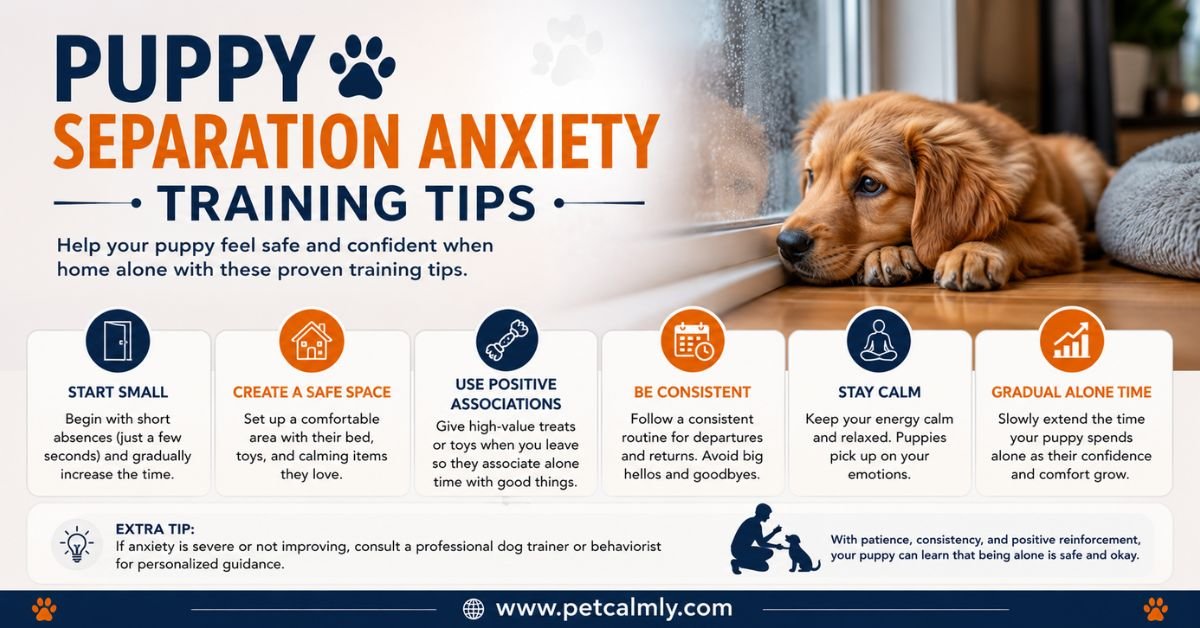
Puppy separation anxiety training tips focus on teaching your puppy that being alone is safe, predictable, and temporary. The most effective approach combines gradual alone-time training, a calm departure routine, mental enrichment, and avoiding emotional goodbyes or punishments. Start with very short absences (seconds to minutes), slowly build duration, and reward calm behavior when you return. The goal is not to “stop crying immediately,” but to rebuild your puppy’s confidence step by step so alone time feels normal, not scary.
Introduction
If your puppy starts barking, whining, chewing furniture, or panicking the moment you reach for your keys, you’re not dealing with “bad behavior.” You’re likely seeing separation anxiety or early signs of attachment distress.
This is one of the most common struggles new dog owners face. Puppies are naturally social and dependent, especially in the first months of life. Being alone is not instinctively easy for them it’s something they must learn slowly.
Many owners feel stuck in a cycle:
- You leave → puppy panics
- You come back → puppy is overly excited
- Next time leaving feels even harder
The good news is that separation anxiety is highly trainable when handled correctly and early. In this guide, you’ll learn practical puppy separation anxiety training tips that actually work in real homes not theory that only works in perfect conditions.
We’ll break down what’s happening in your puppy’s mind, what mistakes make it worse, and how to rebuild confidence step by step.
Why Puppies Develop Separation Anxiety
Understanding the cause makes training much easier. Puppies don’t panic because they are “stubborn” or “spoiled.” They panic because they feel unsafe when alone.
Common causes include:
1. Sudden change in environment
Moving to a new home, leaving littermates, or switching caregivers can trigger insecurity.
2. Over-attachment to one person
If a puppy follows you everywhere, sleeps on you, and never practices independence, alone time becomes shocking.
3. Lack of alone-time training
Many puppies are never gradually introduced to solitude. The first experience is a full workday alone.
4. Traumatic experiences
Loud noises, being locked in a room too long, or panic episodes can create lasting fear.
5. High-energy breeds
Some breeds (like Border Collies, German Shepherds, and Labrador Retrievers) are more prone to attachment behaviors because of their social and working instincts.
The key takeaway: separation anxiety is not a personality flaw. It is a learned emotional response—and it can be unlearned.
Signs Your Puppy Has Separation Anxiety
Not all whining means anxiety, but consistent patterns matter.
Emotional and behavioral signs:
- Excessive barking or howling when left alone
- Destructive chewing near doors or windows
- Scratching at exits
- Drooling or panting excessively before you leave
- Refusing to eat when alone
- Following you constantly, even in the house
- Accidents indoors only when alone
- Panic behavior starting as soon as departure cues appear (keys, shoes, bag)
A subtle but important clue:
Some puppies begin panicking before you even leave. This means they’ve learned your “departure routine.”
What’s Happening in Your Puppy’s Mind
To train separation anxiety effectively, it helps to understand the emotional experience.
When a puppy with anxiety is left alone, they often feel:
- “I am unsafe without my human.”
- “I might be abandoned.”
- “I need to stop this from happening.”
This triggers a stress response similar to panic. The body releases stress hormones, making it harder for the puppy to calm down even after you leave.
That’s why punishment or scolding doesn’t work—it increases fear rather than building trust.
The real goal of training is simple:
Change alone time from a panic trigger into a neutral or positive experience.
Puppy Separation Anxiety Training Tips That Actually Work
This is the core of the solution. These methods are used by trainers and behavior specialists because they focus on gradual confidence building.
1. Start with “micro separations”
Do not begin with hours alone. Start with seconds.
Example training steps:
- Walk to another room for 5–10 seconds
- Return calmly (no excitement)
- Repeat until your puppy stays relaxed
- Gradually increase to 30 seconds, 1 minute, 5 minutes
The key is repetition without emotional spikes.
2. Remove emotional departure signals
Puppies learn patterns quickly.
If your routine is:
- Put on shoes
- Grab keys
- Say goodbye
- Leave
Your puppy starts panicking at step one.
Try this instead:
- Put on shoes randomly during the day
- Pick up keys without leaving
- Break the pattern so it loses meaning
You are teaching your puppy that these signals do NOT always predict abandonment.
3. Practice “boring exits and entries”
One of the most powerful puppy separation anxiety training tips is emotional neutrality.
When leaving:
- Do not say long goodbyes
- Do not hug or over-soothe
- Keep it calm and brief
When returning:
- Wait until your puppy is calm
- Avoid overly excited greetings
- Keep interactions neutral for 1–2 minutes
This prevents emotional highs and lows that reinforce anxiety cycles.
4. Use food-based independence training
Food can help shift emotional associations.
Try:
- Frozen stuffed Kongs
- Lick mats
- Puzzle feeders
Only give these when you are about to leave or when the puppy is alone. Over time, your puppy begins to associate your absence with something rewarding.
5. Teach “safe space” training
A crate or designated area can help—but only if introduced correctly.
Steps:
- Make the space comfortable (blanket, toy, treat)
- Feed meals inside the space
- Keep the door open at first
- Gradually close it for short periods
Never force a puppy into confinement as punishment. The goal is safety, not restriction.
6. Build independence during the day
A common mistake is constant contact.
Encourage:
- Short alone time while you’re home
- Puppy resting in another room
- Independent play sessions
Even 10–15 minutes of separation during the day helps reduce emotional dependency.
7. Avoid “all-or-nothing” leaving
Many owners try to “test” progress by leaving for hours too soon.
Instead:
- Increase time gradually
- Only progress when previous step is calm
- If anxiety appears, step back slightly
Progress is not linear. Small setbacks are normal.
8. Exercise before alone time
A mentally and physically tired puppy is calmer.
Before leaving:
- Short walk
- Play session
- Basic training exercises
This reduces excess energy that can fuel anxious behavior.
Daily Routine for Reducing Separation Anxiety
Consistency matters more than intensity.
Morning routine:
- Calm wake-up
- Short play or walk
- Feed in puzzle feeder
Midday practice:
- 3–5 short separations
- Random departures (no routine buildup)
Afternoon:
- Independent toy time
- Quiet rest in separate space
Evening:
- Light training session
- Calm bonding time (not constant attention)
The goal is balance—connection without dependency.
6 Common Mistakes That Make Separation Anxiety Worse
Even well-meaning owners accidentally reinforce anxiety.
Avoid these:
- Punishing barking or destruction after returning
- Long emotional goodbyes
- Leaving suddenly for long hours too early
- Giving attention only when puppy is anxious
- Allowing constant physical contact all day
- Ignoring early warning signs
One of the biggest misunderstandings is thinking “more comfort” fixes anxiety. In reality, structured independence builds confidence better than constant reassurance.
When Should You Worry?
Mild anxiety is normal in young puppies, but some signs need attention.
Seek veterinary or professional behavioral help if:
- Your puppy injures themselves trying to escape
- Excessive drooling, vomiting, or panic during absence
- No improvement after consistent training for several weeks
- Severe distress even during very short separations
- Self-destructive behaviors (chewing paws, walls, crates)
A vet or certified behaviorist can rule out medical issues and create a structured plan.
What Should Pet Owners Do First?
If you’re feeling overwhelmed, focus on this simple starting plan:
Step-by-step:
- Stop long absences temporarily
- Begin micro separation training
- Remove departure triggers
- Introduce calming enrichment toys
- Build crate or safe space slowly
- Reward calm behavior consistently
- Increase alone time gradually
The key is patience. Puppies don’t “outgrow” anxiety on their own—they outgrow it through repeated safe experiences.
Conclusion
Separation anxiety can feel emotionally exhausting, especially when your puppy seems distressed the moment you leave. But the important thing to remember is this: your puppy isn’t trying to misbehave—they are trying to cope.
With consistent puppy separation anxiety training tips like gradual separation, calm routines, independence practice, and positive associations, most puppies improve significantly over time.
There’s no quick fix, but there is a reliable path forward. Small steps repeated daily build something powerful: trust that being alone is safe and temporary.
That’s the foundation of a confident, emotionally balanced dog.
More Information About Pets, Please Visit Our Website: Strange Dog Behavior Before Death
Frequently Asked Questions
1. How long does it take to fix puppy separation anxiety?
It depends on severity and consistency. Mild cases may improve in a few weeks, while stronger anxiety can take several months of gradual training.
2. Should I ignore my puppy when leaving the house?
Yes, keep departures calm and low-key. Emotional goodbyes can increase anxiety and make separation harder for your puppy.
3. Can crate training help with separation anxiety?
It can help if introduced properly and positively. However, forcing a crate on an anxious puppy can make the problem worse.
4. What if my puppy cries every time I leave?
Start with very short separations—seconds, not hours—and slowly build tolerance. Avoid leaving too long too soon.
5. Is it okay to leave the TV or music on?
Yes, soft background noise can help some puppies feel less alone, but it should support training, not replace it.
6. When should I see a professional trainer?
If your puppy shows panic behaviors, self-harm, or no improvement after consistent training, a certified behaviorist is strongly recommended.