Short direct answer
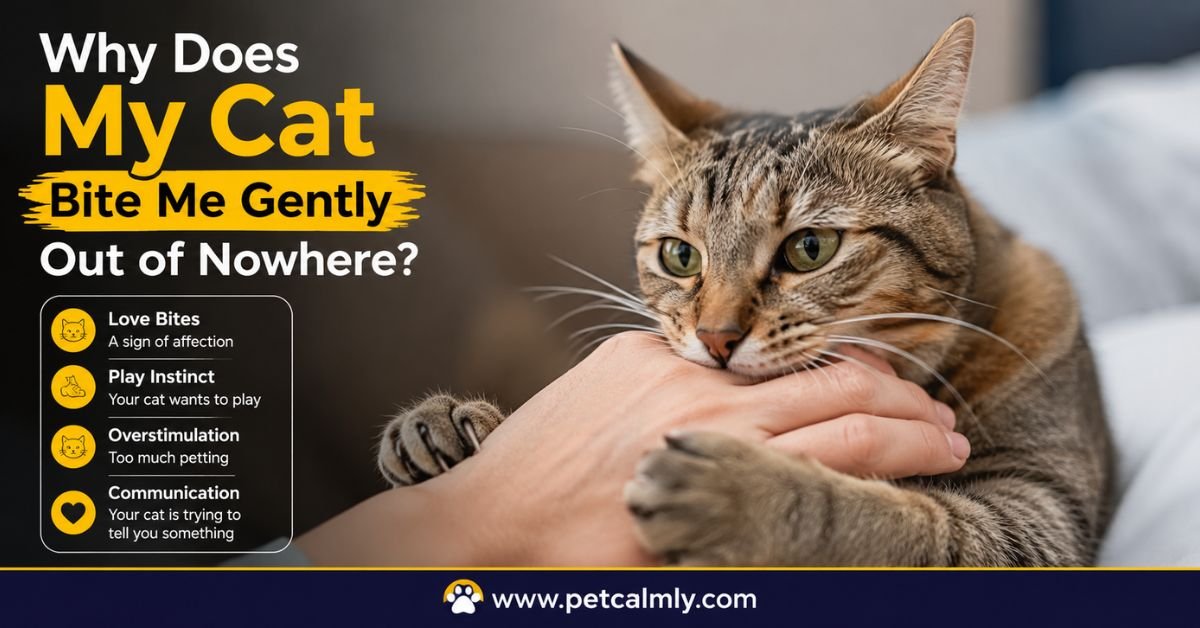
A cat that bites you gently and seemingly out of nowhere is usually communicating something, not attacking. The most common reasons are overstimulation from petting, redirected play energy, affection (“love bites”), asking for attention, or mild anxiety. Gentle bites rarely break skin and are often paired with other body language a flicking tail, flattened ears, or a sudden stillness right before the bite. Once you learn to read those signals, the “random” biting almost always makes sense.
You’re Not Imagining It This Is More Common Than You Think
If you’ve ever been calmly stroking your cat, everything seemingly fine, and then felt a soft nip on your hand out of nowhere, you’re in good company. It’s one of the most common questions cat owners search for, and it’s also one of the most misunderstood.
Cats don’t bite the way dogs do. A dog bite is usually loud, obvious, and tied to a clear trigger. A cat’s gentle bite is quieter, more subtle, and often looks like it came from nowhere because the warning signs happened in the two or three seconds before it, not in the moment itself. Once you know what to watch for, the mystery mostly disappears.
This guide walks through every realistic reason a cat nips gently, how to tell the difference between playful, affectionate, and stressed biting, what mistakes make it worse, and exactly what to do about it without shaming your cat or overreacting to normal feline behavior.
What a “Gentle Bite” Actually Looks Like
Before diagnosing the cause, it helps to define the behavior itself. A gentle bite typically:
- Doesn’t break the skin or leave more than a light red mark
- Happens quickly, then the cat pulls back or walks away
- Is often followed by the cat looking relaxed, not defensive
- May come with a soft grab of the paw around your hand or arm
This is different from a fearful or defensive bite, which tends to be harder, sometimes repeated, and paired with hissing, growling, or a flattened body posture. If your cat’s biting falls into that second category, the reasons and the response are different, and it’s worth reading that distinction carefully further down.
The Real Reasons Cats Bite Gently Without Obvious Warning
1. Overstimulation During Petting (The Most Common Cause)
This is the number one reason behind what feels like a random bite. Many cats enjoy being petted, but only up to a point. Their nervous system can go from “this feels nice” to “this is too much” surprisingly fast, especially with repetitive stroking along the back or near the base of the tail.
What’s happening physically: repeated touch builds up sensory input, and for some cats, that input crosses from pleasant to uncomfortable within seconds. The bite is your cat’s way of saying “that’s enough now,” because a cat can’t say it out loud, and a swat or bite is faster and more effective than getting up and leaving.
The tricky part is that this can happen even during affectionate moments. Your cat wasn’t upset with you five minutes into the petting session it simply reached its limit.
2. Redirected Play or Hunting Instinct
Cats are natural hunters, and the parts of their brain responsible for play and predation are closely linked. If your hand or fingers move quickly, wiggle under a blanket, or brush past your cat while it’s already in a playful mood, it can trigger a instinctive grab-and-bite response.
This is especially common in kittens and young cats who haven’t yet learned bite inhibition, and in cats who were hand-raised without proper play boundaries early on. It’s not aggression it’s misdirected hunting behavior aimed at the wrong “prey” (your hand, instead of a toy).
3. Affection the So-Called “Love Bite”
Cats groom each other as a bonding behavior, and grooming naturally includes gentle nibbling. When a cat gently bites you while relaxed, purring, or headbutting you beforehand, it may be treating you the way it would treat another cat it trusts.
This kind of bite usually feels almost like a soft mouthing rather than a true bite, and it often happens during cuddling, not during rough play. Many owners describe it as their cat “biting them out of nowhere” right after a calm, affectionate moment — which, from the cat’s perspective, is exactly the context in which grooming-style nibbling makes sense.
4. Seeking Attention or Communicating a Need
Some cats learn that a light nip gets an instant reaction you look at them, talk to them, or stop what you’re doing. If a cat wants food, playtime, or simply your attention and other signals (meowing, pawing) haven’t worked, a gentle bite can become the go-to method.
This is a learned behavior, which means it can also be unlearned with consistent responses, covered later in this guide.
5. Mild Stress, Anxiety, or Environmental Changes
Cats are highly sensitive to changes in their environment a new pet, a rearranged room, a houseguest, or even a change in your schedule can raise their baseline stress level. When a cat is mildly anxious, its threshold for tolerating touch or handling drops, so bites that seem unprovoked may actually be linked to something happening in the household that you haven’t connected yet.
According to the Cornell Feline Health Center, environmental stress is a well-recognized contributor to changes in a cat’s normal behavior, including touch sensitivity and irritability.
6. Pain or an Underlying Medical Issue
This is the one owners most often overlook. A cat that suddenly starts biting during petting sessions it used to enjoy — especially if the bites cluster around a specific body area like the lower back, hips, or tail may be experiencing discomfort or pain in that area. Dental pain, arthritis (which is common even in cats as young as seven or eight), or an internal issue can all change how a cat tolerates touch.
If the biting is new, sudden, and doesn’t match your cat’s usual personality, a veterinary check is the responsible next step before assuming it’s purely behavioral.
How to Read the Warning Signs Before the Bite Happens
Cats almost always give a signal before biting it’s just quick and easy to miss if you’re not looking for it. Watching for these cues lets you stop petting before the bite happens at all.
| Body Language Sign | What It Usually Means |
|---|---|
| Tail flicking or thumping | Rising irritation or overstimulation |
| Ears rotating back or flattening | Discomfort or defensiveness building |
| Skin rippling along the back | Sensory overload, common right before a bite |
| Sudden stillness or freezing | A pause before a reactive response |
| Dilated pupils | Heightened arousal — could be play or stress |
| A quick glance toward your hand | Cat is tracking the “trigger” |
A simple habit that helps: pet in short sessions of 10–15 seconds, then pause and watch your cat’s reaction before continuing. This alone prevents a large percentage of overstimulation bites.
Common Mistakes Owners Make (Without Realizing It)
- Continuing to pet after early warning signs appear. This is the single biggest reason gentle bites keep happening.
- Using hands as toys during kittenhood. This teaches a cat that biting hands is an acceptable play pattern.
- Punishing the bite after it happens. Yelling or tapping a cat’s nose doesn’t teach appropriate behavior — it usually just adds fear or confusion.
- Ignoring the context. Assuming every bite is “random” instead of tracking what happened in the minute before it.
- Withdrawing your hand suddenly during the bite. Fast movement can actually intensify the instinct to bite harder, since it mimics prey trying to escape.
Practical Training and Prevention Guide
Redirect Play Energy the Right Way
Keep a wand toy or soft plush nearby during play sessions, especially with kittens. If your cat starts to mouth your hand during play, calmly stop moving your hand, and offer the toy instead. Consistency here matters more than any single correction.
Respect the “Petting Threshold”
Learn where your specific cat prefers to be touched most cats tolerate cheek, chin, and base-of-ear scratches far better than prolonged back or tail-area petting. Stick to those “safe zones” if overstimulation biting has been an issue.
Don’t Reinforce Attention-Seeking Bites
If your cat bites for attention, avoid reacting with a big response, even a startled one — that’s still attention, and it reinforces the behavior. Instead, calmly stand up, disengage for a minute, then return once your cat is settled. Reward calm behavior with attention instead.
Create Predictable Routines
Cats that experience consistent feeding times, play schedules, and quiet spaces tend to show fewer stress-related behaviors overall, including touch sensitivity. A short daily play session before your usual cuddle time can also burn off hunting energy that might otherwise get redirected onto your hands.
A Simple Daily Checklist to Reduce Gentle Biting
- Watch for early body language cues during petting
- Keep petting sessions short and pause often
- Use toys, not hands, during play
- Stick to known “safe” petting zones
- Maintain a consistent play and feeding routine
- Track any new or sudden biting patterns
When Should You Worry? Signs That Go Beyond Normal Behavior
Most gentle biting is completely normal cat communication. But a few patterns are worth paying closer attention to:
- The biting is new, sudden, and doesn’t match your cat’s usual temperament
- Bites are becoming harder or breaking skin over time
- Your cat flinches, growls, or reacts defensively when touched in a specific spot
- The behavior is paired with other changes reduced appetite, hiding, limping, or litter box changes
- Biting happens alongside excessive grooming or licking of one particular area
Any of these patterns can point to pain, illness, or significant stress rather than typical behavior, and they’re worth discussing with a veterinarian rather than managing through training alone. As the American Association of Feline Practitioners notes, sudden behavior changes in cats are frequently an early sign of an underlying medical issue rather than a purely behavioral one.
What Pet Owners Should Actually Do About It
If your cat’s gentle biting fits the normal categories above, the response is simple: adjust how and when you interact, rather than trying to eliminate the behavior entirely. Cats communicate through their mouths and paws far more than people expect, and a soft nip is often just their version of a tap on the shoulder.
If you’re unsure which category your cat falls into, keep a short mental (or written) log for a week: when the bite happened, what you were doing, and what your cat’s body language looked like beforehand. Patterns usually become obvious quickly, and that pattern tells you whether you’re dealing with overstimulation, play, affection, attention-seeking, or something that needs veterinary input.
A Quick Note on Kittens vs. Adult Cats
Kittens bite far more frequently than adult cats, and it’s a normal part of learning bite inhibition something they’d typically learn from littermates and their mother. If you’re raising a kitten alone or one that was separated early, expect more mouthing behavior, and be patient with consistent redirection rather than expecting it to stop overnight. Most cats naturally reduce biting frequency as they mature, especially with consistent, gentle guidance.
Conclusion
A cat biting you gently out of nowhere almost never comes out of nowhere at all it’s usually the end of a short chain of signals that happened just before you noticed. Whether it’s overstimulation, redirected play, affection, attention-seeking, or a mild stress response, the behavior is a form of communication, not a character flaw. Learning your own cat’s specific patterns, respecting their limits, and watching their body language will resolve the vast majority of these situations. The exceptions sudden changes, harder bites, or signs of pain are worth a vet visit rather than more training, and knowing that difference is really the core of understanding this behavior well.
More Information About Pets, Please Visit Our Website: Why Do Cats Purr?
Why Do Cats Knead?
Can Cats Eat Eggs?
Can Cats Eat Tuna?
Frequently Asked Questions
1: Is it normal for my cat to bite me gently and then lick me right after?
Yes this combination of a soft bite followed by licking is often a grooming-style affectionate behavior, similar to how cats groom each other. It’s usually not a sign of aggression.
2: Why does my cat bite me when I stop petting them?
This is typically attention-seeking behavior. The cat learned that biting brings your hand or attention back, especially if it’s worked before.
3: Should I bite my cat back or tap their nose to discourage biting?
No. Physical corrections like this don’t teach appropriate behavior and can increase fear or confusion, which sometimes makes biting worse, not better.
4: Why does my cat bite me gently while purring?
Purring during a gentle bite usually indicates the cat is relaxed and affectionate, not distressed this fits the “love bite” or grooming-style behavior described above.
5: Can teething cause gentle biting in kittens?
Yes, kittens going through teething (usually between 3–7 months) often mouth and nip more than usual as their adult teeth come in. Offering appropriate chew toys can help.
6: When does gentle cat biting become a medical concern?
If biting is new, sudden, tied to a specific body area, or paired with other symptoms like appetite changes, limping, or excessive grooming of one spot, it’s worth a veterinary visit rather than assuming it’s purely behavioral.