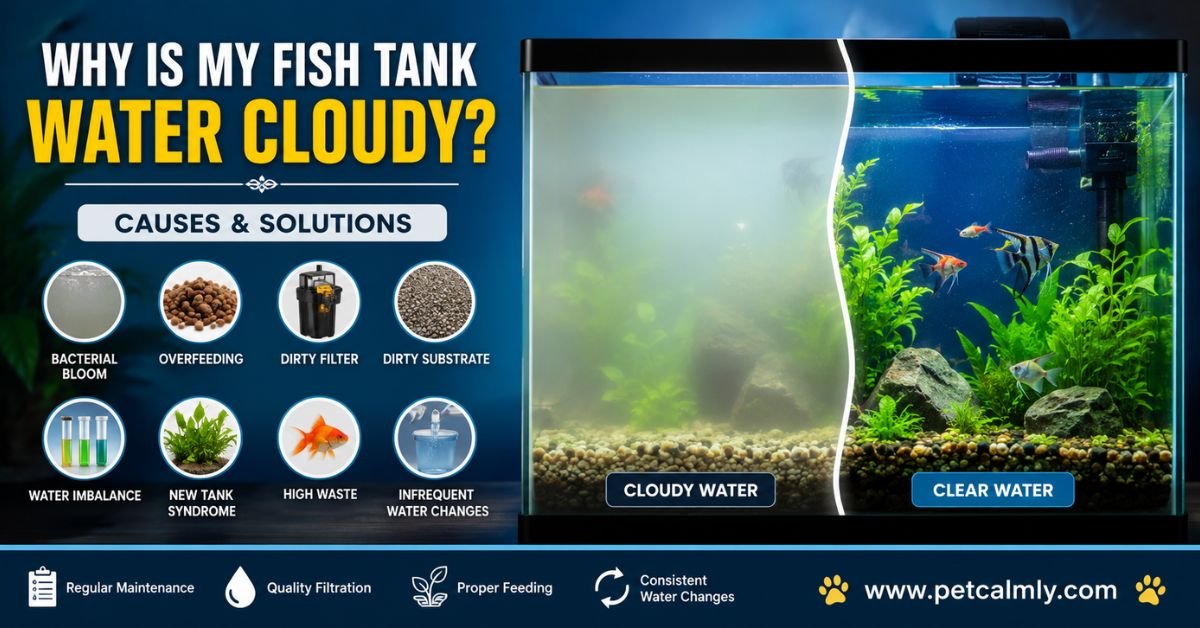
Short direct answer
Cloudy fish tank water is almost always caused by one of four things: a new tank going through its bacterial cycle, overfeeding, a dirty filter or substrate, or an algae bloom. White or gray cloudiness usually points to a bacterial bloom, while green cloudiness means algae, and brown or yellow tints often come from tannins or waste buildup. The good news is that most cases clear up on their own within a few days to two weeks once the underlying cause is addressed you rarely need to panic or tear down the tank.
If you’re standing in front of your tank right now, worried and Googling this at 11 p.m., take a breath. Cloudy water looks alarming, but in the vast majority of cases, your fish are not in immediate danger. What matters is figuring out which type of cloudiness you’re dealing with, because the fix is different depending on the cause. Let’s walk through it together.
What Does Cloudy Fish Tank Water Actually Mean?
Cloudy water is your tank’s way of telling you something has changed in its internal balance. Think of your aquarium as a small, enclosed ecosystem every fish, plant, and bit of leftover food is part of a chemical and biological loop. When that loop gets disrupted, particles that were previously kept in check start multiplying or floating freely, and the water loses its clarity.
The color and texture of the cloudiness is actually a diagnostic clue. A milky white haze, a green tint, and a brown, tea-like tinge each tell a different story, and an experienced fishkeeper can often narrow down the cause just by looking at the tank before testing a single parameter.
The Most Common Causes of Cloudy Aquarium Water
1. New Tank Syndrome (Bacterial Bloom)
If your tank is less than six weeks old, this is very likely your answer. When you first set up an aquarium, there aren’t enough beneficial bacteria living in the filter and substrate to process fish waste. As ammonia builds up from fish waste and uneaten food, a different type of bacteria one that thrives on ammonia multiplies rapidly to take advantage of the food source. That population explosion is what turns your water a hazy white or gray.
This is often called “new tank syndrome,” and it’s a completely normal part of the nitrogen cycle. It usually appears within the first two weeks of adding fish and can last anywhere from a few days to a couple of weeks. Many first-time owners panic and start doing aggressive water changes, which can actually prolong the process by removing the very bacteria the tank needs to stabilize.
2. Overfeeding
This is, in my experience, the single most common cause of ongoing cloudiness in established tanks. Fish only need a small amount of food, and anything they don’t eat within two to three minutes sinks to the substrate, where it decomposes. Decomposing food feeds bacteria and releases ammonia, both of which cloud the water and stress your fish.
A telltale sign of overfeeding is cloudiness that returns a day or two after every water change, no matter how thoroughly you clean. If that sounds familiar, your feeding routine is worth a hard look before you blame the filter or the fish themselves.
3. Dirty Filter or Substrate
Filters are supposed to trap debris, but a filter that’s overdue for a rinse can become a source of the problem instead of the solution. Compacted filter floss stops water from flowing through it properly, which lets particles bypass filtration entirely. Gravel and sand can trap the same debris, especially in low-flow corners of the tank.
4. Algae Bloom (Green Cloudiness)
Green, slightly cloudy water is caused by free-floating algae, not the kind that grows on glass or decorations. This type of algae grows explosively under too much light either too many hours of direct sunlight, an aquarium light left on too long, or a tank positioned near a window. Excess nutrients from overfeeding or infrequent water changes give algae the fuel it needs to multiply.
5. Substrate or Décor Dust
New gravel, sand, or driftwood that wasn’t rinsed thoroughly before going into the tank is an easy-to-overlook cause. Fine dust particles cling to substrate from the manufacturing process, and even a quick rinse under the tap can miss it. This kind of cloudiness typically shows up right after setup or rescaping and settles within 24 to 48 hours on its own.
6. Sudden Water Changes or Temperature Shock
Adding water that’s a different temperature than the tank, or adding it too quickly, can cause a brief cloudy reaction as minerals and gases in the water react. This is usually mild and short-lived, but it’s a good reminder to always match temperature and add new water slowly.
Brown or Yellow-Tinted Water: Is That the Same as Cloudy?
Not exactly, and it’s worth separating from true “cloudiness.” Brown or yellow-tinted water that’s still see-through is usually caused by tannins natural compounds released by driftwood, dried leaves, or certain types of substrate. This is common in tanks with bogwood or Indian almond leaves, and many aquarists actually encourage it on purpose, since tannins can have mild antibacterial properties and are a natural part of blackwater biotope setups that mimic rivers like the Amazon.
If your water has gone the color of weak tea but you can still clearly see through it and your fish are behaving normally, this is almost always cosmetic rather than a water quality problem. Activated carbon in your filter will remove tannins if you’d prefer clear water, but it isn’t required for your fish’s health.
True cloudiness, by contrast, scatters light rather than tinting it you’ll notice the water looks hazy or foggy rather than simply colored, and visibility across the tank drops noticeably. Knowing this difference saves a lot of unnecessary worry, since tannin-stained water is often mistaken for a health issue when it’s really just aesthetics.
Why New Tanks Are Especially Prone to Cloudiness
It helps to understand the biology behind new tank syndrome a little more, because it explains why patience is genuinely the best strategy. In an established aquarium, colonies of nitrifying bacteria live in the filter media, substrate, and even on decorations. These bacteria convert toxic ammonia (from fish waste and uneaten food) into nitrite, and then a second group of bacteria converts that nitrite into much less harmful nitrate, which is removed through regular water changes.
In a brand-new tank, none of these bacteria colonies exist yet in meaningful numbers. It typically takes four to six weeks for a tank to fully cycle, meaning the beneficial bacteria populations grow large enough to keep ammonia and nitrite at zero even with a full fish load. During that window, a different, faster-growing type of bacteria one that thrives directly on the ammonia itself — often blooms first, and it’s this bloom that causes the classic milky-white cloudiness.
This is genuinely one of the more misunderstood parts of fishkeeping. Many new owners assume cloudy water in a new tank means something has gone wrong, when in reality it’s often a visible sign that the cycling process is actively happening. The mistake isn’t the cloudiness — it’s reacting to it with a full water change, which removes the very bacteria trying to establish themselves and can restart the whole process.
How Often Is “Too Often” for Water Changes?
One question that comes up constantly is whether more frequent water changes will speed up recovery from cloudy water. The answer depends on why the water is cloudy in the first place.
For a bacterial bloom during cycling, small, infrequent changes (10–15% every few days) are generally more effective than large, frequent ones, since large changes disrupt the very colonies you’re waiting on. For overfeeding-related cloudiness, the more effective fix is adjusting portions rather than increasing water change frequency you’re treating the input, not just the symptom. For algae blooms, water changes alone won’t solve the problem unless paired with a reduction in light and excess nutrients, since algae will simply regrow using whatever nutrients remain.
A helpful way to think about it: water changes remove symptoms, while adjusting feeding, lighting, and filter maintenance address causes. Long-term clarity comes from the second category, not the first.
How to Tell What Kind of Cloudy Water You Have
| Water Appearance | Likely Cause | How Long It Usually Lasts |
|---|---|---|
| Milky white or gray haze | Bacterial bloom (new tank syndrome) | 3–14 days |
| Green tint | Free-floating algae bloom | Until light/nutrients are corrected |
| Brown or yellow tint | Tannins from driftwood, or waste buildup | Days to weeks, depending on cause |
| Cloudy with a foul smell | Rotting food or a dead fish/plant | Immediate cleanup needed |
| Cloudy right after setup or rescaping | Substrate dust | 24–48 hours |
| Cloudy with visible floating particles | Overfeeding or filter debris | Improves after feeding/cleaning adjustments |
Step-by-Step: How to Clear Up Cloudy Fish Tank Water
Step 1: Stop Feeding for 24 Hours
Fish can comfortably go a day or two without food, and skipping a feeding removes one major source of the problem while you investigate further. This alone often noticeably improves cloudiness caused by overfeeding within 24 hours.
Step 2: Test Your Water Parameters
Before changing anything else, test for ammonia, nitrite, nitrate, and pH using a liquid test kit. This tells you whether you’re dealing with a cycling tank (elevated ammonia and/or nitrite) or something else entirely. If you don’t own a test kit, most local fish stores will test a water sample for free.
Step 3: Check and Clean the Filter Gently
Rinse mechanical filter media (floss, sponges) in a bucket of removed tank water, never tap water, since chlorine and chloramine in tap water kill the beneficial bacteria living on your filter media. Never replace all filter media at once, as this resets your tank’s biological filtration and can trigger a new cycle.
Step 4: Do a Partial Water Change Not a Full One
A 10–20% water change is usually enough to dilute excess waste without disrupting the tank’s balance. Avoid the temptation to do a 100% water change during a bacterial bloom; it removes the bacteria that are actively working to stabilize your tank and can restart the cycle from scratch.
Step 5: Reduce Light Exposure If You Suspect Algae
If the cloudiness has a green tinge, cut your lighting back to 6–8 hours a day and move the tank out of direct sunlight if possible. A blackout period of 2–3 days (covering the tank and turning off lights entirely) can knock back a stubborn algae bloom.
Step 6: Avoid Over-Cleaning
It sounds counterintuitive, but scrubbing every surface, replacing all your substrate, or bleaching decorations during a cloudy spell usually makes things worse, not better. Beneficial bacteria live on every surface in your tank, not just in the filter, and aggressive cleaning wipes out your tank’s ability to self-regulate.
5 Common Mistakes Owners Make When Water Turns Cloudy
- Doing a complete water change immediately. This resets the nitrogen cycle and often makes cloudiness return worse than before.
- Adding extra fish “to help.” Fantail or algae-eating fish don’t fix a bacterial bloom, and adding more fish to an already-stressed tank increases the bioload at the worst possible time.
- Overdosing water conditioner or “clarifier” products. These can help in some cases, but relying on them instead of addressing the root cause just masks the symptom temporarily.
- Panicking and returning fish to the store. Most cloudy water resolves within two weeks with basic care adjustments; it’s rarely a reason to rehome fish.
- Ignoring a foul smell. Cloudiness paired with a rotten-egg or sulfur smell is different from a typical bacterial bloom and usually signals decomposing matter that needs to be found and removed right away.
Is Cloudy Water Dangerous for My Fish?
In most cases, mild to moderate cloudiness from a bacterial bloom or minor overfeeding is not immediately dangerous. Fish can tolerate it for the days it takes to resolve, especially if you continue monitoring ammonia and nitrite levels. What actually harms fish isn’t the cloudiness itself it’s the underlying water chemistry problem that sometimes causes it, particularly elevated ammonia or nitrite.
This is why testing your water matters more than judging clarity by eye. Water can look perfectly clear and still have dangerous ammonia levels, and water can look cloudy while parameters are actually fine. Clarity is a visual clue, not a substitute for testing.
When Should You Worry? Signs That Need Fast Action
Most cloudy water resolves with patience and small adjustments, but a few warning signs mean it’s time to act quickly rather than wait it out:
- Fish gasping at the water surface or hovering near the filter outflow (signs of low oxygen or high ammonia)
- Rapid gill movement, lethargy, or fish hiding constantly
- Cloudy water accompanied by a strong, foul odor
- Ammonia or nitrite readings above 0 ppm in an established tank that has been running for months
- Cloudiness that hasn’t improved at all after two to three weeks of consistent water changes and reduced feeding
- Visible white spots, fin damage, or unusual lesions on fish alongside the cloudy water
If you see any of these signs, prioritize a larger water change (30–50%) right away and consider reaching out to an aquatic veterinarian or a knowledgeable local fish store for guidance, since these symptoms can point to something beyond typical cloudiness, such as a bacterial or parasitic issue affecting the fish directly rather than just the water.
What Pet Owners Should Do: A Simple Recovery Checklist
- Stop feeding for 24 hours to reduce waste input
- Test ammonia, nitrite, nitrate, and pH
- Rinse filter media in removed tank water, not tap water
- Perform a 10–20% water change (not a full change)
- Reduce lighting to 6–8 hours/day if algae is suspected
- Hold off on adding new fish until water clears
- Recheck water parameters every 2–3 days until stable
- Watch fish behavior closely, not just water clarity
How to Prevent Cloudy Water From Coming Back
Prevention comes down to a few consistent habits rather than any single fix:
Feed smaller amounts. Offer only what your fish can finish in two to three minutes, once or twice a day. If you’re unsure, it’s almost always better to underfeed slightly than overfeed.
Stick to a regular maintenance schedule. A weekly 10–20% water change, paired with a monthly filter rinse, keeps waste and debris from accumulating to the point where they cause visible cloudiness.
Don’t overstock your tank. Every fish adds to the bioload your filter has to process. A tank that’s stocked beyond its capacity will struggle to stay clear no matter how often you clean it.
Rinse new substrate and décor thoroughly before adding them to an established tank, even if the packaging says “pre-washed.”
Give new tanks time. Cycling a tank properly ideally before adding a full stock of fish prevents most new tank syndrome cloudiness from happening in the first place. Many experienced keepers recommend fishless cycling for exactly this reason.
Match your lighting to your tank’s needs, not your room’s aesthetic preferences. Most freshwater community tanks do well with 6–8 hours of light daily.
Real-World Example: A Common Scenario
A new fishkeeper sets up a 20-gallon tank on a Saturday, lets it run for two days, and adds six fish by Monday. By Wednesday, the water has turned a hazy white. This is a textbook case of new tank syndrome the bacterial colonies needed to process fish waste simply haven’t had time to establish themselves yet. The fix isn’t to change all the water or return the fish; it’s to test ammonia daily, do small partial water changes if ammonia rises above 0.5 ppm, and let the tank finish cycling naturally over the next one to two weeks, feeding sparingly the entire time.
More Information About Pets, Please Visit Our Website: How to Cycle a Fish Tank With Plants
Freshwater Aquarium Algae Control
Freshwater Fish Diseases
Ich Treatment for Freshwater Fish
Frequently Asked Questions
1: How long does it take for cloudy fish tank water to clear up?
Most bacterial bloom cloudiness clears within 3 to 14 days once feeding is reduced and the tank is left to stabilize. Algae-related cloudiness can take a bit longer if lighting isn’t corrected, sometimes two to three weeks.
2: Should I do a water change if my fish tank is cloudy?
A small partial water change of 10–20% can help dilute waste, but avoid full or very large water changes during a bacterial bloom, since this removes the beneficial bacteria your tank needs to stabilize on its own.
3: Is cloudy water harmful to my fish?
Mild cloudiness usually isn’t harmful by itself, but the underlying cause — especially high ammonia — can be. Testing your water parameters is the most reliable way to know if your fish are actually at risk.
4: Why did my tank water turn cloudy after I cleaned it?
This is often caused by disturbed substrate dust or a filter that was cleaned too aggressively, removing beneficial bacteria. It usually settles within a day or two as the tank readjusts.
5: Can overfeeding really cause cloudy water?
Yes. Uneaten food decomposes on the substrate, releasing ammonia and feeding bacteria that cloud the water. Reducing portions is one of the fastest ways to see visible improvement.
6: Do I need a water clarifier product to fix cloudy water?
Not usually. Clarifier products can help clump particles together for the filter to catch, but they don’t address the root cause. Adjusting feeding, cleaning habits, and lighting typically resolves cloudiness without added chemicals.
Conclusion
Cloudy water is one of the most common things new and experienced fishkeepers alike run into, and in almost every case, it’s a sign that your tank is working through a temporary imbalance rather than a crisis. The key is matching the fix to the actual cause a bacterial bloom needs patience and light water changes, while an algae bloom needs less light, and dirty filters need a gentle rinse rather than a full replacement. Keep an eye on your fish’s behavior alongside the water’s appearance, test your parameters when in doubt, and resist the urge to overcorrect. Give it time, and your tank will almost always find its balance again.