Short direct answer
You cycle a fish tank with plants by planting a heavily stocked tank with fast-growing, nutrient-hungry species (like Pothos, Hornwort, or Water Wisteria) before adding fish. The plants absorb ammonia directly for their own growth, which lowers the ammonia spike that normally drives the nitrogen cycle. This is often called a “silent cycle” or “plant-based cycle.” It doesn’t eliminate beneficial bacteria it works alongside them and it typically lets you add fish sooner and more safely than a traditional fishless cycle, as long as you stock lightly and test your water before adding anyone.
That’s the short version. If you’ve ever felt overwhelmed staring at a brand-new tank, wondering whether it’s actually safe for fish yet, you’re not alone and the rest of this guide will walk you through exactly what to do, step by step, without the jargon overload most aquarium sites throw at you.
Why New Tanks Aren’t Safe for Fish Right Away
Every aquarium, no matter how clean the water looks, needs an invisible workforce of beneficial bacteria before it can safely support fish. These bacteria live on your filter media, substrate, and decorations, and their job is to break down fish waste before it builds up to toxic levels.
Here’s the part most beginners don’t realize: a brand-new tank has almost none of these bacteria yet. So when fish start producing waste, ammonia builds up fast and ammonia is toxic to fish even in small amounts. This is what’s known as “New Tank Syndrome,” and it’s the number one reason new fish die in their first two weeks of tank ownership.
Cycling is simply the process of building up that bacterial colony (and, in this method, supporting it with live plants) before your fish are exposed to dangerous water conditions.
What Is the Nitrogen Cycle, in Plain English
Think of the nitrogen cycle as your tank’s waste-management system. It happens in three stages:
- Ammonia (NH3/NH4+) — produced by fish waste, uneaten food, and decaying plant matter. Highly toxic to fish, even at low levels.
- Nitrite (NO2-) — produced when bacteria (Nitrosomonas) break down ammonia. Still toxic, and it interferes with a fish’s ability to carry oxygen in its blood.
- Nitrate (NO3-) — produced when a second group of bacteria (Nitrobacter and related species) convert nitrite into nitrate. Nitrate is far less toxic and is removed through water changes or absorbed by live plants.
In a traditional fishless cycle, you wait for bacteria colonies to grow large enough to process ammonia and nitrite quickly, which can take four to six weeks. Adding live plants changes this timeline in a meaningful way, because plants compete for the same ammonia the bacteria would otherwise process and plants can use it almost immediately.
Why Plants Speed Up (and Soften) the Cycling Process
Live aquatic and semi-aquatic plants absorb ammonium directly through their roots and leaves as a nitrogen source for growth. This matters for two reasons:
- Plants act as a buffer. Instead of ammonia climbing to dangerous levels while bacteria slowly catch up, fast-growing plants pull a meaningful share of that ammonia out of the water column right away.
- Plants reduce the nitrite spike. Because less ammonia is left for bacteria to convert, the secondary nitrite spike is often smaller and shorter than in a plant-free cycle.
This doesn’t mean you skip the nitrogen cycle altogether bacteria still colonize your filter and substrate, and they’re still doing real work. Plants simply take pressure off the system while that bacterial colony establishes itself, which is why many experienced fishkeepers consider a heavily planted tank one of the most forgiving ways for a beginner to start.
Best Plants for Cycling a Fish Tank
Not all plants pull their weight equally. Some genuinely fast-growing, low-maintenance species do most of the heavy lifting:
| Plant | Type | Why It Works Well | Difficulty |
|---|---|---|---|
| Pothos (Epipremnum aureum) | Semi-aquatic (roots in water, leaves above) | Extremely fast growth, huge nitrogen uptake, doesn’t need substrate | Beginner |
| Hornwort | Fully aquatic, floating or planted | Grows quickly, no roots needed, easy to trim | Beginner |
| Water Wisteria | Rooted aquatic | Fast grower, tolerates a wide range of water conditions | Beginner |
| Amazon Sword | Rooted aquatic | Slower than the above but hardy and long-lasting | Beginner-Intermediate |
| Java Fern | Rooted or attached to décor | Doesn’t need substrate, low light tolerant | Beginner |
| Duckweed | Floating | Fast nitrogen uptake, but can be hard to control and messy | Beginner (with caution) |
A quick note from experience: Pothos is a favorite among planted-tank beginners because you don’t even need to plant it in substrate you can rest the vine on top of the tank with just the roots submerged, and it will thrive off nothing but ammonia and light. It’s forgiving, cheap, and nearly impossible to kill.
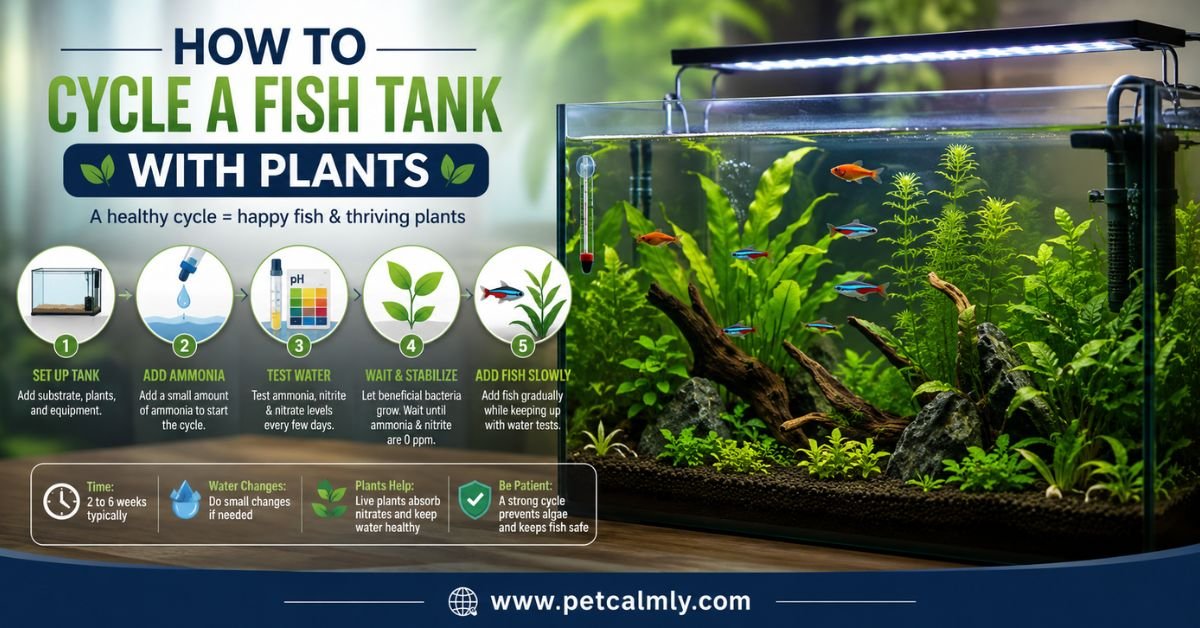
Step-by-Step: How to Cycle a Fish Tank With Plants
Step 1: Set Up Your Tank and Filter First
Add substrate, decorations, and your filter, then fill the tank with dechlorinated water. Run the filter continuously from day one this is where most of your beneficial bacteria will eventually live.
Step 2: Add Your Plants Before Any Fish
Plant heavily. A lightly planted tank won’t absorb enough ammonia to make a real difference. Aim for a mix of fast-growing stem plants and at least one floating or semi-aquatic species like Pothos or Hornwort.
Step 3: Introduce an Ammonia Source
Since there are no fish yet, you need something to feed both the plants and the bacteria. Options include:
- A pinch of fish food, added every day or two and left to decay
- Pure ammonia solution (unscented, no surfactants or additives), added in small doses
- A small piece of raw shrimp, added once and left to decompose over a week
This step matters even in a planted cycle without an ammonia source, there’s nothing for the bacteria to colonize around, and your plants won’t have anything to absorb either.
Step 4: Test Your Water Every 2–3 Days
Use a liquid test kit (API Freshwater Master Test Kit is a commonly recommended option) rather than test strips, which tend to be less accurate. Track:
- Ammonia
- Nitrite
- Nitrate
- pH
You’re watching for a pattern: ammonia should stay lower than in an unplanted cycle, nitrite should rise and then fall, and nitrate should gradually appear.
Step 5: Watch the Plants, Not Just the Numbers
Healthy new growth, upright leaves, and root development are good signs your plants are actively using the nitrogen in the water. Yellowing leaves or stalled growth can mean the plants are struggling — which is worth investigating before you add fish, since a struggling plant isn’t pulling its weight in the cycle.
Step 6: Add Fish Gradually, Not All at Once
Once ammonia and nitrite consistently read at or near zero, and nitrate is present (showing the cycle is functioning), you can add fish but slowly. Start with just two or three hardy fish, wait one to two weeks, test again, and add more only if levels stay stable. This gives your bacteria and plants time to adjust to the new bioload rather than being overwhelmed all at once.
6 Common Mistakes People Make When Plant-Cycling a Tank
- Assuming plants alone are enough. Plants reduce ammonia, but they don’t replace the need for beneficial bacteria or ongoing water testing.
- Adding too few plants. A couple of small plants in a 20-gallon tank won’t make a measurable dent in ammonia levels. Density matters here.
- Skipping the ammonia source. Without something feeding the system, neither the bacteria nor the plants have anything to establish themselves around.
- Adding all your fish on day one. Even with plants helping, a full stocking load introduces more waste than a young colony (biological or botanical) can handle safely.
- Not testing water at all. Visual clarity is not the same as water safety. Ammonia and nitrite are invisible and odorless at dangerous levels.
- Using tap water without conditioning it. Chlorine and chloramine in tap water can kill the beneficial bacteria you’re trying to grow, so always treat water with a dechlorinator before adding it to the tank.
How Long Does a Plant-Assisted Cycle Take?
There’s no single fixed number, because it depends on plant density, tank size, water temperature, and light levels. As a general range:
- Heavily planted, fast-growing species: Often shows usable ammonia control within 1–3 weeks, though full bacterial maturity can still take longer to stabilize.
- Lightly planted tanks: May not see a meaningful difference from a standard fishless cycle, which typically runs 4–6 weeks.
- Warmer water (75–80°F) and consistent light: Tends to speed up both plant growth and bacterial reproduction.
Patience is genuinely the hardest part of cycling for most new fishkeepers. It’s tempting to add fish the moment the water looks clear, but clarity has nothing to do with ammonia or nitrite levels only a test kit can tell you that.
When Should You Worry? Signs Your Tank Isn’t Cycling Properly
Most plant-assisted cycles go smoothly, but keep an eye out for these warning signs:
- Ammonia or nitrite readings that stay elevated for more than three to four weeks without improvement
- Plants that are melting, yellowing, or not growing at all despite adequate light
- A strong, persistent odor from the tank (healthy cycling water shouldn’t smell foul)
- Cloudy water that doesn’t clear after the first week (a mild “bacterial bloom” in week one is normal, but ongoing cloudiness may signal a stalled cycle)
If you’ve already added fish and notice them gasping at the surface, gathering near the filter outflow, or showing red or inflamed gills, that’s a sign of ammonia or nitrite poisoning, not just “settling in.” This calls for an immediate partial water change and reduced feeding, and if symptoms continue, it’s worth consulting an aquatic veterinarian or a knowledgeable local fish store, since prolonged exposure to ammonia and nitrite can cause lasting gill and organ damage.
What Should Pet Owners Do Before Buying Fish?
If you’re setting up your first tank, here’s a realistic checklist before you bring fish home:
- ✅ Tank, filter, and heater (if needed) have been running for at least several days
- ✅ Live plants are established and showing new growth
- ✅ Ammonia and nitrite both test at or near 0 ppm
- ✅ Nitrate is present, confirming the cycle is active
- ✅ Water has been treated with a dechlorinator matched to your tap water
- ✅ You’ve researched the specific species you want, including adult size and tank mates
- ✅ You have a liquid test kit on hand for ongoing monitoring, not just the initial cycle
Skipping straight to “the water looks clean, let’s get fish” is the single most common reason new aquarium owners lose fish in the first month. A few extra days of patience protects both your fish and your wallet.
A Realistic Owner Example
A common scenario looks like this: someone sets up a 10-gallon tank, adds a few stem plants and a Pothos vine trailing from the back, and starts dosing a small amount of fish food every other day. By day 10, ammonia is reading around 0.25 ppm instead of spiking to 4+ ppm like an unplanted tank might. Nitrite rises briefly around day 12–14, then drops. By day 18–20, both ammonia and nitrite read zero, nitrate is present, and the Pothos has visibly new leaf growth. At that point, adding two or three hardy fish (like white cloud mountain minnows or a small school of tetras, depending on tank size) is a reasonable next step followed by continued testing for the next couple of weeks before stocking further.
Every tank behaves a little differently depending on plant mass, temperature, and light, so treat this as a general pattern rather than an exact timeline for your setup.
Conclusion
Cycling with plants isn’t a shortcut that skips the science it’s a way of working with the nitrogen cycle instead of just waiting it out. Live plants give your tank a head start by absorbing ammonia directly, softening the toxic spikes that make traditional cycling so stressful to watch. But the fundamentals still apply: test your water, stock slowly, and let the process take the time it needs.
If there’s one thing worth taking away, it’s this a few extra days of patience at the start of your aquarium journey almost always means a healthier, calmer tank (and far fewer heartbreaking surprises) down the line.
More Information About Pets, Please Visit Our Website: Freshwater Aquarium Algae Control
Freshwater Fish Diseases
Ich Treatment for Freshwater Fish
Frequently Asked Questions
1: Can you cycle a tank with just plants and no fish food or ammonia source?
Not effectively. Plants need a nitrogen source to absorb, and without fish, food, or an added ammonia source, there’s nothing in the water for them (or your bacteria) to process. Most plant-only “cycles” still rely on a small ammonia source in the early stages.
2: Do I still need a water test kit if I’m using plants to cycle?
Yes. Plants reduce ammonia levels, but they don’t guarantee zero ammonia, especially in lightly planted tanks. A liquid test kit is the only reliable way to confirm your tank is actually safe for fish.
3: How many plants do I need to cycle a fish tank?
There’s no exact number, but a good rule of thumb is to plant heavily enough that plants make up a noticeable portion of the tank’s visual space, with at least one fast-growing species like Hornwort, Water Wisteria, or Pothos included.
4: Can I add fish immediately if I have a lot of live plants?
It’s not recommended. Even heavily planted tanks benefit from a short establishment period usually one to three weeks to confirm ammonia and nitrite are staying at safe levels before fish are introduced.
5: Will plants alone remove nitrate from my tank?
Plants absorb some nitrate as they grow, but they usually can’t keep up with nitrate produced by a fully stocked tank on their own. Regular partial water changes are still necessary for long-term nitrate control.
6: What’s the difference between a fishless cycle and a plant-based cycle?
A fishless cycle relies entirely on beneficial bacteria to process an added ammonia source before fish arrive. A plant-based cycle uses the same bacterial process but adds live plants that absorb ammonia directly, which often reduces ammonia spikes and can shorten the time before fish can be safely added.