
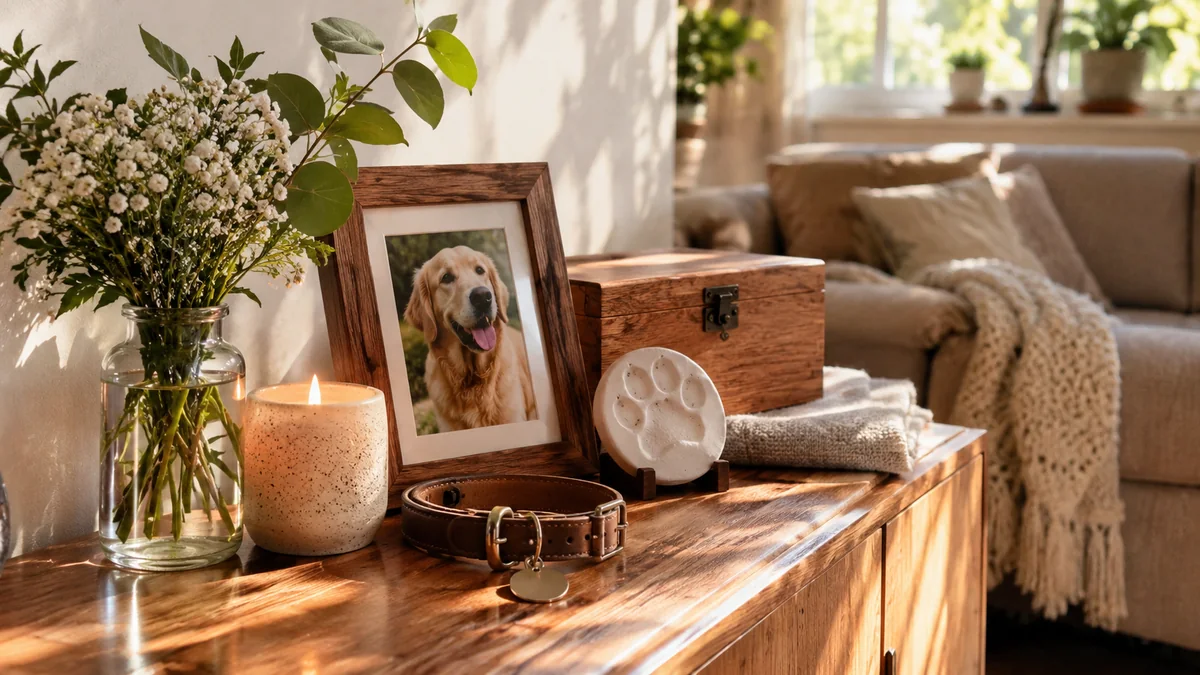
The first thing you notice after losing a pet may be something ordinary. The hallway is quiet at the hour when paws used to hurry toward the door. A sunny spot on the floor stays empty. You still glance toward the food bowl before remembering why no one is there.
Those small moments deserve a place in the story of your pet’s life. A home memorial can help you keep a few of them close, without turning grief into a project or filling an entire room with keepsakes. It might be a photograph, a box of familiar objects, a place for ashes, or a ritual you return to on difficult days.
Here are seven practical ways to create a memorial that reflects your companion’s personality and fits the way you live. Choose the ideas that feel useful; there is no need to do all seven.
1. Start With a Place That Already Holds a Memory
Before buying a frame or clearing a shelf, walk through your home and notice where you naturally think of your pet. Perhaps your dog used to wait by the hallway rug, or your cat watched the street from the same window every afternoon. The right location is often somewhere ordinary rather than a specially decorated corner.
Begin small: a stable surface, one picture, and an object that reminds you of a shared routine. A leash hook may be more meaningful than an elaborate display. If the memorial is in a busy room, use a shallow tray to keep objects together and choose an area away from shelf edges, heat, and direct sunlight. Keep glass frames, candles, and small items out of reach of children or other pets. A flameless light is a safer alternative to a candle in an active household.
Ask yourself whether you want the memorial to be visible each day or somewhere private. Try the arrangement for a few days before making anything permanent. You may discover that the bedroom feels too personal but a bookshelf beside the living room chair feels just right.
2. Let Three Photographs Tell Their Story
The photographs that feel most like your pet are rarely the most polished. Maybe there is a picture of your dog with a sock in their mouth, or your cat half-hidden in a shopping bag. An imperfect image can preserve the expression or habit that everyone in the family remembers.
Try making a small three-picture story: an early photograph, one ordinary day together, and a moment from later in your pet’s life. Under each image, write a sentence that only someone who knew them would understand: “Insisted on sitting in the laundry basket,” or “Always checked the kitchen at 6 p.m.” Those details make the display unmistakably personal.
Choosing meaningful photographs is often easier when you focus on the small habits and expressions that made your companion unique. Our guide to capturing your pet’s personality in everyday photos shares practical ideas for preserving those natural moments and creating lasting memories.
You can also create a digital version. Collect photographs and short videos in a named folder, save a second copy somewhere separate, and ask relatives or friends to add their favorites. If there are hundreds of pictures, choose ten today rather than trying to sort the entire collection. A modest first selection is easier to enjoy and easier to update.
3. Keep Their Everyday Things in a Memory Box
A collar, an ID tag, a worn toy, or the brush that stayed in the drawer for years may carry a stronger memory than something expensive. A memory box allows you to preserve those objects without needing to display everything at once.
Choose a clean, dry box with a lid. Put photographs and handwritten notes in paper sleeves or acid-free envelopes if you plan to keep them for years; store the box away from damp rooms and strong sunlight. Very dirty or damp fabric should be cleaned and dried before being stored, when that can be done without damaging something you want to preserve. Keep heavier objects below fragile ones.
Include a note explaining why each item matters. Instead of writing simply “blue toy,” you might write, “The one she carried to the front door whenever someone arrived.” Years later, those sentences may be as valuable as the objects themselves.
If other family members want different keepsakes, let each person choose something. You can keep a shared box and separate small items without deciding that one way of remembering is better than another.
4. Find a Secure Place for Cremated Ashes
For families who choose cremation, the day the ashes come home can bring practical questions at an already emotional time. Should you move them into an urn immediately? Is the temporary container suitable? What if you might want to scatter or bury the ashes later?
There is no need to transfer ashes simply to create a memorial. The original sealed bag or container can stay in a dry, secure place while you decide. A photograph and a small keepsake beside it can make that temporary arrangement feel intentional.
If you later select an urn, check three things before ordering: the usable internal capacity, the width of the opening (especially if you plan to keep the sealed bag intact), and the type of closure. Exterior dimensions alone do not establish how much the container will hold. If the original packaging or transfer instructions are unclear, ask the cremation provider before opening anything. For outdoor scattering or burial, check local rules and obtain any necessary permission.
Families considering these choices can use this guide to what to do with your pet’s ashes after cremation to compare keeping, scattering, burial, and other remembrance options.
A useful starting point is to write down what matters most: keeping the memorial close, being able to move it to a new home, or having a permanent place to visit. Those priorities are more helpful than choosing a container by appearance alone.
5. Choose One Detail That Could Belong Only to Your Pet
The most personal memorial detail is often a small, familiar imperfection: an ear that folded forward when your dog listened, a white patch beside your cat’s eye, a crooked whisker, or the look they gave you at dinnertime. A memorial need not reproduce every feature perfectly to feel recognizable.
For a handmade option, paint a stone with a simple paw outline, frame a handwritten nickname, or create a card showing your pet’s favorite daily ritual. If you want a portrait, look for photographs that capture both their face and distinctive markings. A front-facing image may show expression; a second angle may reveal the shape of the ears or the color pattern along the body.
Some families prefer a drawing or framed photograph. Others who keep ashes at home choose personalized pet urns, including hand-painted designs made with pet photographs as references. If you consider a custom piece, ask how the artwork is created, whether you can review a finished preview, and whether its internal capacity and opening fit your needs. A beautiful portrait is meaningful, but a functioning urn must also be practical.
A small exercise: Complete this sentence without overthinking it: “I will always remember the way you…” The answer may point toward the most fitting photograph, phrase, or keepsake. It can also remind you that meaningful memorials do not have to be purchased.
6. Grow Something in Their Memory—Safely
A living memorial can turn remembrance into an everyday act. Watering a small plant or noticing new leaves gives you a gentle reason to pause. You might choose a container garden by the door, a flowering plant for a sunny window, or a tree in a garden where you expect to stay.
First consider the other animals in your home. Some familiar flowers and houseplants are toxic to pets, particularly cats. The ASPCA maintains a searchable list of toxic and non-toxic plants; check the exact species before bringing a plant within reach. Also think about the available light, drainage, and whether the plant can be moved if you change homes. A healthy, easy-care plant will usually be more comforting than one that needs constant attention.
The memorial does not need to involve burying ashes or adding them to soil. A pot with a small name marker, a favorite stone beside it, or a photograph nearby can be enough. If a plant does not survive, it does not mean you have failed to honor your pet; you can choose a different way to remember them.
7. Make Remembrance Something You Do, Not Only Something You Own
Objects preserve moments; rituals can help keep stories alive. You might take a short walk on the route you once shared, make a donation to a rescue group on your pet’s birthday, or invite family members to tell one funny story over dinner.
Writing can be surprisingly specific. Begin a letter with “Today I wanted to tell you…” and describe something ordinary: the first snowfall without your dog, the sound of a cupboard opening without your cat appearing, or a habit you still catch yourself following. You can keep the letter in the memory box, read it aloud, or leave it private.
For children, a drawing or story can be easier than a formal ceremony. Invite them to participate, but allow them to say no. If family members remember the pet differently, a shared album can hold more than one perspective. Ohio State University’s Veterinary Medical Center, through its Honoring the Bond program, provides resources that recognize how important the human-animal relationship remains during loss.
A ritual should fit the life you have now. Once a month may feel appropriate; an occasional moment when you pass a favorite park may be enough. What matters is that the gesture feels connected to your companion, rather than like a task you must complete.
If a Memorial Feels Too Difficult Right Now
You may be able to choose a photograph but not open the box of belongings. Or you may prefer to pack everything away for a while. Both are possible responses to loss. Cornell University’s College of Veterinary Medicine explains that grief is individual and does not follow a prescribed timeline.
If grief is interfering with sleep, eating, work, or daily life, consider talking with someone supportive rather than managing everything alone. Cornell provides pet-loss resources, and the Cummings School of Veterinary Medicine at Tufts University operates a pet-loss support helpline. These services can offer a starting point for finding understanding and support.
A memorial can begin as simply as saying your pet’s name and remembering the way they greeted you. You can add the objects, photographs, or rituals later—or leave the memory as it is.
The Best Memorial Looks Like Your Life Together
There is no perfect arrangement to copy. A single framed photograph may suit a quiet apartment. A memory box may work best for a busy family. A garden plant, an urn, or a familiar walk might become the place where you feel most connected to your pet.
Start with one detail you would recognize anywhere: a small habit, a peculiar expression, a favorite afternoon ritual. That detail can guide every choice that follows. The point is not to recreate the life you had, but to give its everyday moments a place in the life you have now.
References
For further information on pet-loss support and pet-safe planting:
- Cornell University College of Veterinary Medicine — Pet Loss Resources and Support: https://www.vet.cornell.edu/impact/community-impact/pet-loss-resources-and-support
- The Ohio State University Veterinary Medical Center — Honoring the Bond: https://vmc.vet.osu.edu/services/honoring-the-bond
- Cummings School of Veterinary Medicine at Tufts University — Pet Loss Support Helpline: https://vet.tufts.edu/pet-loss-support-helpline
- ASPCA Animal Poison Control — Toxic and Non-Toxic Plants for Cats: https://www.aspca.org/pet-care/animal-poison-control/cats-plant-list