Short direct answer
The most common signs that your dog has separation anxiety include excessive barking or howling when left alone, destructive chewing, scratching at doors or windows, accidents indoors despite being house-trained, pacing, drooling, trembling, and following you constantly before you leave. These behaviors usually begin within minutes of your departure and stop once you return. With patience, training, and the right routine, most dogs can learn to feel more secure when home alone.
Introduction
Many dogs dislike seeing their favorite person walk out the door. A little disappointment is perfectly normal. Separation anxiety, however, is much more than missing you.
Dogs with separation anxiety experience genuine emotional distress when left alone or separated from a person they depend on. Instead of relaxing while you’re away, they may panic, bark for hours, destroy furniture, or even injure themselves trying to escape.
This condition can be stressful for both dogs and owners. You may come home to damaged belongings, upset neighbors, or a frightened pet that seems impossible to calm. The good news is that separation anxiety is a treatable behavior problem. Understanding the early signs is the first step toward helping your dog feel safe and confident.
In this guide, you’ll learn exactly what separation anxiety looks like, why it happens, how to tell it apart from normal boredom, and practical ways to help your dog become more comfortable when left alone.
What Is Separation Anxiety in Dogs?
Separation anxiety is a behavioral condition in which a dog becomes extremely anxious whenever they are separated from a person or people they have formed a strong attachment to.
Unlike stubbornness or “bad behavior,” these actions are driven by fear and panic. Your dog is not trying to punish you for leaving. Instead, they are struggling to cope with being alone.
The anxiety usually begins:
- Within a few minutes after you leave
- During departure routines like picking up keys or putting on shoes
- When your dog notices signs that you’re about to leave
Many dogs calm down almost immediately once their owner returns.
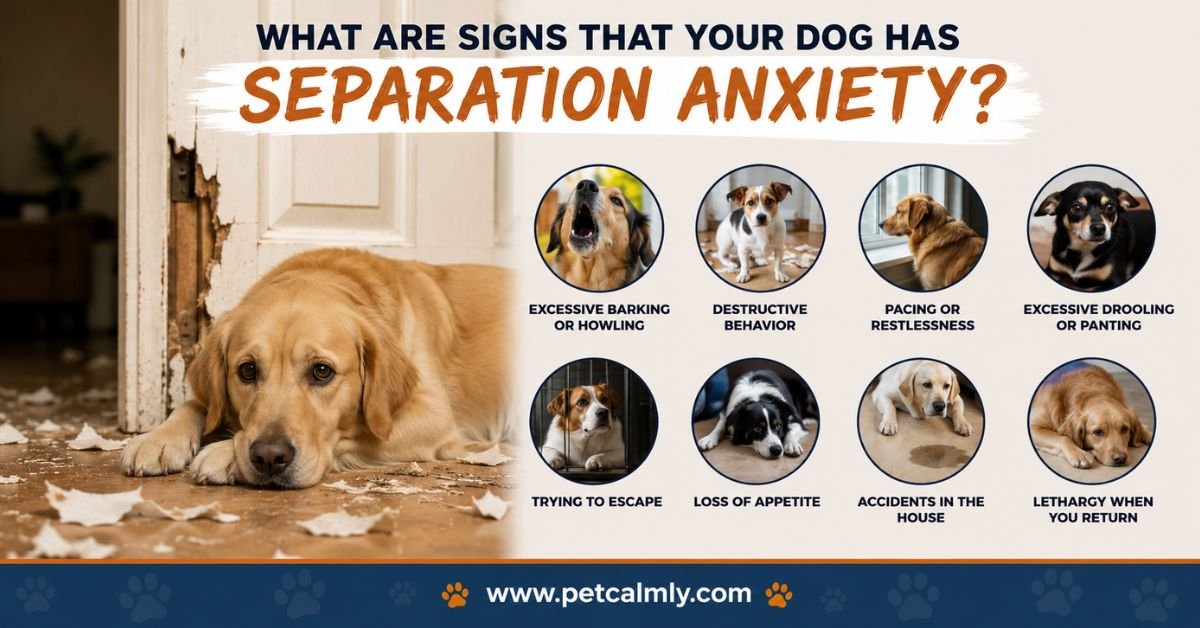
What Are Signs That Your Dog Has Separation Anxiety?
Recognizing the symptoms early can make treatment easier. Dogs rarely show just one sign. Instead, you’ll often notice several behaviors happening together.
Excessive Barking, Whining, or Howling
One of the earliest warning signs is nonstop vocalization.
A dog with separation anxiety may:
- Bark continuously
- Whine loudly
- Howl for long periods
- Cry immediately after you leave
This often starts within minutes of your departure rather than several hours later.
If neighbors report constant barking while you’re away, separation anxiety may be the cause.
Destructive Behavior Around Doors and Windows
Dogs suffering from panic often try to reach their owners.
Common examples include:
- Scratching doors
- Digging at carpets near exits
- Chewing door frames
- Damaging blinds
- Biting window sills
- Destroying crates
The goal isn’t destruction—it’s escape.
Many anxious dogs focus specifically on places where they last saw their owner leave.
Urinating or Defecating Indoors
House-trained dogs that suddenly have accidents only when left alone deserve closer attention.
This is especially concerning if:
- The accidents happen shortly after you leave.
- They never occur when you’re home.
- Your veterinarian has ruled out medical problems.
Stress hormones can trigger loss of bladder or bowel control during episodes of intense anxiety.
Pacing Repeatedly
Some anxious dogs don’t bark or destroy furniture.
Instead, they pace.
You may notice on a pet camera that your dog:
- Walks the same route repeatedly
- Circles the living room
- Moves between windows
- Can’t settle down
Pacing may continue for much of the time you’re away.
Heavy Drooling and Panting
Stress affects the body as well as behavior.
Signs of physical anxiety include:
- Excessive drooling
- Heavy panting
- Trembling
- Dilated pupils
- Fast breathing
These symptoms are especially noticeable if your home isn’t hot and your dog wasn’t exercising before you left.
Trying to Escape
Some dogs panic so intensely that they attempt to escape the house.
This can involve:
- Breaking through screens
- Jumping fences
- Biting crate bars
- Scratching doors until paws bleed
- Breaking windows
Escape attempts can lead to serious injuries and should never be ignored.
Constantly Following You Around the House
Separation anxiety often begins before you even leave.
Many affected dogs become “velcro dogs.”
They may:
- Follow you into every room
- Wait outside the bathroom
- Become upset when doors close
- Watch your every movement
Attachment alone doesn’t always mean separation anxiety, but combined with other symptoms it can be an important clue.
Becoming Anxious During Your Departure Routine
Dogs are excellent observers.
Many learn that certain actions predict your departure.
Watch your dog’s reaction when you:
- Pick up your keys
- Put on shoes
- Grab your purse
- Wear your work jacket
- Pack a laptop bag
An anxious dog may immediately begin pacing, whining, trembling, or refusing food before you’ve even opened the door.
Why Do Dogs Develop Separation Anxiety?
There isn’t one single cause. Usually, several factors contribute.
Major Changes in Routine
Dogs thrive on predictable routines.
Separation anxiety sometimes develops after:
- Returning to work after working from home
- Children going back to school
- Moving house
- New work schedules
- Retirement changes
Even positive life changes can feel confusing to a dog.
Adoption or Rehoming
Dogs adopted from shelters or rescue organizations sometimes have a higher risk of separation-related problems.
This doesn’t mean every rescue dog develops anxiety. However, previous life experiences, inconsistent routines, or multiple homes can make adjustment more challenging.
With patience and consistency, many adopted dogs become confident companions.
Loss of a Family Member or Pet
Dogs form strong emotional bonds.
Losing:
- An owner
- Another dog
- A family member
can increase stress and make remaining family members even more important to them.
Traumatic Experiences
Some dogs associate being alone with frightening events.
Examples include:
- Loud storms
- Fireworks
- Home renovations
- Break-ins
- Previous neglect
These experiences can make alone time feel unsafe.
Lack of Independence Training
Puppies that are rarely left alone during early development may struggle later in life.
Likewise, adult dogs that suddenly go from constant companionship to many hours alone can find the transition difficult.
Teaching gradual independence from an early age helps build confidence.
Separation Anxiety vs. Boredom: How to Tell the Difference
Many owners mistake boredom for separation anxiety. While both can lead to unwanted behaviors, the reasons behind them are very different.
| Behavior | Separation Anxiety | Boredom |
|---|---|---|
| Starts soon after owner leaves | Yes | Usually later |
| Constant barking | Common | Occasional |
| Panic signs | Yes | Rare |
| Escape attempts | Common | Uncommon |
| Pacing | Frequent | Mild |
| Settles after exercise | Sometimes not | Often yes |
| Triggered by owner leaving | Yes | Not necessarily |
A bored dog often benefits from more exercise, enrichment, and mental stimulation. A dog with separation anxiety needs a structured behavior modification plan that addresses their emotional distress rather than simply tiring them out.
How to Confirm Your Dog Has Separation Anxiety
Before starting a training plan, it’s important to make sure separation anxiety is really the problem.
Many behaviors that happen when you’re away can have other causes, including boredom, lack of exercise, medical conditions, fear of noises, or incomplete house training.
A careful approach helps you choose the right solution instead of treating the wrong problem.
Watch Your Dog When You’re Away
A pet camera is one of the most useful tools for understanding what happens after you leave.
Try recording your dog during a normal absence. Pay attention to:
- How quickly the behavior starts
- Whether your dog eventually settles
- If barking continues for long periods
- Signs of pacing or panic
- Destructive behavior near exits
- Whether your dog sleeps peacefully after a while
Dogs with true separation anxiety often begin showing distress within the first 5 to 30 minutes after their owner leaves.
Keep a Behavior Journal
Tracking your dog’s behavior can reveal patterns you might otherwise miss.
Include details such as:
| Record | Example |
|---|---|
| Date | Monday |
| Time away | 8:00 AM–12:00 PM |
| Behavior | Barking, pacing, scratched door |
| Exercise before leaving | 30-minute walk |
| Special events | Thunderstorm nearby |
| Recovery after return | Calmed within 10 minutes |
After a couple of weeks, you may notice triggers that make your dog’s anxiety worse.
Rule Out Medical Problems
Some symptoms linked to separation anxiety can also be caused by health issues.
Schedule a veterinary examination if your dog suddenly begins:
- Having accidents indoors
- Panting excessively
- Drooling more than usual
- Becoming restless
- Vocalizing unexpectedly
- Showing changes in appetite
Pain, urinary problems, digestive disorders, age-related cognitive changes, or other illnesses should be ruled out before assuming anxiety is the cause.
What Should You Do If Your Dog Has Separation Anxiety?
Helping an anxious dog isn’t about stopping bad behavior it’s about helping them feel safe.
Most dogs improve through patience, consistency, and gradual training rather than punishment.
Start With Short Practice Departures
Instead of leaving for several hours immediately, teach your dog that your departures are temporary.
A simple progression might look like this:
- Pick up your keys.
- Sit back down.
- Repeat several times each day.
- Walk outside for 10 seconds.
- Return before your dog becomes distressed.
- Slowly increase the time over days or weeks.
The goal is to build confidence without pushing your dog into panic.
Make Departures Calm and Predictable
Many owners accidentally increase excitement by making a big fuss before leaving.
Instead:
- Stay calm.
- Avoid emotional goodbyes.
- Leave quietly.
- Return calmly.
- Wait until your dog is relaxed before giving lots of attention.
This teaches your dog that departures and arrivals are normal parts of the day.
Create a Comfortable Environment While You’re Away
Your home can either increase or reduce your dog’s stress.
Small changes often make a big difference.
Provide Mental Enrichment
Keeping your dog’s brain busy can help some dogs relax.
Good options include:
- Food puzzle toys
- Stuffed rubber toys
- Long-lasting chews (appropriate for your dog’s size and chewing habits)
- Snuffle mats
- Treat-dispensing toys
Offer these special items only when you’re leaving so they become associated with something positive.
Give Plenty of Physical Exercise
Exercise doesn’t cure separation anxiety, but it can help reduce excess energy.
Before leaving, consider:
- A brisk walk
- A game of fetch
- Nose work activities
- Basic obedience practice
- Gentle play
Avoid exhausting your dog, especially in hot weather. The goal is healthy activity, not fatigue.
Maintain a Predictable Daily Routine
Dogs often feel more secure when they know what to expect.
Try to keep consistent times for:
- Meals
- Walks
- Play sessions
- Bedtime
- Departure and return, when possible
Even small routines can help reduce uncertainty.
Should You Crate a Dog With Separation Anxiety?
The answer depends on the individual dog.
For some dogs, a crate feels like a safe, cozy space.
For others, especially those with severe separation anxiety, confinement may increase panic.
A Crate May Help If Your Dog:
- Already enjoys resting there
- Enters willingly
- Sleeps comfortably inside
- Doesn’t attempt to escape
A Crate May Not Be Appropriate If Your Dog:
- Bends crate bars
- Injures their teeth
- Scratches excessively
- Panics immediately after being confined
- Has previously escaped from crates
If your dog has hurt themselves trying to escape, speak with your veterinarian or a qualified behavior professional before continuing crate training.
8 Common Mistakes That Can Make Separation Anxiety Worse
Even well-meaning owners sometimes unknowingly reinforce anxious behavior.
1: Punishing Your Dog
Coming home to damaged furniture is frustrating.
However, punishment doesn’t teach your dog to feel safe.
Your dog won’t connect the punishment with something they did hours earlier. Instead, they may simply become more fearful.
Focus on preventing panic rather than correcting it afterward.
2: Leaving Without Preparation
Suddenly leaving an anxious dog alone for long periods often causes repeated episodes of panic.
Whenever possible, build up alone time gradually.
3: Inconsistent Training
Progress usually comes from repetition.
Changing routines every few days or skipping practice sessions can slow improvement.
Short, consistent training sessions are often more effective than occasional long ones.
4: Expecting Quick Results
Recovery takes time.
Some dogs improve within weeks, while others need several months of steady behavior modification.
Celebrate small improvements, such as your dog remaining calm for five extra minutes compared to last week.
5: Can Separation Anxiety Be Prevented?
Not every case can be prevented, but early habits can reduce the risk.
6: Teach Puppies to Enjoy Alone Time
Start with brief separations while your puppy is relaxed.
Gradually increase the duration so being alone becomes a normal experience rather than something to fear.
7: Encourage Healthy Independence
It’s wonderful to have a close bond with your dog, but they should also learn to relax without constant attention.
Encourage independent activities such as:
- Resting on their own bed
- Chewing enrichment toys
- Exploring puzzle feeders
- Relaxing in another room for short periods
8: Socialize Your Dog Carefully
Positive experiences with different people, places, sounds, and environments help many dogs develop confidence.
Socialization should always be gradual and enjoyable not overwhelming.
Real-Life Examples of Separation Anxiety
Understanding what separation anxiety looks like in everyday life can help owners recognize the problem sooner.
Example 1: The Morning Panic
Every weekday morning, Max barked continuously within minutes of his owner leaving for work. A home camera showed him pacing between the front door and the living room for nearly an hour before finally settling.
Example 2: The Destructive Escape Artist
Bella never chewed furniture when her family was home. But each time they left, she scratched the front door so intensely that the paint began peeling. Her behavior wasn’t due to boredom it was an attempt to reach her family.
Example 3: The Silent Worrier
Luna didn’t bark or destroy anything. Instead, she spent hours pacing from window to window, panting heavily and refusing to lie down until her owner returned. Separation anxiety doesn’t always involve loud or destructive behavior.
When Should You Seek Professional Help?
Some dogs need more support than owners can provide on their own.
Don’t wait too long if your dog’s anxiety is severe.
Contact your veterinarian if your dog:
- Injures themselves while trying to escape
- Refuses food whenever left alone
- Panics almost immediately after you leave
- Shows extreme drooling, trembling, or hyperventilation
- Doesn’t improve despite consistent training
- Develops sudden anxiety later in life without an obvious reason
Your veterinarian can rule out medical conditions and, if needed, recommend a qualified animal behavior professional. In some cases, medication may be part of a comprehensive treatment plan alongside behavior modification—not a replacement for training.
When Should You Worry About Your Dog’s Separation Anxiety?
Mild separation anxiety can often improve with consistent training and routine changes. However, some situations require professional guidance because your dog’s emotional distress may be affecting both their mental and physical well-being.
Don’t ignore these warning signs if they continue despite your efforts.
Signs Your Dog Needs Veterinary or Professional Behavioral Help
Contact your veterinarian or a qualified animal behavior professional if your dog:
- Injures themselves by scratching, chewing, or trying to escape
- Damages doors, windows, or crates during nearly every absence
- Refuses food or treats whenever left alone
- Panics even when you’re gone for only a minute or two
- Shows excessive panting, drooling, trembling, or signs of extreme stress
- Develops separation anxiety suddenly later in life
- Has anxiety that continues to worsen over time
- Stops responding to gradual training
A veterinarian can rule out underlying medical problems that may contribute to behavioral changes. If separation anxiety is confirmed, they may recommend a combination of behavior modification and, in some cases, anti-anxiety medication to support training.
Important: Medication alone does not teach a dog to feel comfortable being alone. It is typically most effective when combined with a structured behavior modification plan.
A Step-by-Step Recovery Plan for Dogs With Separation Anxiety
Improvement rarely happens overnight. Most dogs make progress through small, consistent changes over time.
Here’s a practical roadmap you can follow.
Step 1: Identify Your Dog’s Triggers
Observe what happens before your dog becomes anxious.
Common triggers include:
- Picking up keys
- Putting on shoes
- Wearing a work jacket
- Closing the garage door
- Turning off lights
- Picking up a purse or laptop bag
Knowing your dog’s triggers helps you work on reducing their emotional response.
Step 2: Practice Departure Cues Without Leaving
Dogs quickly associate certain actions with your departure.
Break that association by doing those activities without actually leaving.
For example:
- Pick up your keys and watch TV.
- Put on your shoes and make coffee.
- Open the front door, then sit back down.
- Grab your work bag but continue relaxing at home.
Over time, these cues become less alarming.
Step 3: Build Independence Slowly
Encourage your dog to enjoy relaxing on their own, even while you’re home.
You might:
- Give them a chew toy on their bed.
- Reward calm behavior in another room.
- Encourage independent naps.
- Avoid following each other constantly around the house.
Confidence starts long before you walk out the door.
Step 4: Increase Alone Time Gradually
Only increase your absence if your dog stays relaxed.
A progression might look like:
- 15 seconds
- 30 seconds
- 1 minute
- 3 minutes
- 5 minutes
- 10 minutes
- 20 minutes
If your dog becomes distressed, shorten the duration and progress more slowly.
Step 5: Stay Consistent
Training works best when everyone in the household follows the same routine.
Consistency helps your dog understand what to expect and builds trust over time.
Daily Checklist for Managing Separation Anxiety
Use this simple checklist before leaving home.
✔ Give your dog physical exercise.
✔ Offer mental enrichment, such as a food puzzle.
✔ Keep departures calm and low-key.
✔ Avoid punishing anxiety-related behaviors.
✔ Practice short separation sessions regularly.
✔ Maintain a predictable daily schedule.
✔ Monitor progress using a pet camera or behavior journal.
✔ Celebrate small improvements instead of expecting overnight success.
Myths About Separation Anxiety in Dogs
Many misconceptions can delay effective treatment.
Myth 1: My Dog Is Being Stubborn
Reality: Dogs with separation anxiety are experiencing genuine fear, not acting out of spite.
Myth 2: They’ll Eventually Grow Out of It
Reality: Some dogs improve naturally, but many need behavior training. Without help, anxiety may become more severe.
Myth 3: Getting Another Dog Will Solve the Problem
Reality: Separation anxiety is usually directed toward a specific person, not simply loneliness.
A second dog may provide companionship but often doesn’t eliminate anxiety.
Myth 4: A Long Walk Fixes Everything
Exercise is valuable, but it doesn’t address the emotional cause of separation anxiety.
Most anxious dogs need both enrichment and structured behavior training.
Myth 5: Crating Always Helps
Some dogs feel secure in crates.
Others become even more anxious.
Every dog should be assessed individually.
More Information About Pets, Please Visit Our Website: Best Dog Anxiety Medication Over the Counter
How to Reduce Dog Anxiety During Thunderstorms
Frequently Asked Questions
1. What are the first signs that your dog has separation anxiety?
Early signs often include following you constantly, becoming nervous when you prepare to leave, whining, barking, pacing, or scratching at doors shortly after you’re gone.
2. How long does separation anxiety last in dogs?
It varies. Mild cases may improve within several weeks of consistent training, while moderate to severe cases can take several months. Every dog’s progress is different.
3. Can older dogs suddenly develop separation anxiety?
Yes. Older dogs may develop separation anxiety after changes such as moving home, losing a family member or pet companion, changes in routine, or age-related health issues. A veterinary examination is recommended if the behavior appears suddenly.
4. Should I ignore my dog when I come home?
There’s no need to ignore your dog completely. Instead, greet them calmly and wait until they’re relatively relaxed before engaging in enthusiastic play or affection.
5. Can separation anxiety cause dogs to stop eating?
Yes. Some dogs are too anxious to eat while their owner is away. If your dog regularly refuses food or loses weight, consult your veterinarian to rule out medical causes.
6. Is separation anxiety curable?
Many dogs improve significantly with patience, consistent training, environmental management, and professional guidance when needed. While some dogs may always be more sensitive than others, most can learn to stay home more comfortably.
Conclusion
Recognizing what are signs that your dog has separation anxiety is the first step toward helping your dog feel safe and secure. Behaviors like nonstop barking, destructive chewing, pacing, indoor accidents, or panic when you leave are not signs of a “bad” dog—they’re signs of emotional distress.
The encouraging news is that separation anxiety is manageable. By identifying your dog’s triggers, creating a predictable routine, practicing gradual departures, and using positive reinforcement, you can help them build confidence over time. Progress may be slow, but consistency often leads to meaningful improvements.
If your dog’s anxiety is severe or they risk injuring themselves, don’t hesitate to seek advice from your veterinarian or a qualified animal behavior professional. Early intervention can improve your dog’s quality of life and strengthen the bond you share.