Short direct answer
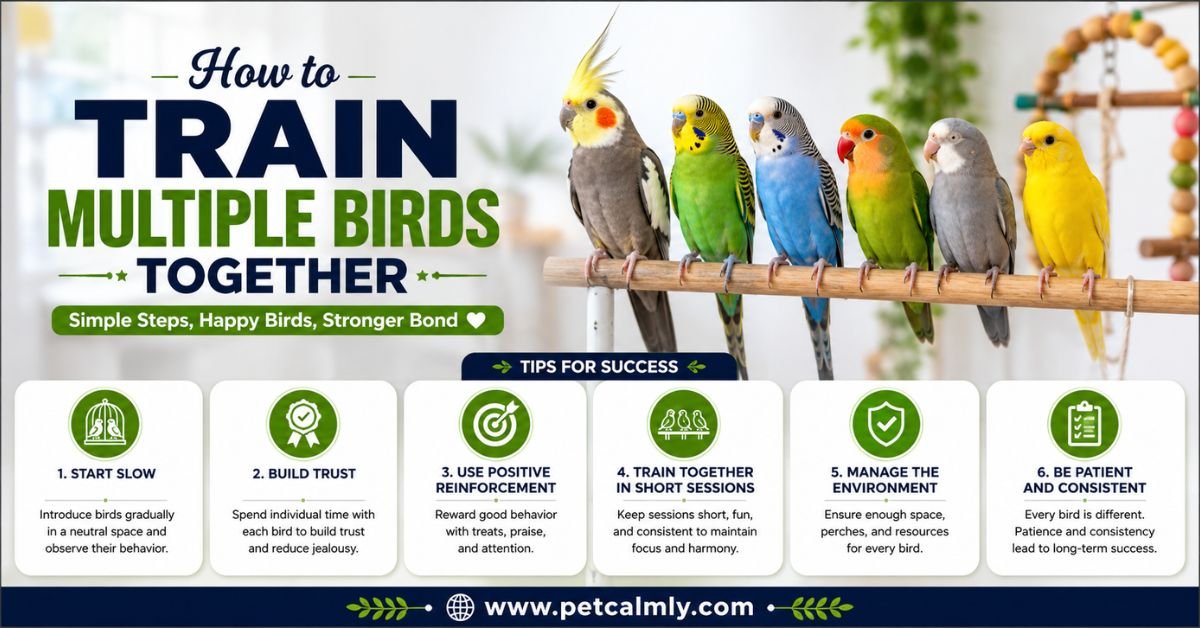
Training multiple birds together is possible, but it works best when you first build individual trust and basic training with each bird separately. Birds learn through social dynamics, so one bird’s confidence can help others but it can also create distraction, competition, or aggression if introduced too early. Start with calm, consistent one-on-one training, then gradually shift to short group sessions in a neutral space. Focus on simple cues like step-up, recall, and stationing. The key is patience, structure, and reading each bird’s body language to avoid stress or conflict.
Introduction
If you’ve ever tried training more than one bird at the same time, you already know it’s not just “twice the work,” it often feels like ten times more chaotic.
One bird steps up perfectly… the other flies away. One bird learns a trick… the others suddenly lose interest. Or worse, one becomes territorial and starts guarding you like you’re part of its flock.
This is completely normal.
Birds are highly social, intelligent animals that think in terms of flock structure, hierarchy, and shared attention. When multiple birds are involved, training becomes less about obedience and more about managing relationships, emotions, and environmental balance.
In this guide, you’ll learn how to train multiple birds together without stress, confusion, or behavioral setbacks. We’ll break everything down into practical steps so you can build a calm, cooperative flock even if your birds have very different personalities.
Understanding How Birds Learn in a Group
Before jumping into training techniques, it’s important to understand something most bird owners overlook:
Birds don’t learn individually in social settings they learn socially.
In a flock, birds observe and copy behavior. This can work in your favor or against you.
Positive social learning:
- One bird steps up → others imitate
- Calm behavior spreads through the group
- Routine reduces fear and anxiety
Negative social learning:
- One bird panics → others panic
- Aggressive bird influences the group
- Competition for attention increases stress
So when training multiple birds together, you are not just teaching commands you are shaping group behavior dynamics.
Can All Bird Species Be Trained Together?
Not always. Compatibility matters more than people expect.
Generally compatible combinations:
- Budgies with budgies
- Cockatiels with cockatiels
- Small conures in stable pairs or groups
- Finches in aviary-style environments
Risky combinations:
- Large parrots with small birds (risk of injury or dominance)
- Highly territorial species mixed with gentle species
- Birds with strong hormonal aggression phases
Important truth:
Even if species match, individual personality differences matter more than breed.
A calm cockatiel and a dominant cockatiel may behave very differently in group training.
Step One: Build Individual Trust First (Non-Negotiable)
If you skip this step, group training becomes unpredictable.
Each bird must first understand:
- Your presence is safe
- Your hand is not a threat
- Rewards come from calm behavior
Individual training goals:
Start with simple skills:
- Step-up command
- Target training (follow a stick or finger)
- Recall (flying or stepping toward you)
- Calm perch behavior
Why this matters:
A bird that doesn’t trust you individually will:
- Copy fear from others
- Avoid participation
- Disrupt group sessions
Think of it like teaching each student before putting them in a classroom.
Setting Up the Right Training Environment
Environment is everything when working with multiple birds.
Ideal setup:
- Neutral room (not a bird’s cage territory)
- No nesting areas nearby
- Minimal mirrors or reflections
- Controlled lighting (soft, not harsh)
- Closed windows and safe flight space
Avoid:
- Training inside one bird’s cage (creates ownership behavior)
- Loud or high-traffic areas
- Too many perches (causes competition)
- Distractions like TVs or pets
A neutral space reduces territorial behavior and helps birds focus on you instead of each other.
Introducing Birds to Group Training Safely
Do not rush this stage. Most training problems start here.
Step-by-step introduction:
Step 1: Visual familiarity
Let birds see each other from separate perches or cages.
Step 2: Short shared sessions
Place birds in the same room but train individually at first.
Step 3: Parallel training
Work with each bird separately but simultaneously.
Step 4: Controlled group training
Only begin once all birds show calm behavior.
Core Techniques for Training Multiple Birds Together
Once your birds are ready, group training should stay structured and predictable.
1. Station Training (Most Important)
Teach each bird to stay on a designated perch.
Why it works:
- Reduces flying chaos
- Prevents competition for your attention
- Builds patience
How to do it:
- Assign one perch per bird
- Reward staying still
- Gradually increase duration
2. Name Recognition Training
Each bird should recognize its name.
This prevents confusion during group commands.
Example:
- “Kiwi, step up”
- “Luna, stay”
Avoid calling all birds at once initially.
3. Turn-Based Training
Birds should learn that training is not a competition.
Rotate:
- One bird performs
- Others wait on perch
- Reward waiting behavior
This reduces jealousy significantly.
4. Group Recall Training (Advanced Stage)
Once basics are solid:
- Call one bird at a time
- Then slowly progress to two birds
- Eventually allow group recall
Never rush this stage it can break trust if done too early.
5 Common Mistakes Owners Make (And Why Training Fails)
Even experienced bird owners make these errors:
1. Starting group training too early
Birds need individual confidence first.
2. Rewarding only the “best” bird
This creates competition and jealousy.
3. Training in cages
Leads to territorial behavior.
4. Overcrowded training sessions
Too many birds = no focus.
5. Ignoring body language
Fluffed feathers, lunging, and pacing are warning signs.
Understanding Bird Body Language During Group Training
Reading your birds is more important than any technique.
Calm signs:
- Relaxed feathers
- Gentle chirping
- Steady posture
- Curious head movement
Stress signs:
- Wing flapping without flying
- Open beak breathing
- Backing away
- Sudden silence
Aggression signs:
- Lunging
- Beak snapping
- Tail flicking rapidly
- Fixated staring
If you see stress or aggression, pause immediately.
Managing Competition Between Birds
Competition is one of the biggest challenges in group training.
Why it happens:
- Limited attention from owner
- Treat competition
- Hierarchy establishment
How to manage it:
Use equal rewards
Every bird gets something, even for waiting.
Rotate attention
Never focus on one bird for too long.
Increase space
Crowding increases tension.
Reinforce calm waiting
Reward birds for staying still, not just performing tricks.
Emotional Dynamics in Multi-Bird Training
Birds don’t just learn commands they form emotional bonds and hierarchies.
You may notice:
- One bird becoming “leader”
- Another becoming shy or withdrawn
- Mimicking behaviors spreading fast
Your role:
You are not just a trainer you are the stabilizer of the flock.
Consistency matters more than intensity.
Step-by-Step Daily Training Routine (Beginner-Friendly)
Morning session (10–15 minutes)
- Individual step-up practice
- Calm rewards
Midday session (10–20 minutes)
- Parallel training in same room
- Focus on stationing
Evening session (10–15 minutes)
- Light recall practice
- Relaxed bonding
Keep sessions short. Birds learn better in small, repeated exposures.
What to Avoid During Multi-Bird Training
Do NOT:
- Force birds onto hands together
- Train when birds are hormonal or nesting
- Mix aggressive birds with calm ones
- Use punishment-based methods
- Ignore early warning signs of stress
Training should never feel like pressure for birds.
When Should You Pause Training or Worry?
Stop or adjust training if you notice:
- Persistent aggression between birds
- One bird refusing to eat or engage
- Sudden fear responses
- Feather plucking or stress behaviors
- Constant chasing or bullying
In some cases, separating birds temporarily helps reset behavior patterns.
If aggression continues, consulting an avian veterinarian or behavior specialist is recommended.
Realistic Expectations: How Long Does It Take?
There is no fixed timeline.
But generally:
- Basic trust: 2–4 weeks per bird
- Group station training: 3–6 weeks
- Reliable group recall: several months
Progress depends on:
- Species
- Personality
- Age
- Prior handling experience
Patience is not optional here it is the foundation.
What Should Pet Owners Do First? (Simple Action Plan)
If you’re just starting:
Step 1:
Train each bird individually every day.
Step 2:
Observe how they behave around each other.
Step 3:
Introduce shared space without pressure.
Step 4:
Start station training in group settings.
Step 5:
Gradually build complexity.
Consistency matters more than speed.
Conclusion
Training multiple birds together is less about control and more about harmony.
When done correctly, your birds begin to:
- Learn from each other
- Stay calmer in shared spaces
- Respond more confidently to cues
- Trust your leadership without fear
But the real success comes from understanding something simple:
Each bird is an individual first, and a flock member second.
If you respect that balance, training becomes smoother, safer, and far more rewarding for both you and your birds.
More Information About Pets, Please Visit Our Website: Clicker training for small birds at home
How to Train African Grey Parrot to Sit on Hand
How to Train a Lovebird to Sit on Your Finger
Frequently Asked Questions
1. Can I train two birds at the same time?
Yes, but only after each bird has learned basic commands individually. Start with parallel training before group sessions.
2. Why do my birds get distracted during group training?
Birds naturally focus on each other in flock settings. Reduce distractions and shorten sessions to improve attention.
3. What is the best bird species for group training?
Small social birds like budgies or cockatiels tend to adapt better to group learning when properly introduced.
4. How do I stop birds from fighting during training?
Separate them immediately, reduce competition for attention, and reintroduce slowly with structured sessions.
5. Should I reward all birds equally?
Yes. Unequal rewards create jealousy and aggression in flock environments.
6. How long should group training sessions be?
Keep them short 10 to 20 minutes maximum to avoid stress and overstimulation.