Short direct answer
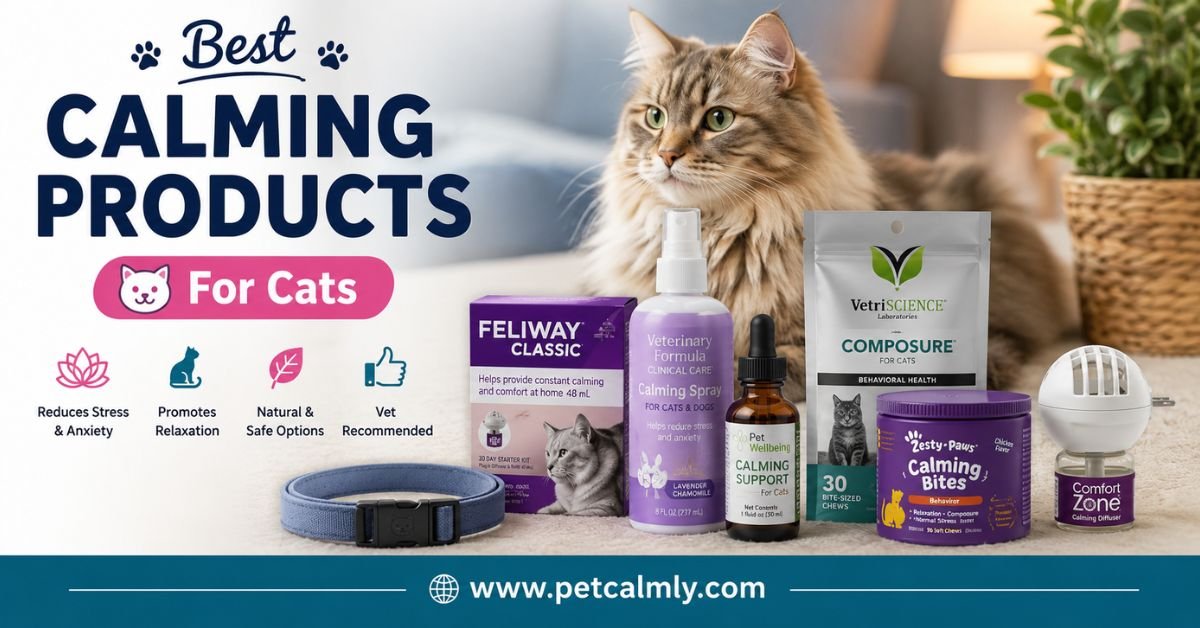
The most effective calming products for cats include synthetic pheromone diffusers (like Feliway), calming supplements with L-theanine or casein-derived peptides, anxiety wraps such as the Thundershirt, calming cat beds with raised edges, and low-stimulation background sound or white noise. No single product works for every cat, because feline anxiety has different root causes. The best approach is matching the product to the trigger whether that’s a new home, a vet visit, loud noises, or another animal in the house and giving it time to work before switching to something else.
Why Trust This Guide
This guide was written by pulling together practical, real-world patterns of what tends to help anxious cats and what tends to disappoint owners, along with guidance drawn from established veterinary and behavior resources like the Cornell Feline Health Center, the American Veterinary Medical Association (AVMA), and VCA Animal Hospitals. Nothing here claims to cure anxiety or replace a veterinary behaviorist. It’s meant to help you understand why your cat is stressed, and which category of product is worth trying first.
Why Your Cat Needs Calming Help in the First Place
Before buying anything, it helps to understand what’s actually happening in your cat’s body when they’re anxious. Cats are territorial animals with a strong need for predictability. When their environment changes a new pet, a move, construction noise, a visit to the vet their nervous system reacts the same way it would to a real threat in the wild. That’s not dramatic; it’s biology.
This matters because it explains why calming products work differently depending on the cause:
- A cat stressed by environmental change (moving house, new furniture, a renovation) often responds well to pheromone diffusers, because these mimic the scent cats naturally use to mark their space as safe.
- A cat stressed by noise (fireworks, thunderstorms, vacuum cleaners) often responds better to physical comfort, like a wrap or a hiding-friendly bed, than to scent alone.
- A cat stressed by travel or vet visits usually needs a combination approach carrier training, a calming spray on the carrier, and sometimes a short-term supplement recommended by a vet.
- A cat stressed by another animal in the household may need behavioral management (separate resources, slow reintroduction) alongside any product, because the product alone won’t fix a resource-guarding or territorial conflict.
Recognizing which bucket your cat falls into will save you money and frustration. A lot of owners buy a pheromone diffuser for a cat who’s actually reacting to a housemate cat’s presence, and then feel like “calming products don’t work” when the real issue was never addressed.
Common Signs Your Cat Is Anxious (Not Just “Being a Cat”)
Cats are subtle communicators, and a lot of anxiety gets mistaken for personality quirks. Some signs worth paying attention to:
- Hiding more than usual, especially during times they used to be social
- Over-grooming, sometimes to the point of bald patches
- Reduced appetite or eating much faster/slower than normal
- Increased vocalization, particularly at night
- Urinating outside the litter box despite a clean box being available
- Flattened ears, tucked tail, or crouching low when approached
- Sudden aggression toward people or other pets they were previously fine with
If you’re noticing several of these at once, it’s worth pausing before buying a product and thinking about what changed recently in your cat’s world. Often the trigger is obvious once you look for it a new baby, a neighbor’s dog, a schedule change and knowing the trigger will guide which calming product actually makes sense.
The Main Types of Calming Products for Cats (And How Each One Works)
Pheromone Diffusers and Sprays
These release a synthetic copy of the facial pheromone cats naturally leave when they rub their cheeks on furniture — the scent that tells them “this is my safe space.” Plug-in diffusers work well for whole-room, ongoing stress (like a multi-cat household with tension), while sprays are better for specific triggers like a carrier or a new piece of furniture.
Best for: general household stress, introducing a new pet, moving homes, mild noise sensitivity.
Realistic expectation: these tend to take one to two weeks of consistent use before you notice a real difference. Cats who improve overnight are the exception, not the rule.
Calming Supplements and Chews
These usually contain ingredients like L-theanine (found naturally in tea), alpha-casozepine (a milk protein derivative), or tryptophan, all of which are thought to support a calmer nervous system without sedating the cat. They come as chews, powders, or liquid drops added to food.
Best for: cats with ongoing, low-level anxiety not sudden panic during a thunderstorm, since these need time to build up in the system.
Important caution: always check with your vet before starting a supplement, especially if your cat is on any medication, pregnant, elderly, or has kidney or liver concerns. “Natural” doesn’t automatically mean risk-free for every cat.
Calming Collars
These work similarly to diffusers but are worn directly on the cat, releasing pheromones close to the face. They’re popular because they don’t require an outlet or line of sight, making them useful for cats who travel or spend time outdoors.
Best for: cats who resist being near a diffuser, or households where a stationary diffuser isn’t practical.
Watch for: proper fit. A collar that’s too tight can cause its own stress or, in rare cases, injury if it snags. Always use a breakaway collar design for safety.
Anxiety Wraps (Compression Garments)
Products like the Thundershirt use gentle, constant pressure — similar to swaddling an infant — which appears to have a calming effect on many cats’ nervous systems. They’re most associated with dogs but are made in cat sizes too.
Best for: short-term, high-stress events like thunderstorms, fireworks, or car rides.
Realistic expectation: some cats settle within minutes; others resist wearing anything at all. It’s worth introducing the wrap during a calm moment first, rather than only pulling it out during a stressful event, so the cat doesn’t associate it with fear.
Calming Beds and Hideaways
A raised-rim calming bed, or simply a covered hideaway, gives an anxious cat somewhere to retreat and feel physically enclosed and protected. This taps into a cat’s natural instinct to seek small, defensible spaces when stressed.
Best for: cats who hide under furniture or in closets during stressful events — giving them a designated, comfortable version of that hiding spot often reduces stress-related behaviors like over-grooming.
Calming Music and White Noise
Research-informed playlists designed specifically for cats (rather than generic “relaxing” music) use frequency ranges and tempos closer to a cat’s natural vocal range. White noise machines can also help mask sudden triggering sounds like fireworks or construction.
Best for: noise-sensitive cats, especially during predictable stressful periods like holidays with fireworks.
Interactive and Enrichment Toys
This category doesn’t get talked about enough in “calming product” articles, but a lot of feline anxiety is rooted in boredom and pent-up energy rather than fear alone. Puzzle feeders, wand toys, and scheduled play sessions can reduce baseline stress by giving cats an outlet.
Best for: cats who seem restless, destructive, or vocal rather than fearful this is often an energy problem disguised as an anxiety problem.
How to Choose the Right Calming Product for Your Cat’s Situation
| Situation | Best First Try | Why |
|---|---|---|
| New home or recent move | Pheromone diffuser | Rebuilds scent-based sense of safety across the whole space |
| Thunderstorms or fireworks | Anxiety wrap + white noise | Combines physical comfort with sound masking |
| Vet visits or car travel | Carrier spray + carrier training | Addresses the association with the carrier itself |
| Multi-cat household tension | Diffuser + separate resources (litter, food, resting spots) | Product alone won’t resolve territorial conflict |
| Ongoing low-level anxiety | Vet-approved calming supplement | Needs consistent use to build effect over time |
| Boredom-driven restlessness | Enrichment toys + play schedule | Targets the root cause rather than masking symptoms |
A Realistic Owner Example
Picture a cat named Milo who started hiding under the bed and refusing to eat in front of anyone after his owners brought home a rescue puppy. A pheromone diffuser alone didn’t fix it, because the actual trigger wasn’t the environment — it was the puppy. What helped was a combination: keeping the dog and cat physically separated at first, giving Milo an elevated, closed-off resting spot the dog couldn’t reach, and using the diffuser to support the overall adjustment period. Within about three weeks, Milo was eating normally again and cautiously exploring shared spaces.
This kind of layered approach is usually more realistic than expecting one product to solve everything on its own.
Common Mistakes Owners Make With Calming Products
- Expecting instant results. Most pheromone and supplement products need one to two weeks of consistent use before you can fairly judge whether they’re working.
- Only using the product during the stressful event. A wrap or diffuser introduced for the first time during a thunderstorm is starting from a disadvantage. Introduce calming tools during calm periods so your cat associates them with comfort, not crisis.
- Ignoring the underlying trigger. Products manage stress; they rarely erase the source of it. If the trigger is fixable (a litter box in a noisy spot, a resource conflict between cats), fixing that will do more than any product.
- Combining products without checking safety. Mixing multiple supplements, or a supplement with a collar and a diffuser all at once, makes it hard to know what’s actually helping and can occasionally cause unwanted interactions. Introduce one change at a time.
- Using dog products on cats. Cats are not small dogs. Their liver processes substances differently, and some ingredients that are safe for dogs (certain essential oils, for example) can be toxic to cats. Always choose products explicitly labeled and dosed for cats.
Safety Considerations Before You Buy
- Avoid any product containing essential oils unless it’s specifically formulated and vetted for feline safety — cats lack certain liver enzymes needed to break down many essential oils, and this can lead to toxicity over time.
- Check collar and wrap sizing carefully; anything too tight can restrict breathing or movement, and anything too loose can be chewed or become a hazard.
- If you’re considering an herbal or nutraceutical supplement, run it by your vet first, particularly for kittens, senior cats, or cats with existing health conditions.
- Prescription anti-anxiety medication exists for cats with severe or chronic anxiety, but this should only ever come from a licensed veterinarian after an in-person evaluation — never from an online recommendation, including this article.
When Should You Worry? Signs That Go Beyond What Products Can Fix
Calming products are designed for mild to moderate, situational stress. They are not a substitute for veterinary care. You should contact your veterinarian, rather than relying on an over-the-counter product, if you notice:
- Anxiety that’s severe, sudden, or worsening despite consistent use of calming tools
- Self-injury from over-grooming, such as open sores or bald patches with irritated skin
- A complete refusal to eat for more than 24 hours
- Straining in the litter box, or urinating outside the box combined with visible discomfort — this can indicate a painful medical issue, not just stress
- Aggression that puts people or other pets at risk
- Any sudden behavior change in an older cat, since this can sometimes signal an underlying medical condition rather than pure anxiety
According to general guidance from veterinary behavior resources, persistent or severe anxiety in cats can sometimes be linked to underlying pain or illness, which is why a vet visit is the right first step before assuming it’s purely behavioral.
What Pet Owners Should Actually Do, Step by Step
- Identify the likely trigger. Think back to what changed in the days or weeks before the behavior started.
- Rule out medical causes. A quick vet check is worth it, especially for litter box issues or appetite changes, since pain often looks like anxiety.
- Start with one calming product that matches the trigger, using the table above as a starting point.
- Give it two full weeks before deciding it isn’t working, unless symptoms are getting worse, in which case check in with your vet sooner.
- Layer in environmental fixes more hiding spots, separate resources for multi-cat homes, consistent routines alongside the product rather than instead of it.
- Reassess and escalate if needed. If a cat isn’t improving with over-the-counter options, ask your vet about a referral to a veterinary behaviorist rather than trying every product on the shelf.
Conclusion
There isn’t one single “best” calming product for every cat, because anxiety in cats isn’t one single thing — it’s a response to a specific trigger, and the right product depends on what that trigger actually is. Pheromone diffusers, supplements, wraps, calming beds, and enrichment all have a real place, but they work best when matched thoughtfully to the situation and given enough time to take effect. If you’ve tried a reasonable, consistent approach and your cat still isn’t settling, that’s not a sign you picked the wrong product it’s a sign it’s time to loop in your veterinarian.
More Information About Pets, Please Visit Our Website: Best Cat Calming Treats
Best Cat Calming Treats for Travel
Best Cat Brushes for Shedding
Frequently Asked Questions
1: What is the fastest-working calming product for cats?
Anxiety wraps tend to show effects the quickest, sometimes within minutes, because they work through direct physical pressure rather than needing time to build up like supplements or pheromones do.
2: Do calming products actually work on cats, or is it a placebo for owners?
Many cats do respond to pheromone-based and supplement-based products, though the effect is usually gradual and works best for mild to moderate stress rather than severe anxiety or panic.
3: Can I use a calming diffuser and a calming collar at the same time?
Generally yes, since both typically use similar pheromone technology, but introduce them one at a time so you can tell what’s actually helping your cat.
4: Is it safe to give my cat calming treats every day?
Many calming chews are formulated for regular use, but daily use should still be confirmed with your vet, especially for cats with existing health conditions or those on other medications.
5: Why does my cat seem more anxious after I brought home a calming product?
Sometimes a new product itself is a change your cat needs to adjust to a new smell, a new collar, or a new object in the room. Introduce new products gradually and during calm moments rather than during an already stressful event.
6: When should I stop trying products and see a vet instead?
If your cat’s anxiety is severe, sudden, involves self-injury, or hasn’t improved after a couple of weeks of a consistent, well-matched calming approach, it’s time for a veterinary evaluation rather than trying more products.