Short direct answer
Most veterinary sources suggest roughly 1 mg of melatonin for every 10–20 pounds of body weight, given up to three times a day depending on why it’s being used. In practice, that works out to about 1 mg for small dogs, 1.5–3 mg for medium and large dogs, and up to 6 mg for giant breeds. These are general starting points, not personalized medical advice dosage can shift based on your dog’s age, health conditions, and what you’re treating. Always confirm the amount with your veterinarian before your dog’s first dose.
Why So Many Pet Owners Turn to Melatonin
If you’re reading this at 11 p.m. because your dog won’t settle down, or because tomorrow is the Fourth of July and you’re already dreading the fireworks, you’re not alone. Melatonin has quietly become one of the most commonly recommended over-the-counter supplements in veterinary behavior medicine not because it’s flashy, but because it works with a dog’s biology instead of against it.
Unlike sedatives that force the nervous system to slow down, melatonin is a hormone your dog’s brain already makes. Their pineal gland releases it naturally as darkness falls, which is part of what tells the body it’s time to wind down. Giving a supplemental dose essentially nudges that same internal switch a little earlier, or a little more firmly, when stress or an irregular schedule has thrown it off.
That’s a big part of why melatonin has a reputation for being gentle. It’s not knocking your dog out it’s reminding their body of something it already knows how to do.
This article walks through exactly how much to give based on your dog’s weight, how to time it correctly, what mistakes to avoid, and — just as importantly — when melatonin isn’t the right tool at all.
What Melatonin Actually Does in a Dog’s Body
Melatonin plays a role in regulating the sleep-wake cycle, and in dogs it’s most often used off-label for three overlapping purposes: general anxiety and noise phobias (like thunderstorms or fireworks), sleep disturbances, and certain types of non-allergic hair loss. According to VCA Animal Hospitals, melatonin in dogs is also sometimes used to support management of Cushing’s disease-related skin changes and seasonal flank alopecia.
It’s worth being clear about one thing: melatonin is not FDA-approved for use in dogs. In the United States, the only FDA-approved veterinary use of melatonin is an implant used in mink farming. Everything else — every dosage chart, every recommendation for anxiety or sleep falls under what’s called “off-label” or “extra-label” use. That’s extremely common in veterinary medicine and doesn’t mean it’s unsafe, but it does mean the guidance you’ll find (including in this article) comes from clinical experience and published dosing patterns rather than an FDA-reviewed label.
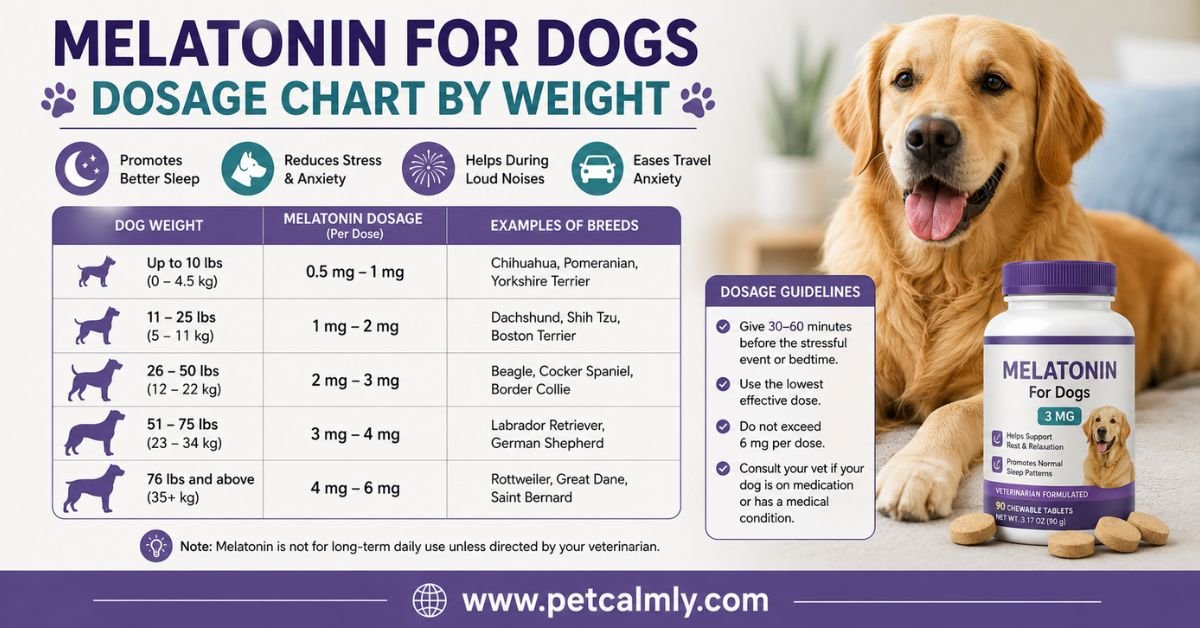
Melatonin Dosage Chart for Dogs by Weight
This chart reflects the dosing ranges most frequently cited across veterinary sources. Start at the lower end of your dog’s range, especially the first time you use it.
| Dog’s Weight | Typical Melatonin Dose | Notes |
|---|---|---|
| Under 10 lbs (small breeds) | 1 mg | Toy breeds like Chihuahuas or Yorkies |
| 10–25 lbs (small-medium) | 1–1.5 mg | Beagles, Cocker Spaniels, French Bulldogs |
| 26–50 lbs (medium) | 1.5–3 mg | Border Collies, Bulldogs, Corgis |
| 51–100 lbs (large) | 3 mg | Labs, Golden Retrievers, German Shepherds |
| Over 100 lbs (giant breeds) | 3–6 mg | Great Danes, Mastiffs, Newfoundlands |
A simpler way to think about it, if your dog falls between weight brackets: many vets use a rough guideline of 1 mg per 10 to 20 pounds, adjusted up or down depending on the dog’s sensitivity and the reason for dosing. Dogs being treated for skin or hormonal conditions like Cushing’s disease sometimes receive higher, more frequent doses, but that should only ever be set by a veterinarian who’s actually examined the dog.
Factors That Can Change Your Dog’s Ideal Dose
The chart above is a starting point, not a fixed prescription. A few things nudge the right dose up or down for an individual dog:
- Age. Senior dogs tend to metabolize supplements more slowly, so many vets recommend starting lower and watching for grogginess the next day.
- Liver or kidney function. Since melatonin is processed through the liver, dogs with liver or kidney disease often need reduced doses.
- Reason for use. A dog getting occasional help through a thunderstorm may only need a single low dose, while one with a diagnosed sleep disorder might be on a more structured, repeated schedule.
- Other medications. Dogs already taking sedatives, anti-anxiety medication, or supplements like CBD may need a lower melatonin dose to avoid stacking calming effects.
- Individual sensitivity. Just like people, some dogs respond strongly to a small amount, while others barely notice a moderate dose.
How to Give Melatonin Safely: Timing, Frequency, and Form
Getting the dose right is only half the picture timing matters almost as much.
For situational anxiety (fireworks, car rides, vet visits, thunderstorms), most guidance points to giving melatonin 30 minutes to 2 hours before the anticipated stressful event. That window gives it time to take effect before your dog actually needs it.
For sleep support, give it about 30 minutes before your dog’s normal bedtime rather than earlier in the evening giving it too early can just shift when the sleepy feeling kicks in, not necessarily helping at bedtime.
For ongoing use, many vets recommend spacing doses roughly every 8 to 12 hours if more than one dose a day is needed, though plenty of dogs only need a single evening dose. This is exactly the kind of detail your vet should confirm based on why your dog is taking it.
A few practical notes on the supplement itself:
- Choose a pure melatonin product no xylitol, no added flavorings you can’t identify. Xylitol is highly toxic to dogs even in small amounts, and it’s a common ingredient in human melatonin gummies and chewables.
- Tablets typically come in 1 mg, 3 mg, or 10 mg strengths, which means smaller dogs often need a tablet split or a lower-dose product made specifically for pets.
- Give it with a small amount of food if your dog tends to get an upset stomach from supplements on an empty stomach.
- Liquid formulations can make it easier to fine-tune small doses for tiny breeds.
6 Common Mistakes Pet Owners Make With Melatonin
A few patterns show up again and again in dogs who don’t respond well to melatonin and most of them are fixable.
- Guessing the dose instead of weighing the dog. “About medium-sized” isn’t the same as 42 pounds. A kitchen scale or a recent vet visit weight will give you a far more accurate starting point.
- Using a human gummy without checking the label. Some contain xylitol. Always read the ingredient list, not just the front of the bottle.
- Giving it too far in advance. Dosing hours before a thunderstorm that arrives unpredictably late means the effect may have already worn off.
- Expecting it to work like a sedative. Melatonin calms; it doesn’t heavily sedate. If your dog is having a severe panic response to noise, melatonin alone may not be enough, and that’s worth a conversation with your vet about additional support.
- Increasing the dose too quickly. If the first dose doesn’t seem to do much, resist the urge to double it the next night. Give it a few uses at the recommended dose before assuming it isn’t working.
- Not accounting for other medications. Combining melatonin with certain antidepressants or sedatives without veterinary guidance can increase the risk of over-sedation.
Using Melatonin for Specific Situations
Storm and firework anxiety. This is one of the most common reasons owners reach for melatonin. Giving it ahead of a known event rather than after your dog is already panicking tends to work better, since melatonin is meant to support a calmer baseline rather than interrupt an active fear response.
General restlessness or trouble settling at night. Some dogs, especially as they age, develop irregular sleep-wake patterns. A consistent bedtime dose paired with a predictable nighttime routine (dim lights, a set wind-down time) tends to produce better results than the supplement alone.
Hair loss conditions. Melatonin is sometimes used for non-allergic hair loss patterns, including seasonal flank alopecia, where a dog loses fur in patches tied to changes in daylight. This use is more specialized and really does need veterinary diagnosis first, since hair loss has many possible causes and treating the wrong one wastes time your dog’s skin doesn’t need to lose.
Senior dogs with disrupted sleep. Older dogs sometimes pace, whine, or seem confused at night, which can look similar to simple restlessness but may point to canine cognitive dysfunction, a condition with some similarities to dementia in humans. Melatonin may offer some support here, but this is a case where ruling out other causes with your vet matters more than the dosage itself.
Side Effects and Safety Precautions
Melatonin has a strong reputation for being gentle, and most dogs tolerate it well. Still, no supplement is entirely without risk. Reported side effects, while uncommon, can include:
- Daytime drowsiness or grogginess, especially the morning after a higher dose
- Mild digestive upset, such as loose stool or an unsettled stomach
- Changes in reproductive hormone cycles in dogs who haven’t been spayed or neutered, since melatonin interacts with hormonal pathways
- Increased grogginess if combined with other calming medications or supplements
These effects are typically mild and resolve once the dose is lowered or discontinued. That said, “generally safe” isn’t the same as “no need to check with anyone” especially for dogs who are pregnant, nursing, diabetic, or already on prescription medication.
When Should You Worry? Signs That Need Veterinary Attention
General grogginess the next morning usually isn’t cause for alarm. But certain signs mean it’s time to call your vet or an emergency animal hospital rather than waiting it out:
- Vomiting or diarrhea that doesn’t resolve within a few hours
- Extreme lethargy where your dog is difficult to wake or rouse
- Tremors, disorientation, or wobbliness
- Signs consistent with xylitol exposure (if a human product was used), such as sudden weakness, vomiting, or collapse — this is a genuine emergency
- Any dose given accidentally far above the recommended amount for your dog’s weight
If in doubt, calling your vet, an emergency clinic, or a pet poison helpline costs you a phone call. Waiting to see if symptoms pass on their own can cost your dog valuable treatment time.
What Pet Owners Should Do Before Starting Melatonin
Think of this as your pre-flight checklist before that first dose:
- Get an accurate current weight. Don’t estimate — use a scale or your dog’s most recent vet visit.
- Check the ingredient label for xylitol or unfamiliar additives, especially with human products.
- List any current medications or supplements your dog is taking, and mention them to your vet before combining anything with melatonin.
- Pick your timing based on what you’re treating — situational anxiety versus nightly sleep support call for different schedules.
- Start at the lower end of the weight-based range, even if the chart suggests a higher amount could be appropriate.
- Watch and log the response for a few uses before adjusting anything.
- Call your vet if your dog has liver, kidney, or hormonal health conditions, is pregnant or nursing, or is a puppy under 6 months old.
Conclusion
Melatonin has earned its place in a lot of pet owners’ cabinets because it does something genuinely useful it works with a dog’s own biology to support calm, rather than overriding the nervous system entirely. A weight-based dosage chart gives you a sensible starting point, but the right dose for your dog specifically depends on their size, age, health history, and what you’re actually trying to help with. When you pair a sensible starting dose with good timing and a bit of patience, most dogs do well on it. And when something feels off unusual grogginess, digestive upset, or no improvement after a fair trial that’s your cue to loop in your veterinarian rather than adjust the dose yourself.
More Information About Pets, Please Visit Our Website: Warren London Essential Oil Dog Calming Spray
Best Dog Anxiety Medication Over the Counter
Best Dog Calming Treats
Best Dog Hair Removal Products
Frequently Asked Questions
1: Is melatonin safe to give my dog every night?
Many dogs tolerate nightly melatonin well for sleep support, but long-term daily use should really be discussed with your vet first, particularly to rule out an underlying cause for the sleep disturbance and to make sure the dose stays appropriate as your dog ages.
2: Can I give my dog the same melatonin gummies I take?
Only if you’ve checked the label carefully. Human melatonin products frequently contain xylitol, an artificial sweetener that’s toxic to dogs even in small quantities. A plain, pet-safe melatonin supplement is the safer choice.
3: How long does it take for melatonin to work in dogs?
Most owners notice an effect within 30 minutes to an hour, which is why it’s typically given ahead of a stressful event or right before bedtime rather than after anxiety has already set in.
4: What happens if my dog gets too much melatonin?
An accidental overdose is more likely to cause grogginess, vomiting, or digestive upset than anything life-threatening, but doses far beyond the recommended range — or any exposure to xylitol-containing products warrant a call to your vet or an emergency clinic right away.
5: Can puppies take melatonin?
This is a conversation for your veterinarian rather than a home decision. Puppies are still developing, and dosing guidance for adult dogs doesn’t automatically translate to young puppies.
6: Does melatonin interact with other medications my dog might be on?
It can, particularly with sedatives, certain antidepressants, and other calming supplements. Always tell your vet about everything your dog is currently taking before adding melatonin to the mix.