Short direct answer
Healthy dog poop is chocolate brown, log-shaped, and firm but pliable. Green often means grass-eating or bile issues, yellow or orange can point to fast digestion or liver trouble, grey or pale stool suggests pancreatic problems, and black or bright red stool signals possible bleeding and needs urgent veterinary attention. A single odd-colored stool usually isn’t an emergency but color changes that repeat, or come with vomiting, lethargy, or appetite loss, are.
If you’ve ever paused mid-poop-bag-duty and thought, “wait, is that normal?” you’re not being paranoid. You’re paying attention, and that’s exactly what keeps small problems from becoming big ones.
Dogs can’t tell us when their stomach hurts or their liver is struggling. Their stool is one of the few honest, physical clues we get. This guide breaks down what each color means, what usually causes it, and just as importantly when a color change is nothing to lose sleep over versus when it’s time to pick up the phone.
Why Your Dog’s Poop Color Actually Matters
Stool color isn’t random. It’s shaped by bile, a digestive fluid made in the liver and stored in the gallbladder that breaks down fat and gives poop its typical brown tone. Anything that changes how fast food moves through the gut, how well bile is flowing, or what your dog has actually eaten can shift that color.
That’s why vets treat stool checks as a genuinely useful, low-effort health screen. It costs nothing, takes five seconds, and often flags problems parasites, dietary intolerance, early organ issues before a dog shows any other symptoms.
None of this means you need to inspect every bowel movement like a forensic scientist. It means knowing the baseline for your own dog, so you notice when something’s off.
What Does Healthy Dog Poop Look Like?
Before we get into problem colors, it helps to know the target. Normal, healthy dog poop is usually:
- Chocolate brown in color
- Log-shaped and segmented, not a shapeless pile
- Firm but slightly pliable think of a modeling clay consistency, not concrete
- Moist on the surface without being wet or greasy
- Easy to pick up in one piece, leaving minimal residue on the ground
Some day-to-day variation is completely normal. A dog eating a beef-based food may have slightly darker stool than one on a chicken and rice diet, and that’s not something to worry about.
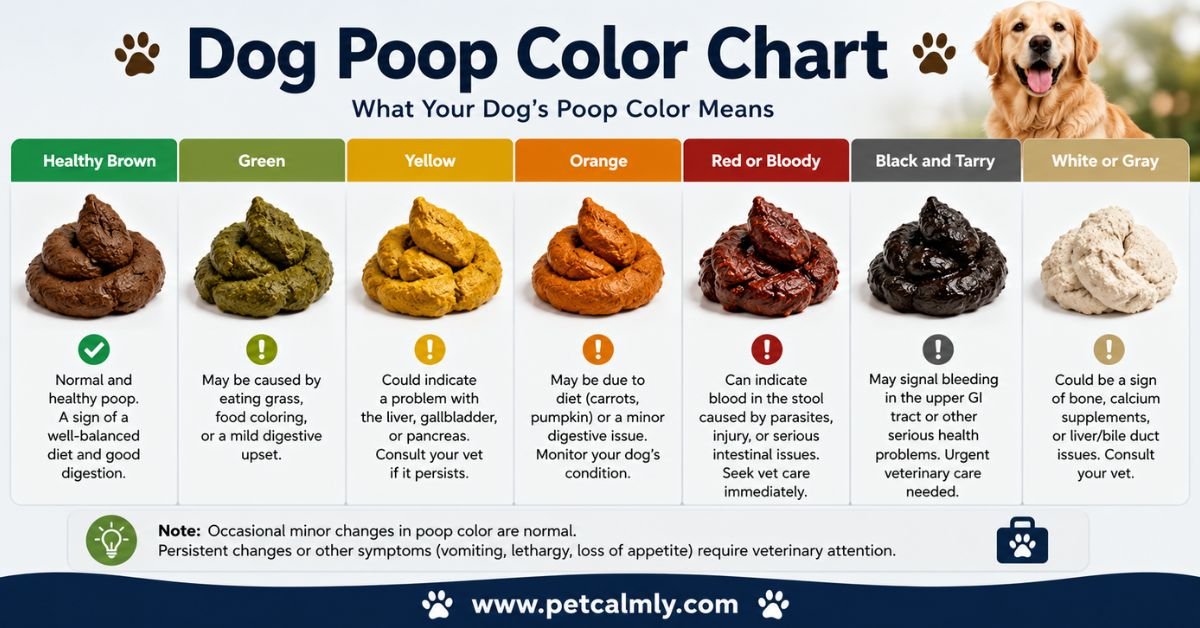
The Complete Dog Poop Color Chart
Here’s a fast reference table, followed by a deeper explanation of each color below it.
| Color | What It Often Means | Action Needed |
|---|---|---|
| Brown | Normal, healthy digestion | None |
| Green | Grass-eating, fast transit, or bile issue | Monitor 24–48 hrs |
| Yellow | Diet change, food sensitivity, liver stress | Monitor, consider vet if persistent |
| Orange | Food moving too fast, bile not fully processed | Monitor, mention at next vet visit |
| Black or tarry | Digested blood from upper GI tract | Vet visit same day |
| Red or streaked with blood | Bleeding lower in the GI tract, straining, or irritation | Vet visit promptly |
| Grey or greasy | Pancreatic or bile duct problem | Vet appointment needed |
| White specks | Possible tapeworm segments | Vet visit for deworming |
Now let’s walk through what’s actually happening behind each of these.
Brown Dog Poop: The Healthy Baseline
If your dog’s poop is some shade of brown — light tan to deep chocolate — that’s a good sign. Brown color comes from normally processed bile, which means digestion is working the way it’s supposed to. Slight shade shifts from food to food are expected and not something to track obsessively.
Green Dog Poop: Usually Grass, Sometimes More
Green stool throws a lot of owners off, but the most common cause is simple: your dog ate grass. Dogs graze for all kinds of reasons — mild stomach upset, boredom, or just because they like the taste — and that chlorophyll can tint stool green on its way out.
Less commonly, green stool can point to:
- Rapid intestinal transit (food moving through too fast to be fully digested)
- A gallbladder issue affecting bile release
- Intestinal parasites
If it’s a one-off after a walk through a grassy field, give it 24 to 48 hours. If the green shade sticks around across multiple bowel movements, that’s your cue to call the vet.
Yellow Dog Poop: Diet Shifts and Digestive Speed
Yellow stool is common during food transitions — switching brands, adding a new treat, or introducing table scraps can all cause it temporarily. It can also indicate:
- A food intolerance the digestive system is reacting to
- Digestion moving through the gut faster than normal
- In some cases, early liver stress
If yellow appears right after a diet change and clears up within a few days, it’s rarely serious. If it shows up out of nowhere with no diet change, or your dog also seems off — less energy, less appetite — it’s worth a vet visit.
Orange Dog Poop: Bile Not Fully Doing Its Job
Orange stool often means bile isn’t being fully incorporated before the stool is passed, frequently because food is transiting the gut too quickly. It can also come from something as simple as your dog eating a lot of orange-pigmented food, like carrots or sweet potato — beta-carotene is notorious for tinting stool.
Rule out diet first. If the orange color continues after you’ve ruled out food, mention it at your next vet visit, especially if there’s also diarrhea or a change in appetite.
Black or Tarry Dog Poop: Take This Seriously
This is one of the colors that deserves immediate attention. Black, sticky, tar-like stool (sometimes called melena) usually means there’s digested blood coming from higher up in the gastrointestinal tract — the stomach or small intestine. By the time blood reaches the far end of the digestive tract, it’s been broken down and turns dark, almost like coffee grounds.
Possible causes include ulcers, certain medications (like NSAIDs), ingestion of a foreign object, or a more serious internal issue. This is not a “wait and see” color. If you see black, tarry stool — especially paired with vomiting, weakness, pale gums, or lethargy — treat it as a same-day veterinary concern.
Red Dog Poop or Blood in the Stool
Bright red streaks or spots usually point to bleeding lower in the digestive tract, closer to the rectum or colon, which is why the blood still looks fresh and red rather than dark. Common, less alarming causes include:
- Straining from constipation, which can cause small surface tears
- Anal gland irritation
- Mild colitis
More serious causes can include parasites, infections, or — in dogs that are also vomiting and lethargic — hemorrhagic gastroenteritis, a sudden and serious form of bloody diarrhea. A small streak once, with no other symptoms, may resolve on its own, but any repeated or heavier blood in the stool warrants a vet visit. When in doubt, don’t wait it out — get it checked.
Grey or Greasy Dog Poop
Grey, pale, or oily-looking stool that leaves a residue behind is often related to a problem with fat digestion — commonly tied to the pancreas or bile duct. Vets sometimes call this “steatorrhea,” which is essentially undigested fat passing through the stool instead of being broken down properly.
This color and texture combination is one of the more consistent signs that something internal needs a professional look. It’s not usually a diet-and-wait situation — book a vet appointment.
White Specks in Dog Poop
Small, rice-like white specks that move (or dry into flat, sesame-seed-like flecks) are a classic sign of tapeworm segments. This is common in dogs that have swallowed fleas or hunted small rodents. It’s treatable with a simple deworming medication, but it does require a vet visit to confirm and treat properly — over-the-counter dewormers don’t always target the correct parasite.
The Poop Consistency Scale: Why Shape Matters as Much as Color
Color tells half the story. Shape and firmness tell the rest. Vets often reference a scale that runs from hard, dry pellets (a sign of constipation) through the ideal firm, log-shaped stool, all the way to unformed, watery liquid (a sign of significant diarrhea).
A quick mental checklist:
- Too hard or pellet-like — often dehydration or low fiber
- Firm, log-shaped, holds together — the healthy target
- Soft but still holds a shape — mild upset, often diet-related
- Loses shape entirely, cow-patty consistency — moderate digestive upset
- Watery, no shape at all — diarrhea, worth monitoring closely
A normal-colored stool with abnormal consistency still matters. Watery brown diarrhea, for example, deserves attention even though the color itself looks fine.
Beyond Color: Other Clues Worth Noticing
A quick glance at your dog’s stool can reveal more than just color.
- Mucus coating: A light, clear or slightly milky mucus film is normal every so often — it lubricates the intestines. Thick, repeated, or greenish mucus is not, and usually points to inflammation, stress colitis, or infection.
- Undigested food: Bits of carrot, hair, or grass are usually harmless. Whole chunks of kibble, repeatedly undigested, may signal the food is moving through too fast or isn’t being broken down properly.
- Strong or unusual odor: A sudden shift to a sharp, metallic, or sulfuric smell can appear before any visible color change and is worth paying attention to on its own.
- Foreign objects: String, plastic, or fabric in stool should always prompt a vet call, even if the color looks normal, since it can indicate a partial intestinal blockage.
Common Reasons for a Sudden Color Change
Most sudden stool color changes trace back to something fairly ordinary. Before assuming the worst, run through this list:
- A new food or treat, even a “healthy” one
- Table scraps or human food the dog doesn’t usually eat
- Beets, carrots, or other pigmented foods, which can tint stool red or orange
- Food dye in low-quality treats
- Stress, from boarding, travel, a new pet, or a loud event
- A new medication or supplement
- Grass or plant material eaten on a walk
Ruling out diet and recent changes first can save an unnecessary trip to the vet and a lot of worry.
When Should You Worry About Your Dog’s Poop Color?
Here’s a straightforward way to think about it. A color chart like this one is meant to help you observe patterns, not diagnose your dog yourself.
Usually fine to monitor at home:
- One-off green, yellow, or orange stool with no other symptoms
- Color returns to normal within 24–48 hours
- Your dog is eating, drinking, and behaving normally
Time to call the vet:
- Black, tarry, or bright red stool — any amount, any time
- Grey, greasy stool that persists
- White specks or visible worms
- Off-color stool lasting more than 2–3 days
- Diarrhea lasting longer than 2–3 days, or constipation lasting more than 48 hours
- Any color change paired with vomiting, lethargy, appetite loss, weight loss, fever, or visible pain
If you’re ever unsure whether something falls into “monitor” or “call the vet,” lean toward calling. It costs a few minutes of your time and often provides real peace of mind.
What Should You Do If You Notice an Abnormal Color?
- Don’t panic immediately. Think back over the last 24–48 hours — new food, treats, a chewed-up plant, stress from a car ride.
- Save a sample if you can. A small amount in a sealed bag or container makes it much easier for your vet to run tests, and it saves you trying to describe color and texture from memory.
- Take a photo. Color and consistency are hard to describe accurately after the fact — a quick photo helps your vet see exactly what you saw.
- Track how many bowel movements are affected. One odd stool is very different from every stool over two days.
- Watch for supporting symptoms. Energy level, appetite, and water intake tell you a lot about how urgent the situation is.
- Call your vet if anything on the “worry” list applies, and describe what you noticed as specifically as possible.
How to Support Healthy Digestion Going Forward
You can’t prevent every stomach upset, but a few consistent habits reduce how often you’ll be squinting at an unusual-colored pile in the yard.
- Transition foods gradually, mixing old and new over 7–10 days instead of switching overnight
- Limit table scraps, especially fatty or seasoned foods
- Keep treats consistent rather than rotating through new brands frequently
- Stay current on parasite prevention, since intestinal parasites are one of the more common causes of ongoing stool changes
- Provide consistent access to fresh water, which affects stool firmness
- Reduce stress around mealtimes, since anxiety and digestion are closely linked in dogs
- Keep an eye on what they pick up on walks, since scavenged food is a frequent, avoidable cause of stomach upset
A Realistic Example
Say your dog’s stool is a normal brown for weeks, and then one morning it’s soft and slightly orange. You think back — yes, they got a big piece of sweet potato treat the night before. You watch the next couple of stools, they’re back to normal brown by day two, and your dog is eating and playing as usual. That’s a textbook example of diet-related color change that needed nothing more than a little observation.
Now compare that to a dog whose stool turns black and tarry, who’s also quieter than usual and skipped breakfast. That combination color plus behavior change is the pattern that should move you from “keep an eye on it” to “call the vet today.”
Learning to tell these two situations apart is really the whole point of using a color chart in the first place.
Frequently Asked Questions
1: Is it normal for dog poop color to change from day to day?
Slight shade variation, especially light-to-dark brown, is normal and usually tied to diet. A dramatic shift to green, yellow, black, or red is less common and worth watching more closely.
2: What does it mean if my dog’s poop is dark brown, almost black, but not tarry?
Very dark brown stool without a tarry, sticky texture is often just diet-related, especially with red-meat-based foods or certain supplements. True black, tar-like stool is different it looks glossy, sticky, and has a distinct odor, and that version needs a vet visit.
3: Can stress cause a dog’s poop color to change?
Yes. Stress and anxiety can speed up or disrupt digestion, which sometimes shows up as looser stool or a lighter color. Situations like boarding, travel, or a new household member are common triggers.
4: How long should I wait before calling the vet about unusual stool color?
For mild colors like green, yellow, or orange with no other symptoms, 24–48 hours of monitoring is generally reasonable. For black, red, grey, or white-flecked stool, don’t wait call your vet the same day.
5: Does puppy poop color mean something different than adult dog poop?
The same general color guide applies to puppies, but puppies are more vulnerable to dehydration and parasites, and their symptoms can escalate faster. If a puppy shows an unusual stool color along with lethargy or reduced appetite, treat it as more urgent than you might for an adult dog.
6: Can changing my dog’s food cause a temporary color change?
Yes, and it’s one of the most common causes. A gradual food transition over 7–10 days usually minimizes noticeable color and consistency changes compared to switching foods abruptly.
More Information About Pets, Please Visit Our Website: Can Dogs Eat Cucumber?
Can Dogs Eat Watermelon?
Bad Breath in Dogs Home Remedies
How to Calm an Anxious Dog in a Car?
How to Crate Train an Anxious Puppy
Conclusion
A dog poop color chart is a genuinely useful tool it helps you catch patterns, rule out simple explanations like diet, and know when something deserves a closer look. But it’s not a diagnosis, and it was never meant to replace an actual veterinary exam.
The real skill isn’t memorizing every color and its meaning. It’s knowing your own dog’s normal, noticing when something shifts, and trusting your gut when a change feels like more than “just something they ate.” That instinct, paired with this chart, is exactly what keeps small digestive hiccups from turning into missed warning signs.