Short direct answer
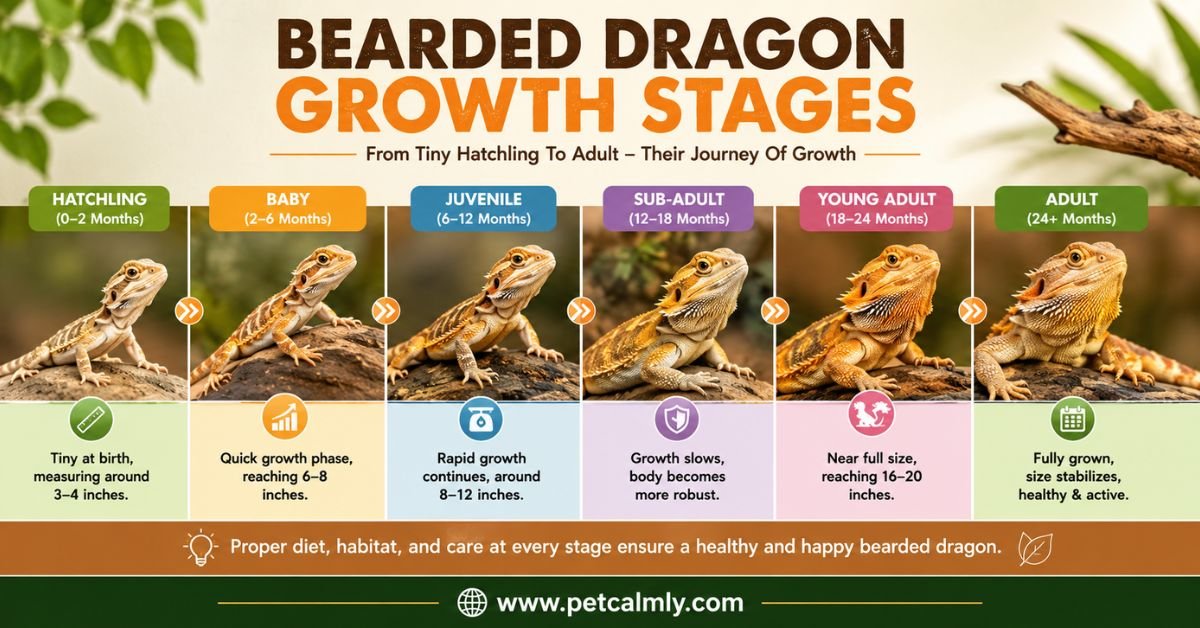
Bearded dragons move through four main growth stages: hatchling (0–3 months), juvenile (3–8 months), sub-adult (8–18 months), and adult (18 months and up). A hatchling is usually 3–4 inches long, while a fully grown adult reaches 16–24 inches depending on genetics and sex. Growth is fastest in the first year of life, then slows dramatically once a beardie reaches sexual maturity. Diet, tank size, and supplement needs change at every stage, which is why knowing where your dragon is in its growth timeline matters so much for its long-term health.
Why Bearded Dragon Growth Stages Matter More Than You’d Think
If you’ve just brought home a tiny, wiggly hatchling or you’re staring at a rescue beardie with no idea how old it actually is the “growth stage” question isn’t just trivia. It changes almost everything about daily care.
A juvenile dragon that’s still being fed like a hatchling can end up malnourished. An adult still getting juvenile-level protein can pack on excess weight and face fatty liver problems down the road. Feeding, supplementing, and even handling all need to shift as your dragon grows, and the biggest mistakes I see new owners make almost always trace back to treating every bearded dragon like it’s the same age.
This guide walks through each stage in real detail size, appetite, behavior changes, tank setup, and the specific things that tend to go wrong so you can match your care routine to where your dragon actually is, not just its age on paper.
Hatchling Stage (0–3 Months): The Fragile Beginning
Hatchlings are tiny, fast-growing, and more vulnerable than most new owners expect. At this stage, a beardie is essentially still building its skeleton, so nutrition mistakes here can leave lasting effects.
What a Hatchling Bearded Dragon Looks Like
- Length: roughly 3–4 inches nose to tail at hatching
- Body: thin tail, oversized head relative to body, translucent-looking skin
- Color: often paler than adult coloring will eventually be true coloring develops over months
- Energy: bursts of frantic activity followed by long naps
Feeding a Hatchling
Hatchlings need frequent, protein-heavy meals because they’re growing faster than at any other point in their lives. Most keepers feed appropriately sized insects (like small crickets or dubia roach nymphs) two to three times a day, offered for about 10–15 minutes per sitting, alongside a small amount of finely chopped leafy greens daily to start building the habit early.
A rough rule many experienced keepers use: insects should be no wider than the space between the dragon’s eyes. Feeding oversized prey is one of the more common causes of impaction in young dragons.
Calcium dusting matters enormously here. Because bones are forming rapidly, most hatchlings need calcium powder (without D3, unless the lighting setup requires it) on insects at nearly every feeding, with a multivitamin two to three times a week.
Housing Needs at This Stage
A 20-gallon tank is usually enough for a hatchling, though many keepers start in something smaller and size up as the dragon grows oversized tanks can actually make it harder for tiny hatchlings to find food and feel secure. Basking temperatures should sit around 100–105°F, with a cooler side in the mid-80s°F, and UVB lighting running the full length of the enclosure.
Juvenile Stage (3–8 Months): Rapid, Visible Growth
This is the stage where growth is the most dramatic. A dragon can nearly double in length during these months, and appetite tends to be relentless.
Size and Physical Changes
By the end of the juvenile stage, most bearded dragons reach somewhere between 9 and 16 inches, though individual growth rates vary a lot based on genetics, feeding consistency, and temperature accuracy. Coloring becomes more defined, and the beard that patch of spiky skin under the chin becomes more noticeable when the dragon is stressed, showing dominance, or regulating temperature.
Adjusting Feeding for Juveniles
Juveniles still need a protein-forward diet, but this is the stage to start increasing the ratio of vegetables gradually. A workable target many keepers follow is around 60–70% insects and 30–40% plant matter, feeding insects once or twice daily and offering fresh greens daily.
Common juvenile feeding mistakes:
- Continuing hatchling-sized prey too long, which limits calorie intake during peak growth
- Skipping vegetables because insect feeding is easier, which delays the shift toward adult eating habits
- Inconsistent calcium dusting, since owners often ease up once the “fragile hatchling” phase feels over
Behavior Shifts to Expect
Juveniles often become bolder, more curious, and sometimes more food-driven — glass surfing (repeatedly scratching or pacing at the tank walls) can appear here, usually tied to needing more space, wanting out for exploration, or reacting to something outside the tank like another pet.
Tank Size for Juveniles
Most juveniles do well in a 40-gallon breeder tank, with an upgrade to a 75-gallon (roughly 4 feet long) tank as they approach sub-adult size. Moving too slowly on tank upgrades is one of the more overlooked stressors at this stage — cramped juveniles show more stress behaviors and can grow unevenly.
Sub-Adult Stage (8–18 Months): Slowing Down and Filling Out
Growth doesn’t stop here, but it does slow noticeably. This stage is really about the dragon “filling out” — gaining muscle and girth rather than dramatic length.
What Changes Physically
Sub-adults typically measure 16–20 inches, with more defined jowls (especially in males), thicker limbs, and richer, more saturated coloring. Sexual characteristics also become easier to identify around this stage — femoral pores along the underside of the thighs become more pronounced in males, and hemipenal bulges may be visible near the base of the tail.
Feeding Adjustments
This is the transition window where the diet ratio should flip: many keepers move toward roughly 50/50 insects to vegetables, then gradually toward a more plant-heavy adult diet by the end of this stage. Feeding frequency for insects usually drops to every other day rather than daily, since overfeeding sub-adults is a common cause of early obesity.
Common Sub-Adult Concerns
- Territorial or moody behavior: Especially in males, hormonal shifts can bring more head-bobbing, arm-waving, and beard-darkening displays
- Appetite dips: Some sub-adults temporarily eat less as growth slows — this is usually normal, not a red flag, as long as body condition looks healthy
- Shedding more visibly in patches: Uneven growth spurts can cause patchy shedding that looks alarming but is typically harmless with proper humidity and rough surfaces to help rub off skin
Adult Stage (18+ Months): Full Size and Long-Term Maintenance
By 18 months, most bearded dragons have reached close to their full adult length, though subtle filling out can continue for another six months to a year.
Adult Size Expectations
| Measurement | Typical Range |
|---|---|
| Length (nose to tail) | 16–24 inches |
| Weight | 350–600 grams (varies by sex and build) |
| Lifespan from this point | Often 8–12+ years with good care |
Males tend to run slightly larger and more robust than females, though there’s real variation between individual dragons and morphs (color/pattern varieties), so these numbers are guidelines rather than strict rules.
Adult Diet and Feeding Routine
Adult bearded dragons should be eating a mostly plant-based diet many keepers aim for around 80% vegetables and leafy greens to 20% insects. Feeding insects two to three times a week is usually plenty for a healthy adult that isn’t breeding, egg-laying, or recovering from illness. Overfeeding insects to an adult is one of the most common (and most preventable) causes of obesity and fatty liver disease in captive bearded dragons.
Adult Housing
A single adult bearded dragon needs at minimum a 75–120 gallon tank (roughly 4 feet long, though many experienced keepers now recommend closer to 6 feet for better thermal gradients and exercise room). Basking spots should sit around 95–105°F with a cool end in the low-to-mid 80s°F, and UVB bulbs should be replaced roughly every 6–12 months even if the light still appears to work, since UVB output fades well before the bulb burns out.
Practical Growth Guide: Size, Diet, and Tank at a Glance
| Stage | Age | Length | Insect:Veggie Ratio | Feeding Frequency | Tank Size |
|---|---|---|---|---|---|
| Hatchling | 0–3 months | 3–4 in | ~80:20 | 2–3x/day | 20 gallon |
| Juvenile | 3–8 months | 9–16 in | ~60:40 | 1–2x/day | 40 gallon → 75 gallon |
| Sub-Adult | 8–18 months | 16–20 in | ~50:50 | Every other day | 75 gallon |
| Adult | 18+ months | 16–24 in | ~20:80 | 2–3x/week | 75–120+ gallon |
A Simple Growth-Tracking Checklist
- Weigh your dragon monthly using a small kitchen scale (gram-accuracy is best)
- Measure snout-to-tail-tip length every few weeks during the hatchling and juvenile stages
- Photograph your dragon from the same angle monthly to spot subtle changes in body condition
- Track feeding amounts and frequency in a simple notebook or phone note
- Note shedding frequency, since consistently normal shedding is a good general sign of healthy growth
When Should You Worry About Your Bearded Dragon’s Growth?
Slower-than-expected growth isn’t automatically a crisis genetics, morph, and individual metabolism all play a role. That said, certain signs point toward something that needs closer attention.
Watch for:
- No visible growth over 2+ months during the hatchling or juvenile stage, when rapid growth is expected
- Soft or rubbery jaw, limbs, or tail — a possible sign of Metabolic Bone Disease (MBD), often linked to inadequate calcium or UVB exposure
- Lethargy paired with poor appetite lasting more than a few days
- Visibly sunken eyes, wrinkled skin, or tenting skin that doesn’t smooth back down, which can point to dehydration
- Swollen or asymmetrical limbs
- Black bearding combined with stress behavior and appetite loss, which can sometimes indicate impaction or illness rather than just normal stress display
According to the Merck Veterinary Manual, Metabolic Bone Disease remains one of the most common health issues in captive reptiles and is largely preventable with correct calcium supplementation and UVB lighting which is exactly why growth-stage-appropriate care matters so much.
Any of these signs, especially in combination, are a reason to consult an exotics-experienced veterinarian rather than trying to diagnose and treat at home. Reptile physiology is different enough from cats and dogs that a general small-animal vet may not have the right experience look specifically for a vet who lists reptiles or exotics in their practice.
What Should Pet Owners Actually Do at Each Stage?
Here’s the short version, stage by stage:
- Hatchling: Feed small, frequent meals; dust calcium heavily; keep the tank modest in size; handle gently and briefly to reduce stress.
- Juvenile: Increase prey size gradually; start introducing more vegetables daily; upgrade tank size proactively rather than waiting until it’s overcrowded.
- Sub-adult: Shift the diet ratio toward more plants; reduce insect feeding frequency; watch for hormonal behavior changes and give extra space if territorial displays increase.
- Adult: Settle into a mostly-plant diet with limited insects; maintain consistent UVB and temperature gradients; keep up monthly weight checks even though growth has mostly stopped, since weight changes in adulthood are often the first sign something’s off.
Across every stage, the two things that matter most consistently are accurate UVB lighting and correct calcium-to-phosphorus balance in the diet both are foundational to healthy bone development from hatchling through adulthood, according to guidance from VCA Animal Hospitals on reptile calcium metabolism.
Conclusion
Bearded dragon growth isn’t a straight line it’s fast and dramatic early on, then gradually levels off into the slower, steadier maintenance of adulthood. Matching your feeding ratios, tank size, and supplement routine to your dragon’s actual growth stage rather than just guessing based on age is one of the simplest ways to prevent the most common health problems keepers run into, from stunted growth to obesity later in life. If something ever feels off a plateau in size, a change in energy, a shift in appetite that doesn’t resolve in a few days trust that instinct and loop in a reptile-experienced vet. Most growth hiccups are manageable when caught early, and knowing what’s normal for each stage is what makes that possible.
More Information About Pets, Please Visit Our Website: Bearded Dragon Lifespan in Captivity
How Long Do Bearded Dragons Live?
Why Is My Bearded Dragon Not Eating?
How Often Should I Feed My Bearded Dragon Vegetables?
Frequently Asked Questions
1: How fast do bearded dragons grow?
Growth is fastest in the first eight months of life, when a hatchling can go from around 3–4 inches to 12–16 inches. After that, growth slows considerably, with most dragons reaching close to full size by 18 months.
2: At what age is a bearded dragon fully grown?
Most bearded dragons reach close to their full adult length by 18 months, though some continue to fill out in muscle and girth for another six months to a year after that.
3: How can I tell how old my bearded dragon is if I don’t know its hatch date?
Length and body proportions are the best general clue a 4-inch dragon is likely a young hatchling, while a 16-plus-inch dragon with defined jowls and coloring is likely sub-adult or older. A reptile vet can also give a rough age estimate based on overall development.
4: Why has my bearded dragon stopped growing?
Slowed growth is expected and normal once a dragon reaches sub-adult and adult stages. If growth stops unexpectedly early during the hatchling or juvenile stage it’s worth reviewing UVB lighting, temperatures, and diet, and consulting a vet if the dragon also seems lethargic or is eating poorly.
5: Do male and female bearded dragons grow at different rates?
Growth rates are fairly similar between sexes in the early stages. As adults, males tend to grow slightly larger and more robust overall, though individual variation and genetics play a bigger role than sex alone.
6: What’s the biggest feeding mistake owners make as their dragon grows?
Not adjusting the insect-to-vegetable ratio over time. Feeding an adult dragon like it’s still a protein-hungry juvenile is one of the most common paths to obesity and related health issues later in life.