Short direct answer
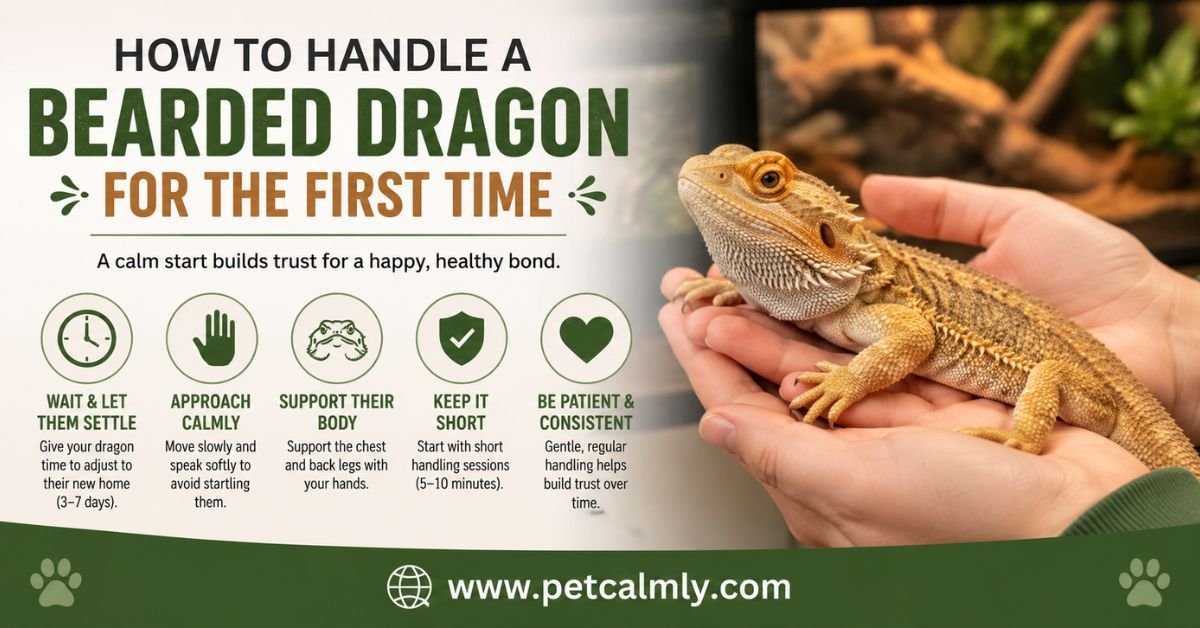
To handle a bearded dragon for the first time, let it settle into its new home for 3-7 days before touching it, then approach slowly from the side (never from above), scoop it up gently by sliding one hand under its belly and the other under its back legs, and support its full body weight against your chest or forearm. Keep sessions short (5-10 minutes), watch for stress signals like darkening beard or hissing, and always let the dragon walk onto your hand rather than grabbing it.
That’s the short version. If you actually want your beardie to trust you, relax in your hands, and stop giving you that wide-eyed “who are you” stare every time you reach into the tank, you’ll want the details below because how you do this in the first two weeks shapes your entire relationship with your dragon.
Why the First Few Handling Sessions Matter So Much
Bearded dragons aren’t like dogs or cats that instinctively seek out human contact. They’re prey animals with a built-in wariness of anything large moving toward them from above which, unfortunately, is exactly how most new owners try to pick them up.
Every time a dragon is handled roughly, grabbed suddenly, or approached in a way that mimics a predator swooping down, it files that experience away. A few bad early interactions can make a young beardie flighty or defensive for months. On the flip side, a calm, predictable introduction teaches your dragon that hands mean safety, not danger and that trust is what eventually lets you handle a fully grown adult without a fight.
This isn’t about being overly cautious. It’s about doing it right the first time so you’re not spending the next year undoing a bad first impression.
Wait Before You Touch: The Settling-In Period New Owners Skip
If you just brought your bearded dragon home, the most helpful thing you can do is nothing for a few days.
New environments are disorienting for reptiles. Different smells, different lighting, a different basking spot, and a completely unfamiliar routine all add up to stress, even if the dragon looks calm sitting under its heat lamp. Handling during this window, no matter how gentle, adds another unfamiliar variable on top of everything else.
Give a young dragon 3 to 5 days and an older, previously-owned dragon 5 to 7 days before your first handling attempt. During this time:
- Keep the enclosure lighting and temperature consistent
- Offer food daily and note whether it’s eating normally
- Talk near the tank so it gets used to your voice
- Move slowly around the enclosure so movement stops feeling threatening
You’ll know it’s ready when it’s eating consistently, basking normally, and not bolting to hide every time you walk by.
How to Approach a Bearded Dragon Without Startling It
This is the step most guides skim past, and it’s the one that actually determines whether the next five minutes go smoothly.
Bearded dragons have a strong instinct to associate overhead motion with birds of prey. Reaching straight down into the tank from above which feels completely natural to us can trigger a genuine fear response, even in a dragon that’s usually easygoing.
Instead:
- Open the enclosure and pause for a second before moving your hand in, so the dragon registers you’re there.
- Approach from the side or front at roughly the dragon’s eye level, not from directly overhead.
- Move slowly and steadily. Sudden, fast hand movements are what read as “threat” to a reptile brain.
- Let your hand rest near it for a moment before making contact, rather than grabbing immediately.
If your dragon puffs up, darkens its beard, or opens its mouth at this stage, stop and back off. That’s not defiance — it’s genuine alarm, and pushing through it teaches the opposite of what you want.
The Correct Way to Pick Up a Bearded Dragon
Once your dragon seems relaxed with your hand nearby, you’re ready for the actual pickup. The goal is full-body support nothing dangling, nothing gripped.
Step-by-step:
- Slide one hand gently under the dragon’s belly, just behind the front legs.
- Slide your other hand (or fingers) under the back legs and tail base for support.
- Lift slowly and evenly, so the dragon feels supported the entire time rather than tipped or swung.
- Bring it close to your body — against your chest, forearm, or shoulder — rather than holding it out at arm’s length, which feels unstable to the dragon and to your arms.
Never pick a bearded dragon up by:
- The tail — this can cause serious injury or tail loss in younger dragons
- Grabbing from above — triggers the predator response discussed earlier
- Squeezing the body — restricts breathing and causes unnecessary stress
- One hand under the belly only — leaves the back legs and tail unsupported and dangling
A well-supported dragon usually settles within a minute or two. One that’s improperly supported will keep scrambling to find footing, which owners often misread as the dragon “not liking to be held” when really it just doesn’t feel safe.
Reading Your Bearded Dragon’s Body Language During Handling
Bearded dragons are surprisingly expressive once you know what to look for. Learning this vocabulary early means you’ll know exactly when to keep going and when to stop.
| Behavior | What It Usually Means | What To Do |
|---|---|---|
| Relaxed body, slow blinking, resting on your hand | Comfortable, content | Continue as normal |
| Slight beard darkening | Mild alertness or arousal (not always bad) | Watch closely, proceed gently |
| Full black beard, mouth open, hissing | Feeling threatened or stressed | Stop, return to enclosure |
| Puffing up the body | Trying to appear larger, feeling defensive | Pause, give space |
| Arm waving (slow circular arm motion) | Submission signal, often normal | No action needed, generally fine |
| Head bobbing (fast, jerky) | Territorial or dominance display, more common between dragons | Usually not directed at you, but monitor |
| Digging or scratching at your hand | Wants down, restless | Return to enclosure |
| Glass surfing before handling | Existing stress, possibly enclosure-related | Address enclosure setup before handling |
A dragon that goes fully black-bearded and hisses isn’t being aggressive for no reason it’s telling you, as clearly as it can, that something about the situation feels unsafe. Respecting that signal early builds trust faster than any amount of “getting it used to handling.”
How Long and How Often Should You Handle a New Bearded Dragon
More handling isn’t automatically better, especially in the first couple of weeks. Short, positive sessions build trust faster than long ones that end in stress.
A reasonable starting schedule:
- Week 1 (after settling-in period): 1 short session per day, 2-5 minutes
- Week 2: 1-2 sessions per day, 5-10 minutes each
- Week 3 onward: Gradually extend based on how relaxed the dragon seems, up to 15-20 minutes
Always end the session on a calm note rather than when the dragon is already stressed. If it starts showing the warning signs from the table above, that’s your cue to return it to the enclosure — even if you only just started. Ending early on a calm note teaches your dragon that handling reliably ends safely, which matters more than the total number of minutes.
Common First-Time Handling Mistakes That Undo Your Progress
Most trust issues between owners and their bearded dragons trace back to a handful of avoidable mistakes:
- Handling too soon after bringing it home. Skipping the settling-in period is the single most common mistake.
- Handling right after a big meal. This can cause discomfort or regurgitation in some dragons — wait at least an hour after eating.
- Letting kids handle it unsupervised. Kids often move quickly or grip tightly without realizing it, which can genuinely frighten or injure a dragon.
- Handling during shedding. Skin is more sensitive during a shed cycle, and dragons are often more irritable. Light handling is fine, but avoid pulling at loose skin.
- Chasing the dragon around the enclosure. If it darts away, cornering or grabbing it teaches it that hands are something to escape from.
- Inconsistent handling. Handling heavily for a week and then ignoring the dragon for a month resets progress every time.
- Ignoring beard color and body posture. Pushing through visible stress signals is the fastest way to create a defensive dragon.
If you notice your dragon becoming more skittish over time rather than less, it’s worth reviewing this list the answer is often in there somewhere.
When You Should Worry (And When It’s Just Normal Adjustment)
Some hesitation is completely normal, especially in the first few weeks. But a few signs point to something beyond typical shyness and are worth paying closer attention to:
Likely normal adjustment:
- Some initial stiffness or freezing when first picked up
- Occasional beard darkening that fades once settled
- Preferring to stay near the enclosure rather than explore
Worth monitoring more closely, and mentioning to an exotic vet if it continues:
- Consistent refusal to eat for more than a few days
- Ongoing weight loss
- Lethargy that doesn’t improve with proper heat and lighting
- Labored breathing, gaping, or wheezing during or outside of handling
- Discoloration of the skin, black patches on toes or tail tip, or visible injury
- Persistent aggression that doesn’t ease even after weeks of gentle, consistent handling
General care articles like this one can guide you on normal handling and behavior, but they aren’t a substitute for veterinary evaluation. If your dragon shows any of the health-related signs above, an exotic-animal veterinarian is the right next step reptile health issues can progress quickly, and early evaluation makes a real difference. American Veterinary Medical Association and reptile-experienced vets recommend annual wellness checks even for beardies that seem perfectly healthy.
What First-Time Owners Should Actually Do (A Simple Checklist)
If you want a straightforward game plan rather than reading back through all of the above, here’s the condensed version:
- Let your dragon settle in for 3-7 days before any handling
- Approach from the side, never from directly above
- Support the full body — belly and back legs — every time you lift
- Keep first sessions to 2-5 minutes
- Watch beard color and body language throughout
- End sessions calmly, before stress signs appear
- Avoid handling right after feeding or during heavy shedding
- Supervise all handling by children
- Build up duration and frequency gradually over several weeks
- Contact an exotic vet if you notice appetite loss, lethargy, or breathing changes
Print this out or screenshot it it covers the first month better than trying to remember every detail from a single read-through.
Handling Juvenile vs. Adult Bearded Dragons: What Changes
Age makes a real difference in how you should approach handling, and treating a baby dragon exactly like an adult (or vice versa) is a common source of frustration for new owners.
Juvenile dragons (under 4-5 months): Baby and juvenile dragons are faster, more skittish, and more fragile than adults. Their tails are especially prone to injury if grabbed or if they get caught on something during a quick movement, and their smaller size means they can wriggle free more easily if not fully supported. Keep sessions shorter a few minutes at most and always handle over a soft surface or low to the ground in case of an unexpected jump.
Sub-adult and adult dragons (5+ months): Older dragons are generally calmer, heavier, and easier to support securely, but they’re also set in whatever handling habits they developed young. An adult that was rarely handled as a juvenile may need the same slow reintroduction process described earlier in this guide, just with a bigger, stronger animal to manage. Adults tolerate longer sessions well once trust is established, often 20-30 minutes.
Rescue or rehomed dragons of any age: These deserve extra patience. You often don’t know their handling history, and a dragon that was mishandled previously may show stronger stress responses even to gentle approaches. Start as if you’re working with a completely new, easily startled dragon regardless of its actual age, and let its behavior — not a general timeline — set the pace.
Setting Up a Safe Handling Environment
Where and how you handle your dragon matters almost as much as the technique itself. A few environmental details reduce risk and stress considerably:
- Handle at a low height or seated on the floor, especially with juveniles, so a sudden jump or slip doesn’t result in a fall.
- Clear the area of other pets. Dogs and cats can trigger a strong stress response in a bearded dragon even if they mean no harm, and a startled dragon may bolt.
- Avoid handling near open doors or windows where a loose or panicked dragon could escape.
- Wash your hands before and after handling — before, to avoid transferring food smells that might prompt a bite; after, as routine hygiene since reptiles can carry salmonella.
- Keep handling sessions away from the basking area right after lighting changes, since dragons are often more alert or reactive during light transitions.
- Support surfaces matter too. A towel-covered lap or a stable forearm gives a dragon better footing than a smooth countertop, which can feel slippery and insecure underfoot.
None of this needs to be elaborate. A quiet room, a low seated position, and a calm pace covers most of what matters.
A Realistic Example: What the First Two Weeks Often Look Like
It helps to know what “normal” actually looks like, since first-time owners often expect either instant cuddliness or constant struggle — and the reality is usually somewhere in between.
Day 1-4: The dragon mostly stays still or retreats to its hide when you’re near the tank. This is expected and not a sign anything is wrong.
Day 5-6: First handling session. The dragon may freeze up or scratch at your hand for the first minute, then settle once it feels supported.
Week 2: Sessions get slightly longer. Some dragons start climbing onto a forearm voluntarily; others still need to be lifted each time. Both are normal at this stage.
Week 3-4: Most dragons show a noticeable shift walking toward the front of the tank when you approach, tolerating longer sessions, and displaying fewer stress signals like beard darkening.
Not every dragon follows this exact timeline. Some individuals are naturally bolder and skip straight to comfortable handling within days; others, especially rescues or dragons with an unclear handling history, take longer. Both are within the range of normal.
Conclusion
Handling a bearded dragon well for the first time isn’t about being fast or getting through the “training” period as quickly as possible it’s about moving at a pace that lets the dragon feel safe enough to trust you. A settling-in period, a slow side approach, full-body support, and short, calm sessions will get you further in two weeks than rushing ever would.
Pay attention to what your dragon’s body is telling you, adjust based on its individual personality, and don’t be discouraged if progress feels slow at first. Most bearded dragons that start out wary become genuinely relaxed, easygoing pets once handling becomes a predictable and safe part of their routine.
More Information About Pets, Please Visit Our Website: 15 Bearded Dragon Illness Signs
Bearded Dragon Tail Rot Treatment
Heat Pad for Bearded Dragon at Night
Bearded Dragon Black Beard Meaning
Bearded Dragon Lifespan in Captivity
How Long Do Bearded Dragons Live?
Why Is My Bearded Dragon Not Eating?
Frequently Asked Questions
1: How soon can I handle a bearded dragon after bringing it home?
Most bearded dragons need 3-7 days to settle into a new environment before their first handling session. Younger dragons often adjust in 3-5 days, while older or rehomed dragons may need closer to a week.
2: Why does my bearded dragon puff up or turn its beard black when I try to hold it?
A darkened, puffed-up beard is a stress or alertness signal, not aggression for its own sake. It usually means the dragon feels threatened by the approach or the handling itself slowing down and approaching from the side rather than above often resolves it.
3: Is it normal for a bearded dragon to run away from my hand?
Yes, especially in the first couple of weeks. It doesn’t mean the dragon dislikes you it means it hasn’t yet learned that your hand isn’t a threat. Consistent, calm handling over time usually reduces this.
4: Can I hold my bearded dragon every day as a beginner?
Yes, short daily sessions are generally fine and actually help build trust faster than infrequent handling. The key is keeping early sessions brief (a few minutes) and ending before the dragon shows stress signs.
5: Should kids be allowed to handle a bearded dragon?
Children can handle bearded dragons, but always with direct adult supervision. Kids often move quickly or grip harder than they realize, which can frighten the dragon or, in a worst case, cause injury.
6: What should I do if my bearded dragon bites me while handling it?
A first bite from a young or startled dragon is usually a fear response rather than true aggression, and it rarely breaks skin. Stay calm, avoid pulling your hand away suddenly, and set the dragon down gently. If biting continues across multiple calm, properly-supported sessions, it’s worth having an exotic vet or experienced keeper assess whether pain, illness, or an enclosure issue is behind it.