Short direct answer
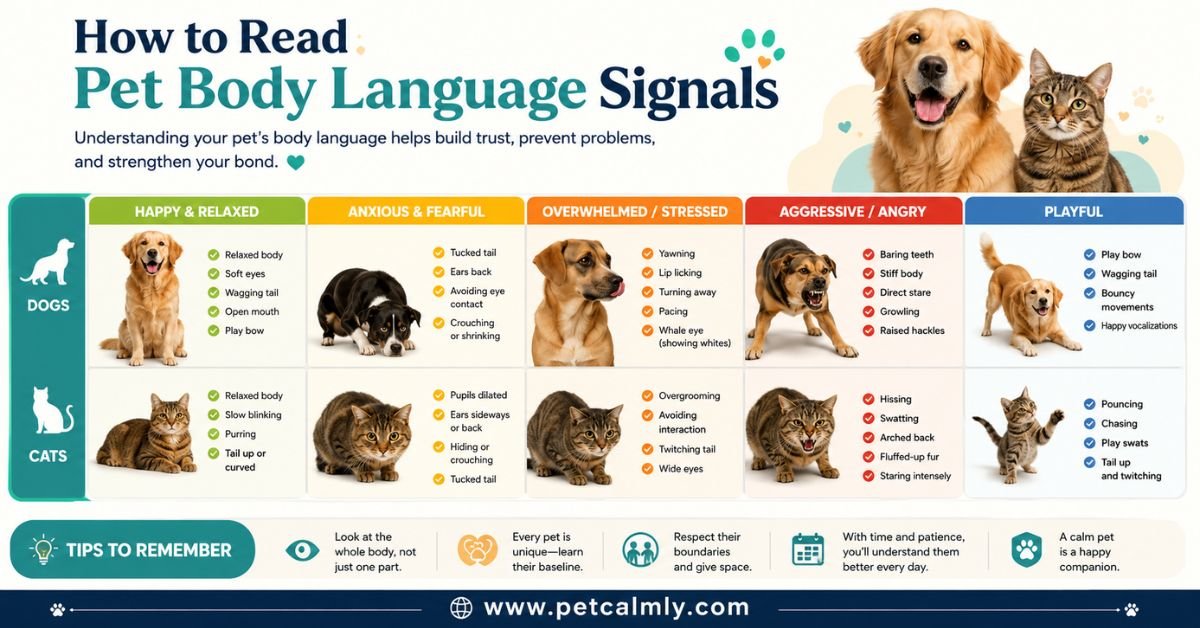
Reading pet body language signals means observing how your pet uses their eyes, ears, tail, posture, and movement to communicate emotions like comfort, fear, excitement, stress, or aggression. Most pets, especially dog and cat, rely far more on body language than vocal sounds.
In short, you understand your pet better by looking at the full picture not just one signal like a wagging tail or purring. Context matters: a stiff body with a wagging tail can still mean tension, while slow blinking in cats usually signals trust and calm.
Learning these signals helps prevent misunderstandings, reduces behavioral issues, and strengthens your bond with your pet.
Introduction
Most pet owners don’t realize how much communication is happening silently every day.
Your dog might be telling you they’re overwhelmed in a busy park without making a sound. Your cat might be asking for space even while sitting close to you on the sofa. The problem is, we often miss these signals or misread them through a human lens.
This leads to common situations like:
- A dog snapping “out of nowhere”
- A cat scratching when being petted
- A pet hiding during guests or loud noises
- Sudden behavioral changes that feel confusing
The truth is simple: pets rarely act randomly. They respond to emotional triggers long before behavior becomes obvious.
In this guide, you’ll learn how to read pet body language step by step—eyes, ears, tail, posture, and movement—so you can understand what your pet is actually feeling in real time.
The Foundation: Pets Don’t Use Words They Use Patterns
Before diving into signals, there’s one key idea to understand:
Body language is never a single sign. It’s a combination of signals happening together.
For example:
- A wagging tail alone means nothing without posture and face
- A purring cat can still be stressed if ears are flattened
- A relaxed dog has loose muscles, not just a “happy face”
Think of it like reading a sentence instead of a word. You don’t interpret one word you interpret the full meaning.
Once you shift into this mindset, everything about pet behavior becomes clearer and far less confusing.
Dog Body Language Signals Explained Clearly
Understanding dogs starts with observing the whole body. Dogs communicate constantly through posture, tail movement, and facial tension.
1. Tail Language in Dogs
A tail is not just a “happy meter.”
Here’s what different tail positions usually mean:
- Loose wagging at mid-level: relaxed and friendly
- High stiff wagging: alert, possibly tense or overstimulated
- Low or tucked tail: fear, uncertainty, or submission
- Slow wag with stiff body: caution or internal conflict
A common mistake is assuming all wagging means happiness. In reality, speed and stiffness matter more than direction.
2. Ear Positions
Dog ears are surprisingly expressive:
- Forward ears: curiosity or focus
- Relaxed sideways ears: calm and comfortable
- Pinned back tightly: fear, stress, or discomfort
- One ear forward, one back: uncertainty or mixed emotions
Breeds with floppy ears show subtler changes, so you may need to rely more on posture and eyes.
3. Eye Signals
Eyes often reveal emotional intensity:
- Soft eyes: calm, trust
- Blinking slowly: relaxation or affection
- Hard stare: focus, challenge, or tension
- Wide eyes with visible whites (“whale eye”): stress or fear
If you notice a dog showing whites of the eyes frequently, they are likely uncomfortable in their environment.
4. Body Posture
Body posture is one of the most reliable indicators:
- Loose, wiggly body: happy and relaxed
- Stiff frozen body: alert or stressed
- Lowered body stance: fear or submission
- Leaning forward: interest or potential challenge
A stiff body is often the earliest warning sign of discomfort before any vocalization happens.
5. Mouth and Vocal Cues
Even though this guide focuses on body language, mouth behavior matters:
- Relaxed open mouth = calm dog
- Tight closed mouth = tension or focus
- Lip licking (when no food is present) = stress signal
- Yawning (when not tired) = emotional pressure
Cat Body Language Signals Explained
Cats are more subtle than dogs, which makes their signals easier to miss.
1. Tail Communication in Cats
Cats use their tail like a mood bar:
- Upright tail with soft curve: friendly and confident
- Puffed tail: fear or overstimulation
- Swishing tail: irritation or frustration
- Low or tucked tail: anxiety or insecurity
Unlike dogs, cats rarely “fake” tail signals—what you see is usually genuine emotion.
2. Ear Positions in Cats
- Forward ears: calm curiosity
- Sideways ears (“airplane ears”): irritation or discomfort
- Flattened ears: fear or defensive mode
Flattened ears are often a sign that a cat is preparing to defend itself if needed.
3. Eye Communication
Cats use eyes for emotional expression more than most people realize:
- Slow blinking: trust and affection
- Dilated pupils: excitement, fear, or overstimulation
- Narrowed eyes: focus or irritation
- Avoiding eye contact: submission or discomfort
Slow blinking is often considered a “cat smile.”
4. Body Position and Movement
- Loaf position (paws tucked in): relaxed but alert
- Arched back with fur raised: fear or threat response
- Rolling onto back: trust (but not always an invitation to touch belly)
- Crouching low: fear or readiness to escape
A key misunderstanding: not all belly exposure means “pet me.” In many cases, it’s defensive.
Emotional Triggers Behind Pet Body Language
Understanding why pets show certain signals is just as important as recognizing them.
Common emotional triggers include:
- Loud environments (fireworks, construction)
- Sudden changes in routine
- New people or animals at home
- Pain or illness
- Lack of mental stimulation
- Overhandling or unwanted touch
- Resource guarding (food, toys, space)
For example, a normally friendly dog may show stiff posture and lip licking when a stranger leans too close. This is not “bad behavior”—it is communication.
5 Common Mistakes Pet Owners Make
Even experienced pet owners misread signals sometimes. Here are the most frequent mistakes:
1. Interpreting one signal in isolation
A wagging tail does not always mean happiness.
2. Ignoring subtle early warnings
Lip licking, yawning, and turning away are often missed.
3. Assuming pets “should tolerate” everything
Pets communicate discomfort before reacting physically.
4. Humanizing behavior incorrectly
For example, assuming a cat is “guilty” when avoiding eye contact after mischief.
5. Forcing interaction when signals show stress
This often increases fear-based reactions over time.
Real-Life Example: What Owners Often Miss
Imagine this situation:
A guest visits your home. Your dog approaches with a wagging tail, but:
- The body is stiff
- Ears are slightly back
- Mouth is closed tightly
- The tail wag is fast but high
Many owners assume “happy greeting.”
But in reality, this is likely alertness mixed with tension, not pure friendliness.
If the interaction continues without space, the dog may eventually growl or retreat. The earlier signals were already there.
Step-by-Step Guide: How to Read Your Pet in Real Time
Here’s a simple routine you can use daily:
Step 1: Observe the environment
Ask: What just changed? Noise, people, movement?
Step 2: Look at the full body
Don’t focus only on tail or face.
Step 3: Check tension level
Loose muscles = calm
Stiff posture = stress
Step 4: Watch repetition patterns
Is the behavior consistent or new?
Step 5: Adjust your response
Give space, reduce stimulation, or calmly engage depending on signals.
Quick Reference Checklist
Calm and Happy Pet:
- Loose body
- Soft eyes
- Natural tail movement
- Relaxed ears
Stressed or Uncomfortable Pet:
- Stiff posture
- Lip licking or yawning
- Avoiding eye contact
- Low or tucked tail
Alert or Overstimulated Pet:
- Fast movements
- Dilated pupils
- High tail position
- Focused stare
When Should You Worry?
Some body language signals require closer attention.
Seek veterinary or behavioral help if you notice:
- Sudden aggression without clear trigger
- Constant hiding or withdrawal
- Refusal to eat alongside behavioral changes
- Persistent trembling or fear responses
- Repeated self-harming behaviors (licking, scratching excessively)
- Pain-related posture changes (hunched back, limping)
These may indicate medical or emotional issues that need professional evaluation.
What Should Pet Owners Do Daily?
Understanding body language is not just observation—it’s response.
Do:
- Give space when pets show stress signals
- Reward calm behavior
- Keep routines consistent
- Allow pets to initiate interaction
- Observe before touching unfamiliar pets
Don’t:
- Force hugs or handling
- Ignore early stress signals
- Punish warning behaviors (like growling)
- Overstimulate shy or anxious pets
Why This Skill Changes Your Relationship With Your Pet
Once you learn to read body language, your relationship shifts in a subtle but powerful way.
You stop guessing.
Your pet stops needing to escalate behavior to be understood.
And everyday moments—feeding, walking, resting—become clearer conversations instead of confusion.
Most behavior problems are not “bad pets.” They are misunderstood communication patterns.
Conclusion
Learning how to read pet body language signals is one of the most important skills any pet owner can develop. It helps you understand what your pet is feeling before behavior escalates, reduces stress at home, and builds a stronger emotional bond.
Whether it’s a dog showing subtle tension or a cat expressing discomfort through posture, every signal is meaningful when you look at the full picture.
With patience and observation, you start to notice something powerful: your pet has been communicating all along you just needed the right language.
More Information About Pets, Please Visit Our Website: Smart Pet Care Tips for Apartment Living in 2026
Frequently Asked Questions
1. How can I tell if my pet is stressed or just excited?
Stress usually comes with stiffness, avoidance, or tension in the face. Excitement looks looser and more fluid in movement.
2. Why does my dog wag his tail but seem tense?
Because tail wagging alone doesn’t mean happiness. A stiff body or high rigid wag often indicates alertness or uncertainty.
3. Do cats show affection through body language?
Yes. Slow blinking, relaxed posture, and tail held upright are strong signs of trust and affection in cats.
4. What is the most reliable sign of fear in pets?
Tucked tail, lowered body posture, and avoidance of eye contact are among the clearest fear indicators.
5. Can body language predict aggressive behavior?
Yes, often. Stiff posture, hard staring, and frozen movement can be early warning signs before aggression.
6. Should I correct my pet for showing warning signals like growling?
No. Growling is communication, not misbehavior. It’s a warning that your pet feels uncomfortable and needs space.