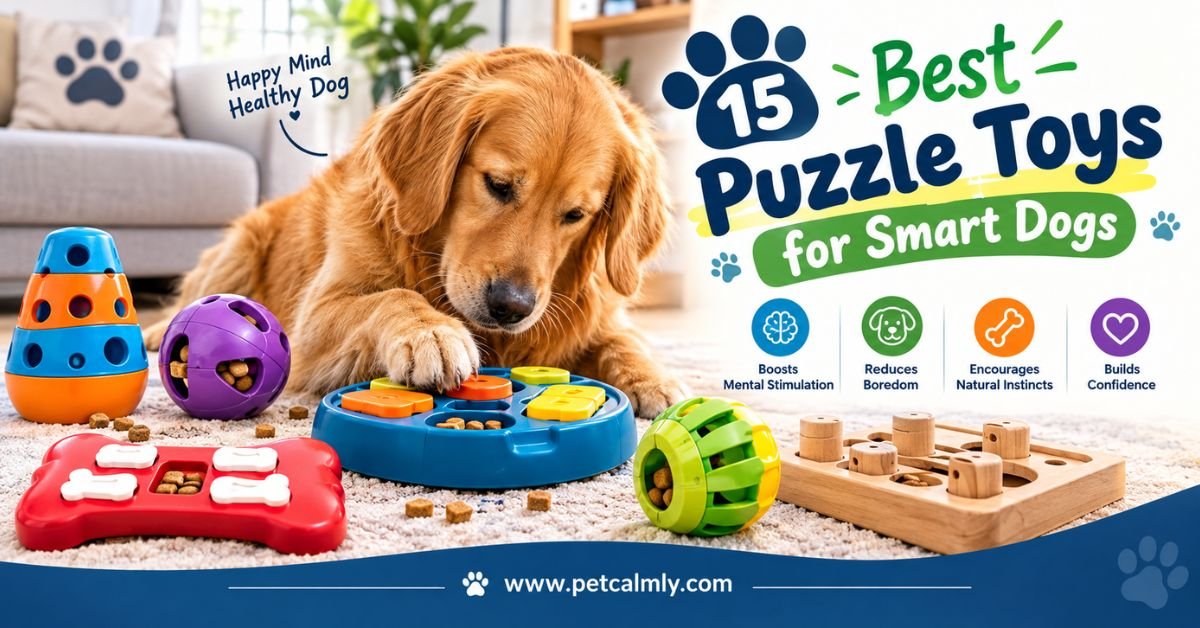
Short direct answer
The 15 best puzzle toys for smart dogs combine real problem-solving with safe, durable materials. Top picks include the Nina Ottosson Dog Casino and Dog Tornado for advanced thinkers, the West Paw Toppl and KONG Classic for stuffable challenges, and a snuffle mat for sniff-and-search play. Start with a beginner-level toy, supervise every session, and move up in difficulty only when your dog solves the current puzzle quickly and calmly.
Why Your Clever Dog Is Chewing the Couch (and What Puzzle Toys Fix)
If your dog has ever solved a baby gate, opened a cabinet, or watched you with an expression that says I know where the treats are, you probably live with a smart dog. Border Collies, Poodles, German Shepherds, Australian Shepherds, Golden Retrievers, and many mixed breeds fall into this group, but plenty of ordinary-looking dogs are secretly brilliant too.
The trouble is that a sharp mind needs a job. When it does not get one, dogs often invent their own: shredding cushions, barking at nothing, digging up the yard, or following you from room to room. That is not naughtiness. It is a capable brain with nowhere to go.
Puzzle toys give that brain a legitimate outlet. A good one asks your dog to sniff, think, try something, fail, and try again. That is satisfying work, and many owners notice their dog settles more calmly afterward.
In this guide you will find 15 puzzle toys worth considering, a simple way to match each one to your dog’s skill level, a step-by-step plan for introducing them, and clear guidance on when a behavior problem needs a professional rather than another toy.
A quick note on how this list was built: I have not personally tested every product, and I will not pretend otherwise. The picks below are chosen based on design, materials, long-standing popularity with dog owners and trainers, and how well each toy fits a different kind of dog. Check current reviews and sizing before you buy, since products change.
How Puzzle Toys Work and Why Smart Dogs Need Them
A puzzle toy is any toy that makes your dog work for a reward, usually food. Instead of eating from a bowl in thirty seconds, your dog has to slide a panel, flip a lid, nudge a ball, or lick and chew something until the treat comes out.
The Short Version of the Science
Dogs were bred to work alongside people: herding, retrieving, guarding, hunting. Many modern pets have the drive without the job. Mental enrichment is widely recommended by veterinary and behavior organizations as part of a healthy routine, alongside exercise, good nutrition, and social time.
Think of it this way. A twenty-minute walk tires the legs. Ten minutes with a puzzle tires the mind. Smart dogs usually need both.
Signs Your Dog Is Under-Stimulated
These are common clues that boredom, not bad character, is behind the trouble:
- Chewing furniture, shoes, or walls while you are home
- Barking or whining for attention at the same time every evening
- Pacing, circling, or following you constantly
- Digging or tearing up bedding
- Finishing a walk and still seeming wound up
- Learning new tricks in a few tries and then demanding more
If several of these sound familiar, puzzle toys are a smart place to start.
Types of Interactive Dog Puzzle Toys Explained
Not all puzzle toys do the same job, and the label matters more than people think. Choosing the wrong type is the most common reason a dog loses interest.
| Type | How it works | Best for |
|---|---|---|
| Sliding and lifting puzzles | Dog moves panels or lifts lids to find treats | Problem solvers, beginners to advanced |
| Treat-dispensing toys | Dog rolls or nudges the toy so food falls out | Active dogs, quick thinkers |
| Stuffable chew toys | Food is packed inside, dog licks or chews | Calming, crate time, chewers |
| Snuffle and scent toys | Treats hidden in fabric or folds | Nose-driven dogs, anxious dogs |
| Hide-and-seek plush puzzles | Small toys tucked inside a larger one | Gentle chewers, retrievers |
How to Choose the Best Puzzle Toy for Your Smart Dog
Before you buy, spend two minutes on these questions. They will save you money and frustration.
Match the Difficulty to Your Dog’s Experience
A brilliant dog who has never seen a puzzle is still a beginner. If the first toy is too hard, many dogs simply walk away and decide puzzles are not for them. Start at level one, even if you are sure your dog is a genius. You can level up within days.
Consider Your Dog’s Chewing Style
Gentle chewers do well with plastic sliding puzzles and plush toys. Power chewers can break thin plastic or tear fabric, and swallowed pieces are a real emergency risk. For strong chewers, look at heavy-duty rubber toys and always supervise.
Check Size and Materials
A toy that is too small can become a choking hazard. One that is too large may be frustrating or unmanageable. Follow the manufacturer’s size guide, look for non-toxic materials, and avoid toys with loose parts your dog can pull off.
Quick Buyer’s Checklist
- Is it the right size for my dog’s mouth and weight?
- Can my dog destroy it in a few minutes?
- Is it easy to clean? Food residue breeds bacteria.
- Does the difficulty match my dog’s current skill?
- Can I supervise the first several sessions?
- Does the treat amount fit into my dog’s daily food allowance?
The 15 Best Puzzle Toys for Smart Dogs
The toys below are grouped from beginner-friendly to advanced, with notes on who each one suits. Treat all difficulty ratings as general guidance. Every dog is different.
1. Nina Ottosson Dog Brick (Beginner to Intermediate)
This is a classic sliding puzzle. Your dog pushes blocks aside and lifts pieces to uncover treats underneath. It teaches the core idea of puzzles very clearly, which makes it a good first step for a clever dog. Best for dogs that are patient with their paws and nose.
2. Outward Hound Dog Brick (Beginner)
A similar sliding-block style that is widely available and generally easy to understand. It works well as a first puzzle for owners who want to test their dog’s interest before spending more.
3. Nina Ottosson Dog Casino (Advanced)
This one asks for a sequence: slide a cover, flip a lid, then slide another. It rewards dogs that can remember steps and tackle multiple tasks. Smart dogs who have mastered easier puzzles often enjoy this level of challenge.
4. Nina Ottosson Dog Tornado (Intermediate to Advanced)
A spinning, layered design with hidden treat compartments. Dogs must rotate the layers and move small bones aside to reach rewards. It is a nice choice for dogs who enjoy pawing and nosing things around.
5. Trixie Poker Box or Activity Flip Board (Intermediate)
Trixie makes several strategy-style toys that need lifting, sliding, and pulling. They are a solid option when your dog has outgrown simple puzzles and likes figuring out different mechanisms.
6. West Paw Toppl (Beginner, Great for Stuffing)
A durable, stuffable toy shaped so food can be packed in layers. Beginners can lick the soft filling, while advanced dogs can get frozen versions. It is popular for crate time and quiet afternoons.
7. KONG Classic (Beginner to Advanced Depending on How You Stuff It)
The KONG is a favorite for a reason. You can make it easy with soft food or very hard by freezing layers of filling. Because you control the difficulty, it grows with your dog. Choose the right size and rubber strength for your dog’s chewing style.
8. KONG Wobbler (Beginner)
A weighted toy that dispenses kibble as your dog tips and nudges it around. It is a gentle introduction to food-dispensing play and a good way to slow down fast eaters at mealtimes.
9. Starmark Bob-A-Lot (Beginner to Intermediate)
Another weighted dispenser that bounces back upright, which adds to the fun. You can adjust how fast the treats fall out, so the challenge can be tuned to your dog’s skill.
10. PetSafe Busy Buddy Twist ‘n Treat (Beginner to Intermediate)
This rubber toy has two halves that twist together to hold treats inside. Dogs have to chew and nudge to release the food, and the challenge can be changed by how much you load into it.
11. Pet Zone IQ Treat Ball (Beginner)
A simple, rolling treat dispenser that is easy for most dogs to grasp. It is good for energetic dogs who like to chase and bat things across the floor, though it may be loud on hard floors.
12. Outward Hound Hide-A-Squirrel (Beginner)
A plush log with small squirrels to hide and find. It suits gentle chewers who love stuffed toys and enjoy retrieving. Supervise carefully, because plush can be torn apart by strong chewers.
13. Snuffle Mat (Beginner, Nose Work)
A fabric mat with strips where you scatter treats or kibble. Your dog sniffs and searches to find every piece. It is a great calming activity for dogs who have a strong nose, and many owners find it easy to make at home or buy from several brands.
14. LickiMat (Beginner, Calming)
A textured silicone mat you spread with soft food like plain yogurt or wet food, if your vet approves. Licking is soothing for many dogs, which makes this useful during grooming, thunderstorms, or vet-prep routines.
15. Outward Hound Fun Feeder Slow Bowl (Beginner)
It is not a high-level puzzle, but the ridged shape makes dogs work for each bite. It is helpful for fast eaters and a nice entry step into mealtime enrichment for dogs that are new to puzzle play.
Quick Comparison: Which Toy Fits Which Dog?
| Dog type | Best starting picks |
|---|---|
| First-time puzzle dog | Outward Hound Dog Brick, KONG Wobbler, Snuffle Mat |
| Very clever, bored dog | Nina Ottosson Dog Casino, Dog Tornado, Trixie toys |
| Strong chewer | KONG Classic (extreme), West Paw Toppl |
| Anxious or restless dog | LickiMat, Snuffle Mat, Toppl |
| Fast eater | Fun Feeder, KONG Wobbler, Bob-A-Lot |
How to Introduce a Puzzle Toy Step by Step
How you introduce the toy often matters as much as which toy you pick. Here is a simple approach many trainers recommend.
- Pick a quiet time. Choose a calm moment when your dog is relaxed but a little hungry, not right after a big meal.
- Make the first try very easy. Put treats where the dog can see and grab them quickly.
- Let your dog explore. Do not rush in to help. Watch how your dog tries to solve it.
- Praise small wins. Quiet encouragement works better than excited cheering that might distract your dog.
- Raise the difficulty slowly. Hide the treats a little deeper, or close one compartment at a time.
- Stop while it is still fun. Ten to fifteen minutes is plenty for most sessions.
- Take the toy away afterward. This keeps it special and lets you check for damage.
A small real-world example: imagine a young Border Collie mix who dives into a sliding puzzle, pushes all the pieces at once, and then barks in frustration. The fix is not a harder toy or a scolding. It is stepping back one level, letting a few easy successes build confidence, and trying again later.
6 Common Puzzle Toy Mistakes to Avoid
Most problems with puzzle toys come down to a few easy-to-fix habits.
- Starting too hard. Frustration can look like quitting, barking, or chewing the toy itself.
- Using too many treats. Puzzle rewards count as food. Use part of your dog’s regular meal or low-calorie treats to avoid weight gain.
- Leaving dogs alone with new toys. Supervise until you know how your dog interacts with it.
- Never changing things up. Smart dogs learn fast. Rotate toys, change the filling, or hide treats in new places.
- Skipping cleaning. Wash according to the manufacturer’s directions, because leftover food can grow bacteria.
- Expecting puzzles to replace exercise. They complement walks and play, not replace them.
Free DIY Puzzle Ideas for Smart Dogs
You do not need to spend much to give your dog a mental workout. These homemade options use things you already have.
Muffin Tin Shell Game
Place treats in a muffin tin and cover each cup with a tennis ball. Your dog must remove the balls to find the food. Use a size appropriate for your dog so the balls cannot be swallowed.
Towel Roll-Up
Lay out a towel, scatter treats, and roll it up loosely. Your dog sniffs, paws, and unrolls to find them. It is safe for most dogs, but remove it if your dog starts eating the fabric.
Cardboard Box Hunt
Hide treats in a box with crumpled paper. It is messy but very satisfying. Remove any tape or staples first and keep a close eye so your dog does not swallow cardboard.
Puzzle Toy Safety Tips Every Dog Owner Should Know
Safety is where good intentions can go wrong. A toy is only helpful if your dog uses it as intended.
- Always supervise, especially with new or plush toys.
- Throw away any toy with cracks, missing chunks, or loose pieces.
- Avoid toys small enough to be swallowed whole.
- Never use stuffing that contains xylitol, chocolate, grapes, raisins, or onion. Check ingredient labels on peanut butter and similar spreads, since some contain xylitol, which is highly toxic to dogs.
- If your dog has food allergies, pancreatitis, kidney disease, or diabetes, ask your vet which fillings are safe.
- Choose the right size, since a toy that is too small is dangerous and one that is too large may go unused.
When Should You Worry About Your Dog’s Behavior?
Puzzle toys are enrichment, not medicine. Some behavior changes point to a medical or emotional issue that no toy will solve. Contact your veterinarian or a qualified behavior professional if you notice any of the following:
- Sudden destructive behavior in a dog who was previously calm
- Compulsive behaviors such as constant licking, tail chasing, or spinning
- Extreme distress when left alone, including panic, drooling, or self-injury
- Vomiting, retching, or a swollen belly after chewing a toy or eating fillers
- Refusing food or losing interest in things they usually love
- Aggression around toys or food (guarding)
- Signs that your dog swallowed a piece of a toy, such as repeated gagging, lethargy, or abdominal pain, which is an emergency
A behavior change can be the first sign of pain, cognitive changes in older dogs, or anxiety. A vet visit is a sensible first step before assuming it is just boredom.
What Should Pet Owners Do Next?
If you are not sure where to begin, here is a simple plan you can follow this week.
- Pick one beginner toy and one stuffable toy that fit your dog’s size and chewing style.
- Plan three short sessions of ten to fifteen minutes, spaced over a few days.
- Use part of your dog’s regular meal as the reward.
- Watch for signs of frustration or boredom and adjust the difficulty.
- Rotate toys weekly to keep your clever dog curious.
- Combine puzzles with exercise, training, and quiet time together.
Over a few weeks, you will learn how your dog thinks, and that is the part that makes enrichment so rewarding.
Conclusion
A smart dog does not need an expensive collection of gadgets. What helps most is the right level of challenge, a few safe toys, and an owner who pays attention. Start easy, build confidence, and increase difficulty when your dog is ready.
If you are choosing just one toy to begin with, pick something simple like the KONG Wobbler, Toppl, or Dog Brick, then add an advanced option like the Dog Casino later. Watch how your dog responds, adjust gently, and enjoy the moment when they finally work it out and look up at you with pure pride.
That look is worth more than any product description.
More Information About Pets, Please Visit Our Website: Best Chew Toys for Aggressive Chewers Dogs
Best Dog Anxiety Medication Over the Counter
What causes sudden anxiety in dogs?
Home Treatment for Anxious Dog
How to Calm Down a Hyper Dog?
Frequently Asked Questions
1: What are the best puzzle toys for smart dogs?
The best options depend on your dog’s skill and chewing style. Nina Ottosson puzzles like the Dog Casino and Dog Tornado suit advanced thinkers, while the KONG Classic, West Paw Toppl, and snuffle mats work well for beginners and for calming time.
2: How long should my dog play with a puzzle toy?
Most dogs do well with sessions of about ten to fifteen minutes, though stuffable toys can last longer. Stop if your dog seems frustrated or loses interest, and end on a success so the activity stays fun.
3: Are puzzle toys safe to leave with my dog when I am not home?
Not always. Sturdy rubber toys that are the right size may be safer, but any toy can cause problems if chewed apart. Supervise new toys first, and ask your vet if you are unsure about unsupervised use.
4: Do puzzle toys really tire out a dog?
Many dogs seem noticeably calmer after mental work, and owners often describe it as a different kind of tired than exercise. Puzzles do not replace walks and play, but they add mental effort that physical activity alone may not provide.
5: How do I teach my dog to use a puzzle toy?
Start with an easy version where treats are visible and simple to reach. Let your dog explore without help, praise small wins, then slowly increase the challenge over several sessions. Patience matters more than speed.
6: What should I do if my dog destroys puzzle toys?
Switch to a heavy-duty rubber toy designed for strong chewers and keep sessions supervised. If your dog tears toys apart out of frustration, try an easier puzzle or a stuffable toy instead. If destructive behavior is new or intense, check with your vet.