Short direct answer
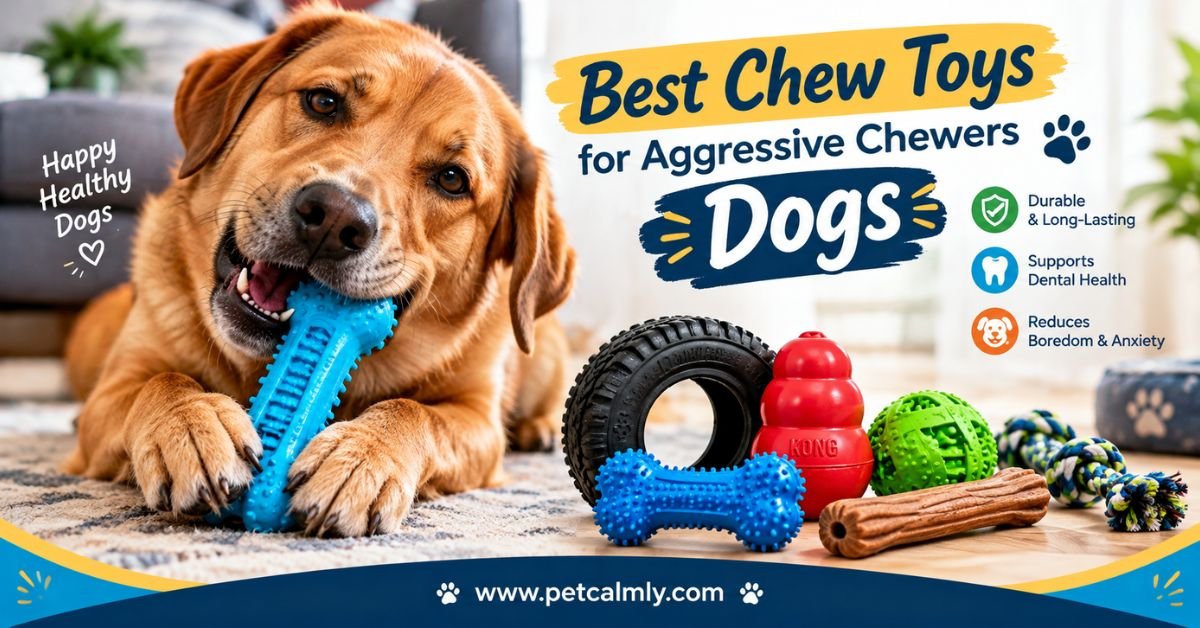
The best chew toys for aggressive chewers dogs will tolerate are dense, solid rubber toys (like KONG Extreme or GoughNuts), firm nylon chews sized for your dog, and puzzle-style stuffable rubber toys that keep a strong jaw busy. Choose a toy that is tough but still has a little give, never rock-hard. Match the size to your dog, supervise every session, and replace the toy as soon as it cracks, splinters, or loses chunks.
Why This Question Is Harder Than It Sounds
If you’re reading this, there is probably a pile of chewed-up stuffing, shredded rubber, or half a table leg somewhere in your house. You bought the “indestructible” toy. It lasted about eleven minutes.
That’s frustrating, and a little scary too, because a dog who destroys toys can also swallow pieces of them. The good news is that strong chewers are not “bad dogs.” They have a need, and the right toy can meet it safely.
This guide walks you through what actually holds up, how to judge a toy before you buy it, which popular chews are riskier than they look, and what to do if your dog swallows something. No miracle claims. Every dog is different, so the goal is to help you choose well and stay safe while you find your dog’s match.
Best Chew Toys for Aggressive Chewers at a Glance
Here’s a quick reference before we get into the detail. Think of these as categories first and brands second, because the category tells you more about safety than a logo does.
| Toy type | Good for | Watch out for | Examples to look at |
|---|---|---|---|
| Dense solid rubber | Most heavy chewers, daily use | Aggressive dogs can still gouge and tear it over time | KONG Extreme, GoughNuts rings and sticks |
| Stuffable rubber | Dogs who need mental work, crate time | Needs refilling and cleaning | KONG Extreme, West Paw Zogoflex Tux |
| Firm nylon chews | Dogs who love long chewing sessions | Can be too hard for some; small shaved bits get swallowed | Nylabone Power Chew, Benebone |
| Rubber fetch toys | Active dogs who chew when bored | Not meant for unsupervised gnawing | Heavy-duty rubber balls and rings |
| Edible long-lasting chews | Dogs who need a reward chew | Calories, digestive upset, choking if swallowed whole | Vet-approved dental chews, appropriately sized |
Product lines change their materials and sizing over time, so always read the current label and the manufacturer’s size chart before buying.
Why Some Dogs Chew Like Their Life Depends on It
Before choosing a toy, it helps to understand what is driving the chewing. A toy that matches the reason works better than one that just looks tough.
- Natural drive. Chewing is normal canine behavior. Some breeds and mixes, including many retrievers, terriers, shepherds, and bully breeds, tend to be especially mouthy.
- Teething. Puppies chew to ease sore gums, usually until their adult teeth settle in at around six to seven months of age.
- Boredom and excess energy. A dog who hasn’t had enough exercise or mental work will find something to do with that energy. Often it’s your shoes.
- Anxiety or stress. Chewing is self-soothing. Dogs who chew mostly when you leave, or when storms roll in, may be coping with stress rather than being destructive.
- Dental or medical discomfort. Sudden new chewing, especially paired with drooling or dropping food, can point to a sore tooth or gum issue.
It’s worth asking yourself when your dog chews most. A dog who destroys things at 5 p.m. every day is telling you something different from a dog who only chews when alone.
How to Pick a Chew Toy That’s Tough but Tooth-Safe
This is the part most buying guides skip. A toy that never breaks is not automatically a good toy. If it’s harder than your dog’s teeth can handle, you trade a ruined toy for a cracked tooth, and those repairs can be painful and expensive.
Use the thumbnail test
Press your thumbnail into the surface of the toy. If it leaves a slight dent, the toy has enough give to be reasonably tooth-friendly. If it feels like pressing into stone, it’s probably too hard. Veterinary dental groups commonly suggest this simple check, and it works well as a first screen.
Get the size right
A toy that is too small can be swallowed or lodge in the throat. A toy that is too large is awkward and may frustrate your dog. As a general rule, it should be big enough that your dog can’t fit the whole thing, or the end of it, in the back of the mouth. When your dog is between sizes, go up.
Look at the shape
For power chewers, simple and solid shapes tend to outlast thin, bumpy, or hollow-walled ones. Thin edges are easy to tear. Large flat surfaces are easy to hold with the paws, which gives your dog leverage.
Check the material and labeling
Look for clear information on what the toy is made from, who makes it, and what dog weight and chewing style it’s built for. Vague packaging is a red flag. Non-toxic, single-material toys are generally simpler to evaluate than multi-part toys with squeakers, which are a classic weak point.
Think about your dog’s actual chewing style
Some dogs gnaw slowly. Others rip, tear, and pull. Rippers need different toys from gnawers. A dog who shreds fabric may be harder on soft toys but fine with dense rubber. A dog who clamps and grinds may be better served by a bulky stuffable toy than a thin ring.
Best Chew Toy Types for Heavy Chewers, Explained
There is no single winner, but there are good fits. Here’s how each category tends to perform for strong chewers, along with its limits.
Dense solid rubber toys
This is where most owners of strong chewers should start. Thick, solid rubber has a bit of give, which helps protect teeth, and it can take a lot of repeated pressure. KONG’s black Extreme line is a common first choice for dogs who go through the standard red ones. GoughNuts toys are built with a visible inner layer that is meant to warn you when your dog has chewed deep enough that it’s time to replace the toy.
No rubber toy is truly indestructible. A determined dog can still gouge or pull off pieces over time, so inspect it often.
Stuffable and puzzle toys
Many power chewers are also smart, high-energy dogs, and a toy that makes them work for food can tire them out faster than a toy that just sits there. Stuff a rubber toy with a little of your dog’s regular kibble, a spoonful of plain canned dog food, or a bit of plain pumpkin, then freeze it. A frozen stuffed toy can keep a dog busy far longer and helps soothe sore gums.
Count the stuffing as part of the meal. It shouldn’t be an extra layer of calories on top.
Firm nylon chews
Nylon chews are made for dogs who love to grind and gnaw. Many dogs enjoy them, but the type of chewing matters. As nylon wears down, it can shed small rough bits. Most of these are tiny, but larger pieces can come off in a very aggressive chewer. Choose a size and firmness level made for your dog’s weight and chewing style, and take it away once it’s worn down or the ends are chipped.
Rubber fetch toys and tug-and-chew combinations
Heavy-duty rubber balls and rings do double duty by burning energy through play and giving your dog something satisfying to bite. They’re best for supervised play. A dog who gets tired out by a game of fetch is also less likely to start on the couch cushions afterward.
Edible long-lasting chews
Some edible chews are designed to last, and dogs often find them irresistible. They can work as a high-value treat. Be careful, though. Gulping large pieces can cause choking or blockage, and rich chews can upset the stomach. Pick one sized for your dog, offer it only under supervision, and take away the last small piece so it can’t be swallowed whole.
Chew Toys to Skip for Aggressive Chewers
Some of the most popular “natural” chews are the riskiest for power chewers. This is where well-meaning owners get caught out.
- Cooked bones. They can splinter and cause mouth injuries, choking, or intestinal damage.
- Real bones, antlers, and hooves. They’re very hard, and veterinary sources regularly link them to fractured teeth. Many antlers marketed as “long-lasting” are exactly the problem.
- Hard plastic and very hard nylon. If your thumbnail won’t dent it, be cautious.
- Tennis balls. The fuzzy outer layer acts like sandpaper on teeth over time, and a strong dog can compress and swallow the ball.
- Plush toys with stuffing and squeakers. These are fine for gentle play but a poor choice for destroyers. Stuffing and squeakers can cause blockages.
- Rope toys. Strands can unravel and be swallowed. They can cause serious intestinal problems if they bunch up.
- Rawhide. Many vets caution against it for dogs who tear off and swallow chunks, since it can swell and block the digestive tract.
- Ice cubes and rocks. These are tough on teeth, and the combination of habit and hard surfaces is a common cause of chipped enamel.
If your dog already loves one of these, don’t panic. Just swap in a safer option gradually and keep an eye on dental wear.
Matching the Toy to Your Dog’s Situation
The right choice depends on who is doing the chewing. These quick matches cover common situations.
Teething puppies
Puppy teeth and jaws are still developing, so avoid anything very hard. Soft rubber toys designed for puppies, and frozen options such as a chilled stuffed toy or a damp frozen washcloth under supervision, can ease gum discomfort. Keep a few toys on rotation, because puppies get bored quickly.
Large, powerful breeds
Dogs with a strong bite, like Rottweilers, Mastiffs, and many shepherd mixes, need toys sized and rated for their weight. Don’t go by the dog’s age alone. A small or medium toy that would be fine for a smaller dog can become a hazard in a powerful jaw.
Senior dogs who still chew hard
Older dogs may have worn teeth, gum disease, or sore jaws, even if they still love to chew. A softer rubber toy or a stuffed toy is usually kinder than hard nylon. If your older dog suddenly loses interest in chewing, that’s worth mentioning to your vet.
Anxious chewers
A dog who chews when you leave isn’t going to be fixed by a tougher toy alone. A stuffed frozen toy before you go can help, but the underlying stress still needs attention. Gradual alone-time practice, exercise before you leave, and a calm departure routine all help. If anxiety is serious, a veterinarian or certified behavior professional can guide you.
Dogs who swallow everything
Some dogs treat every toy as a snack. For them, avoid anything with parts that can break off. Choose bulky, one-piece toys, supervise closely, and consider a safer feeder-style chew that releases food slowly rather than something they can bite apart.
How to Make Chew Toys Last Longer and Stay Safe
Even the toughest toy lasts longer, and is safer, when you manage how it’s used. Try this simple routine.
- Rotate toys. Keep three or four toys out of sight and swap them every few days. A “new” toy is more interesting and gets less repetitive wear.
- Supervise, especially at first. Watch how your dog actually chews a new toy for the first several sessions. Does he rip, gnaw, or swallow bits?
- Inspect often. Check for cracks, deep gouges, loose pieces, or sharp edges. Throw it out if you see any.
- Wash regularly. Rinse rubber toys in warm soapy water, or place dishwasher-safe ones in the top rack if the manufacturer allows it.
- Freeze for gum relief. A frozen stuffed rubber toy can be soothing and lasts longer.
- Pair chewing with exercise. A walk or a game of fetch before chew time makes chewing more of a wind-down than a workout.
- Pick up toys when you leave if you’re not sure they’re safe. Unsupervised chewing is where most accidents happen.
7 Common Mistakes Owners Make With Chew Toys
Most problems come from small, understandable mistakes. Here are the ones that come up again and again.
- Buying by the “indestructible” label. Marketing terms like “tough” or “for power chewers” aren’t regulated standards. Judge the toy yourself.
- Choosing hard over safe. A toy that survives your dog may still harm his teeth.
- Leaving dogs alone with new toys. The first sessions tell you the most about whether a toy is safe.
- Keeping worn-out toys too long. Sentimental attachment is real, but a chewed-down toy can break into swallowable pieces.
- Ignoring the reason for chewing. More toys won’t fix boredom, anxiety, or lack of exercise.
- Skipping size charts. Toys sized “about right” are a common cause of choking incidents.
- Punishing chewing. Scolding after the fact confuses most dogs and can make anxiety-based chewing worse. Redirect to an appropriate toy instead.
Teaching Your Dog What Is Okay to Chew
A good toy helps, but a bit of simple training makes it work better. You’re not trying to stop chewing. You’re giving your dog a clear yes.
When you catch your dog chewing something off-limits, calmly trade. Offer an appropriate toy, then praise when he takes it. Over time he learns that the “right” toy leads to good things. Keep valuables out of reach in the early weeks, and use baby gates or a crate when you can’t watch him.
Young dogs and newly adopted dogs often need a few weeks of this routine before it sticks. Consistency matters more than perfection.
When Should You Worry About Your Dog’s Chewing?
Most chewing is normal. A few signs, though, mean it’s time to call your veterinarian rather than just buy a different toy.
- Repeated vomiting, especially after chewing or swallowing something
- Loss of appetite, lethargy, or a tender, bloated belly
- Straining to poop, or no stool at all
- Pawing at the mouth, drooling, or dropping food
- A visibly cracked, chipped, or discolored tooth
- Bleeding from the mouth or gums
- Sudden, intense new chewing in a dog who never did it before
- Compulsive chewing that your dog can’t stop, even when offered toys
Tooth fractures and intestinal blockages are both situations where waiting can make things worse. If you’re unsure, a phone call to your vet is always reasonable.
What to Do If Your Dog Swallows Part of a Toy
It happens even to careful owners. Here’s what to do.
- Stay calm and take the toy away. Check your dog’s mouth gently for pieces and see how much is missing.
- Figure out what and how much. Note the material, the size of what’s missing, and when it happened.
- Call your vet or an emergency clinic. Don’t wait for symptoms. Don’t try to induce vomiting at home unless a veterinarian tells you to, since some objects can cause more harm coming back up.
- Watch closely. Vomiting, lethargy, belly pain, or a lack of stool are warning signs and need immediate attention.
- Bring the toy or packaging. It helps your vet judge what was swallowed and whether imaging may be needed.
A small, soft piece may pass without trouble, but only a veterinarian can tell you that for your dog.
A Realistic Example: Finding the Right Toy for a Retriever Mix
Here’s the kind of story many owners will recognize. A two-year-old retriever mix goes through a standard rubber toy in an afternoon and has started chewing the sofa arm. His owner tries a hard nylon bone, but it seems too hard, and a chunk of the tip chips off within a week.
What tends to work in a situation like this is a change in approach. The owner switches to a dense rubber toy sized up from the “recommended” weight, stuffs it with a bit of his kibble, and freezes it. She adds a longer walk before work, and she keeps two other toys in rotation. The sofa gets a break, the toy lasts much longer, and she checks it every few days for wear.
It isn’t a perfect fix, and it isn’t instant. But it’s a pattern that works for many strong chewers: the right material, the right size, more exercise, and regular checks.
Conclusion
The best chew toys for aggressive chewers dogs love aren’t always the hardest or the most expensive. They’re the ones that fit your dog’s size and chewing style, have a little give, and get checked and replaced before they fall apart. Start with dense rubber and a stuffable toy, rotate what you offer, add exercise, and skip bones, antlers, and anything that splinters.
Be patient with the process. You may need to try two or three toys before you find the one that works. And if your dog’s chewing seems intense, sudden, or tied to anxiety, bring it up with your veterinarian. Chewing is how your dog copes with the world. With a safe toy and a little guidance, you can help him do it without risking his health or your furniture.
More Information About Pets, Please Visit Our Website: Why Does My Dog Destroy Toys?
How to Stop Dog Chewing
What Are the Worst Dental Chews for Dogs?
What are the best toys for large dogs
Worst Dental Chews for Dogs
Best Toys for Large Dogs
Frequently Asked Questions
1: What is the most durable chew toy for a dog who destroys everything?
There’s no truly indestructible toy, but dense solid rubber toys, such as heavy-duty KONG Extreme or GoughNuts options, are among the most durable for most strong chewers. Choose the right size, supervise, and replace the toy at the first sign of serious damage.
2: Are nylon chew toys safe for aggressive chewers?
They can be, if you choose the right firmness and size for your dog and supervise use. Small rough bits can wear off as the toy gets chewed, so remove the toy once it’s worn down or chipped. Very hard nylon may be too tough for some dogs’ teeth.
3: How do I know if a chew toy is too hard for my dog?
Try the thumbnail test. If you can press a slight dent into the toy with your thumbnail, it likely has enough give. If it feels like rock or hard plastic and doesn’t dent, it’s more likely to damage teeth.
4: Can I leave my dog alone with a chew toy?
Only if you’re confident it is safe for your dog, and even then it’s a risk. Supervise new toys until you know how your dog chews. For dogs who swallow pieces, it’s safer to pick the toy up when you leave the house.
5: How often should I replace chew toys?
Replace a toy whenever you see cracks, deep gouges, missing chunks, or sharp edges. For heavy chewers that can mean every few weeks, and sometimes sooner. There’s no fixed timeline, so rely on regular inspection.
6: Why does my dog chew everything even when he has toys?
It could be boredom, excess energy, teething, anxiety, or just a strong natural urge. Try more exercise, puzzle feeding, and rotating toys. If it’s sudden, constant, or comes with mouth discomfort, a vet check is a good idea.