Short direct answer
Daytime crate training a puppy involves gradually introducing your puppy to a crate as a safe, positive space through short, rewarded sessions. Start with the door open, use high-value treats and toys, keep initial sessions brief (5-10 minutes), and never force your puppy inside. Most puppies begin to accept daytime crate time around 8-12 weeks old, with sessions gradually increasing as they mature and develop better bladder control. Consistency, patience, and positive associations not pressure are what make crate training successful.
Why New Puppy Owners Feel Stressed About Crate Training
If you’re googling “how to crate train a puppy during the day,” you’re probably feeling a bit overwhelmed. Maybe your puppy cries when you close the door. Maybe you’re worried that crate training is cruel or that you’re doing something wrong. Maybe you just got conflicting advice from friends, family, and that one person at the dog park.
Here’s the truth: crate training doesn’t have to be stressful for you or your puppy. In fact, when done thoughtfully, it becomes one of the most valuable tools in your parenting toolkit. It’s not about punishment or confinement it’s about teaching your puppy that a crate is a secure, calm place where good things happen.
This guide walks you through daytime crate training with realistic timelines, practical troubleshooting, and honest insights into what you might actually experience (not just what training books promise). You’ll understand not just how to do it, but why each step matters for your puppy’s emotional and behavioral development.
Why Crate Training Matters: It’s Not About Confinement
Before diving into the how, it helps to understand the why. This matters because your confidence in the process directly affects your puppy’s confidence.
For your puppy: A crate becomes a personal refuge a space where they feel safe, secure, and in control. Puppies actually seek out enclosed spaces because they mimic den-like environments. Dogs are denning animals by nature, and a properly conditioned crate taps into this instinct. When crate training is done right, your puppy learns that the crate is their choice to enter and occupy, not a prison you’re forcing them into.
For your household: Daytime crate training prevents destructive behavior, protects your puppy from household hazards, reduces housebreaking accidents in other rooms, and gives you peace of mind during those inevitable moments when you can’t actively supervise. A 3-month-old puppy will get into trouble in about 6 seconds if unsupervised, so a safe confined space isn’t overkill it’s practical parenting.
For your relationship: When your puppy learns that their crate is positive, you’re not fighting them into confinement. You’re building trust. Your puppy learns that you won’t force them into scary situations and that they can predict what happens next both foundational to a secure, confident dog.
Before You Start: The Foundations Matter
Getting the setup right before day one prevents weeks of frustration.
Choosing the Right Crate Size
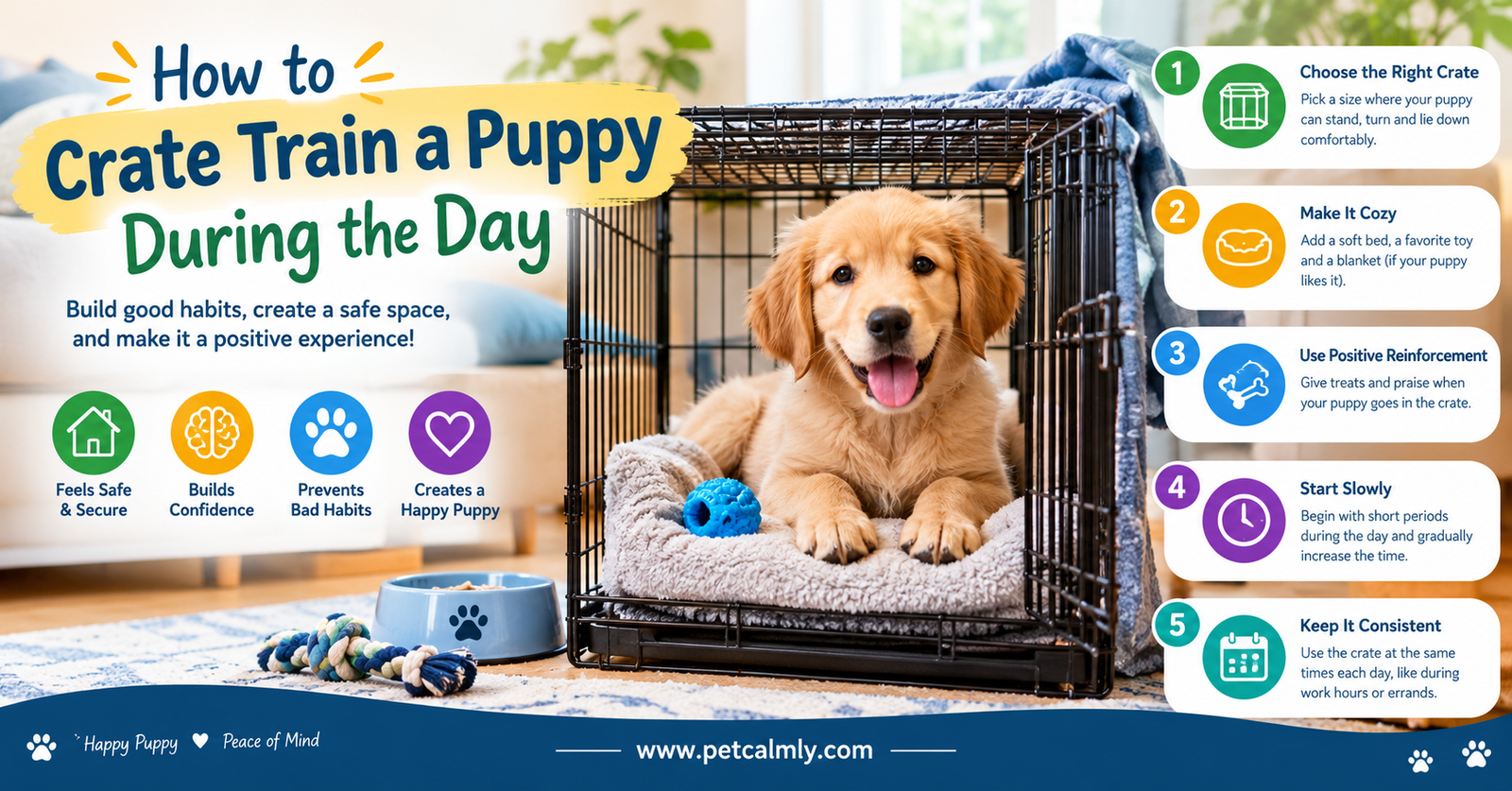
Your puppy’s crate should be large enough for them to stand up, turn around, and lie down comfortably but not so large that they can potty in one corner and sleep in another. This is critical for housebreaking because puppies have a natural instinct not to soil their sleeping area.
Sizing guide by breed:
- Small breeds (Chihuahua, Pug, Toy Poodle): 24–28 inches long
- Medium breeds (Beagle, Cocker Spaniel, Springer Spaniel): 30–36 inches long
- Large breeds (Golden Retriever, Labrador, German Shepherd): 42–48 inches long
- Giant breeds (Great Dane, Mastiff): 42–48 inches (or larger depending on adult size)
If you’re buying one crate for a growing puppy, consider a crate with a divider panel. You use the divider to reduce the space as your puppy grows, so you’re not buying multiple crates.
Setting Up a Comfortable Crate Space
Where you place the crate matters more than you might think.
Place the crate in a room where your family spends time during the day not isolated in a bedroom or garage. Your puppy is a social animal and wants to be near you. They’re far more likely to rest calmly in their crate if they can see and hear you while you’re working, cooking, or watching TV.
Line the crate with a washable, comfortable pad or blanket. This isn’t just for comfort it provides texture and scent that makes the space feel secure. Your puppy will naturally use the pad as a “bed” marker, which reinforces the idea that the crate is their space.
Leave the crate door open initially. This removes any sense of threat or surprise. Your puppy should explore it on their own terms, first getting used to the size, sounds, and feel of being inside.
Gathering Your Training Supplies
You’ll need the right rewards. This is where many people make mistakes. Kibble (your puppy’s regular food) won’t cut it. You need high-value treats small, soft, quick-to-eat rewards that your puppy goes crazy for. Some puppies lose their minds for small pieces of chicken, cheese, or commercial training treats like hot dog pieces. The key is finding what your puppy finds irresistible.
You’ll also want to have a chew toy or food-puzzle toy to leave in the crate during sessions. This gives your puppy something productive to do and creates additional positive associations.
The Daytime Crate Training Timeline: What to Expect
Here’s a realistic breakdown of what you’ll actually see across 2-4 weeks of consistent training.
Week 1: Exploration and Curiosity
Goal: Your puppy willingly enters the crate and explores it without fear.
This is about zero pressure. Leave the door open, drop treats in randomly, and let your puppy discover the crate at their own pace. Some puppies will investigate immediately; others will take a few days. Neither is wrong.
Say the word “crate” or “kennel” (whichever you prefer) in a happy, casual tone whenever your puppy naturally enters. Don’t make it a big deal. You’re just labeling the behavior that’s already happening.
Daily sessions: 3–5 times, as natural investigations happen Duration: 30 seconds to 2 minutes (your puppy controls the exit) Treat placement: Inside the crate, near the entrance, inside
Week 2: Building Positive Associations
Goal: Your puppy enters the crate willingly for treats and has neutral feelings about you briefly closing the door.
Now you’re deliberately placing treats or a stuffed food puzzle inside and letting your puppy enter to retrieve them. This teaches “crate = good things appear here.”
After your puppy eats a few treats and has been inside for 30–45 seconds, gently close the door for 5–10 seconds while your puppy is still inside exploring. Open it before any whining starts. The goal is a positive experience with the door being closed, not a crisis situation.
Daily sessions: 5–6 times Duration: 1–3 minutes Door closed time: 5–30 seconds Treat placement: Scattered inside, including a stuffed Kong or puzzle toy
Week 3: Building Duration and Calm Behavior
Goal: Your puppy stays in the crate for 15–20 minutes with the door closed while remaining calm.
By now, your puppy understands the crate is safe. You’re extending the time by very small increments. Close the door, step away (but stay in sight), and do your own thing for a few minutes. Initially, your puppy might whine—we’ll address this shortly. But as consistency builds, many puppies start to settle.
Daily sessions: 3–4 times Duration: 10–25 minutes Door closed time: 5–20 minutes Environment: Puppy can see you; you’re calm and not engaging with the whining
Week 4+: Integration into Daily Life
Goal: Your puppy accepts crate time as a normal part of the day.
At this stage, the crate training becomes less of a “training exercise” and more of a routine part of your puppy’s day. You’ll use it during work, errands, mealtime, or rest periods. Your puppy settles into it with minimal fuss.
This doesn’t mean every session is perfect some days your puppy will be more resistant, depending on mood, energy level, and what’s happening in your home. That’s normal.
How to Crate Train Your Puppy During the Day
Step 1: Make the First Introduction Effortless
Take your puppy to the crate when they’re naturally calm not when they’re overstimulated or frustrated. Mid-morning or after a meal works well. Leave the door completely open.
You don’t need to “introduce” them formally. Just let them sniff around. Sit near (not next to) the crate and do your own thing. If your puppy enters, great. If not, leave it. They’ll explore eventually.
When your puppy enters, say “good puppy” in a calm, quiet voice. Avoid jumping around or making it a huge celebration that actually creates excitement and teaches your puppy that entering the crate means you’re about to interrupt their calm with interaction.
Step 2: Feed Your Puppy in or Near the Crate
This is a stealth-mode training technique that most new owners miss. Start leaving your puppy’s kibble bowl right at the entrance of the crate. Then gradually move it inside, toward the back.
Puppies are food-motivated, and eating in the crate creates powerful, repeated positive associations without any formal training. By the time your puppy is eating their regular meals inside, they already believe the crate is a pleasant place.
Step 3: Play the “Treat Surprise” Game
With the door still open, toss high-value treats into the crate randomly throughout the day. Don’t announce it. Just when your puppy isn’t looking, toss a treat in and let them discover it. This teaches “good things appear in the crate without me asking for them.”
Do this 5–10 times daily for at least a week. It seems repetitive, but it’s building automatic positive associations.
Step 4: Name the Crate and Create a Cue
Choose a word: “crate,” “kennel,” “house,” or “bed.” Be consistent. Every time your puppy naturally enters the crate, quietly say the word in a calm, happy tone. You’re labeling the behavior, not commanding it.
After a week of this labeling, most puppies will start to enter the crate when they hear the word, because they’ve learned: “That word means I go in there and good things happen.”
Step 5: Close the Door Very Briefly at First
Once your puppy is entering freely and spending 1–2 minutes inside without stress, you can briefly close the door.
Do this while your puppy is actively eating a treat or engaging with a puzzle toy inside. Close the door gently for just 5 seconds, then open it before they realize what happened. Repeat this 3–4 times in one session, gradually extending to 10–15 seconds.
The key: always open the door before your puppy whines. If you wait until they whine to open it, you’ve just taught them that whining makes the door open. Instead, you want to build the association that the door closing = the door opening again, without any fuss required.
Step 6: Step Away While the Door Is Closed
Now extend the duration and add distance. Close the door, wait 10 seconds, then open it. Next session, 15 seconds. Next time, 20 seconds.
Crucially, while the door is closed, don’t look at your puppy, don’t talk to them, and don’t engage. You’re teaching them that being in the crate with the door closed isn’t an invitation to interact with you. It’s a calm, quiet space.
Step 7: Build Duration Gradually
Keep extending time by 5–10 second increments every few sessions. There’s no rush. After 2–3 weeks of consistent practice, most puppies will happily rest in their crate for 20–30 minutes while you’re visibly in the same room.
How Long Can Your Puppy Actually Stay in a Crate?
This is where realistic expectations matter.
A general guideline used by many trainers is one hour per month of age, plus one. So:
- 8 weeks: 3 hours maximum
- 12 weeks: 4 hours maximum
- 16 weeks: 5 hours maximum
- 6 months: 6–7 hours maximum
- 1 year+: 8 hours (adult dogs)
However, this is a maximum, not a goal. Your 3-month-old puppy can technically hold their bladder for 4 hours, but that doesn’t mean you should leave them in the crate for 4 hours every day. Puppies need frequent potty breaks, play, socialization, and exercise.
For daytime crate training specifically, most puppies do best with sessions of 30 minutes to 2 hours, with breaks in between for bathroom time, play, and interaction. If you’re using the crate during your work day, aim for multiple shorter sessions rather than one long confinement.
When Your Puppy Cries or Whines: The Hardest Part
Okay, let’s talk about the part that keeps new puppy owners awake at night: the crying.
Why Puppies Cry in the Crate
Your puppy cries because:
- They’re communicating “I want out” (very common)
- They need a potty break (legitimate)
- They’re lonely or overstimulated (needs soothing, not rewarding)
- They’re learning a new boundary (normal adjustment)
The Critical Rule: Don’t Reward the Crying
This is where crate training falls apart for most people. If you open the crate while your puppy is whining, you’ve accidentally taught them that whining = door opens. Now they’ll whine louder and longer, knowing it works.
Instead:
- Ignore the whining while staying calm yourself. Your puppy will sense your frustration, which makes them more anxious.
- Wait for a pause, even 5 seconds of silence, then open the door and calmly take them out.
- Immediately take them to the potty area in case they needed a bathroom break.
- Resume training only after a break, not immediately.
This is genuinely hard, especially if you live in an apartment or close to neighbors. But consistency here makes the difference between a puppy who settles after 3 weeks and one who’s still crying after 3 months.
Realistic Timelines for the Crying Phase
- Days 1–3: Crying is often intense and frequent. This is the hardest part.
- Days 4–7: Crying usually decreases but may spike with tiredness or frustration.
- Weeks 2–3: Most puppies show significant improvement. Some still cry occasionally.
- Week 4+: Many puppies settle into the crate with minimal fussing.
Some puppies cry less; some cry more. This depends on their temperament, your consistency, and what they’ve learned from previous experiences (e.g., if you’ve previously let them out during crying, it’ll take longer to change that pattern).
Distinguishing Between Normal Adjustment and Genuine Distress
Normal crate training crying:
- Whining or yelping that comes in waves
- Calms down if you leave the room
- Doesn’t escalate to panic barking or hysterical behavior
- Puppy settles after 5–20 minutes of crying
Signs your puppy may be genuinely distressed:
- Frantic, panicked barking or high-pitched yelping that doesn’t stop
- Excessive drooling, panting, or pacing
- Attempts to escape by climbing or digging at the crate
- Diarrhea or vomiting in the crate (not just accidents)
- Freezing or extreme lethargy
If your puppy shows these signs, something else may be happening. They could have a medical issue, severe separation anxiety, or a fear response rather than standard adjustment behavior. In these cases, consulting a certified dog trainer or veterinary behaviorist makes sense.
6 Common Mistakes That Derail Daytime Crate Training
Mistake 1: Moving Too Fast
This is the #1 reason crate training fails. You close the door for 5 minutes, your puppy panics, and then you’ve convinced both of you that the crate isn’t safe. Go slower than you think you need to. Seriously. The training actually gets faster when you don’t push too hard initially.
Mistake 2: Using the Crate as Punishment
Never say “Go to your crate!” as a consequence for bad behavior. Never use it to remove your puppy when they’re being annoying. The crate needs to stay positive in your puppy’s mind, or it becomes a place of dread.
If your puppy misbehaves, redirect them or ignore them. The crate is a safe space, not a timeout box.
Mistake 3: Insufficient Exercise Before Crate Time
A puppy with pent-up energy will absolutely fight the crate. Before asking your puppy to settle in the crate for 30+ minutes, give them a play session, a training session, or a potty break. A tired puppy is a settling puppy.
Mistake 4: Leaving Too Long Without Bathroom Breaks
Your puppy will have accidents if they physically can’t hold it anymore. This teaches them that the crate is a place where bathroom breaks happen, which makes the whole housebreaking process harder. Respect your puppy’s bladder capacity.
Mistake 5: Making the Crate the Only Confinement Space
If your puppy’s crate time is the only break they get from free roaming your house, they’ll resent the crate. Instead, use baby gates, pens, or closed doors to create naturally confined spaces throughout your home. The crate becomes one safe space among several, not the only place they’re ever restricted.
Mistake 6: Abandoning Consistency
The worst thing you can do is crate train perfectly for 10 days, then stop because your puppy seems to “get it.” Puppies need ongoing reinforcement. The crate shouldn’t be a temporary training tool it should become a permanent, normal part of your daily routine.
Signs Your Puppy Is Ready to Progress
You’ll know it’s time to extend duration or try new variations when:
- Your puppy enters the crate without hesitation or prompting
- The door closing causes minimal or no reaction
- Your puppy will rest calmly for 15–20 minutes with you in the room
- Your puppy isn’t having frequent accidents in the crate
- The whining phase has mostly resolved
- Your puppy sometimes voluntarily naps in the crate when the door is open
Troubleshooting: What If Training Isn’t Going Smoothly?
“My Puppy Refuses to Enter the Crate”
Go back to step 1. Feed all meals at the entrance, then inside. Drop treats randomly. Give it more time. Some puppies need 2–3 weeks just to become curious about the crate, and that’s fine.
If your puppy is actively avoiding it (not just indifferent), check:
- Is the crate in a scary location? Move it to a brighter, more social space.
- Is something in the crate uncomfortable? Try a different pad or bedding.
- Are you accidentally making it feel threatening? Never force your puppy inside.
“My Puppy Has Accidents in the Crate”
This usually means either:
- The crate is too large. Resize it with a divider.
- Your puppy has been in too long. Reduce duration.
- There’s a medical issue. If accidents are frequent despite appropriate sizing and duration, contact your vet.
- Your puppy hasn’t learned to hold their bladder yet. This is age-dependent and can’t be rushed.
“My Puppy Cries Constantly, Even After Weeks”
Check:
- Are you accidentally rewarding the crying sometimes? (Opening the door during whining, even once, restarts the learning process)
- Is your puppy getting enough exercise outside the crate?
- Could there be a medical issue or pain? Puppies in discomfort cry differently—it’s higher-pitched and more frantic.
- Does your puppy have true separation anxiety or fear-based reactions? This might need professional help.
“My Puppy Seems Happy in the Crate but Then Suddenly Acts Traumatized”
Puppies can shift their feelings about situations based on a single negative experience. If your puppy was trapped in the crate while needing a potty break, or got scared by something happening near the crate, they may regress. Go back to basics: open door, positive associations, slow progression. It’ll likely be faster the second time around.
Integrating Crate Time into Your Actual Daily Schedule
Real-life crate training looks different from training sessions.
During Your Work Day
If you’re working from home, you can use the crate for 30–90 minute blocks, depending on your puppy’s age. Let them out for a potty break, playtime, and interaction, then crate them again. This isn’t continuous confinement it’s strategic breaks that allow you to get work done without constant supervision.
If you’re leaving your puppy for 8 hours, they need a dog walker, doggy daycare, or someone checking in midday. No amount of crate training changes a puppy’s actual bladder capacity.
Before Naptime or Bedtime
Many puppies will naturally settle in the crate as part of their nap or sleep routine. A 15-minute play session, a potty break, a stuffed Kong, and crate time often naturally flow together. Your puppy learns to see the crate as “it’s rest time now.”
During Meals
Once your puppy is eating in the crate comfortably, feeding time becomes an automatic crate time. Your puppy eats, you close the door briefly, they settle, you open it. Zero resistance required.
When You’re Home But Busy
Use the crate during times when you need to be hands-off but present: cooking, video calls, cleaning, etc. This teaches your puppy that your presence doesn’t mean entertainment is guaranteed. They learn to self-soothe and occupy themselves.
When Should You Talk to a Professional?
Crate training is usually very manageable with patience, but some situations benefit from expert help.
Consider a certified dog trainer or veterinary behaviorist if:
- Your puppy shows signs of panic or extreme distress that don’t improve after 4 weeks of consistent, proper training
- Your puppy has a history of confinement trauma (rescued puppies, previously confined for long periods)
- Your puppy shows signs of separation anxiety beyond normal adjustment
- You’re uncertain whether your puppy’s behavior is normal adjustment or a deeper issue
- Crate training conflicts with other behavioral concerns you’re experiencing
A professional can assess your specific puppy, rule out medical issues, and create a tailored plan. There’s no shame in getting help it often makes the whole process faster and less stressful for everyone.
Frequently Asked Questions
1: How old should my puppy be before starting crate training?
You can start introducing the crate at any age, even 8 weeks. However, very young puppies (8-12 weeks) can’t physically hold their bladder long, so expect frequent potty breaks and accidents. The training is still valuable you’re building positive associations and teaching the concept. The duration naturally extends as your puppy grows.
2: Is crate training the same as potty training?
They’re related but different. Crate training teaches your puppy that the crate is a safe, positive space. It supports potty training because puppies naturally avoid soiling their sleeping area, so the crate encourages them to hold it. But crate training itself isn’t potty training. You still need to actively teach your puppy where it’s appropriate to go to the bathroom.
3: Can I crate train a puppy if I live in an apartment?
Yes, absolutely. The crying phase is harder in apartments because the sound carries, but the training works the same way. You’ll want to be especially consistent about not opening the crate during whining, since the motivation to stop the noise is higher. A white noise machine can help mask the sound for neighbors.
4: What’s the difference between a crate and a playpen?
A crate is smaller and more den-like, encouraging settling. A playpen is larger and allows more movement. Both are useful. Many owners use a playpen during the day (when the puppy needs more space to play) and a crate for specific rest times. They serve different purposes.
5: How do I know if my puppy has separation anxiety vs. normal crate adjustment?
Normal adjustment: Crying that eventually stops, settling after 10-20 minutes, calming when you leave the room, no panic behavior.
Separation anxiety: Persistent panic (not calming after 20+ minutes), frantic behavior, attempts to escape, destructive behavior, or continued distress even after weeks of training. True separation anxiety requires different training approaches and sometimes professional help.
6: Should I use a crate at night or only during the day?
Many owners use the crate both day and night. Nighttime crate training works similarly to daytime training and supports housebreaking. However, this guide focuses on daytime training. Nighttime training has some different considerations (like where the crate is located relative to your bed, handling nighttime potty breaks, etc.), so it’s worth researching separately if you plan to use the crate for sleeping.
More Information About Pets, Please Visit Our Website: Puppy Sleeping After Vaccination
How to Litter Train a Kitten Without Mother
How to Stop Puppy Biting
How to Reduce Dog Anxiety During Thunderstorms
Best Natural Dog Calming Treats
How to Clean a Puppy Without Bathing
Conclusion
Crate training isn’t a race. The puppies who settle most comfortably in their crates aren’t the ones trained the fastest they’re the ones trained the most patiently.
Every time you resist the urge to rush, every time you wait for your puppy to calm down before opening the door, every time you end on a positive note you’re building your puppy’s confidence. You’re teaching them that you’re trustworthy, that new situations are manageable, and that they can solve problems without panic.
That’s not just good crate training. That’s the foundation of a well-adjusted dog.
Start slow, stay consistent, celebrate small wins, and remember: your puppy isn’t trying to be difficult. They’re trying to understand the world, and you’re teaching them that it’s a safe place. That takes time, but it’s absolutely worth it.