Short direct answer
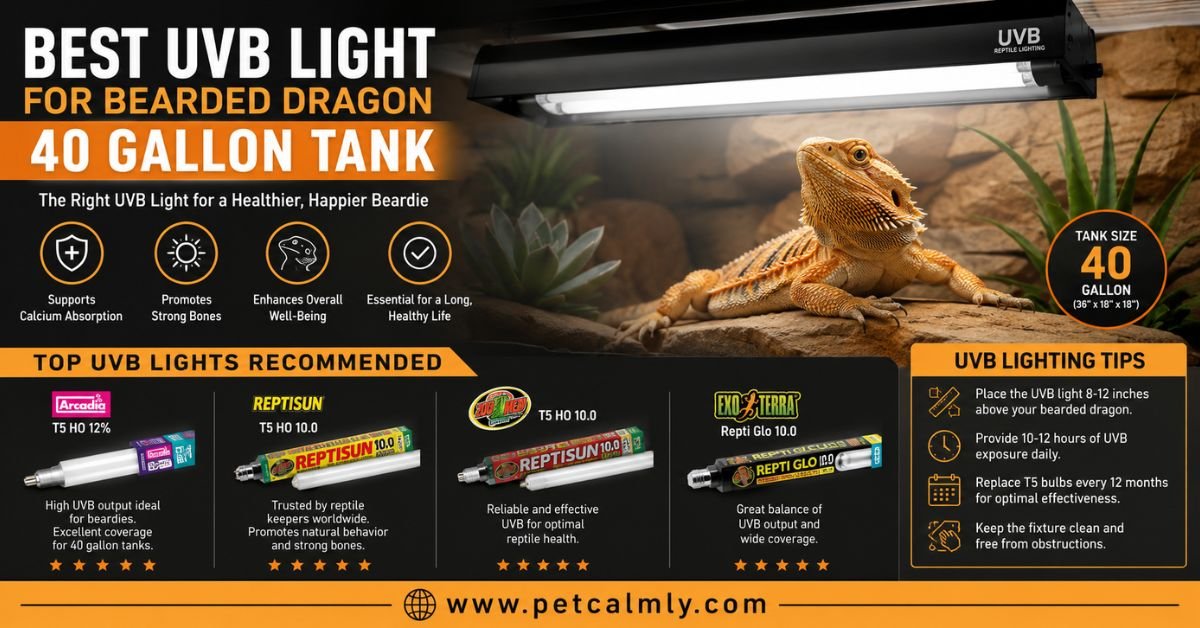
The best UVB light for a bearded dragon in a 40-gallon tank is a high-output T5 fluorescent tube that provides 10–12% UVB, such as the Arcadia ProT5 12% UVB Kit or Zoo Med ReptiSun T5 HO 10.0. Unlike compact UVB bulbs, a full-length T5 tube spreads UVB evenly across the enclosure, helping your bearded dragon produce vitamin D3, absorb calcium properly, and avoid serious health problems like metabolic bone disease. Pair the UVB light with a proper basking bulb, replace it on schedule, and position it at the correct distance for the healthiest habitat.
Introduction
Choosing the right UVB light isn’t just another item on your shopping list it’s one of the most important decisions you’ll make for your bearded dragon.
Many new owners spend time comparing basking bulbs, decorations, or tank accessories but underestimate the role of UVB lighting. Unfortunately, poor UVB exposure is one of the most common reasons bearded dragons develop weak bones, reduced appetite, slow growth, or unusual behavior.
If your bearded dragon lives in a 40-gallon tank, selecting the correct UVB fixture becomes even more important because the enclosure size affects how light spreads and how far your pet sits from the bulb.
This guide explains everything you need to know, from choosing the best UVB fixture to avoiding common lighting mistakes that many beginners unknowingly make. Whether you’re setting up your first enclosure or upgrading an older habitat, you’ll learn how to create lighting that closely mimics the Australian sunlight bearded dragons evolved under.
Understanding the Search Intent Behind This Topic
Most people searching for “best UVB light for bearded dragon 40 gallon tank” are trying to answer questions like:
- Which UVB bulb is safest?
- Is a T5 or T8 UVB better?
- Can I use a coil UVB bulb?
- How long should the UVB fixture be?
- Where should the light be placed?
- Which UVB strength is best for a 40-gallon enclosure?
- How often should UVB bulbs be replaced?
- What happens if my bearded dragon doesn’t get enough UVB?
This guide answers all of these questions in one place so you can confidently choose the right lighting without wasting money on products that don’t meet your pet’s needs.
Why UVB Light Is Essential for Bearded Dragons
Bearded dragons come from the sunny, dry regions of Australia, where they naturally spend hours basking under intense sunlight.
In captivity, they rely entirely on their owner to recreate those conditions.
Without proper UVB exposure, even the healthiest diet cannot fully support normal bone development.
UVB light helps your bearded dragon:
- Produce vitamin D3 naturally
- Absorb calcium from food
- Build and maintain strong bones
- Support healthy muscle function
- Maintain a strong immune system
- Encourage normal growth in juveniles
- Promote natural activity levels
- Support healthy egg production in females
Think of UVB as an invisible nutrient. Your dragon cannot see it, but its body depends on it every single day.
What Happens If a Bearded Dragon Doesn’t Get Enough UVB?
Poor UVB lighting often causes problems gradually rather than overnight.
Early signs can be subtle, which is why many owners don’t notice anything wrong until the condition becomes serious.
Some common symptoms include:
- Reduced appetite
- Sleeping more than usual
- Weak legs
- Trembling while walking
- Difficulty climbing
- Soft jaw
- Swollen limbs
- Slow growth
- Frequent falls
- Poor shedding
- Muscle weakness
Over time, chronic UVB deficiency can contribute to metabolic bone disease (MBD), one of the most serious yet preventable conditions seen in captive reptiles. Adequate UVB lighting, along with proper calcium supplementation and nutrition, plays a key role in reducing this risk.
Important: If your bearded dragon shows weakness, deformities, repeated falls, or difficulty moving, schedule an examination with an experienced exotic animal veterinarian as soon as possible.
Best UVB Light for a Bearded Dragon 40 Gallon Tank: What to Look For
Not all reptile lights produce the same amount or quality of UVB.
Many inexpensive bulbs advertise UVB output but fail to provide sufficient coverage across the enclosure.
Instead of focusing only on wattage, consider these key factors.
Choose a T5 High Output UVB Tube
Today, most reptile lighting experts recommend T5 High Output (HO) fluorescent tubes for bearded dragons.
They provide:
- Strong UVB output
- Even light distribution
- Better penetration through mesh lids
- Longer effective lifespan
- Wider basking coverage
- More natural lighting conditions
A T5 fixture is especially beneficial in a 40-gallon tank because it creates a larger usable UVB zone rather than concentrating light in a single small spot.
Select the Correct UVB Strength
For most standard 40-gallon breeder enclosures, look for bulbs rated around:
- 10% UVB
- 12% UVB
These strengths closely match the needs of desert reptiles like bearded dragons when installed at the proper distance.
Very low-output bulbs often fail to provide adequate UVB, while excessively strong bulbs placed too close can expose your dragon to more UVB than intended. Proper bulb strength and placement work together to create a safe basking zone.
Choose the Right Fixture Length
A common mistake is buying a UVB fixture that only covers a small section of the enclosure.
Instead, the UVB tube should span approximately half to two-thirds of the tank’s length.
This creates two important areas:
Warm UVB Zone
Your dragon can bask while receiving both heat and UVB.
Cooler Shade Zone
Your dragon can move away when it wants to cool down while still having access to visible light.
This natural temperature and light gradient allows your pet to regulate its body temperature and UVB exposure throughout the day.
T5 vs T8 vs Compact UVB Bulbs
Many first-time owners are confused by the different UVB bulb styles.
Here’s how they compare.
| UVB Type | Suitable for a 40-Gallon Tank? | Why |
|---|---|---|
| T5 High Output Tube | ⭐⭐⭐⭐⭐ Excellent | Strong, even UVB coverage and ideal for desert reptiles. |
| T8 Fluorescent Tube | ⭐⭐⭐ Good | Works in some setups but produces lower UVB and usually needs to be mounted closer. |
| Compact/Coil UVB Bulb | ⭐⭐ Limited | Covers only a small area and may leave much of the enclosure without adequate UVB. |
| Mercury Vapor Bulb | ⭐⭐ Sometimes | Combines heat and UVB but requires careful setup and is less flexible for smaller enclosures. |
For most 40-gallon habitats, a T5 High Output UVB tube is the most reliable and beginner-friendly choice.
Can You Use a Compact UVB Bulb?
Technically, yes but it’s usually not the best option.
Compact UVB bulbs tend to create a narrow beam of ultraviolet light, meaning your bearded dragon only receives adequate exposure while sitting directly beneath the bulb.
In a 40-gallon enclosure, this often leaves large areas without meaningful UVB coverage.
This setup can lead to inconsistent exposure, especially if your dragon enjoys exploring different parts of the enclosure.
For this reason, experienced keepers generally recommend a full-length T5 UVB tube instead of relying on a compact bulb as the primary UVB source.
Features to Look for in the Best UVB Light
When comparing different UVB lighting systems, keep these features in mind.
High UVB Output
Look for bulbs specifically designed for desert reptiles with a UVB output around 10–12%.
Reflective Hood
A quality reflector directs more UVB downward into the enclosure instead of allowing light to scatter upward.
Long Lifespan
Even if a UVB bulb still appears bright, its UVB output gradually declines over time. Quality bulbs generally maintain useful UVB levels longer than budget alternatives, though they should still be replaced according to the manufacturer’s recommendations.
Reliable Brand Reputation
Well-established reptile lighting brands typically provide more consistent UVB output and quality control than generic alternatives.
Compatibility with Mesh Tops
If your enclosure has a screen lid, choose a fixture designed to deliver adequate UVB through mesh or consider mounting it safely inside the enclosure if appropriate for your setup.
Common Beginner Mistakes When Buying UVB Lighting
Many health problems begin with simple setup errors rather than poor intentions.
Avoid these common mistakes:
- Buying the cheapest UVB bulb available.
- Confusing LED lights with UVB lights.
- Using only a heat bulb without UVB.
- Choosing a fixture that’s too short.
- Leaving old UVB bulbs in use for years.
- Mounting the fixture too high above the basking area.
- Placing decorations that completely block UVB from reaching the basking spot.
- Assuming bright visible light automatically means sufficient UVB.
Correcting these issues early can make a significant difference in your bearded dragon’s long-term health.
The Best Types of UVB Lights Worth Considering
Rather than focusing on dozens of nearly identical products, it’s more useful to understand the categories that consistently perform well.
Generally, the best options include:
- High-output T5 UVB kits with built-in reflectors.
- Desert-rated 10–12% UVB fluorescent tubes.
- Fixtures designed to cover at least half of a 40-gallon enclosure.
- Systems from reputable reptile lighting manufacturers known for consistent UVB output.
Best UVB Light for a Bearded Dragon 40 Gallon Tank: Top Picks Compared
Now that you know why UVB lighting is so important, it’s time to compare the best options available. These recommendations are based on their ability to provide consistent UVB output, cover a 40-gallon enclosure effectively, and support the long-term health of a bearded dragon.
Rather than choosing the cheapest bulb, focus on reliability, proper coverage, and ease of installation.
Arcadia ProT5 12% UVB Kit – Best Overall Choice
For most bearded dragon owners, the Arcadia ProT5 12% UVB Kit is one of the best all-around options.
It combines a high-output T5 UVB tube, a reflective fixture, and simple installation. The reflector helps direct more usable UVB toward the basking area instead of wasting light inside the fixture.
Why it’s a great choice
- High-output 12% UVB for desert reptiles
- Excellent coverage across a 40-gallon tank
- Includes a quality reflector
- Easy to mount above or inside many enclosures
- Trusted by many experienced reptile keepers
Best for
- Juvenile bearded dragons
- Adult bearded dragons
- New enclosure setups
- Owners upgrading from compact bulbs
Zoo Med ReptiSun T5 HO 10.0 – Best Value
The Zoo Med ReptiSun T5 HO 10.0 has been a trusted choice among reptile keepers for many years.
It delivers dependable UVB output while fitting most standard T5 fixtures.
Advantages
- Reliable UVB production
- Widely available
- Good value for the price
- Works well in 40-gallon breeder tanks
- Proven performance over many years
Many owners choose this bulb because replacement tubes are easy to find when it’s time for routine maintenance.
Arcadia Desert 12% T5 Tube
If you already own a compatible T5 fixture, purchasing the replacement tube separately can save money.
The Arcadia Desert 12% tube provides strong UVB output suitable for desert reptiles.
Good choice for
- Existing T5 fixtures
- Experienced keepers
- Enclosure upgrades
Zoo Med ReptiSun T8 10.0
Although older than T5 technology, the T8 version still works when installed correctly.
However, it produces lower UVB intensity and usually needs to be mounted much closer to the basking area.
Consider this only if
- You already own a T8 fixture
- Your enclosure allows proper mounting distance
- You’re working within a limited budget
If buying a completely new setup, a T5 system is usually the better long-term investment.
UVB Lights That Are Usually Less Suitable
Some lighting products appear attractive because they’re inexpensive or widely advertised, but they often aren’t ideal as the primary UVB source for a 40-gallon bearded dragon enclosure.
These include:
- Small compact UVB bulbs
- Decorative LED reptile lights
- Colored reptile bulbs marketed as “all-in-one”
- Low-output tropical UVB bulbs
- Unknown generic brands with inconsistent UVB performance
A bright bulb isn’t necessarily producing the UVB your dragon needs.
How Long Should the UVB Fixture Be for a 40-Gallon Tank?
A standard 40-gallon breeder tank measures approximately:
- 36 inches long
- 18 inches wide
- 16 inches high
For this size enclosure, most keepers choose a UVB fixture measuring 22–24 inches.
This allows the UVB light to cover around half to two-thirds of the enclosure while leaving a shaded area where your dragon can rest.
Avoid installing a UVB tube that stretches across the entire tank from end to end. Your bearded dragon should always have the option to move into lower-UV areas whenever it chooses.
Where Should You Place the UVB Light?
Proper placement is just as important as choosing the correct bulb.
The UVB fixture should run alongside the basking lamp rather than on the opposite side of the enclosure.
This mimics natural sunlight, where heat and UVB come from the same direction.
Ideal Layout
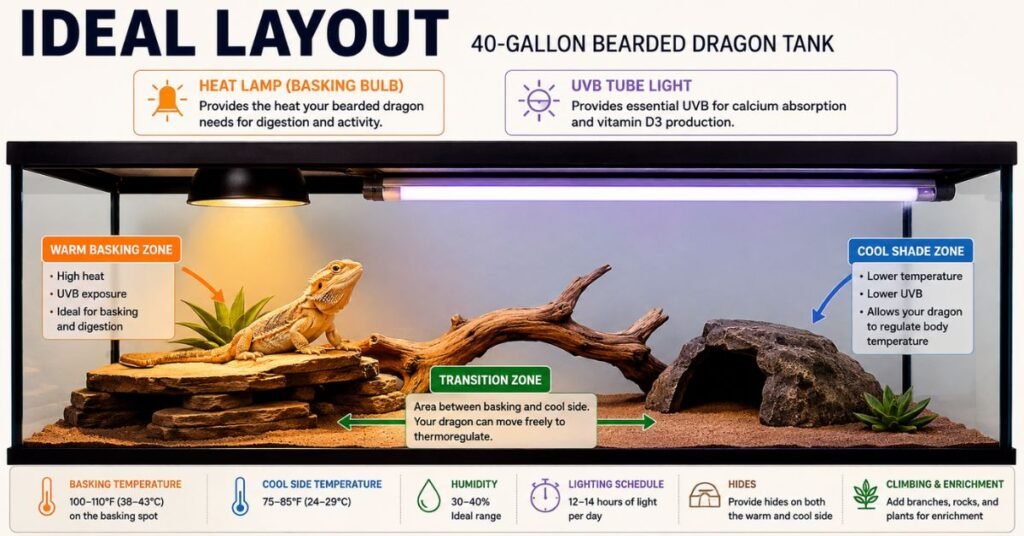
When your dragon climbs onto the basking platform, it should receive both warmth and UVB at the same time.
Should the UVB Fixture Be Mounted Inside or Above the Tank?
This depends on your enclosure.
Mounted Above a Mesh Lid
This is the most common setup.
Pros:
- Easy installation
- Safe from moisture
- Protected from curious pets
- Convenient for maintenance
However, remember that mesh screens can reduce the amount of UVB reaching your dragon. Fine metal mesh blocks more UVB than many people realize, so always follow the bulb manufacturer’s recommended distance for screen-top installations.
Mounted Inside the Enclosure
Some owners mount the fixture inside the enclosure.
Advantages include:
- Stronger UVB exposure
- Less UVB blocked by mesh
- More efficient lighting
If you choose this option, make sure the fixture is securely mounted and positioned so your dragon cannot touch or climb directly onto it.
How Far Should the UVB Light Be from the Basking Spot?
Distance matters because UVB intensity changes quickly as you move farther from the bulb.
The exact distance depends on:
- T5 or T8 bulb
- UVB percentage
- Reflector quality
- Mesh lid
- Mounting location
A general guideline is:
| UVB Setup | Approximate Distance to Basking Area |
|---|---|
| T5 HO with reflector (inside enclosure) | 12–18 inches |
| T5 HO above mesh | 10–14 inches (depending on mesh type) |
| T8 fixture | 6–8 inches |
Always check the manufacturer’s instructions, as different fixtures are designed to perform at specific distances.
Pair the UVB Light with the Right Heat Lamp
UVB bulbs are not designed to produce basking heat.
You’ll need a separate basking bulb to create the warm temperatures bearded dragons require for digestion and activity.
The basking area should allow your dragon to warm up while also receiving UVB.
This combination helps your pet:
- Digest food efficiently
- Absorb calcium effectively
- Stay active throughout the day
- Maintain healthy metabolism
Using only a UVB bulb without heat or only a heat bulb without UVB creates an incomplete habitat.
How Many Hours Should the UVB Light Stay On?
A consistent day-night cycle is important.
Most adult bearded dragons benefit from:
- 12–14 hours of light during spring and summer
- 10–12 hours during winter, depending on normal seasonal husbandry
Many owners use an automatic timer so the lights switch on and off at the same time every day.
Keeping a regular schedule reduces stress and encourages natural daily behavior.
When Should You Replace the UVB Bulb?
One of the biggest misconceptions is that a UVB bulb is still effective as long as it lights up.
Visible light and UVB are not the same thing.
Even when a bulb still looks bright, its UVB output gradually decreases over time.
As a general rule:
- Replace T5 UVB tubes according to the manufacturer’s recommended schedule, often around 12 months.
- Replace T8 tubes more frequently, commonly around 6 months, depending on the product.
If you own a UV Index meter, you can monitor UVB output more precisely instead of relying only on the calendar.
Signs Your UVB Light May No Longer Be Effective
Sometimes the enclosure still looks bright, but your dragon begins showing subtle changes.
Watch for:
- Spending less time basking
- Reduced appetite
- Lower activity levels
- Slower growth in juveniles
- Difficulty shedding
- Weak grip
- Softer jawline
- Increased sleeping during normal daylight hours
These signs don’t automatically mean the UVB bulb has failed, but they do suggest it’s time to review your lighting, temperatures, diet, and overall husbandry. If symptoms persist, consult an experienced exotic animal veterinarian.
5 Common UVB Setup Mistakes to Avoid
Even experienced reptile owners occasionally make lighting mistakes.
Here are some of the most common:
Using a Heat Bulb Instead of UVB
Heat bulbs provide warmth but almost no useful UVB.
Your dragon needs both.
Installing the UVB on the Cool Side
The UVB fixture should overlap the basking area.
Otherwise, your dragon must choose between staying warm and receiving UVB, which isn’t natural.
Placing Glass Between the Bulb and the Dragon
Standard glass and acrylic block nearly all useful UVB rays.
The UVB light must shine directly into the enclosure without passing through glass or plastic.
Forgetting to Replace Old Bulbs
UVB gradually weakens long before the bulb burns out.
Mark the installation date on the fixture or set a calendar reminder so replacements aren’t forgotten.
Using Decorations That Block UVB
Large branches, caves, artificial plants, or stacked rocks can cast heavy shadows over the basking area.
Arrange decorations so your dragon has a clear, unobstructed place to bask under both heat and UVB.
UVB Lighting Maintenance Checklist
Keeping your lighting system in good condition doesn’t take much time, but regular maintenance makes a big difference.
Use this simple checklist:
- ✔ Check that the UVB bulb turns on every day.
- ✔ Wipe dust from the fixture regularly (when powered off and cool).
- ✔ Replace bulbs according to the manufacturer’s schedule.
- ✔ Inspect fixtures and cords for wear or damage.
- ✔ Confirm the basking platform is still at the correct distance.
- ✔ Recheck temperatures after moving decorations or changing bulbs.
- ✔ Observe your dragon’s daily basking behavior for any changes.
These small routine checks can help prevent many common husbandry problems before they affect your pet.
How to Choose the Best UVB Light for Your Budget
Not every bearded dragon owner has the same budget, but UVB lighting is one area where quality matters. A dependable UVB system can help prevent expensive health problems later and gives your dragon the conditions it needs to thrive.
Here’s how to choose based on your situation.
Best Premium Option
If you want a complete, long-lasting lighting system with excellent performance, choose a T5 High Output kit with a reflector, such as the Arcadia ProT5 12% Kit.
This option offers:
- Excellent UVB coverage
- High-quality reflector
- Simple installation
- Reliable long-term performance
- Ideal lighting for a standard 40-gallon tank
It’s a worthwhile investment for both first-time and experienced keepers.
Best Mid-Range Choice
If you’re looking for strong performance at a more affordable price, the Zoo Med ReptiSun T5 HO 10.0 is an excellent option.
It provides dependable UVB output and is widely available, making replacement bulbs easy to find.
Best Budget Option
If you already own a compatible T5 fixture, purchasing only a replacement UVB tube can save money.
Avoid choosing the cheapest unknown brand simply because it costs less. Consistent UVB output is more important than a low purchase price.
Quick Comparison Table
| Feature | T5 HO UVB Tube | T8 UVB Tube | Compact UVB Bulb |
|---|---|---|---|
| UVB Coverage | Excellent | Good | Limited |
| Best for 40-Gallon Tank | ✅ Yes | ✔ Acceptable | ❌ Not Ideal |
| Mesh Lid Performance | Excellent | Fair | Poor |
| Even Light Distribution | Excellent | Good | Limited |
| Easy for Beginners | Yes | Moderate | Limited |
| Long-Term Value | Excellent | Good | Fair |
For most owners, a T5 High Output UVB tube remains the best overall choice because it provides consistent, enclosure-wide UVB exposure that closely matches the needs of a bearded dragon.
Sample Lighting Setup for a 40-Gallon Bearded Dragon Tank
A balanced enclosure should include more than just a UVB bulb.
A typical setup looks like this:
| Equipment | Recommendation |
|---|---|
| UVB Light | T5 HO 10–12% UVB tube |
| Heat Source | Separate basking bulb |
| Thermometer | Digital probe thermometer |
| Hygrometer | Monitor humidity |
| Timer | Automatic 12–14 hour light cycle |
| Basking Platform | Positioned at the correct UVB distance |
| Cool Hide | Located away from the basking area |
This combination creates a natural temperature and lighting gradient, allowing your bearded dragon to regulate its body temperature and UVB exposure throughout the day.
Mistakes to Avoid When Setting Up a 40-Gallon Tank
Even with the right equipment, small setup mistakes can reduce the effectiveness of your lighting.
Avoid these common errors:
Buying an LED Instead of a UVB Bulb
LED lights brighten the enclosure but do not provide the UVB needed for vitamin D3 production.
Placing the UVB Too Far Away
If the basking platform is too far below the fixture, your dragon may receive little or no useful UVB.
Covering the Fixture
Decorative lids, thick screens, or objects placed over the fixture can reduce the amount of UVB reaching your pet.
Forgetting to Replace Bulbs
UVB output declines with time, even if the bulb still looks bright.
Using Colored Daytime Bulbs
White daylight bulbs create a more natural environment and make it easier for your dragon to regulate its daily activity.
How to Tell If Your Bearded Dragon Is Benefiting from Proper UVB
A healthy bearded dragon won’t thank you for good lighting—but its behavior often will.
Signs your lighting setup is working well include:
- Regular basking after lights turn on
- Strong appetite
- Bright, alert eyes
- Active exploration
- Healthy growth in juveniles
- Strong grip while climbing
- Normal movement without weakness
- Consistent shedding
- Well-formed stools when diet and hydration are also appropriate
Good lighting works together with proper nutrition, hydration, heating, and overall husbandry.
When Should You Worry About Your Bearded Dragon?
Lighting problems can sometimes lead to serious health issues if they go unnoticed.
Contact an experienced exotic animal veterinarian if your bearded dragon has:
- Persistent loss of appetite
- Noticeable weight loss
- Weak or swollen legs
- Tremors or shaking
- Soft jaw or curved limbs
- Difficulty walking or climbing
- Frequent falls
- Repeated fractures
- Severe lethargy
- Eyes that remain closed for long periods despite proper temperatures and lighting
These symptoms may indicate metabolic bone disease or another illness that requires professional diagnosis and treatment. While improving the lighting setup is important, it should not replace veterinary care when your dragon is showing signs of illness.
What Should Bearded Dragon Owners Do?
If you’re setting up a 40-gallon enclosure, focus on the essentials rather than buying every reptile accessory available.
A simple action plan is:
- Choose a quality T5 High Output UVB fixture.
- Select a 10–12% UVB tube designed for desert reptiles.
- Position the UVB over the basking area.
- Pair it with an appropriate basking heat bulb.
- Check temperatures using reliable digital thermometers.
- Feed a balanced diet with appropriate calcium supplementation.
- Replace the UVB bulb on the manufacturer’s recommended schedule.
- Observe your dragon’s behavior every day for any changes.
Consistent daily care is far more valuable than expensive gadgets.
Frequently Asked Questions
1: What is the best UVB light for a 40-gallon bearded dragon tank?
A T5 High Output fluorescent tube with 10–12% UVB is generally the best choice. It provides broad, consistent UVB coverage and supports healthy calcium metabolism when installed at the correct distance.
2: Is a T5 UVB better than a compact UVB bulb?
Yes. A T5 UVB tube covers a much larger area, allowing your bearded dragon to receive consistent UVB while basking. Compact bulbs are better suited for smaller enclosures or species with lower UVB requirements.
3: Can a bearded dragon survive without UVB light?
A bearded dragon may survive for a short period without UVB, but it cannot remain healthy long term. Lack of UVB can lead to poor calcium absorption, weakened bones, reduced appetite, and serious health problems.
4: How often should I replace a bearded dragon UVB bulb?
Follow the manufacturer’s replacement schedule. Many T5 bulbs are replaced around every 12 months, while T8 bulbs often require replacement sooner. Even if the bulb still produces visible light, its UVB output will gradually decrease.
5: Should the UVB light stay on all day?
UVB lighting should follow a regular day-night cycle. Most owners provide 12–14 hours of light each day during the active season, using an automatic timer for consistency.
6: Can UVB shine through glass?
No. Standard glass and acrylic block nearly all useful UVB rays. The UVB light should shine directly into the enclosure without glass or plastic between the bulb and your bearded dragon.
More Information About Pets, Please Visit Our Website: Bearded Dragon Basking Temperature
Common Bearded Dragon Health Problems
Safe Vegetables for Bearded Dragons
Why Is My Bearded Dragon Not Eating?
Bearded Dragon Stress Signs
Bearded Dragon Tank Setup Guide
Conclusion
Choosing the best UVB light for a bearded dragon 40 gallon tank is one of the most important investments you can make in your pet’s long-term health. A high-quality T5 High Output 10–12% UVB tube provides the broad, reliable coverage that closely replicates natural sunlight and supports healthy bone development, calcium absorption, normal growth, and active behavior.
Remember that even the best UVB bulb works only as part of a complete husbandry setup. Correct temperatures, a nutritious diet, proper calcium supplementation, regular bulb replacement, and careful observation all work together to keep your bearded dragon thriving.
If you’re ever unsure whether your lighting setup is providing the right conditions or your dragon begins showing signs such as weakness, appetite loss, or difficulty moving don’t delay seeking advice from an experienced exotic animal veterinarian. Early action can make a significant difference to your pet’s health.
By investing in quality lighting and following good husbandry practices, you’ll create a safe, natural environment where your bearded dragon can live a healthy and active life.