Short direct answer
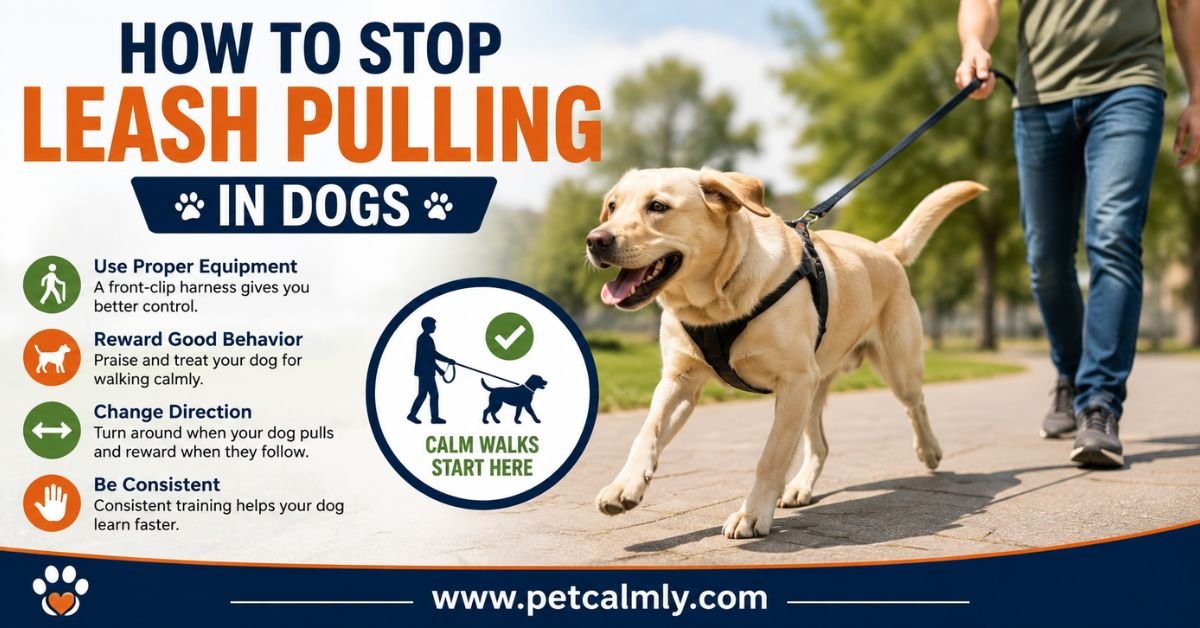
Leash pulling happens because dogs haven’t learned to walk calmly beside you yet. The fastest solution is to stop moving forward when your dog pulls, reward them for slack leash walking, and stay consistent. Most dogs respond to this “no pull training” approach within 2–3 weeks, though some behaviors take longer to fully break. Using a front-clip harness, redirecting attention before pulling starts, and teaching a solid “heel” command create lasting change.
Why Your Dog Pulls on the Leash (And It’s Not Dominance)
Before we talk solutions, it helps to understand why pulling happens in the first place.
Your dog isn’t pulling to test you or show dominance that’s actually a myth veterinary behaviorists have largely debunked. Dogs pull because they’re goal-driven and haven’t yet learned that pulling doesn’t work.
When your dog tugs toward a squirrel, another dog, or an interesting smell, they’re experiencing a moment of genuine excitement or curiosity. If pulling actually gets them to that place faster, they learn: “Pulling reaching my goal.” You just accidentally trained them to pull.
Dogs also pull because:
They haven’t learned what you want yet. Many owners correct pulling but never teach the alternative behavior. Your dog needs to actually understand what “walking next to me” looks like and feels like.
Walks feel like freedom. Some dogs are so over-stimulated by the outdoor environment that self-control feels impossible. Their arousal level is too high.
Pulling works sometimes. If your dog pulled and you eventually moved forward (even reluctantly), the pulling “paid off” at least once. That’s enough to reinforce the behavior.
Medical or behavioral issues are present. Rarely, constant pulling indicates pain, anxiety, or an underlying behavioral condition worth discussing with your vet or certified trainer.
The good news? Understanding the reason makes the solution clearer.
Common Leash Pulling Mistakes Dog Owners Make
Before you start training, know what doesn’t work or makes things worse.
Using a retractable leash is the biggest mistake. These leashes actually reward pulling by allowing 16+ feet of loose line. Your dog learns that pulling extends their reach, which is exactly the opposite of what you want to teach.
Yanking or jerking the leash sends confusing signals. It might startle your dog into stopping for a moment, but it doesn’t teach them what to do instead. It can also damage your dog’s neck, trachea, or thyroid if done repeatedly.
Punishing without teaching. Saying “no!” or correcting your dog after they’ve already pulled isn’t effective. Dogs need to learn the right behavior, not just what’s wrong.
Inconsistency. Walking with a loose leash on Tuesday but letting your dog pull on Thursday confuses them. They don’t know which behavior earns rewards. Everyone in your household needs to enforce the same rule.
Ignoring your dog’s arousal level. If your dog is over-stimulated, training is nearly impossible. You need to first lower their arousal before expecting focus.
Using only a collar instead of proper equipment. A flat collar on a pulling dog can cause tracheal collapse, especially in small breeds. A front-clip harness redirects pulling safely.
How to Stop Leash Pulling: The Complete Training Method
The Foundation: Stop-and-Go Training
This is the most effective, humane, and consistent method for teaching loose-leash walking.
What you’re doing: Every time your dog pulls ahead, you stop moving. You don’t jerk. You don’t correct. You simply become immovable until they release the pressure on the leash.
How to start:
- Clip a 4–6 foot standard leash (not retractable) to your dog’s collar or harness.
- Begin walking in a safe area—a quiet street, driveway, or empty parking lot works perfectly.
- Walk forward normally. The moment your dog steps ahead and creates tension on the leash, stop.
- Stand silently and calmly. Don’t talk to your dog or interact.
- Wait. Your dog will eventually look back at you, sniff the ground, sit, or just ease off the pressure.
- The instant the leash becomes slack, say “Yes!” or use a clicker and reward with a treat immediately.
- Resume walking.
Repeat this 10–15 times per walk. Within days, your dog starts to notice: “When I pull, we stop. When I don’t pull, we go.”
Why this works: Dogs are outcome-oriented. If pulling stops all forward progress, they stop pulling. There’s no physical punishment, no confusion, and no reason to resent you. You’re simply making the math clear: slack leash = forward motion. Tight leash = nothing happens.
Timeline: Some dogs catch on within 3–5 days. Others need 2–3 weeks. Consistency matters far more than speed.
Reward the Right Behavior Aggressively
Timing and rewards are everything.
Many owners use too-small treats or reward too infrequently. Your dog needs to see a clear connection between walking calmly and good things happening.
High-value rewards work fastest:
- Small pieces of chicken, cheese, or turkey
- Soft training treats (easier to eat quickly)
- Praise + physical affection
- Access to sniff something (the dog version of a reward)
Reward placement matters: When your dog walks beside you with a slack leash, toss a treat directly in front of them or feed it from your hand near your leg. This creates a mental association: staying close to you = good things happen.
Reward frequently at first sometimes every 3–5 steps. Gradually space rewards further apart as the behavior becomes automatic. After several weeks, your dog should walk beside you expecting nothing, because the behavior itself has become the new default.
Front-Clip Harnesses: When Equipment Helps
A front-clip (or “no-pull”) harness redirects your dog’s momentum toward you instead of forward, making it harder (and less rewarding) to pull.
The leash connects to a ring on the dog’s chest, not their neck. When your dog pulls, they turn slightly toward you rather than charging ahead. This mechanical disadvantage, combined with the stop-and-go method, speeds up learning.
Front-clip harnesses are especially helpful for:
- Large, strong dogs
- Dogs with neck sensitivity or tracheal issues
- Owners with limited strength
- Dogs who haven’t responded to collar training alone
They’re not a magic fix. A harness doesn’t teach behavior it just makes pulling less rewarding. You still need to train consistently.
Note: Avoid chest harnesses that connect on the back (like the Ruffwear Cloud Chaser or K9 Sport Sack). Back-clip harnesses actually encourage pulling by allowing forward momentum. Front-clip is the way to go.
Popular and effective options include the Eagloo No-Pull Harness, Rabbitgoo Front-Clip Harness, and Blue-9 Balance Harness all affordable and widely available.
Teaching “Heel” (Optional But Powerful)
Once your dog understands that loose leash movement, you can formalize the behavior with a heel command.
“Heel” simply means: “Walk on my left side with a slack leash.” It’s not necessary for every dog, but it’s useful in unpredictable situations (parking lots, busy streets, meeting other dogs).
Teaching heel:
- Start with high-value treats and your dog on your left side.
- Say “Heel” and take a few steps forward.
- If your dog stays beside you, reward immediately.
- Practice in short sessions (5–10 minutes) in low-distraction areas first.
- Gradually increase difficulty: busier locations, longer distances, more distractions.
Heel training typically takes 4–8 weeks to solidify, depending on your dog’s experience with training.
Managing Distractions and High-Arousal Situations
Pulling often gets worse when your dog spots something exciting—another dog, a squirrel, a person with a treat bag.
This is normal. In high-arousal moments, your dog’s impulse control collapses temporarily. Managing this requires a different approach than basic training.
Before the Distraction Appears
Prevention is easier than correction.
Increase distance. If your dog goes wild around other dogs, cross the street or change routes to avoid those situations while training.
Lower arousal proactively. A tired dog pulls less. A 15-minute fetch session or chase game before your walk makes loose-leash walking easier.
Use higher-value rewards in distracting areas. Save your best treats for walks near dog parks or busy streets where your dog’s attention is most divided.
Stay calm yourself. Your dog feels tension in the leash and reads your body language. If you tense up when you see a distraction, your dog gets the message that something exciting is happening.
When Your Dog Pulls Toward a Distraction
Stay consistent with stop-and-go. Don’t move forward. Don’t move toward the distraction. Sometimes, you need to actually increase distance (by turning and walking away) to reset your dog’s arousal.
Once your dog refocuses on you and the leash relaxes, reward generously.
Special Situations and Age Considerations
Puppies and Young Dogs
Young dogs pull because they lack impulse control and coordination, not because they’re “learning dominance.” Leash training puppies is actually easier than with adults—they haven’t spent years reinforcing the pulling habit.
Start stop-and-go training as soon as your puppy is ready for walks (after initial vaccinations). Keep sessions short (5–10 minutes) because puppies tire quickly and have short attention spans.
Use softer, smaller treats because puppies can’t always finish large ones mid-walk.
Senior Dogs with New Pulling Problems
If your older dog suddenly starts pulling after years of calm walking, something’s changed. Consider:
- Pain or discomfort. Arthritis, hip dysplasia, or spinal issues can change gait and cause pulling. A vet check is wise.
- Cognitive changes. Older dogs sometimes lose housetraining or behavioral control. Dementia is possible.
- Reduced arousal or awareness. Some seniors pull less because they’re less interested in the world. If pulling just started, pain is the most likely cause.
Don’t assume it’s a training regression. Rule out medical issues first.
Dogs with Anxiety or Reactivity
If your dog pulls away from stimuli (backing up, trying to flee, trembling), you’re dealing with anxiety, not normal pulling.
Similarly, if your dog lunges, growls, or snaps when pulling toward another dog or person, reactivity is the real issue—not lack of leash manners.
These behaviors need different solutions:
- Anxiety-driven pulling often requires counterconditioning (changing your dog’s emotional response to triggers).
- Reactivity might need professional help from a certified trainer or veterinary behaviorist.
- In severe cases, anti-anxiety medication prescribed by your vet can help your dog think clearly during training.
If your dog shows fear, anxiety, or aggression, consult a professional before assuming standard leash training will work.
Avoiding Setbacks and Maintaining Progress
Training doesn’t move in a straight line. You’ll see progress, then occasional regression. Here’s how to keep moving forward.
Stay consistent across everyone. If you use stop-and-go but your partner or kids let your dog pull, progress stalls. Get everyone in your household on the same page.
Don’t use the same route every day. Varying where you walk keeps your dog engaged and prevents them from autopiloting into old pulling patterns.
Refresh training in distracting environments. Your dog might walk perfectly in your quiet neighborhood but pull like crazy downtown. Retrain in each new environment.
Avoid long walks when tired. Inconsistent training teaches your dog that the rule is flexible. Short, intentional walks where you can enforce the behavior consistently work better than marathon strolls where you’re exhausted and let things slide.
Celebrate small wins. Notice when your dog walks for even 30 seconds with a loose leash and reward it. Building a new habit takes patience.
When to Seek Professional Help
Most dogs respond beautifully to stop-and-go training within a few weeks. But some situations call for a professional trainer or behaviorist.
Reach out to a trainer if:
- Your dog shows no improvement after 4–6 weeks of consistent training
- You feel unsafe or nervous handling your dog on the leash
- Your dog has anxiety, reactivity, or aggression in addition to pulling
- You’re inconsistent or frustrated, and a human coach would help you stay accountable
Look for:
- Certified trainers with credentials from IAABC, CPDT-KA, or CCPDT
- Force-free, positive reinforcement methods
- Someone willing to assess your individual dog (not one-size-fits-all solutions)
- Local references or online reviews from real clients
A good trainer can spot what’s actually driving your dog’s pulling whether it’s true lack of training, anxiety, frustration, or something else and customize a plan accordingly.
More Information About Pets, Please Visit Our Website: Do Dogs Understand Cat Body Language?
How to Stop Dog Chewing
How to Stop Puppy Biting
Why Does My Dog Bark at Night for No Reason?
When One Dog Dies Does the Other Grieve?
How to Potty Train a Puppy at Night
Frequently Asked Questions
1: How long does it take to stop leash pulling?
Most dogs show noticeable improvement within 2–3 weeks of consistent stop-and-go training. Full habits typically take 8–12 weeks to solidify, depending on your dog’s age and how long they’ve been pulling. Consistency matters far more than time.
2: Is my dog pulling because they think they’re the “alpha”?
No. The alpha/dominance theory has been largely debunked by modern animal behaviorists and veterinarians. Dogs pull because they haven’t learned that it doesn’t work, or because they’re excited, anxious, or not taught an alternative. Dominance isn’t the issue.
3: Can I use a retractable leash for loose-leash training?
No. Retractable leashes actively teach pulling the more your dog pulls, the more line they get. They also pose safety risks (tangling, sudden jolts, entanglement). Use a fixed 4–6 foot standard leash for training and ideally for most walks.
4: What if my dog pulls no matter what I do?
First, rule out medical issues. Have your vet check for pain, thyroid problems, or neurological conditions. Then consider whether your dog is over-stimulated, anxious, or reactive rather than simply untrained. Finally, consistency matters enormously if progress isn’t happening, it usually means someone in your household is breaking the training rule. A trainer can identify what’s actually happening.
5: Is a collar or harness better for leash training?
For most dogs, a front-clip harness is safer and more effective, especially for strong dogs or those with neck sensitivity. If you use a collar, ensure it’s a flat collar that won’t slip over your dog’s head, and monitor for tracheal strain (coughing, wheezing). Never use a choke chain or prong collar for everyday walking these outdated tools can cause physical and emotional damage.
6: What do I do if my dog pulls while I’m holding the leash with my hand?
The stop-and-go method works the same way: stop moving, wait for slack, reward. Your grip on the leash should be firm but not tight. Some owners find wrapping the leash around their waist (with a quick-release knot) gives better leverage. Never wrap it around your wrist you need to be able to release instantly if needed.
Making It Stick: Your Action Plan
Here’s how to start this week:
Day 1–3: Get a 4–6 foot fixed leash (if you don’t have one) and practice stop-and-go in a low-distraction area for 10–15 minutes daily. Don’t worry about “heel” or fancy commands yet just get your dog comfortable with the basic concept.
Week 2: Increase your training to 15–20 minutes per session. Start introducing brief walks in slightly busier areas (residential street with occasional passing cars). Reward heavily when your dog succeeds.
Week 3: If using a front-clip harness, introduce it now if progress is slow. Practice stop-and-go with the new equipment for 3–4 days before moving to busier environments.
Week 4+: Gradually phase out training treats in favor of random rewards and verbal praise. Your dog should now walk beside you as their default behavior, not expecting constant treats.
Keep a simple log. Track which walks went well and which were harder. Look for patterns (Was my dog tired? Were there distractions? Did I stay consistent?). This helps you troubleshoot if progress stalls.
The Deeper Truth About Leash Manners
Here’s something many training articles miss: leash pulling usually stops not because your dog fears consequences, but because they understand that calm walking is how the world works in your presence.
The best leash-trained dogs aren’t perfectly behaved because they’re afraid of correction. They’re calm because they’ve learned your expectations, and because you’ve made it worth their while to cooperate.
That’s a relationship. That’s trust.
When you use stop-and-go training instead of physical punishment, your dog learns to respect your boundaries not because you’ve forced them, but because they’ve chosen to work with you. Walk around any dog park and notice: the calmest, most obedient dogs often have owners who smile and talk to them, not owners barking commands and jerking leashes.
Take the long view. Your investment in consistent, patient leash training now pays dividends for the entire life you share with your dog.
Conclusion
Leash pulling isn’t a sign of a badly behaved dog or a bad owner. It’s just a behavior that hasn’t been interrupted and retrained yet. The good news? It’s one of the most responsive behaviors to fix.
Start with stop-and-go training, stay consistent, and reward the behavior you want to see. Within weeks, your walks should feel calmer, safer, and more enjoyable for both of you.
If progress stalls or your dog shows anxiety or reactivity alongside the pulling, bring in a certified trainer. Sometimes a professional eye saves months of frustration.
Your dog can learn to walk calmly beside you. Most dogs do and yours can too.