
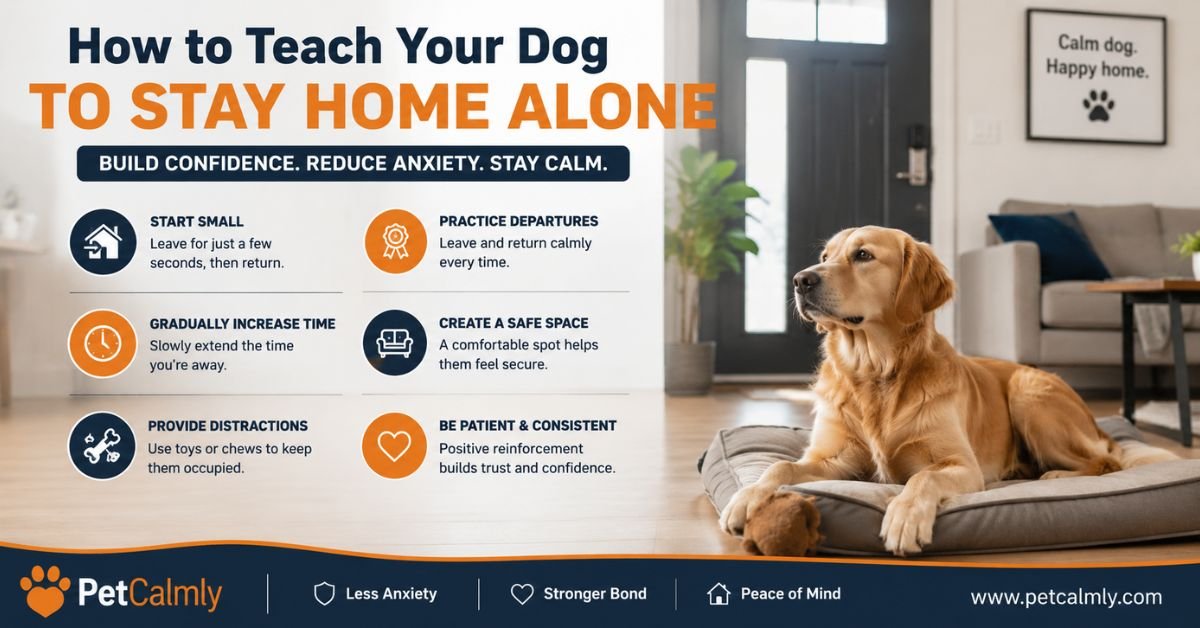
Short direct answer
Teaching a dog to stay home alone means building independence gradually starting with short, calm departures of just a few minutes and slowly working up to longer absences, while giving your dog a predictable routine, a safe space, and something enjoyable to do while you’re gone. Dogs learn to feel okay being alone the same way people get comfortable with anything unfamiliar: through repeated, low-stress exposure that never pushes them past what they can handle. Rushing this process is the single biggest reason training fails.
If your dog barks the second you grab your keys, scratches at the door, or greets you like you’ve been gone for a year (even if it was twenty minutes), you’re not doing anything wrong as an owner. You’re just missing a system. That’s what this guide gives you.
Why Dogs Struggle With Being Left Alone in the First Place
Dogs are social animals that evolved alongside humans, and many breeds were specifically developed to work closely with people herding, guarding, or accompanying us throughout the day. Being suddenly left in an empty house isn’t a “bad habit.” For a lot of dogs, it’s genuinely confusing.
There’s also a practical reason this feels harder than other training. With commands like “sit” or “stay,” you can see your dog succeed in real time and reward it instantly. Alone-time training is different the hardest part happens after you’ve already walked out the door, which means you can’t reward calm behavior the moment it happens. That’s part of why so many owners feel stuck.
A few common triggers make the struggle worse:
- A sudden change in schedule going from working at home to commuting five days a week, for example
- A recent move, where the dog hasn’t yet learned the new home feels safe
- Getting a puppy without ever practicing solo time, so being alone is a “first” instead of a routine
- A stressful event while alone, like a thunderstorm or a loud delivery, that the dog now associates with being by themselves
None of these mean your dog is broken or “too anxious to fix.” They mean the dog hasn’t yet learned that alone time is safe and temporary and that’s a learnable skill.
Separation Anxiety vs. Normal Adjustment: Know the Difference First
Before you start training, it helps to know which situation you’re actually dealing with, because the approach is different.
Normal adjustment looks like a bit of whining at the door for the first minute or two, then settling down. The dog might follow you room to room out of habit but doesn’t panic when a door closes between you.
True separation-related distress is more intense and doesn’t fade on its own. According to Cornell University College of Veterinary Medicine and VCA Animal Hospitals, signs can include:
- Non-stop barking, howling, or crying that continues the whole time you’re gone
- Destructive chewing focused specifically on doors, windows, or exit points
- Pacing, drooling, or panting even in a cool room
- Accidents indoors from a fully house-trained dog
- Self-injury from attempting to escape a crate or room
If your dog is showing several of these signs regularly, especially escape attempts or self-injury, this is a good moment to loop in your veterinarian or a certified separation-anxiety trainer before continuing with home-based training. Some dogs benefit from a structured behavior modification plan alongside training, and in some cases short-term medication support makes the training process possible in the first place. That’s not a failure it’s the same as needing a coach for anything that feels too big to tackle solo.
The rest of this guide focuses on the more common scenario: a dog who gets stressed or restless when left alone but doesn’t have a diagnosed anxiety condition.
The Core Method: Building Alone-Time Tolerance Step by Step
The training approach that behaviorists most often recommend is sometimes called graduated departures — essentially, teaching your dog that doors closing and you leaving is a normal, temporary, safe event, by proving it in tiny increments before asking for anything bigger.
Step 1: Practice the “Leaving Rituals” Without Actually Leaving
Dogs are excellent at reading patterns. Grabbing your keys, putting on shoes, or picking up a bag can become a trigger for anxiety on its own, because your dog has learned that sequence predicts you disappearing.
Break that pattern by doing these actions randomly throughout the day without leaving. Put your shoes on and sit down to watch TV. Grab your keys and set them back down. Pick up your bag and walk it to another room. Do this enough times and the ritual stops meaning “panic” — it just becomes something that happens sometimes.
Step 2: Start With Seconds, Not Minutes
Open the door, step outside, and come right back in. That’s it for your first session. If your dog stayed calm — no frantic barking, no pawing at the door you’ve succeeded.
Over several days, extend the time in small increments: 10 seconds, then 30, then a minute, then five. The goal isn’t to rush toward “an hour by Friday.” It’s to never let your dog reach full-blown distress during practice, because every panicked departure can undo progress rather than build it.
A simple way to track this:
| Session | Time Away | What to Watch For |
|---|---|---|
| 1–3 | 5–15 seconds | Dog stays settled, no barking before you’re even out the door |
| 4–8 | 30 seconds–2 minutes | Brief whining is okay; escalating panic means slow down |
| 9–15 | 5–15 minutes | Dog should be resting or engaged with an activity by minute 3–4 |
| 16+ | 30 minutes–several hours | Only progress here once shorter absences are consistently calm |
If your dog struggles at any stage, that’s useful information not a setback. Go back to the last comfortable duration and stay there a few extra sessions before trying to extend again.
Step 3: Separate “Alone” From “Bad Things Happening”
A dog left alone with nothing to do is a dog who’s likely to get anxious, bored, or both. Before you leave — even for the short practice sessions give your dog something engaging to redirect their focus:
- A frozen food-stuffed toy (this takes longer to finish, which matters for longer absences)
- A snuffle mat or slow-feeder puzzle
- A long-lasting, vet-approved chew appropriate for your dog’s size
The idea is that your departure becomes associated with “something good is starting,” not “something good is ending.”
Step 4: Create a Consistent Safe Space
Whether that’s a crate, a gated-off room, or simply their bed in a quiet corner, dogs generally do better with a defined space rather than free run of the house while unsupervised. This isn’t about restriction for its own sake it’s about giving your dog fewer decisions to make and fewer opportunities to get into something stressful (a delivery at the door, a car passing the window) while you’re not there to help them process it.
If you’re using a crate, make sure your dog already sees it as a comfortable place before alone-time training starts, not as a tool introduced at the same time as being left. Crate comfort and alone-time comfort are two separate skills teach them separately.
How Long Can a Dog Realistically Be Left Alone?
This question comes up constantly, and the honest answer is: it depends on age, training progress, and bladder control not just what feels convenient for your schedule.
As a general guideline that many trainers and veterinarians reference:
- Puppies (8–16 weeks): No more than 1–2 hours, and often less. Their bladders simply can’t hold longer, regardless of how “good” they’re being.
- Puppies (4–6 months): Roughly 3–4 hours, gradually increasing.
- Adult dogs, house-trained and alone-trained: Most healthy adult dogs can comfortably manage 4–6 hours, and many handle a typical 8-hour workday once fully trained — though a midday walk or a dog walker still makes a meaningful difference in their comfort and physical health.
- Senior dogs: Bladder control and joint stiffness often mean shorter windows are kinder, even if the dog was fine with longer stretches earlier in life.
These are starting points, not guarantees a dog with health issues, high anxiety, or very little alone-time practice may need much shorter windows regardless of age. If you’re regularly gone longer than your dog can comfortably handle, a midday dog walker, a trusted neighbor, or a half-day at doggy daycare isn’t a sign of failure it’s a practical accommodation, the same way you’d arrange childcare around a schedule that doesn’t fit perfectly.
Does Breed or Personality Change the Approach?
The core method stays the same across breeds, but some dogs need extra consideration:
Working and herding breeds (Border Collies, Australian Shepherds, German Shepherds) were bred for near-constant mental and physical engagement. For these dogs, boredom often looks like anxiety even when it isn’t purely separation-related. Longer, more demanding enrichment puzzle toys that take real effort, not just a few licks tends to matter more here than for lower-energy breeds.
Companion and lap breeds (Cavalier King Charles Spaniels, French Bulldogs, many toy breeds) were often specifically bred to stay close to people, which can make the “alone” part of alone-time training feel like a bigger ask. This doesn’t mean they can’t learn it — it just means the graduated steps in this guide may need to move a little slower, with more repetitions at each stage before extending time.
Rescue dogs with unknown histories sometimes carry alone-time stress that has nothing to do with anything you’ve done. A dog surrendered after a move, a divorce, or a previous owner’s long work hours may have learned that being left alone predicts abandonment. Patience matters more than speed here and so does not taking slow progress personally.
Older dogs newly experiencing alone-time distress (after previously being fine) are worth a vet visit before assuming it’s purely behavioral. Cognitive changes, vision or hearing loss, and pain can all show up first as new anxiety around being left alone.
Building a Predictable Daily Routine Around Alone Time
Training sessions matter, but so does the structure around them. Dogs that know roughly what to expect each day tend to settle faster when left alone, because the absence fits into a pattern instead of feeling random.
A simple daily rhythm that supports alone-time comfort might look like:
- Morning: Exercise or play before you leave, so your dog isn’t departing with a full tank of pent-up energy
- Departure: Calm, low-key, with an enrichment item ready
- Midday (if possible): A break, walk, or check-in around the halfway point of a long absence
- Return: Calm greeting save the excited play for a few minutes after you’re both settled, not the instant you walk in
- Evening: Normal connection time, so your dog isn’t only getting attention right as you’re about to leave again
This isn’t about rigid scheduling down to the minute. It’s about giving your dog a recognizable shape to the day, which reduces the guesswork that often fuels anxiety.
Signs Your Dog Is Actually Ready to Progress
One of the trickiest parts of this training is knowing when to move to the next step versus when to stay put a while longer. Look for these signals before extending time:
- Your dog settles into rest (lying down, relaxed body) within the first few minutes of you leaving, rather than staying alert at the door
- Greetings when you return are calm rather than frantic
- Enrichment items get used rather than ignored out of stress
- No new damage to doors, crates, or windows
- Consistent success across at least three to five sessions at the current duration, not just one lucky day
If even one of these is missing, that’s your cue to repeat the current stage rather than push forward. Progress that happens too fast tends to unravel faster than it built.
Mistakes That Quietly Sabotage Alone-Time Training
Even well-intentioned owners run into the same handful of missteps.
Making departures and arrivals a big emotional event. An excited “I’m SO sorry, I missed you SO much!” greeting after every outing teaches your dog that your return is a huge deal which, by contrast, makes your leaving feel like a huge deal too. Keep both low-key. A calm “hey, good dog” beats a two-minute reunion.
Only practicing when you’re actually leaving for work. If the first time your dog experiences a long alone period is also the first real test, you haven’t given them a chance to build the skill gradually. Practice on weekends and days off too.
Punishing destructive behavior after the fact. If you come home to a chewed doorframe, scolding your dog at that point doesn’t connect the correction to the behavior dogs don’t reason backward through time the way people do. It usually just adds confusion or fear around your arrival, without addressing why the chewing happened.
Skipping exercise before departures. A dog with pent-up physical energy has a much harder time settling into calm, restful alone time. A walk, a game of fetch, or even ten minutes of focused play before you leave makes a real difference.
Jumping straight to full workdays. This is the most common one. Going from “never alone” to “alone for eight hours” skips the entire foundation this guide is built on.
When Should You Worry?
Most dogs improve steadily with consistent practice over two to six weeks. It’s worth paying closer attention and possibly getting professional input if you notice:
- No improvement at all after several weeks of consistent, gradual practice
- Escalating distress rather than the gradual calming you’d expect
- Any self-injury, including bleeding paws, broken teeth from crate-biting, or bloody noses from scratching at doors
- Loss of appetite specifically tied to being left alone
- Your dog is under six months old and showing extreme distress very young puppies sometimes need a modified approach, and a vet visit can rule out something else going on
None of this is a DIY-only situation once it reaches that level. A veterinarian can check for underlying medical contributors, and a certified separation-anxiety trainer can build a structured plan matched to your dog’s specific triggers.
What Should Pet Owners Do Right Now?
If you’re starting today, here’s a realistic first-week plan:
- Day 1–2: Practice leaving rituals (keys, shoes, bag) without leaving the house.
- Day 2–3: Begin 5–30 second departures, several times a day.
- Day 4–5: Extend to 1–5 minutes if your dog stayed calm the day before.
- Day 6–7: Introduce a stuffed toy or puzzle feeder at the start of each practice session.
- Ongoing: Keep a simple log even just notes in your phone of duration and how your dog handled it, so you can spot patterns instead of guessing.
Consistency across a week or two matters more than any single “perfect” session.
A Realistic Example
Picture a dog adopted from a shelter, where they’d likely spent most of their time surrounded by other dogs and staff. In a new home, being left alone for the first time even for a quick grocery run could understandably be distressing, since the dog has no history of that being safe. Owners in this situation typically see the fastest turnaround not from a single long session, but from many short, boring, uneventful departures stacked close together: out for ten seconds, back in, repeat, several times over a weekend, before ever attempting a real errand. By the time a genuine outing happens, the dog has already rehearsed “this is normal” dozens of times.
Conclusion
Teaching a dog to feel comfortable home alone isn’t about toughing it out or hoping they grow out of it it’s a gradual, trainable skill built on small wins repeated consistently. Start smaller than feels necessary, keep departures and arrivals calm, give your dog something worthwhile to do while you’re gone, and extend the time only as fast as your dog’s behavior tells you they’re ready. For most dogs, that patient approach is enough. For dogs showing real distress rather than mild adjustment, pairing this training with veterinary or professional behaviorist support gives them the best shot at genuine comfort not just quiet compliance.
More Information About Pets, Please Visit Our Website: How to Train a Stubborn Dog
How to Train a Stubborn Dog to Walk on a Leash
How to Stop Leash Pulling in Dogs
Why Does My Dog Bark at Night for No Reason?
What causes sudden anxiety in dogs?
Dog Acting Strange Suddenly at Night
Frequently Asked Questions
1: How long does it take to train a dog to stay home alone?
Most dogs show noticeable improvement within two to six weeks of consistent, gradual practice, though this varies with the individual dog’s temperament, age, and history.
2: What age can I start leaving my puppy home alone?
Very short, supervised practice (a few seconds to a couple of minutes) can start as soon as a puppy settles into your home, but puppies generally shouldn’t be left for long stretches until they’re a bit older and have built up bladder control and confidence — check with your vet for guidance specific to your puppy.
3: Is it cruel to crate train a dog for alone time?
Not when it’s introduced properly. A crate that’s been positively associated with comfort and safety beforehand can actually reduce stress by giving a dog a defined, secure space it becomes a problem only if the crate itself is a source of fear or used purely for confinement without any positive association.
4: Should I get a camera to check on my dog while I’m gone?
It can be genuinely useful for spotting patterns (when does the barking start, does it fade or escalate), but try not to use it to intervene in real time checking in through a speaker or rushing home when you see distress can reinforce the very behavior you’re trying to reduce.
5: Does getting a second dog fix separation issues?
Not usually, and it’s not a reliable substitute for training. A dog’s discomfort with being alone is often tied to being separated from their owner specifically, not simply being alone in the house so a companion animal may help some dogs but leaves the underlying issue untouched for others.
6: What’s the difference between boredom and separation anxiety?
Boredom-related behavior (chewing, digging) tends to be sporadic and often centers on interesting objects. Separation-related distress is usually more intense, happens close to the time you leave, and focuses on exit points like doors and windows rather than random items around the house.