Short direct answer
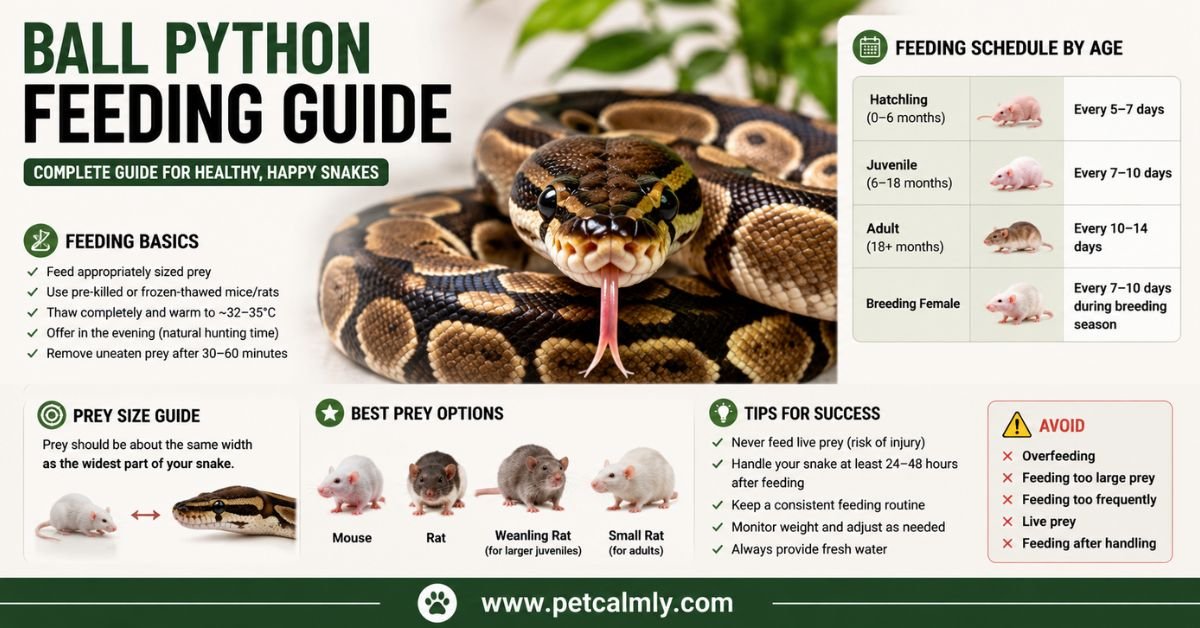
Feeding your ball python shouldn’t feel stressful. Here’s what you need to know immediately: most ball pythons eat one appropriately-sized prey item once every 7-10 days. For younger snakes, that’s every 5-7 days. Prey should be roughly the same width as your snake’s thickest body part not bigger. Start with frozen-thawed mice or small rats, wait 24-48 hours after handling your snake to feed, and never leave uneaten prey in the enclosure. That’s the foundation. Everything beyond that builds on these basics.
Why Feeding Matters for Your Ball Python’s Health
When you first bring home a ball python, feeding feels like it should be the hard part. The enclosure setup, humidity, temperature, handling those all seem to take learning. But feeding, you think, is simple: just drop food in and you’re done.
Then your ball python refuses. Or eats. Or eats too much. Or you’re lying awake wondering if that’s a healthy lump in its belly.
The truth is this: feeding is one of the most important aspects of ball python care, and it’s also where owners make the most mistakes usually unintentional ones. Getting feeding right means your ball python thrives, maintains a healthy weight, and stays free from stress-related illnesses. Get it wrong, and you’re looking at nutritional deficiencies, obesity, regurgitation, or a snake that permanently refuses food.
The good news? Once you understand why we feed the way we do, feeding becomes straightforward and confident.
This guide walks you through everything: what to feed, how often, prey size, the live-versus-frozen debate, why your snake might refuse food, and how to handle common feeding scenarios. By the end, you’ll know exactly what your individual ball python needs.
What Do Ball Pythons Eat in the Wild?
Before we talk about captive feeding, it helps to know what ball pythons naturally hunt. In West African grasslands and scrublands, wild ball pythons are ambush predators that eat small mammals primarily rodents like rats and mice, but also shrews and other small creatures.
Ball pythons are sit-and-wait hunters, not active pursuers. They find a good spot, coil up, and wait for prey to pass. This shapes everything about how they behave in captivity, including their feeding preferences and patterns.
In nature, they don’t eat every day. They hunt opportunistically. When prey is scarce, they might go weeks between meals. When they find prey, they eat and digest slowly. This is important because it means your ball python didn’t evolve expecting frequent meals—it evolved expecting occasional, substantial meals with long digestive periods in between.
Understanding that foundation changes how you approach captive feeding. You’re not trying to mimic daily feeding. You’re providing adequate nutrition on a schedule that respects their natural metabolism.
How Often Should You Feed Your Ball Python?
Feeding frequency is the question I hear most often, and the answer depends on your snake’s age.
Hatchlings and Young Snakes (Under 12 Months)
Young ball pythons have higher metabolic rates and smaller bodies, so they need more frequent meals. Feed hatchlings and juveniles every 5-7 days. At this stage, they’re growing rapidly, and regular feeding supports that growth.
Watch your young snake’s body condition. You should see a gentle taper from the body toward the tail—not a sharp stick or an overstuffed sausage. If your baby looks like it’s disappearing into itself, increase feeding frequency slightly. If it’s visibly chunky, extend the interval.
Subadults and Adults (1 Year and Older)
Once your ball python reaches about 12 months old (roughly 24-30 inches), switch to every 7-10 days. Most adults do well on a 7-day schedule, but some owners stretch it to 10 days without issue. The key is consistency and observation.
Some owners feed every 5 days year-round and see no problems. Others prefer every 10-14 days. As long as your snake maintains a healthy weight and eats regularly, you’re in the right zone. Ball pythons are individuals what works for one might not work for another.
Breeding and Gravid Females
If you’re breeding ball pythons, increase feeding frequency for females you’re conditioning for breeding and for gravid females carrying eggs. These snakes have higher energy demands. Feed them every 5-7 days during conditioning and pregnancy. Resume normal feeding after she’s finished laying eggs and has recovered.
What Size Prey Should You Feed Your Ball Python?
This is where a lot of feeding goes wrong. The most common mistake is feeding prey that’s too large.
The Basic Rule: Prey should be roughly the same width (diameter) as your snake’s thickest body part usually somewhere around the middle of the body. Think of it this way: imagine putting a marble next to a pencil. The marble should be close to the pencil’s width, not larger than it.
For a visual check, some keepers use the “mouse body width equals snake body width” approach. If you’re feeding a mouse, it should be a mouse that roughly matches your snake’s girth. Not an adult house mouse if your snake is still a hatchling.
Prey Sizes by Snake Age
Hatchlings: Pinky mice or small pinky rats (1-3 grams). Some hatchlings might start on smaller pinkies; others jump to larger ones quickly. Watch how easily your hatchling eats—if it seems to struggle, go smaller.
Young Juveniles (3-6 months): Fuzzy mice or small rats (5-15 grams). This is typically where most keepers land.
Larger Juveniles and Young Adults (6-12 months): Weaner to small adult mice or rats (15-40 grams), depending on the snake’s size.
Adults: Small to medium adult rats (40-100 grams). Some smaller females might take large mice; some large males might eventually graduate to large rats. This varies by individual.
Weight-Based Feeding: A practical approach is to feed prey that’s about 5-10% of your snake’s body weight. If your ball python weighs 1,000 grams, a 50-100 gram rat is appropriate. This method removes guesswork.
The Danger of Oversized Prey
Feeding prey that’s too large causes several problems:
- Regurgitation: The most obvious issue. Your snake eats, then throws up the meal 1-4 days later. Besides being unpleasant to witness, regurgitation stresses your snake, damages the esophagus over time, and wastes the energy it took to digest.
- Impaction: Oversized prey can cause blockages, especially if your snake doesn’t drink enough water during digestion.
- Unnecessary stress: Your snake has to work harder to consume and digest an oversized meal. Over time, chronic stress suppresses appetite and immune function.
- Metabolic compromise: Your snake might be eating enough calories, but from prey too large to digest efficiently.
When in doubt, go smaller. Your ball python would rather eat twice as often as struggle with one enormous meal.
Live Versus Frozen-Thawed Prey: Which Is Better?
This debate has strong opinions on both sides. Let me give you the practical, research-supported answer.
Frozen-thawed prey is safer and more practical for most keepers. Here’s why:
Frozen-Thawed Prey (Recommended)
Advantages:
- No risk of injuries to your snake. Live prey can bite, scratch, or cause serious wounds.
- Easier to store (most freezers hold months of supply).
- Consistent availability—you’re not dependent on live-feeder breeding or pet store stock.
- You can thaw exactly what you need, exactly when you need it.
- No ethical concerns about live feeder suffering.
- Cheaper when buying in bulk.
Thawing Method: Thaw frozen prey at room temperature in a sealed container—never in the open where it dries out or grows bacteria. Most prey thaws in 30-60 minutes. Some keepers use warm (not hot) water, which speeds it up to 15-20 minutes. Once thawed, the prey should be at room temperature before offering.
Storage: Keep frozen prey in a dedicated freezer bag or container, separate from human food. Label and date it. Most frozen feeders last 6-12 months in a freezer. Check occasionally for freezer burn—if the prey looks desiccated, it’s past its prime.
Live Prey
Advantages:
- Some snakes prefer the movement and “hunt” stimulus.
- Slightly higher nutritional content (less loss during freezing/thawing).
- Can be offered immediately without thawing.
Disadvantages:
- Risk of serious injury to your snake. Rats especially can bite and claw, sometimes causing infections.
- Live feeders require feeding and care themselves, taking up space and time.
- More expensive.
- Creates ethical concerns about the feeder’s welfare.
When Keepers Use Live Prey: Some experienced keepers use live prey with snakes that refuse frozen-thawed. If you go this route, never leave live prey unattended with your snake. Feed in a separate container, and remove the prey immediately if your snake isn’t interested after 5-10 minutes. Watch closely for injuries.
The Reality: Most ball pythons transition to frozen-thawed easily, even if they started on live prey in a pet store. The transition takes patience (sometimes 2-4 weeks), but it’s worth the reduced injury risk.
Why Your Ball Python Refuses Food (And What to Do About It)
Ball pythons have a reputation for being “picky eaters,” and there’s some truth to that. But most feeding refusal isn’t pickiness it’s a response to something in their environment or routine.
Common Reasons for Feeding Refusal
Stress from Recent Arrival
New ball pythons often refuse food for 1-4 weeks after coming home. The new enclosure, new smells, and new people all trigger a stress response. This is normal and usually resolves on its own.
What to do: Minimize handling, ensure your enclosure setup is correct (temperature, humidity, hiding spots), and give your snake time. Offer food weekly, but don’t be alarmed if it refuses. Most snakes snap back into feeding once they’ve settled in.
Temperature Too Low
Ball pythons need warmth to digest. If your warm side is too cool (below 88-92°F at the warm spot), your snake might refuse food or digest poorly.
What to do: Check your temperature gradient with a digital thermometer (not a stick-on). The warm spot should be 88-92°F; the cool side should be 75-80°F. If you’re below these ranges, your heating isn’t adequate. Upgrading to an under-tank heater with a thermostat usually solves this.
Enclosure Stress or Inadequate Hides
Ball pythons are secretive snakes. If your enclosure feels exposed or lacks hiding spots, your snake is stressed, and stressed snakes don’t eat.
What to do: Provide at least two hides one on the warm side, one on the cool side. Ball pythons love snug spaces. Even a simple hide made from a PVC pipe, a half-log, or a hide box goes a long way.
Recent Shedding
Most ball pythons don’t eat while they’re in shed cycle (usually 1-2 weeks). Their eyes are cloudy, their appetite disappears, and they just want to be left alone.
What to do: Don’t try to feed during shed. Wait until the shed is complete and the eyes are clear again. Your snake will be hungry and ready to eat.
Breeding Season (Winter Months)
In the wild, ball pythons breed during cooler months. In captivity, some males reduce feeding or refuse food during November-February, even if temperatures don’t change. Females might refuse when they’re ready to breed or after laying eggs.
What to do: If your snake refuses food seasonally but is otherwise healthy, this is normal. Resume feeding when appetite returns. If you’re planning to breed, adjust your feeding schedule accordingly. If you’re not breeding, provide adequate cooling during winter (a natural 5-10°F drop) to keep your snake healthy.
Respiratory Infection or Illness
A snake that refuses food for more than 2-3 weeks, seems lethargic, has discharge, or shows other signs of illness needs veterinary care.
What to do: Schedule an appointment with a vet experienced in reptiles. Don’t delay—respiratory infections in snakes worsen quickly. Your vet can assess whether feeding refusal is behavioral or medical.
Sometimes, Your Snake Just Isn’t Hungry
Ball pythons are individuals. Some are enthusiastic eaters; others are more reserved. If your snake eats every 7-10 days, maintains good weight, and shows no signs of stress or illness, feeding refusal between meals is often just your snake being itself.
What to do: Offer food on your schedule. If your snake refuses, remove the prey and try again in a few days. No pressure, no stress. Your ball python isn’t judging you.
Feeding Techniques That Reduce Stress
How you feed matters as much as what you feed. The goal is to make feeding low-stress for both you and your snake.
The Standard Feeding Approach
For most ball pythons, the simplest method works best:
- Wait 48 hours after handling before feeding. This reduces the risk of regurgitation from the stress of handling during digestion.
- Thaw your prey to room temperature (or slightly warm).
- Place the prey in the enclosure near your snake’s hide or in an open area where it can easily find it.
- Leave the room. Seriously. Many snakes eat more readily when they’re not being watched.
- Check after 10-15 minutes. If it’s been eaten, you’re done. If not, wait another 30 minutes, then remove the uneaten prey.
- Don’t retry immediately. If your snake refused, try again in a few days.
Feeding in a Separate Container (Pros and Cons)
Some keepers move their snakes to a feeding container, feed them there, then return them to the main enclosure. This approach:
Pros:
- Reduces risk of substrate ingestion (accidentally eating bedding).
- Keeps the enclosure “clean” in a psychological sense—feeding doesn’t happen in the living space.
- Easier to monitor if your snake is eating.
Cons:
- Adds stress from handling and enclosure changes.
- Requires extra equipment and space.
- Disrupts the snake’s routine.
- Actually increases regurgitation risk for many snakes.
The Bottom Line: For most ball pythons, feeding in the main enclosure is simpler and less stressful. Move to separate-container feeding only if your snake has repeatedly ingested substrate or refuses food in the main enclosure.
Hand-Feeding (When and Why)
Some keepers hand-feed their snakes, offering prey directly. This can work, but it’s not necessary and adds risk.
When hand-feeding might be useful:
- Your snake refuses food consistently and you’re trying to entice it.
- You’re conditioning a snake to accept frozen prey after live feeding.
- You’re trying to help a struggling hatchling find its meal.
Why it’s not ideal:
- Risk of accidental bites (though ball python bites are rare and mild).
- Takes more time and energy.
- Some snakes become overly aggressive around food if hand-fed regularly.
If you hand-feed, use feeding tongs or tweezers, never your fingers.
Post-Feeding Care: What Happens After Your Snake Eats
After your ball python eats, it’s in digestion mode. During this time, handle it minimally and don’t disturb it unnecessarily.
How Long Does Digestion Take?
Digestion depends on meal size and temperature. At proper temperatures (88-92°F warm spot):
- Small prey: 3-5 days
- Medium prey: 5-7 days
- Large prey: 7-10+ days
Cold snakes digest slowly. If your warm spot is 80°F instead of 90°F, digestion stretches to 10-14 days or longer.
This is why maintaining proper temperature is so important—it’s not just about feeding behavior; it’s about digestive health.
Can You Handle Your Ball Python After Feeding?
Wait 24-48 hours after feeding before handling. During digestion, unnecessary handling stresses your snake and can trigger regurgitation, especially if the prey was large or your snake is already nervous.
If you need to handle your snake for tank maintenance or health checks, do it gently and for short periods. Minimize any activities that stress your snake during the first 3-5 days post-feeding.
6 Common Feeding Mistakes and How to Avoid Them
Even experienced keepers make these mistakes. Knowing them helps you sidestep problems.
1: Feeding Prey That’s Too Large
We covered this, but it bears repeating: oversized prey is the #1 feeding mistake. It causes regurgitation, stress, and digestive complications. When in doubt, go smaller.
2: Feeding Too Frequently
Some keepers worry their snake isn’t eating enough and increase feeding frequency. Adult ball pythons fed every 5 days don’t need more food than those fed every 7-10 days they just get heavier.
Overfeeding causes:
- Obesity
- Fatty liver disease
- Reduced lifespan
- Reduced activity and personality
- Breeding complications in females
Stick to the appropriate frequency for your snake’s age, and judge success by body condition, not meal count.
3: Not Waiting Before Feeding After Handling
Feeding immediately after handling increases regurgitation risk. The 24-48 hour wait isn’t arbitrary—it allows your snake’s stress hormones to normalize and its digestive system to settle.
4: Leaving Uneaten Prey in the Enclosure
Live prey can bite and injure your snake. Dead prey (frozen-thawed) can rot and harbor bacteria or insects. Always remove uneaten prey within 30 minutes.
5: Inconsistent Feeding Schedules
Ball pythons thrive on routine. Feeding every day one week, then skipping days the next week, creates stress and unpredictable feeding behavior.
Pick a feeding schedule and stick to it. Most keepers pick a day of the week (Friday feeding day, for example) and maintain it consistently.
6: Trying Too Hard to Force-Feed a Reluctant Snake
If your ball python refuses food for 1-2 weeks but is otherwise healthy and maintaining weight, stop trying. Forced feeding (or obsessive feeding attempts) stresses your snake more than missing meals.
Many snakes bounce back to normal feeding after a few weeks of refusal with zero intervention.
Nutrition: What Your Ball Python Actually Needs
Ball pythons are carnivores. They need whole prey to get complete nutrition bones for calcium, organs for vitamins, muscle for protein. Frozen-thawed prey provides complete nutrition if you’re feeding appropriately sized, whole rodents.
Do You Need Supplements?
Whole prey provides nearly everything your ball python needs. Supplementation isn’t necessary for snakes on a consistent whole-prey diet.
Exception: If your snake eats exclusively muscle meat (like thawed pinky mice with no organs), supplementation with calcium becomes important. But if you’re feeding whole, properly-sized prey, you don’t need supplements.
What About Vitamin A, Calcium, and Other Nutrients?
Whole rodents contain appropriate levels of:
- Calcium and phosphorus (from bones)
- Vitamin A (from organs and liver)
- Taurine (from organs)
- Protein and amino acids (from muscle)
- Fat (needed for energy and hormone production)
As long as you’re feeding whole prey at appropriate intervals, your ball python gets complete nutrition.
Signs of Nutritional Deficiency
Nutritional problems are rare in captive ball pythons on appropriate diets. If you see:
- Extreme lethargy or weakness
- Soft or deformed bones
- Tremors or spasms
- Severe weight loss despite eating
These warrant a vet visit. But these conditions are uncommon when feeding whole prey correctly.
Water and Hydration During Feeding
Ball pythons get most of their water from their prey. Rodents are about 70% water, so a healthy feeding schedule provides adequate hydration.
That said, offering a shallow water bowl or misting the enclosure occasionally supports hydration. Some snakes drink from bowls; others don’t. Make water available, but don’t stress if your snake never seems to drink.
If your snake is eating but appears dehydrated (sunken eyes, wrinkled skin), ensure humidity is adequate and water is available, then consult a vet
Monitoring Your Ball Python’s Feeding and Weight
The best way to know if feeding is working is to monitor your snake’s body condition and watch for consistent eating behavior.
Body Condition Scoring
A healthy ball python should have:
- Visible structure: You should see the spine as a gentle line down the center, ribs as a subtle pattern, and a taper toward the tail.
- Not bony: You shouldn’t see individual vertebrae, sharp ribs, or a severely thin tail.
- Not round: The belly shouldn’t look like a water balloon. The snake should have a gentle taper, not a tube.
Every snake has natural variation. Some females are larger and rounder than males. The key is knowing your snake’s normal and watching for changes.
Tracking Feeding Behavior
Keep simple notes:
- Date fed
- Prey type and size
- Whether it ate immediately, hesitated, or refused
- Body condition observations
After a few months, you’ll see patterns. You’ll notice that your snake eats reliably on Fridays, hesitates when temperatures drop, or refuses during November. These patterns help you troubleshoot when something changes.
When to Weigh Your Snake
Many keepers weigh their snakes monthly or quarterly. Weighing isn’t necessary for routine feeding, but it’s useful if:
- You’re concerned about obesity or weight loss
- You’re breeding and need to track condition changes
- Your snake has been sick and you’re monitoring recovery
A simple kitchen scale works fine. Record the weight and date so you have a trend line.
Breeding Feeding Strategies (If You Plan to Breed)
If you’re keeping breeding snakes, feeding strategy shifts slightly.
Conditioning Breeding Snakes
Before breeding season, condition males for 2-3 months by feeding them slightly more frequently (every 5-7 days instead of 7-10) with appropriately sized prey. Some breeders increase meal size modestly but avoid overfeeding.
Females should be in excellent condition but not obese. Overweight females have clutching problems and may not lay eggs. Condition with regular feeding (every 7-10 days), good temperatures, and adequate space to move.
Pre-Breeding Fasting
Before breeding, fast males for 7-10 days and females for 2-3 weeks to reduce stress on the reproductive system. Some breeders fast longer; others skip fasting entirely. Minimize handling during this period.
Post-Egg-Laying Feeding
After a female lays, she’s exhausted and usually refuses food for several weeks. This is normal. Resume feeding once she’s clearly interested, starting with smaller prey than usual, then gradually increasing to her normal diet.
When Feeding Goes Wrong: Signs Something’s Serious
Most feeding issues resolve with minor adjustments. But some signs warrant immediate action.
Regurgitation
If your snake regurgitates more than once, consult a vet. Occasional regurgitation might mean the prey was too large or feeding happened too soon after handling. Repeated regurgitation suggests a deeper issue inadequate temperature, stress, or infection.
Persistent Feeding Refusal (3+ Weeks)
If your snake refuses all food for more than 3 weeks and shows other signs of illness (lethargy, unusual behavior, discharge), schedule a vet visit. This could indicate respiratory infection, mites, inclusion body disease, or other serious conditions.
Visible Distress During or After Feeding
If your snake seems unable to eat, chokes, or appears in severe distress, remove the prey immediately and monitor closely. Contact a vet if distress continues.
Extreme Weight Loss
Healthy snakes maintain weight even with occasional feeding refusal. Rapid weight loss despite eating, or weight loss combined with refusing food, suggests underlying illness.
Refusal Combined with Other Symptoms
Feeding refusal alone, in a snake that’s otherwise alert and active, is usually not an emergency. But feeding refusal combined with:
- Respiratory sounds (wheezing, mucus)
- Lethargy or unresponsiveness
- Discharge from nose or mouth
- Unusual coloration
- Paralysis or inability to move
…warrants a vet appointment.
Frequently Asked Questions
1: How do I know if my ball python is the right weight?
A: Look at body condition, not a number on a scale. A healthy ball python has a visible spine and ribs (you should see the pattern gently, not individual bones sticking out), and a smooth taper toward the tail. No sunken appearance, no distended belly. If you can’t see a gentle taper from body to tail, your snake might be overweight. If you see prominent individual ribs or vertebrae, it might be underfed. When in doubt, your vet can assess condition.
2: Can ball pythons eat chickens or other non-rodent prey?
A: Most ball pythons will refuse non-rodent prey. They’re specialized hunters with prey recognition tied to rodent smell and movement. Some exceptional snakes eat lizards or birds, but this is rare. Stick to mice and rats for the easiest, most reliable feeding. If your snake refuses rodents and only eats other prey, consult a vet or experienced keeper—this can indicate stress or other issues.
3: Is it normal for my ball python to refuse food during certain months?
A: Yes, it’s completely normal. Many ball pythons refuse food seasonally, especially during November-February. This mimics their wild breeding season. As long as your snake maintains weight and shows no other signs of illness, seasonal feeding refusal isn’t concerning. Resume feeding when appetite returns.
4: What should I do if my ball python hasn’t eaten in two weeks?
A: First, assess the situation. Is your snake otherwise healthy? Active? Maintaining weight? If so, offer food again in a few days. Ball pythons can go weeks without eating with no problems. If your snake is lethargic, losing weight, or shows other signs of illness, schedule a vet appointment. But two weeks without eating, in an otherwise healthy snake, isn’t an emergency.
5: Should I leave frozen prey out to thaw in my room during the day?
A: No. Thaw frozen prey in a sealed container at room temperature, in a cool room if possible. Thawing in open air allows bacteria to grow and the prey to dry out. If you need to thaw quickly, use warm (not hot) water in a sealed bag for 20-30 minutes. Once thawed, use the prey within a few hours.
6: My ball python regurgitated. Should I feed again immediately?
A: No. Wait at least 5-7 days before offering food again. Regurgitation is stressful and traumatic for your snake’s digestive system. Give it time to recover. When you do feed again, try smaller prey than last time and ensure your snake isn’t handling-stressed before feeding. If regurgitation happens again, consult a vet.
More Information About Pets, Please Visit Our Website: Ball Python Tank Setup Ideas
Conclusion
Feeding your ball python doesn’t have to be stressful once you understand the basics. Your snake eats reliably on a schedule that respects its natural metabolism. Prey should be appropriately sized, fed at the right frequency, and offered in a low-stress environment with proper temperatures and hiding spots.
Watch your individual snake. Some are enthusiastic eaters; others are more reserved. Some might temporarily refuse food seasonally or during stress that’s normal. Some maintain perfect weight on one schedule; others thrive on a different rhythm.
The best feeding plan is the one that works for your specific snake, delivered consistently, with observation and adjustment based on how your snake responds.
You’ve got this. Your ball python is lucky to have an owner thoughtful enough to learn about feeding properly.