Short direct answer
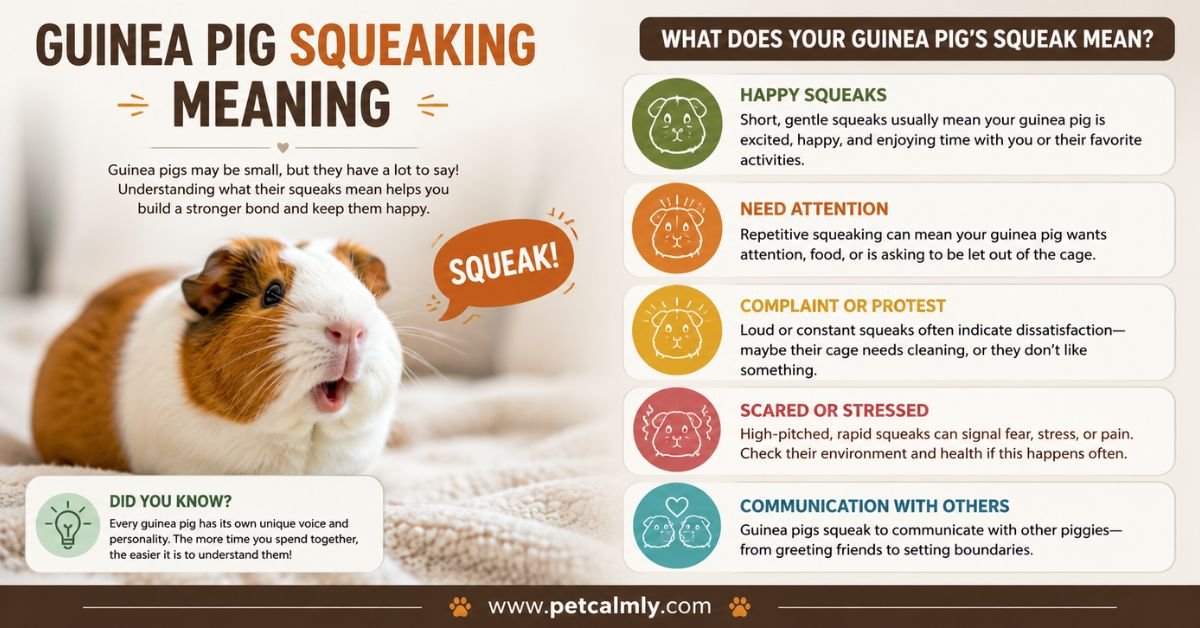
Guinea pig squeaking usually means your pet is trying to communicate excitement, hunger, attention-seeking, happiness, or sometimes mild stress. The exact meaning depends on the pitch, volume, frequency, and situation. A loud squeak when you open the refrigerator often signals anticipation of food, while repeated squeaking during handling may indicate discomfort or a desire to be put down. Understanding your guinea pig’s vocalizations helps you respond appropriately and strengthen your bond with your pet.
Introduction
Few sounds are as recognizable to guinea pig owners as an excited squeak echoing across the room.
Many first-time owners hear their guinea pig squeaking and immediately wonder:
- Is my guinea pig happy?
- Is it hungry?
- Is something wrong?
- Why does it squeak so much when it sees me?
The good news is that squeaking is one of the most common and normal forms of guinea pig communication. These social animals use a variety of sounds to express emotions, needs, and reactions to their environment.
Learning the meaning behind those squeaks can help you understand your pet’s mood, improve daily care, and recognize when a behavior might signal a problem.
In this guide, we’ll break down exactly what guinea pig squeaking means, the different types of squeaks, when to be concerned, and how to respond to your pet’s vocal signals.
What Does Guinea Pig Squeaking Mean?
In most cases, guinea pig squeaking is a form of communication used to express:
| Possible Meaning | Typical Situation |
|---|---|
| Hunger | Feeding time approaches |
| Excitement | Seeing favorite foods |
| Attention seeking | Hearing owner nearby |
| Happiness | Positive interaction |
| Curiosity | Exploring surroundings |
| Mild frustration | Waiting for food |
| Stress or discomfort | Certain handling situations |
The context matters more than the sound itself.
A guinea pig squeaking while running toward fresh vegetables usually means something very different from a guinea pig squeaking repeatedly while being restrained.
Why Do Guinea Pigs Squeak So Much?
Guinea pigs are naturally vocal prey animals.
Unlike some small pets that remain mostly quiet, guinea pigs have evolved to communicate frequently with members of their group.
In the wild and in domestic settings, vocalizations help them:
- Locate companions
- Signal food opportunities
- Express emotions
- Establish social relationships
- Warn of potential threats
- Gain attention
Some guinea pigs are naturally more vocal than others. Certain pets seem to comment on everything happening around them, while others remain relatively quiet.
Both behaviors can be completely normal.
Guinea Pig Squeaking Meaning by Situation
Guinea Pig Squeaking When It Sees Food
This is probably the most common type of squeaking.
Many owners notice their guinea pig starts squealing the moment they:
- Open the refrigerator
- Rustle a vegetable bag
- Open a food container
- Walk into the room at feeding time
This behavior is often called “wheeking.”
What It Means
Your guinea pig is:
- Excited
- Anticipating food
- Asking for treats
- Associating you with feeding
The squeak tends to be:
- Loud
- High-pitched
- Repeated rapidly
This is usually a positive sign indicating your pet feels comfortable and has learned your daily routine.
Guinea Pig Squeaking When It Sees You
Many guinea pigs learn to recognize their owners.
If your guinea pig squeaks when you enter the room, it may be expressing:
- Recognition
- Excitement
- Anticipation
- Desire for interaction
- Expectation of food
A guinea pig that consistently squeaks when seeing its owner often has developed a positive association with that person.
Guinea Pig Squeaking During Petting
Petting can trigger different types of squeaks.
Happy Squeaking
If your guinea pig appears relaxed and remains still while making soft sounds, it may be enjoying the interaction.
Signs include:
- Relaxed posture
- Half-closed eyes
- Calm breathing
- Comfortable body position
Unhappy Squeaking
If squeaking is accompanied by:
- Squirming
- Attempting to escape
- Tense muscles
- Sudden movements
Your guinea pig may be signaling discomfort.
Every guinea pig has different preferences regarding touch and handling.
Guinea Pig Squeaking While Being Held
This situation requires careful observation.
Some guinea pigs squeak because:
- They feel insecure
- They want to return to their cage
- They are nervous
- They dislike prolonged handling
Others simply vocalize while being carried.
Pay attention to body language alongside vocalizations.
Guinea Pig Squeaking at Night
Occasional nighttime squeaking is generally normal.
Possible reasons include:
- Communicating with cage mates
- Requesting food
- Environmental noises
- Rearranging bedding
- General activity
Guinea pigs are not strictly nocturnal, but they can be active during evening and nighttime hours.
Different Guinea Pig Sounds and Their Meanings
Understanding guinea pig squeaking becomes easier when you recognize other common sounds.
Wheeking
What It Sounds Like
A loud, high-pitched squeal.
Meaning
Usually excitement about food.
This is the classic sound most owners hear daily.
Purring
What It Sounds Like
A low vibrating sound.
Meaning
Can indicate:
- Contentment
- Relaxation
- Mild annoyance
The body language determines which meaning applies.
Chirping
What It Sounds Like
Bird-like singing.
Meaning
Researchers and veterinarians still don’t fully understand this rare vocalization.
It may be linked to:
- Stress
- Confusion
- Deep emotional states
Many guinea pigs never chirp.
Chattering Teeth
What It Sounds Like
Rapid clicking of teeth.
Meaning
A warning sign.
This often indicates:
- Irritation
- Aggression
- Feeling threatened
Give your guinea pig space when you hear this sound.
Whining or Whimpering
What It Sounds Like
Soft, drawn-out vocalizations.
Meaning
May indicate:
- Discomfort
- Fear
- Frustration
- Mild pain
Observe closely for other symptoms.
Is Guinea Pig Squeaking a Sign of Happiness?
Often, yes.
Many squeaks are associated with positive emotions.
Signs your guinea pig is squeaking because it is happy include:
- Running around the cage
- Popcorning (joyful jumps)
- Approaching you voluntarily
- Eating normally
- Bright, alert behavior
- Relaxed posture
A happy guinea pig often combines vocal communication with active body language.
Can Guinea Pig Squeaking Mean Stress?
Yes.
Not all squeaks indicate happiness.
Stress-related squeaking may occur when:
- Being handled improperly
- Introduced to a new environment
- Exposed to loud noises
- Separated from companions
- Experiencing illness
Watch for accompanying signs such as:
- Hiding constantly
- Refusing food
- Teeth chattering
- Rapid breathing
- Freezing in place
These clues provide a more complete picture of your guinea pig’s emotional state.
Guinea Pig Squeaking Meaning in Multi-Guinea Pig Households
When guinea pigs live together, squeaking often becomes part of normal social communication.
They may squeak to:
- Call cage mates
- Request space
- Announce food
- Coordinate activities
- Establish social hierarchy
Minor vocal exchanges are usually harmless.
However, persistent squeaking combined with fighting, biting, or chasing may indicate social tension that requires attention.
How to Tell if a Guinea Pig Squeak Is Normal or a Problem
The easiest way to evaluate squeaking is to assess the entire situation.
Normal Squeaking Checklist
✓ Eating normally
✓ Drinking normally
✓ Active and alert
✓ Bright eyes
✓ Normal droppings
✓ Healthy appetite
✓ Social behavior
✓ Consistent daily routine
If most of these are true, squeaking is likely normal communication.
Potentially Concerning Squeaking Checklist
Watch more closely if squeaking occurs alongside:
- Weight loss
- Loss of appetite
- Lethargy
- Labored breathing
- Hunched posture
- Excessive hiding
- Swelling
- Difficulty moving
- Changes in droppings
In these cases, the squeaking could be associated with discomfort or illness.
Common Mistakes Owners Make When Interpreting Guinea Pig Squeaks
Assuming Every Squeak Means Hunger
Many guinea pigs quickly learn that squeaking gets attention.
Not every vocalization is a request for food.
Overfeeding treats can lead to obesity and digestive issues.
Ignoring Body Language
The sound alone rarely tells the whole story.
Always consider:
- Posture
- Activity level
- Facial expression
- Social behavior
- Appetite
These clues help you interpret the message correctly.
Rewarding Excessive Begging
If you offer treats every time your guinea pig squeaks, it may learn to squeak more frequently.
Instead:
- Maintain a feeding schedule
- Offer healthy portions
- Reward calm behavior
Assuming Silence Means Happiness
Some owners worry when a guinea pig is vocal.
In reality, communication is normal.
At the same time, sudden silence in an otherwise vocal guinea pig may warrant closer observation.
What Should You Do When Your Guinea Pig Keeps Squeaking?
Step 1: Check Feeding Schedule
Ask yourself:
- Is it close to meal time?
- Has fresh hay been provided?
- Does your guinea pig have water?
Food anticipation is the most common cause of frequent squeaking.
Step 2: Observe Body Language
Look for signs of:
- Excitement
- Relaxation
- Fear
- Pain
- Frustration
Body language often reveals the true meaning.
Step 3: Evaluate the Environment
Consider recent changes such as:
- New cage
- New pet
- Different room
- Loud household activity
- Rearranged enclosure
Environmental changes can increase vocalizations.
Step 4: Monitor Health
Pay attention to:
- Eating habits
- Weight
- Energy levels
- Droppings
- Breathing
Behavioral changes combined with squeaking deserve closer attention.
When Should You Worry About Guinea Pig Squeaking?
Most squeaking is harmless.
However, contact an exotic animal veterinarian if squeaking is accompanied by:
- Refusal to eat
- Significant weight loss
- Difficulty breathing
- Swelling
- Sudden weakness
- Persistent signs of pain
- Changes in urination
- Digestive problems
Because guinea pigs naturally hide illness, any major behavioral change should be taken seriously.
Early veterinary evaluation can be extremely important.
Practical Guide: Understanding Your Guinea Pig’s Daily Vocal Routine
Many experienced owners find it helpful to track patterns.
Notice:
| Time | Possible Meaning |
|---|---|
| Morning | Anticipating breakfast |
| Afternoon | Social interaction |
| Evening | Feeding excitement |
| Handling sessions | Communication of comfort or discomfort |
| Night | Cage mate communication |
Patterns often reveal why your guinea pig is vocalizing.
How to Build Better Communication With Your Guinea Pig
Understanding squeaks is only one part of communication.
You can strengthen your relationship by:
- Following a predictable routine.
- Speaking softly around your pet.
- Providing enrichment and hiding places.
- Respecting handling preferences.
- Offering daily social interaction.
- Learning individual personality traits.
Over time, many owners become surprisingly good at recognizing what specific squeaks mean for their own guinea pig.
Guinea Pig Squeaking Meaning: Quick Reference Table
| Type of Squeak | Likely Meaning |
|---|---|
| Loud wheeking | Excitement for food |
| Soft squeaking | Attention or interaction |
| Repeated squeaks when seeing owner | Recognition and anticipation |
| Squeaking during handling | Communication of comfort or discomfort |
| Nighttime squeaks | Normal activity or social communication |
| Squeaking with illness symptoms | Possible discomfort requiring evaluation |
Frequently Asked Questions
1: Why is my guinea pig squeaking at me?
Your guinea pig is usually seeking attention, expecting food, recognizing you, or trying to communicate a need. Context and body language help determine the exact meaning.
2: Is guinea pig squeaking a good sign?
Most of the time, yes. Healthy guinea pigs often squeak when excited, socializing, or anticipating food. Persistent squeaking combined with illness signs should be investigated.
2: Why does my guinea pig squeak when I open the fridge?
Many guinea pigs learn to associate refrigerator sounds with vegetables and treats. This excited vocalization is commonly known as wheeking.
3: Why is my guinea pig squeaking while I hold it?
It may feel nervous, insecure, or ready to return to its cage. Observe whether the guinea pig appears relaxed or struggles to escape.
4: Do happy guinea pigs squeak?
Yes. Happy guinea pigs frequently squeak, wheek, popcorn, and approach their owners. Positive body language usually accompanies these sounds.
5: Should I worry if my guinea pig suddenly starts squeaking more?
Not necessarily. Changes in routine, feeding schedules, or excitement can increase vocalization. However, if increased squeaking occurs alongside appetite loss, lethargy, or other health concerns, consult a veterinarian.
More Information About Pets, Please Visit Our Website: Can Guinea Pigs Eat Carrots Everyday?
Conclusion
Understanding guinea pig squeaking meaning is largely about paying attention to context. In most cases, squeaking is a healthy and normal way for guinea pigs to communicate excitement, anticipation, attention-seeking, and social interaction. The familiar wheek before feeding time is often a sign that your pet feels comfortable and has learned its daily routine.
The key is to look beyond the sound itself. A guinea pig’s posture, activity level, appetite, and overall behavior provide important clues about what it’s trying to say. When squeaking is paired with normal eating, active behavior, and bright curiosity, it’s usually nothing to worry about. If vocalizations are accompanied by signs of illness or distress, a veterinary checkup is the safest next step.
For guinea pig owners, learning these vocal cues can transform daily care from simple observation into meaningful communication, helping you build a stronger, more trusting relationship with your pet.