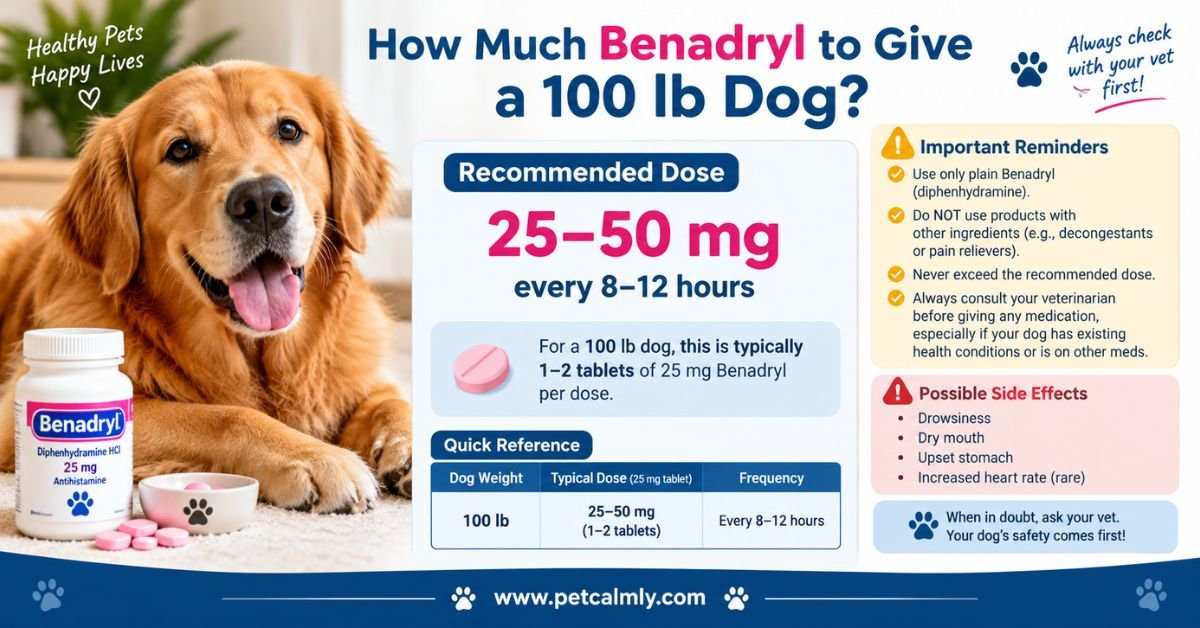
Short direct answer
For a 100 lb dog, the standard diphenhydramine (Benadryl) dose is about 90–180 mg per dose, based on the veterinary reference range of 0.9–1.8 mg per pound (2–4 mg/kg), given every 8 to 12 hours. Most veterinarians use the simple, practical rule of 1 mg per pound, which works out to roughly 100 mg per dose for a 100 lb dog, two to three times a day. This should only ever be a starting reference your vet should confirm the exact dose, the right product, and whether Benadryl is even the correct choice for what your dog is experiencing.
If you’ve landed here at 11 p.m. because your big dog has a swollen face from a bee sting, or you’re staring at a bottle of Benadryl wondering if it’s safe to give before a long car ride, you’re not alone. This is one of the most searched dog-medication questions out there, and for good reason the packaging on human Benadryl says nothing about dogs, and a 100 lb dose looks alarmingly large compared to what you’d give a person.
This guide walks through exactly how much is considered safe, how vets actually think about the range (not just a single number), which products are dangerous, and when Benadryl isn’t the right tool for the job at all.
What Is Benadryl, and Why Do Vets Use It for Dogs?
Benadryl is the brand name for diphenhydramine, an over-the-counter antihistamine originally made for people. It blocks histamine, the chemical your dog’s body releases during an allergic reaction, which is why it can calm itching, hives, swelling, and sneezing.
It’s worth knowing upfront: diphenhydramine isn’t actually FDA-approved for use in dogs. When a vet recommends it, that’s what’s called an “off-label” use a common, accepted practice in veterinary medicine, based on decades of clinical experience and published dosing guidelines like those in the Merck Veterinary Manual. It’s routine, but it’s also exactly why “ask your vet first” isn’t just a legal disclaimer in this article it’s the actual standard of care.
Benadryl is commonly used in dogs for:
- Mild allergic reactions (bee stings, insect bites, hives)
- Seasonal or environmental itching
- Motion sickness during car rides
- Mild situational anxiety, such as vet visits or fireworks
- Minor vaccine reaction swelling, when a vet recommends it
One thing many owners don’t realize: antihistamines like Benadryl only help a portion of allergic dogs. They tend to work best when given before a known trigger (like a car ride or a fireworks show), and considerably less once a reaction is already in full swing.
Benadryl Dosage Chart for Dogs by Weight
Here’s how the standard dosing range breaks down across common dog weights, using the 0.9–1.8 mg per pound reference range, alongside the simpler “1 mg per pound” rule many vets use as a practical starting point.
| Dog’s Weight | Low End (0.9 mg/lb) | Practical Dose (1 mg/lb) | High End (1.8 mg/lb) |
|---|---|---|---|
| 10 lbs | 9 mg | 10 mg | 18 mg |
| 25 lbs | 22.5 mg | 25 mg | 45 mg |
| 50 lbs | 45 mg | 50 mg | 90 mg |
| 75 lbs | 67.5 mg | 75 mg | 135 mg |
| 100 lbs | 90 mg | ~100 mg | 180 mg |
Given every 8–12 hours (2–3 times per day), depending on what your vet recommends for the specific situation.
A note on this chart: this is a reference range, not a prescription. Two 100 lb dogs say, a healthy adult Labrador and a 100 lb dog with early kidney disease should not necessarily receive the same dose. Age, breed, organ health, and what medications your dog already takes all change the calculation. This is exactly the conversation a five-minute call to your vet clinic settles quickly.
Why the Dosage Range Is So Wide
If you’ve read a few different sources, you’ve probably noticed the numbers don’t all match — some say 1 mg/lb, others cite up to 1.8 mg/lb. That’s not conflicting advice; it’s a genuine clinical range, and here’s why:
- Body condition matters. A lean, muscular 100 lb dog and an overweight 100 lb dog don’t process medication identically.
- Reason for use changes the target. A dose meant to take the edge off mild itching is often lower than one meant to help with acute swelling from a sting.
- Individual sensitivity varies. Some dogs get noticeably drowsy at the low end of the range; others barely react until closer to the high end.
This is why most vets will tell you to start conservatively closer to 1 mg per pound and only go higher if your veterinarian specifically advises it for your dog’s situation.
How to Safely Give Benadryl to a Large Dog
Check the Label Before Anything Else
This is the step people skip, and it’s the one that causes real emergencies. Plain diphenhydramine is safe at the doses above. But a lot of “Benadryl” products on pharmacy shelves aren’t plain diphenhydramine at all.
Avoid anything labeled:
- “Allergy and Sinus,” “Allergy Plus Congestion,” or anything ending in “-D” — these usually contain pseudoephedrine, a decongestant that’s dangerous for dogs
- Products combined with acetaminophen (Tylenol), which is toxic to dogs even in small amounts
- Liquid children’s Benadryl, unless you’ve confirmed it’s xylitol-free — many liquid formulations use xylitol as a sweetener, and xylitol is one of the most dangerous substances a dog can ingest, even in tiny amounts
The only ingredient you want to see on the label is diphenhydramine HCl, alone.
Match the Dose to the Product You Actually Have
Standard adult Benadryl tablets are usually 25 mg each — meaning a 100 lb dog on a 100 mg dose would take about four tablets. That can feel like a lot of pills to hand a dog at once, which is a good moment to pause and confirm with your vet rather than eyeball it.
Children’s liquid Benadryl (when xylitol-free) is typically 12.5 mg per 5 mL, which some owners find easier to measure precisely for a large dose — but again, confirm the concentration on your specific bottle before calculating anything.
Give It With a Little Food
Benadryl can occasionally cause mild stomach upset. Giving it with a small amount of food, or hidden in a treat, tends to go down easier for most dogs and can reduce nausea.
Time It Right
Antihistamines work best ahead of a known trigger. If you know your dog gets carsick or panics during thunderstorms, giving Benadryl 30–60 minutes beforehand tends to work better than waiting until your dog is already distressed.
5 Common Mistakes Owners Make With Benadryl Dosing
- Rounding up “to be safe.” More isn’t safer with antihistamines — it increases the risk of side effects without necessarily improving the outcome.
- Using a product with added ingredients. This is the single most common way well-meaning owners accidentally poison their dogs.
- Assuming bigger dogs need proportionally more sedation. A 100 lb dog doesn’t need a “strong” dose just because of size the dose still scales by weight the same way it does for a 10 lb dog.
- Using Benadryl as a routine sedative. It’s not designed or reliable for this, and relying on it for regular anxiety management can mask a bigger behavioral issue that deserves its own treatment plan.
- Not weighing the dog recently. A dose calculated from a guess, or from last year’s weight, isn’t a safe dose. If you’re unsure of your dog’s current weight, a quick trip to the vet’s scale (most clinics will let you use it for free) is worth it.
Side Effects to Expect (and What’s Actually Normal)
Most dogs tolerate Benadryl well. The most common effect is mild drowsiness — which is often why owners use it before stressful events in the first place.
Other typical, usually harmless effects include:
- Dry mouth
- Mild sedation or grogginess
- Slight decrease in appetite
- Occasionally, the opposite mild hyperactivity or restlessness (seen more often in some individual dogs)
These are generally not emergencies. They’re a sign the medication is doing what it’s supposed to do, and they usually fade within a few hours as the drug wears off.
When Should You Worry? Signs of Benadryl Overdose in Dogs
This is the part of the article worth bookmarking. An overdose is different from a normal side effect, and it’s important to know the difference.
Contact your vet or an emergency animal poison control line immediately if you notice:
- Tremors or muscle twitching
- Seizures
- Rapid or irregular heartbeat
- Severe agitation or disorientation
- Dilated pupils that don’t respond normally
- Difficulty breathing
- Collapse
Tremors and seizures in particular are not a normal side effect they’re a sign of overdose and need urgent veterinary attention, not a “wait and see” approach.
If your dog has gotten into a bottle of Benadryl, or a combination product containing xylitol or acetaminophen, don’t wait for symptoms at all. Call for guidance right away with xylitol especially, symptoms can escalate quickly, and early treatment makes a real difference.
ASPCA Animal Poison Control Center: (888) 426-4435
What Should Pet Owners Do Before Giving the First Dose?
- Confirm the reason. Is this for a one-off bee sting, or ongoing itching that’s been going on for weeks? Chronic symptoms deserve a vet visit, not just a dose of Benadryl.
- Check for existing conditions or medications. Dogs with glaucoma, certain heart conditions, urinary retention issues, or those on other sedatives or medications should only take Benadryl under direct veterinary guidance, since interactions and contraindications exist.
- Read the label out loud, literally. If it says anything other than “diphenhydramine HCl” as the active ingredient, put it back.
- Call your vet clinic. Many clinics are happy to confirm a dose over the phone for an existing patient, especially for something as common as this.
- Watch your dog for the first hour. Especially the first time you use it, stay close enough to notice unusual reactions early.
When Benadryl Isn’t the Right Answer
Benadryl is a mild, general-purpose antihistamine not a cure-all. It’s worth talking to your vet about alternatives if:
- Your dog’s allergies are chronic or severe rather than occasional
- Benadryl doesn’t seem to be helping at all after a couple of uses
- Your dog needs something for regular anxiety, not just an occasional stressful event
- Symptoms include facial swelling that’s worsening, difficulty breathing, or vomiting these need same-day veterinary attention, not an antihistamine at home
Vets have access to more targeted allergy and anxiety medications when Benadryl isn’t cutting it, and there’s no downside to asking about them.
Real-Life Example: A Practical Way to Think About It
Say your 100 lb Labrador gets stung by a bee in the backyard and starts pawing at his face, with some mild swelling around the muzzle. This is a reasonable, common scenario for giving Benadryl at home roughly 100 mg (four 25 mg tablets of plain diphenhydramine), and a call to your vet to confirm and to describe what you’re seeing.
Compare that to a 100 lb dog with swelling that’s spreading to the throat, or who starts having trouble breathing. That’s not a Benadryl situation anymore that’s an emergency vet visit, full stop, regardless of dose.
The dose calculation is the easy part. Knowing which of these two situations you’re actually in is the part that matters most.
Frequently Asked Questions
1: How much Benadryl can I give my 100 lb dog for allergies?
Most vets use a starting dose of about 1 mg per pound, which comes to roughly 100 mg for a 100 lb dog, given up to three times a day. Confirm with your vet, especially if this is the first time you’re using it.
2: Can I give my dog Benadryl every day?
Occasional or short-term use is generally considered low-risk for healthy dogs, but daily long-term use should be discussed with your vet chronic allergy symptoms are often better managed with a dedicated allergy treatment plan rather than daily antihistamines.
3: Will Benadryl make my 100 lb dog sleepy?
Often, yes mild drowsiness is one of the most common effects, which is part of why it’s used before car rides or fireworks. It’s not guaranteed, though, and a small number of dogs react with restlessness instead.
4: Is liquid or tablet Benadryl better for a large dog?
Both work, as long as the active ingredient is plain diphenhydramine. Tablets are simple for large dogs since the milligram count is straightforward; liquid can help if your dog won’t take pills, but always double-check it’s xylitol-free.
5: What happens if I accidentally give my dog too much Benadryl?
Watch for tremors, seizures, rapid heartbeat, or severe agitation these need immediate veterinary attention. Mild drowsiness alone typically isn’t cause for alarm, but if you’re ever unsure, it’s always safer to call your vet or a poison control hotline than to wait.
6: Can I give my dog Benadryl and other medications together?
Not without checking first. Diphenhydramine can interact with certain sedatives, anti-anxiety medications, and other drugs. Always tell your vet everything your dog is currently taking before adding Benadryl.
More Information About Pets, Please Visit Our Website: Can I Give My Dog Benadryl?
Benadryl Dosage for Dogs Per Pound
How to Improve Cat Dental Health
Good Mental Health Dogs
What is the Dog Gut Microbiome?
Conclusion
For a 100 lb dog, roughly 100 mg of plain diphenhydramine, given two to three times a day, is the practical starting point most vets reference with a safe range extending from about 90 mg up to 180 mg depending on the situation. The dose itself is the simple part. The parts that actually keep your dog safe are reading the label carefully, confirming with your vet, and knowing the difference between “my dog is a little sleepy” and “my dog needs emergency care.”