Short direct answer
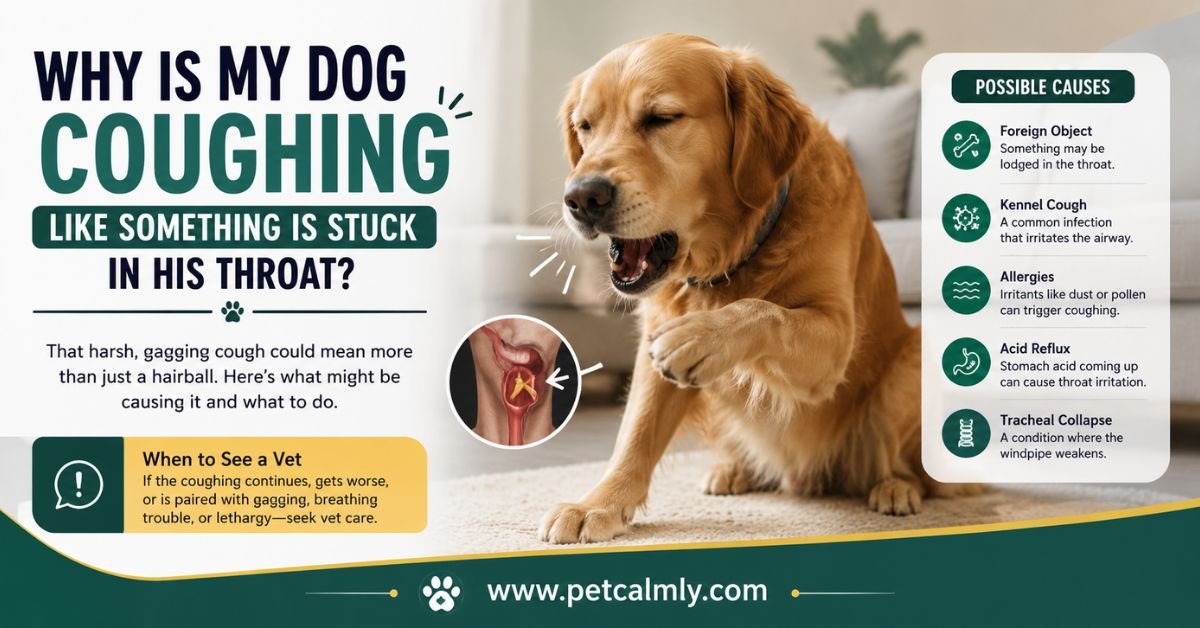
If your dog is coughing like something is stuck in his throat, it could be kennel cough (the most common culprit), reverse sneezing, tracheal collapse, or less commonly, an actual foreign object obstruction. Most cases aren’t emergencies, but you should contact your vet within 24 hours if the coughing is frequent, persistent, or accompanied by lethargy, difficulty breathing, or refusal to eat. If your dog is choking, drooling excessively, or struggling to breathe, seek emergency care immediately.
Introduction
That harsh, distinctive cough that sounds like your dog has a golf ball lodged in his throat is one of the most alarming sounds a pet owner can hear. Your first instinct is to reach into his mouth and pull something out—but more often than not, there’s nothing physically stuck there at all.
I’ve helped dozens of worried dog owners work through this exact scenario, and the pattern is always the same: panic, followed by relief once they understand what’s actually happening. The good news? In the vast majority of cases, this type of cough is treatable and not an emergency.
That said, knowing the difference between “my dog needs to see the vet this week” and “my dog needs emergency care right now” can make all the difference in how you respond. This guide will walk you through the most common causes, how to identify when you need professional help, and what you can do to support your dog while you figure out what’s going on.
Let’s start by understanding why this particular cough sounds the way it does.
Why Dogs Cough Like Something Is Stuck: Understanding the Sensation
When your dog coughs with that distinctive hacking, gagging sound as if something is lodged in his throat he’s experiencing irritation somewhere in his respiratory tract, most commonly in his trachea (windpipe) or larynx (voice box).
The “stuck” sensation happens because:
The cough reflex is trying to clear an irritant. Whether it’s mucus, inflammation, a spasm, or an actual object, the body responds with a dry, sharp cough that sounds quite different from a typical wet cough or sneeze.
The throat is inflamed or tight. Conditions like kennel cough or tracheal collapse cause the airways to become irritated or narrower, which triggers that hacking, goose-honk-like sound.
Muscle spasms are happening. Tracheal collapse, for example, involves the cartilage rings in the windpipe becoming weak, causing the airway to collapse slightly when your dog breathes or coughs—which feels (and sounds) like something is physically in the way.
What’s important to know: most dogs coughing like this are not actually choking. Real choking involves immediate distress, inability to breathe, loss of consciousness, or blue gums. If your dog is eating, drinking, and playing normally between coughing episodes, it’s almost certainly not a foreign object causing the problem.
That said, we’ll cover actual choking risks later in this guide, because while uncommon, it’s worth knowing how to recognize it.
The Most Common Causes of That “Something Stuck” Cough
Kennel Cough (Infectious Tracheobronchitis)
Kennel cough is the number-one reason dogs cough like they have something stuck in their throat. It’s highly contagious, spreads quickly in places where dogs gather (boarding facilities, dog parks, shelters), and is almost never serious—even though it sounds terrible.
What it sounds like: A dry, hacking cough that often ends with a gagging or retching sound. Many owners describe it as a seal’s bark or a goose honk.
Why it happens: Kennel cough is a viral or bacterial infection (often a combination of both) that inflames the trachea and bronchi. The most common culprit is the parainfluenza virus, often combined with Bordetella bronchiseptica bacteria.
How long it lasts: Usually 1–3 weeks, sometimes longer. Most dogs recover on their own, though a vet may recommend rest, cough suppressants, or antibiotics if a bacterial infection is present.
When to worry: If your dog has a fever, is lethargic, has lost his appetite, or is coughing constantly without breaks to eat or sleep, contact your vet. These signs suggest pneumonia or a more serious secondary infection, though this is uncommon.
Transmission: Airborne droplets. If your dog has been to a dog park, boarding facility, groomer, or vet clinic in the past 2 weeks, kennel cough is a real possibility—even if he’s vaccinated. (The vaccine reduces severity but doesn’t guarantee immunity.)
Reverse Sneezing vs. Coughing
Here’s where things get interesting. Many pet owners mistake reverse sneezing for coughing with something stuck in the throat, and it’s an understandable confusion.
Reverse sneezing is when your dog inhales sharply through his nose while keeping his mouth closed, making a snorting, snuffling, or honking sound. It typically lasts 5–30 seconds and can happen repeatedly. The dog may stand still, seeming distressed, until it passes.
Why it happens: Irritation of the soft palate or pharynx—often triggered by excitement, a sudden temperature change, allergens, or even just eating or drinking too quickly.
The key difference: In reverse sneezing, your dog inhales sharply. In coughing, your dog expels air with force. If your dog’s episodes last only seconds and he recovers quickly, you’re probably dealing with reverse sneezing, which is harmless and doesn’t require treatment.
Is it serious? No. Reverse sneezing is annoying but completely benign. It can happen multiple times a day in some dogs, especially small breeds. However, if episodes become very frequent or prolonged, mention it to your vet just to be safe.
Tracheal Collapse in Dogs
Tracheal collapse is a condition in which the cartilage rings that support the trachea (windpipe) weaken, allowing the windpipe to flatten when your dog breathes or coughs. This is particularly common in small-breed dogs (Chihuahuas, Yorkshire Terriers, Pomeranians) and toy breeds, though it can occur in any dog.
What it sounds like: A dry, hacking cough that sounds exactly like your dog has something stuck in his throat. The cough is often worse during excitement, after exercise, or in warm weather.
Why the “stuck” sound: As the trachea collapses, the airway narrows dramatically, creating that distinctive honking, gasping cough. Your dog may also gag or retch.
What makes it worse:
- Excitement or rapid activity
- Heat and humidity
- Pressure on the neck (like from a collar or leash)
- Pulling on the leash
- Respiratory infections
What makes it better:
- Rest
- Cool, humid air
- Weight management (obesity puts extra strain on the airway)
- Using a harness instead of a neck collar
When to see a vet: Most mild cases of tracheal collapse don’t require urgent treatment, but you should have your dog evaluated to confirm the diagnosis and get guidance on management. Severe cases may require medication or, rarely, surgery.
Prevention tip: If your dog is a small breed prone to tracheal collapse, use a harness instead of a neck collar to reduce pressure on the trachea.
Foreign Objects and Choking Risks
While less common than the conditions above, actual foreign objects—grass, toys, bones, rawhide chews—can genuinely lodge in a dog’s throat and require emergency removal.
Signs of a real foreign object obstruction:
- Constant gagging and coughing, with no relief
- Drooling excessively
- Difficulty swallowing
- Refusing food or water
- Retching but not producing anything
- Visible object in the mouth or throat
- Labored breathing or high-pitched, wheezy sounds
- Lethargy or distress
Common objects that get stuck:
- Pieces of toys or rawhide
- Grass and plant material
- Bones or bone fragments
- String, thread, or hair ties
- Small balls or toy parts
- Sticks or twigs
What to do immediately:
- Do not try to push the object deeper. If you can see an object in your dog’s mouth and can safely grasp it, gently try to remove it. But don’t force it or go deep into the throat—you could cause more damage.
- If your dog is choking and can’t breathe, this is a true emergency. Get to an emergency vet immediately or call animal control for transport.
- If your dog is coughing and gagging but breathing, contact your vet or emergency clinic immediately. Don’t wait. Even if the object seems small, a partial obstruction can worsen quickly.
Important: Blockages higher in the esophagus (the tube leading to the stomach) can also cause gagging and a sensation of “something stuck,” even if the object is lower down. This is why professional evaluation is crucial.
How to Tell If Your Dog’s Cough Needs Immediate Veterinary Attention
Not every cough requires a panicked trip to the emergency clinic, but some do. Here’s how to assess the urgency:
Contact your vet within 24 hours if:
- The cough is new and frequent (more than a few times per hour)
- It’s been going on for more than a week
- Your dog has a mild fever (101.5–103°F)
- He’s eating and drinking normally but seems slightly less energetic than usual
- There’s a small amount of nasal discharge (clear or slightly cloudy)
- He’s been around other dogs recently (kennel cough exposure)
Seek same-day or emergency veterinary care if:
- Your dog has difficulty breathing (rapid, shallow, or labored breathing)
- He’s struggling to breathe during rest, not just during play
- He has a high fever (above 103°F)
- He’s not eating or drinking
- He’s lethargic or unusually quiet
- There’s blue-tinged gums or lips (sign of poor oxygen)
- You see a foreign object in his mouth or can feel one in his throat
- He’s drooling excessively or unable to swallow
- The cough is productive (bringing up mucus or blood)
- He’s in obvious pain or distress
This is a true emergency (get to an animal hospital immediately):
- Your dog is choking and cannot breathe
- He’s collapsed or unconscious
- He’s gasping for air or making high-pitched, wheezing sounds at rest
- His gums are pale or blue
- He’s retching or gagging but can’t produce anything (possible complete blockage)
If you’re uncertain about severity, it’s always better to call your vet and describe the situation. They can tell you whether your dog needs to be seen and how urgently.
What to Do When Your Dog Coughs Like Something Is Stuck
Before you panic, let’s walk through what you can actually do to help your dog while you figure out what’s going on.
Step 1: Assess Your Dog’s Overall Condition
Take a moment to observe. Is he:
- Breathing normally, or is he struggling?
- Eating and drinking, or refusing both?
- Playful and normal between cough episodes, or lethargic?
- Showing any signs of distress beyond the coughing?
If he’s eating, drinking, and acting relatively normal—just with this weird cough—you likely have time to call your vet during business hours and get an appointment within a day or two.
Step 2: Minimize Irritants and Triggers
Even before you know the cause, you can reduce coughing by:
- Avoiding neck collars temporarily. Switch to a harness to eliminate pressure on the trachea.
- Keeping your dog calm and rested. Excitement and activity trigger coughing. Stick to short, gentle walks and quiet time at home.
- Using a humidifier. Moist air can soothe an irritated throat. Run a humidifier in the room where your dog spends most of his time.
- Avoiding smoke, strong perfumes, and cleaning chemicals. These irritate the respiratory tract and will make coughing worse.
- Keeping your dog away from other dogs. Until you know what’s causing the cough, assume it could be contagious (kennel cough).
Step 3: Monitor for Changes
Keep track of:
- Frequency: Is the coughing getting better, worse, or staying the same?
- Timing: Does it happen more at certain times (morning, after play, during excitement)?
- Associated symptoms: Any fever, discharge from nose or eyes, lethargy, appetite changes?
- Triggers: Does it happen after drinking, playing, or during certain activities?
This information will be incredibly helpful for your vet and may help identify the cause.
Step 4: Call Your Vet
Describe what you’re seeing: “My dog coughs like he has something stuck in his throat, especially after playing. It sounds like a seal’s bark. He’s eating normally and seems fine otherwise.”
Your vet may want to see him right away, recommend monitoring at home for a few days, or suggest some initial steps. Trust their judgment—they know your dog’s health history and any risk factors.
How to Help Your Dog Feel More Comfortable at Home
While you’re waiting for a vet appointment or monitoring a mild cough, these strategies can ease your dog’s discomfort:
Hydration Is Key
Make sure your dog has constant access to fresh water. A dry cough is often worse when the throat is dry. Some dogs prefer water from a fountain or bowl over tap water experiment to see what your dog drinks most willingly.
Tip: Avoid ice-cold water if your dog has tracheal collapse or a sensitive throat, as cold can trigger coughing. Room-temperature water is gentler.
Use a Humidifier
Humidity soothes irritated airways. If you don’t have a humidifier, you can:
- Close the bathroom door, turn on the hot shower, and let your dog breathe in the steam for 10–15 minutes
- Run a humidifier in your dog’s sleeping area
- Use a cool-mist humidifier (safer than warm-mist if your dog gets too close)
Provide Soft, Easy-to-Swallow Food
If your dog is eating but seems uncomfortable swallowing, soften his food:
- Mix kibble with warm (not hot) water or low-sodium broth
- Offer wet/canned food instead of dry
- Give smaller, more frequent meals to avoid overwhelming the throat
Restrict Vigorous Activity
Rest is one of the best treatments for respiratory infections. Keep your dog calm:
- Take short, slow walks instead of running or playing
- Avoid fetch, wrestling, or high-energy games
- Provide a quiet, comfortable place to rest
- Avoid hot, humid environments that trigger coughing
Consider a Cough Suppressant (Only if Recommended by Your Vet)
Important: Do not give your dog over-the-counter cough medicine without veterinary approval. Some human cough medicines contain ingredients that are toxic to dogs.
Your vet may prescribe:
- Dextromethorphan (DM): A cough suppressant used for some types of coughs
- Honey: Yes, plain honey can help soothe a throat and reduce coughing. A small spoonful (¼ to 1 teaspoon depending on dog size) can be helpful, though it’s not a substitute for veterinary care.
Only use what your vet recommends for your specific situation.
Avoid Common Irritants
- Smoke (secondhand smoke irritates respiratory passages)
- Strong perfumes or air fresheners
- Cleaning chemicals (use pet-safe products)
- Dust from dry food or litter (if you have other pets)
- Extreme temperature changes
Prevention Strategies for Long-Term Respiratory Health
Once you’ve dealt with this acute episode, here’s how to reduce the likelihood of future “something stuck” coughing episodes:
Vaccination Against Kennel Cough
If your dog frequents dog parks, boarding facilities, or groomers, ask your vet about the Bordetella and parainfluenza vaccines. These won’t guarantee immunity (kennel cough can still break through), but they reduce severity and duration. The vaccines are typically given annually or every 6 months for high-risk dogs.
Use a Harness, Not a Neck Collar
Chronic pressure on the neck can contribute to tracheal collapse and irritation. A well-fitted harness distributes pressure across the chest and shoulders instead, which is much gentler on the trachea.
Extra important if your dog:
- Is a small breed (especially toy breeds like Chihuahuas)
- Is overweight
- Has any signs of tracheal collapse
- Pulls frequently on the leash
Maintain a Healthy Weight
Obesity increases stress on the respiratory system and contributes to tracheal collapse. Work with your vet to keep your dog at an ideal body condition. Extra weight puts pressure on internal organs, including the airway.
Avoid Smoke and Air Pollution
Secondhand smoke, wood smoke, and air pollution irritate respiratory passages and trigger coughing. Keep your dog away from smoky environments and monitor air quality alerts. On high-pollution days, keep activity indoors or minimize outdoor time.
Address Dental Disease Promptly
Dental infections can spread to the respiratory tract and cause coughing. Regular dental care and prompt treatment of infections protect both his teeth and his lungs.
Manage Underlying Health Conditions
If your dog has:
- Allergies (which can cause coughing)
- Heart disease (which can cause fluid in the lungs)
- Heartworm disease (which affects the pulmonary arteries)
- Obesity
…these should be actively managed with your vet to prevent respiratory complications.
Minimize Exposure to Infectious Diseases
- Avoid dog parks during kennel cough outbreaks (your vet can tell you if there’s an active outbreak in your area)
- Keep your dog’s vaccinations current
- Avoid close contact with dogs you don’t know
- Wash your hands after touching other dogs before handling your own
7 Common Mistakes Pet Owners Make During a Coughing Episode
Let me address some common things I see pet owners do—often with the best intentions—that actually make coughing worse:
Mistake 1: Panicking and Forcing Your Dog to the ER Unnecessarily
I get it. That cough sounds scary. But if your dog is breathing normally, eating, drinking, and acting relatively fine between episodes, he doesn’t need emergency care. An unnecessary ER visit stresses your dog out, costs money you might not have, and exposes him to other sick animals. Call your regular vet first. They know your dog and can advise whether he needs urgent evaluation.
Mistake 2: Immediately Reaching Into Your Dog’s Mouth
If your dog is actually choking, you might need to reach in and remove an object. But most of the time, when you see your dog gagging and coughing, your instinct to reach in and help can actually make things worse—you might push the object deeper, or you might hurt your dog’s mouth and throat in the process.
Only attempt mouth entry if:
- You can clearly see an object
- You can safely grasp it with your fingers
- Your dog is not thrashing or trying to bite
- The object is in the front of the mouth, not deep in the throat
Otherwise, let your vet handle it.
Mistake 3: Using Human Cough Medicine
Many common OTC cough medicines contain ingredients toxic to dogs, like xylitol (a sugar substitute). Never give your dog human cough syrup, cold medicine, or throat lozenges without explicit veterinary approval.
Mistake 4: Assuming It’s “Just Kennel Cough” and Skipping the Vet
While kennel cough is common and usually resolves on its own, you can’t diagnose it without seeing a vet. What sounds like kennel cough could be tracheal collapse, a foreign object, pneumonia, heart disease, or something else entirely. A vet can listen to your dog’s lungs, examine his throat, and rule out serious conditions.
Mistake 5: Continuing Normal Activity and Exercise
If your dog is coughing, he needs rest. Vigorous exercise, excitement, and rough play will trigger more coughing and delay recovery. Restrict activity even if your dog seems to want to play—he doesn’t understand that rest is what he needs right now.
Mistake 6: Not Following Up If the Cough Doesn’t Resolve
If your dog coughs for more than 3 weeks, or if he improves for a few days and then gets worse again, don’t just assume he’ll get better on his own. Secondary infections, complications, or underlying conditions might be present. Follow up with your vet.
Mistake 7: Ignoring Signs That Something Serious Is Happening
If your dog’s cough is accompanied by lethargy, fever, loss of appetite, or difficulty breathing, don’t wait. These aren’t just “annoying symptoms”they suggest infection or another serious condition that needs treatment.
More Information About Pets, Please Visit Our Website: Why Does My Dog Sniff Me So Much
Why Does My Dog Howl at Night
Calming Exercises for Dogs
10 Calming Techniques for Dogs With Anxiety
Why Is My Dog Scared of People?
Frequently Asked Questions
1: Can I Give My Dog Honey for a Cough?
Yes, plain honey can help soothe throat irritation and reduce coughing in dogs, just as it does in humans. A small amount (¼ to 1 teaspoon, depending on your dog’s size) can be given a few times a day. Honey has mild antibacterial properties and coats the throat.
However, honey is not a substitute for veterinary care if your dog’s cough is due to an infection or underlying condition. It may provide temporary relief while you wait for a vet appointment, but you still need a professional evaluation to identify the cause and provide appropriate treatment.
Important: Never give honey to puppies under one year old (botulism risk) or to dogs with diabetes without consulting your vet.
2: How Long Does Kennel Cough Last?
Kennel cough typically lasts 1–3 weeks. Most dogs recover completely on their own, though some coughing may persist for several weeks. During this time, rest and supportive care (humidifier, hydration, calm environment) help. If your dog develops secondary pneumonia or a bacterial infection, recovery may take longer and require antibiotics.
3: Is a Cough With Gagging Always Serious?
Not necessarily. Gagging can be part of kennel cough, reverse sneezing, tracheal collapse, or other non-serious conditions. However, if gagging is constant, severe, or accompanied by difficulty swallowing, inability to eat, or drooling, it warrants prompt veterinary evaluation.
4: Can Tracheal Collapse Be Cured?
Tracheal collapse cannot be cured, but it can be effectively managed. Mild cases are managed through weight management, harness use, rest, and avoiding triggers. Some vets may recommend cough suppressants or anti-inflammatory medications during acute episodes. Severe cases that significantly affect quality of life may be candidates for surgery, though this is uncommon. Most dogs with tracheal collapse live normal, happy lives with proper management.
5: Should I Use a Cone/E-Collar if My Dog Is Coughing?
No. A cone can actually make coughing worse by restricting movement and preventing your dog from stretching his neck. Only use a cone if your vet specifically recommends it (e.g., if your dog has a wound that needs protection).
6: When Should I Worry About Coughing After Eating?
If your dog coughs only immediately after eating or drinking, it could be a sign of:
- Aspiration (food or water going into the lungs instead of the stomach) usually associated with megaesophagus or swallowing problems
- Eating too fast
- Drinking too much at once
- Collapsing trachea triggered by neck flexion while eating
If this happens occasionally, it’s usually not urgent. But if it’s frequent or your dog seems to be struggling to swallow, mention it to your vet. They may recommend feeding smaller portions, slower feeding (using a slow-feeder bowl), or more frequent meals.
7: Is a Humidifier Safe for Dogs?
Yes, humidifiers are generally safe for dogs. Ultrasonic or cool-mist humidifiers are preferable to warm-mist (which poses burn risk if your dog gets too close). Make sure your dog has access to the room but can retreat to a cooler area if he wants. Don’t place a humidifier directly next to your dog’s face position it so he breathes in the ambient moisture, not direct steam.
When to Stop Waiting and Get Help
I want to be clear about something: if you’re worried, don’t just wait it out. Your gut instinct as a pet owner matters. You know your dog better than anyone. If something feels wrong if his behavior has changed, if the cough is getting worse, or if he seems distressed contact your vet.
The worst case scenario from calling your vet when you’re concerned? You get reassurance that your dog is fine, or you catch something early before it becomes serious. There’s no downside to reaching out.
Your vet might recommend:
- An office visit for examination and listening to his lungs
- Imaging (X-rays) to rule out pneumonia, heart disease, or tracheal collapse
- Specific treatment (antibiotics, cough suppressants, anti-inflammatories)
- A management plan for chronic conditions
All of these are aimed at getting your dog feeling better and giving you peace of mind.
Conclusion
That alarming cough that sounds like your dog has something stuck in his throat is scary, but it’s rarely an emergency. Most of the time, it’s kennel cough, reverse sneezing, or tracheal collapse all manageable conditions. The key is getting a professional evaluation so you know exactly what you’re dealing with, then following through with rest, supportive care, and any treatment your vet recommends.
Until your vet appointment, keep your dog calm, ensure he’s hydrated, and monitor for any signs of distress. Use a humidifier, avoid irritants, and trust that most dogs bounce back from this kind of cough with time and proper care.
Your dog is lucky to have an owner who cares enough to research and figure out what’s going on. That already puts him in good hands.