Short direct answer
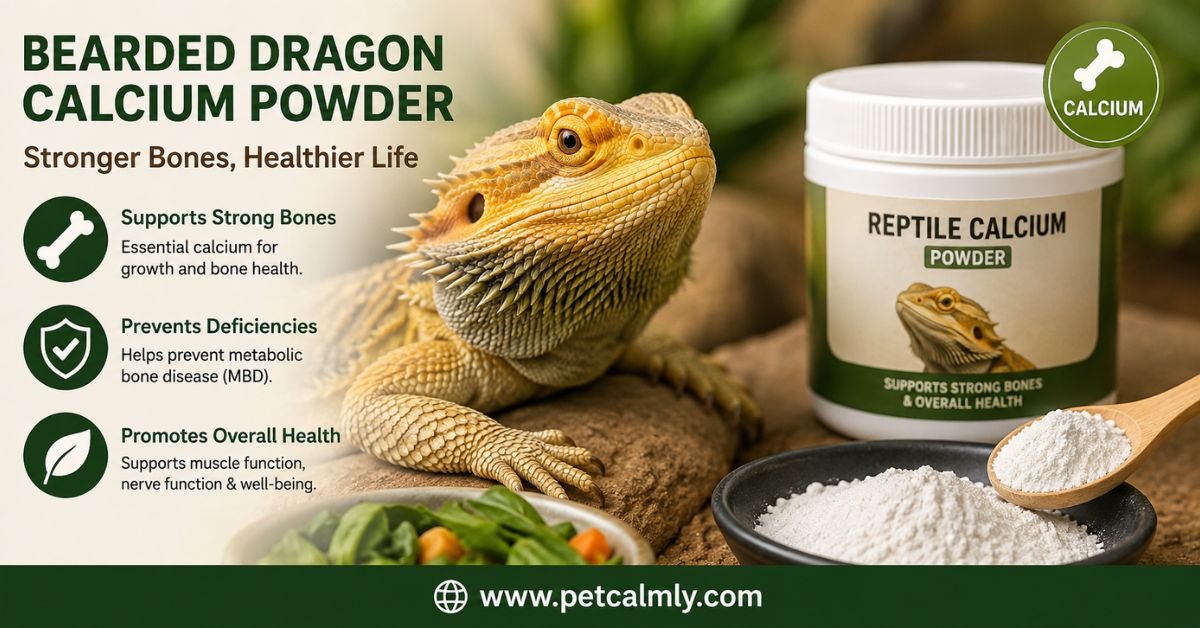
Bearded dragon calcium powder is a dietary supplement you dust onto your dragon’s feeder insects 3-4 times weekly to prevent metabolic bone disease and support skeletal development. Most powders contain calcium carbonate or calcium citrate, and many include vitamin D3, which helps your dragon absorb the calcium effectively. The right calcium routine, combined with proper UVB lighting, is one of the most important aspects of keeping your bearded dragon healthy and active.
Why This Matters: The Calcium Question Most Owners Face
If you’ve recently brought home a bearded dragon, you’ve probably noticed something unsettling: they’re a lot smaller than they look in pet store photos, and their skeleton seems almost delicate. That feeling isn’t wrong. Bearded dragons have intense dietary and environmental needs that most first-time reptile owners don’t anticipate, and calcium deficiency is one of the most common problems I see in dragons under three years old.
Here’s the reality: a bearded dragon without proper calcium supplementation will develop metabolic bone disease (MBD)—a painful, progressive condition where their bones become soft and weak, their movement becomes lethargic and painful, and their quality of life deteriorates significantly. In severe cases, it’s irreversible. But the good news is that this is almost entirely preventable with the right powder, the right schedule, and the right understanding of how calcium works in your dragon’s body.
This guide covers everything you need to know to keep your bearded dragon’s bones strong, starting with why calcium matters so much for this species.
Why Bearded Dragons Need Calcium Powder (And Why It’s Non-Negotiable)
In the wild, bearded dragons get calcium from a varied diet of insects, leafy greens, and environmental UVB exposure. In captivity, we have to recreate that nutrition through supplementation and proper lighting because:
Their rapid growth phase demands constant mineral support. Young bearded dragons (under 18 months) grow incredibly fast. This growth is powered by calcium deposition in their skeleton, and if calcium intake falls short, their bones literally cannot harden properly. A juvenile without adequate calcium will show visible deformities within weeks: a softened jaw that won’t close properly, curved spine, swollen joints, and limbs that bow under their own weight.
Insects don’t contain enough calcium naturally. A dubia roach contains about 0.2% calcium by weight far below what a growing dragon needs. Crickets are even worse, with a calcium-to-phosphorus ratio that actually favors phosphorus, which blocks calcium absorption. Without supplementation, your dragon would need to eat impossible amounts of greens to compensate, and most juveniles prefer insects anyway.
UVB alone isn’t enough. UVB lighting (specifically 290-315nm wavelength) allows your dragon to synthesize vitamin D3 in their skin, and that D3 enables calcium absorption in the gut. But synthesis happens slowly and varies with individual factors like age, skin pigmentation, and basking duration. You cannot UV your way out of a calcium problem you need the powder to fill the nutritional gap.
Dietary phosphorus competes with calcium absorption. This is the detail most new owners miss. Phosphorus is abundant in insects, and calcium and phosphorus compete for absorption in the intestine. If phosphorus is too high relative to calcium, your dragon won’t absorb enough calcium even if they’re consuming it. That’s why calcium powder makes such a difference: it tips the calcium-phosphorus balance in your dragon’s favor.
Calcium deficiency develops silently at first. You might not notice anything wrong for a few weeks or even months. Then, suddenly, your dragon seems lethargic, moves reluctantly, stops basking aggressively, and develops a softened jaw. By that point, bone damage has already occurred.
Understanding Calcium Powder: Types, Ingredients, and What Actually Works
Not all calcium powders are the same, and understanding the difference will save you from buying supplements that either don’t work or do more harm than good.
Types of Calcium Powder
Calcium carbonate is the most common and usually the most affordable option. It’s effective and well-absorbed, but it has a subtle limitation: it requires stomach acid for proper absorption, which means it’s less ideal if your dragon has any digestive issues. Most quality commercial bearded dragon supplements use calcium carbonate as the base ingredient.
Calcium citrate is more bioavailable than carbonate and doesn’t require stomach acid for absorption, making it gentler on digestion. It’s more expensive, but if your dragon has digestive sensitivities or is recovering from illness, citrate-based powders are worth the extra cost.
Calcium gluconate and other chelated forms are highly absorbable but rarely found in bearded dragon supplements. If you see these, they’re usually premium products, and they do work well they’re just often overkill for healthy dragons eating a balanced diet.
Powders with D3 included vs. D3-free. This is crucial and causes confusion for many owners. Here’s the breakdown:
- With D3: Use these 3-4 times weekly if your dragon gets 10-12 hours of proper UVB lighting daily. The added D3 supplements the D3 your dragon produces naturally from UVB.
- Without D3: Also use 3-4 times weekly, but only if your dragon consistently receives strong UVB exposure. Without UVB and without supplemental D3, your dragon cannot absorb calcium, so this option only works for experienced keepers with excellent lighting setups.
- High-D3 powders: Some powders contain excessive D3 levels (over 10,000 IU/gram). These should only be used occasionally (once weekly or less) because vitamin D3 is fat-soluble and accumulates in the body. Too much D3 causes hypervitaminosis D, which is as damaging as vitamin D3 deficiency.
Ingredient Red Flags to Avoid
Not every powder sold for reptiles is safe for bearded dragons. Watch for:
- Oxalates in high amounts: Some greens contain oxalates, which bind calcium and prevent absorption. This is why kale, spinach, and chard should be occasional treats, not dietary staples. Some powders add greens or plant materials to “enhance nutrition”—skip these for juvenile dragons with high calcium needs.
- Unnecessary fillers: Powders with many additives (colorants, artificial flavors, excessive vitamin cocktails) often have lower calcium density. Stick to simpler formulations that are primarily calcium with D3 and a few supporting nutrients.
- Unbalanced ratios: The best powders maintain a calcium-to-phosphorus ratio of at least 2:1, ideally 3:1 or higher. Check the label—it should clearly state both values.
Recommended Product Types (What Works in Practice)
In my experience working with bearded dragon owners, the most reliable options tend to be:
- Reputable branded reptile-specific calcium powders (like Reptile Systems, Arcadia, or similar professional-grade products) that clearly state their D3 content and calcium-to-phosphorus ratio.
- Veterinary-recommended formulations prescribed or suggested by your exotic vet these are often the best choice because they’re chosen specifically for their bioavailability and safety profile.
- Powders specifically formulated for bearded dragons rather than general reptile powders, which are more likely to have appropriate D3 levels and calcium ratios for this species.
Avoid bargain powders from unknown manufacturers, powders without clear labeling of D3 content or calcium-phosphorus ratios, and anything that contains unnecessary additives or makes vague health claims.
How to Actually Use Calcium Powder: The Practical Guide That Works
Understanding why calcium powder matters is half the battle. The other half is applying it correctly so your dragon actually eats it and absorbs it.
The Dusting Method (Most Effective)
The standard approach is “dusting,” which means coating your feeder insects lightly with powder before offering them to your dragon.
Here’s the step-by-step process:
- Place powder in a small, shallow dish (a bottle cap, small ramekin, or designated container works perfectly). About 1/4 teaspoon is usually sufficient for a dusting session.
- Add insects to the dish (5-10 insects depending on your dragon’s age and appetite). You want them lightly coated, not caked in powder.
- Gently shake the container so the powder adheres to the insects’ bodies. The insects should look faintly chalky, not white. If they look like they’ve been dipped in paint, you’ve used too much.
- Offer immediately. Don’t let the dusted insects sit in the dish for more than a minute or two—the powder will clump and fall off.
- Discard any remaining dusted insects. Don’t save them; the powder breaks down and loses effectiveness, and old powder can attract moisture and mold.
Why this works: When your dragon eats a dusted insect, they consume the powder along with the insect, getting a measured dose of calcium with their meal. The timing is ideal because calcium absorption is enhanced when consumed with food.
Troubleshooting: When Dragons Refuse Dusted Insects
Some dragons are sensitive to the taste or texture of powder and will refuse dusted insects. If this happens:
- Try a different powder brand. Some dragons prefer certain formulations over others. It’s not your imagination—different products do have different palatability.
- Use smaller insects. Young crickets or smaller roaches have less surface area and less powder visible, making them less intimidating to picky eaters.
- Dust only half the insects. Offer some dusted, some undusted. Your dragon will eat the dusted ones and get their calcium, while still eating enough to satisfy appetite.
- Switch to vegetable dusting temporarily. If your dragon is absolutely refusing powder-dusted insects, you can dust their salad instead (more on this below), but insects are the preferred delivery method.
Alternative: Dusting Vegetables (Backup Method)
While insects are the optimal delivery vehicle for calcium powder, you can also dust the vegetable portions of your dragon’s diet.
- Use soft vegetables that powder adheres to well: cooked butternut squash, mashed sweet potato, or grated carrot.
- Lightly mist the vegetable with water first to help the powder stick.
- Mix thoroughly and offer immediately.
- Note the limitation: Dragons eat vegetables inconsistently, and some will pick out the powder, so this method is less
reliable than insect dusting. It’s best used as a supplement to insect dusting, not a replacement.
Juvenile bearded dragons should eat primarily insects (70-80% of diet) and only small amounts of greens until they’re a year old, so insect dusting should always be your primary method for young dragons.
What NOT to Do
- Don’t mix powder into water. Calcium powder doesn’t dissolve well and will just settle to the bottom of the bowl, creating a muddy mess your dragon won’t ingest evenly.
- Don’t sprinkle powder directly into the enclosure. It will blow around, get dirty, and your dragon won’t eat enough of it consistently.
- Don’t use the same container for multiple dusting sessions without washing it—old powder accumulates and can harbor bacteria.
- Don’t store dusted insects. They need to be eaten immediately for maximum effectiveness and safety.
Calcium Supplementation Schedule: The Dosing Guide Most Owners Get Wrong
This is where clarity matters enormously. The right frequency protects your dragon; the wrong frequency can cause problems.
The Core Recommendation (For Dragons with Proper UVB)
For juvenile bearded dragons (under 18 months):
- Dust 3-4 feedings per week with calcium powder containing D3
- Alternate with 2-3 feedings per week with vitamin supplements (like multivitamins) to avoid nutrient imbalances
- This means roughly 50% of feeding sessions include calcium dusting
For adult bearded dragons (18 months and older):
- Dust 2-3 feedings per week with calcium powder containing D3
- This lower frequency reflects their slower metabolism and completed skeletal development
- Adults need less frequent supplementation because their bones are no longer growing rapidly
Critical Variable: Your UVB Setup
This schedule assumes you’re providing proper UVB lighting. If your setup doesn’t meet UVB standards, supplementation needs increase significantly.
Minimum lighting standards for bearded dragons:
- UVB-emitting bulbs in the 290-315nm range (typically labeled as “ReptiSun 10.0” or “Arcadia D3 Dragon” or equivalent)
- Placed within 12-18 inches of the basking area (closer is better, and distance matters because UVB degrades with distance)
- Replaced every 6-12 months (most UVB bulbs lose effectiveness after 6-9 months even if they still emit visible light)
- On a 10-12 hour per day schedule that mimics natural day-night cycles
If your UVB setup is suboptimal: You’ll need to increase calcium powder dusting frequency and may need higher D3 levels. Talk to your exotic vet about adjusting your supplementation if you know your lighting isn’t ideal.
The D3 Toxicity Risk (And Why Balance Matters)
Vitamin D3 toxicity is real and underrated in bearded dragon care discussions. Too much D3 causes the body to absorb and deposit calcium everywhere—including soft tissues, organs, and blood vessels—leading to a condition called hypercalcemia.
Signs of possible vitamin D3 toxicity:
- Lethargy and loss of appetite
- Weakness and difficulty moving
- Kidney or liver changes (only detectable through bloodwork)
- Vomiting or digestive upset
How to avoid it:
- Don’t use high-D3 powders more than once per week
- Don’t combine high-D3 powders with D3-containing multivitamins in the same week
- Don’t “load dose” calcium thinking more is better
- Stick to the 3-4 times weekly schedule for D3-containing powders
- Rotate with plain calcium (D3-free) or vitamin supplements for other feeding sessions
Most nutritional imbalances in bearded dragons come from well-meaning owners trying to do more than necessary. Consistency with the right schedule is far better than sporadic over-supplementation.
Common Calcium Powder Mistakes (And How to Avoid Them)
After working with hundreds of bearded dragon owners, I’ve seen the same preventable mistakes repeatedly. Here are the ones that cause the most problems:
Mistake 1: Assuming One Powder Works Forever
Many owners buy a powder and stick with it for years without evaluating whether it’s still appropriate for their dragon’s life stage. A juvenile needs aggressive supplementation; an adult doesn’t. As your dragon ages, their supplementation needs change.
What to do instead: Reassess your powder choice annually, especially when your dragon transitions from juvenile to adult (around 18 months). Talk to your vet about whether your current regimen still fits your dragon’s needs.
Mistake 2: Skipping Dusting “Just This Once”
I understand the temptation. You’re busy, the powder container is in another room, and you figure one undusted feeding won’t matter. But calcium deficiency is cumulative. Each missed dusting session adds up, and what seems like “just one” skip becomes a pattern. Over weeks and months, those skipped sessions result in insufficient calcium absorption.
What to do instead: Keep your calcium powder and dusting container near your feeding area so dusting becomes effortless and automatic. If you have to make a special trip to dust, you’re more likely to skip it.
Mistake 3: Using Powder Way Past Its Expiration Date
Calcium powder degrades over time, especially if stored in humid conditions (like a bathroom shelf). Old powder has reduced calcium availability and degraded D3 (if included). You might be dusting your dragon with powder that’s only 50% as effective as it should be.
What to do instead: Store powder in a cool, dry place (not the bathroom), date your container when opened, and replace it every 6-12 months. If your powder is older than a year, replace it.
Mistake 4: Not Adjusting for Dietary Changes
If your dragon starts eating a higher proportion of greens (which some adults do), they might be consuming more oxalates and phosphorus, which decreases calcium absorption. You might need to increase dusting frequency to compensate.
What to do instead: Monitor your dragon’s diet composition and adjust supplementation if their eating habits change significantly.
Mistake 5: Forgetting That UVB Bulbs Degrade
You install a perfect UVB setup, and then three years later, that bulb is still in there—now probably only 30% effective. Your dragon isn’t producing enough D3 anymore, so your supplementation routine is insufficient.
What to do instead: Replace UVB bulbs every 6-9 months, even though they still look like they’re working. Mark your calendar as a reminder.
Signs Your Bearded Dragon Isn’t Getting Enough Calcium
Calcium deficiency doesn’t announce itself loudly at first. But if you know what to watch for, you can catch it early and prevent serious damage.
Early Warning Signs (Catch It Here)
- Decreased appetite: Your dragon is eating noticeably less than usual, especially insects (their preferred food).
- Sluggish movement: Your typically active dragon moves more slowly, spends more time resting, and shows less interest in climbing or basking.
- Jerky or uncertain movement: Movements look awkward or uncoordinated, as if the dragon is uncertain of their limbs.
- Reduced basking behavior: Your dragon avoids or spends less time at the basking spot (though this can indicate other problems too).
- Softening of the jaw: Gently feel the area around your dragon’s jaw. It should feel firm. If it feels slightly squishy or rubbery, this is an early sign of calcium deficiency.
Advanced Signs (More Serious)
- Visible jaw deformity: The jaw appears slightly deformed, bent, or asymmetrical.
- Curved or bowed spine: The backbone doesn’t follow a straight line from neck to tail.
- Swollen joints: The elbows, knees, or shoulders look puffy or enlarged.
- Tremors or twitching: Involuntary muscle movements, especially in the legs or head (this indicates low blood calcium, a medical emergency).
- Impaction or constipation: Calcium-deficient dragons often become impacted because their muscles, including digestive muscles, weaken.
- Lethargy and refusal to eat: Your dragon is visibly weak, barely moving, and won’t eat at all.
If you notice any of these signs, especially the advanced ones, contact your exotic vet immediately. Severe calcium deficiency requires veterinary intervention, sometimes including calcium injections or hospitalization.
When to Worry: Health Red Flags and Veterinary Guidance
Calcium deficiency is serious, but it’s also preventable with the right protocol. Knowing when to escalate to professional help is crucial.
When to Call Your Exotic Vet Immediately
- Your dragon shows signs of tremors, twitching, or muscle spasms (possible hypocalcemia/low blood calcium emergency)
- Severe jaw deformity affecting eating or appearance
- Your dragon refuses food for more than 24-48 hours
- You suspect calcium toxicity (unusual lethargy, weakness, behavior changes after high supplementation)
- Your dragon has a history of calcium deficiency and isn’t improving with supplementation
When to Schedule a Non-Emergency Vet Visit
- Your dragon shows mild signs of calcium deficiency (soft jaw, slightly sluggish movement)
- You want to verify your supplementation routine is appropriate for your dragon’s individual needs
- Your bearded dragon is over 3 years old and you want geriatric health screening (calcium metabolism changes with age)
- You’re introducing a new diet or housing change and want to adjust supplementation accordingly
When to Adjust at Home (Without a Vet Visit)
- Your dragon has never shown any signs of deficiency and is thriving on your current supplement routine
- You’re updating your UVB bulb and want to adjust supplementation accordingly
- You’re tweaking your feeding schedule (changing insect types or vegetable ratios) and want to optimize your powder use
Most of what goes wrong with bearded dragon calcium isn’t malice or negligence it’s uncertainty. You’re doing your best with incomplete information. This guide is here to bridge that gap.
Calcium Powder and Diet Integration: Building a Complete Nutrition Plan
Calcium powder doesn’t work in isolation. It’s part of a larger nutritional framework, and understanding how all the pieces fit together makes the biggest difference.
Insect Selection Matters More Than People Realize
Different feeder insects have different nutritional profiles, especially regarding calcium and phosphorus.
Best options (calcium-friendly ratios):
- Dubia roaches: 1:2 calcium-to-phosphorus ratio (after dusting, this improves significantly)
- Black soldier fly larvae: Higher natural calcium content
- Crickets (in moderation): Lower calcium naturally, so they benefit most from dusting
Less ideal options (higher phosphorus):
- Mealworms: High phosphorus relative to calcium
- Superworms: Even higher phosphorus than mealworms
- Hornworms: Low calcium and phosphorus both (better as treats)
Strategy: Build your feeder rotation around insects with decent calcium profiles. Use dubia roaches and BSFL as staples, rotate with crickets, and save mealworms and waxworms for occasional treats. This approach maximizes the impact of your calcium powder.
Greens: Supportive but Not Calcium-Primary
Here’s the hard truth about greens for bearded dragons: they’re important for fiber, hydration, and micronutrients, but they’re not reliable calcium sources because of oxalate content.
Calcium-friendly greens (better choice):
- Collard greens
- Mustard greens
- Turnip greens
- Dandelion greens
- Arugula
Oxalate-rich greens (feed occasionally, not daily):
- Spinach
- Kale
- Chard
- Beet greens
For juveniles, greens should be 10-20% of total diet. For adults, this increases to 30-40%. But even in adulthood, your calcium supplementation strategy should focus on insects, not vegetables.
The Water Factor (Hydration and Absorption)
Proper hydration supports nutrient absorption. A dehydrated bearded dragon won’t absorb calcium as efficiently, even with perfect supplementation.
Support hydration through:
- Misting vegetables and offering water droplets (some dragons drink from droplets, others from dishes)
- Offering moisture-rich foods like dubia roaches (which contain more water than crickets)
- Providing a shallow water dish during shedding season
- Misting greens before feeding (which also helps powder stick)
Bearded Dragon Calcium at Different Life Stages
Your dragon’s supplementation needs evolve as they grow. Understanding these changes helps you optimize care throughout their life.
Hatchling to 6 Months: Critical Growth Phase
At this stage, your dragon’s skeleton is forming rapidly, and calcium demand is highest. They’re also often in the transition between breeder or store conditions to home conditions, and their health baseline can be unpredictable.
Calcium approach:
- Dust 4-5 times weekly with D3-containing powder
- Use insects as primary diet (75-80%)
- Small amounts of greens (20-25%)
- Ensure excellent UVB lighting
- Watch closely for any signs of deficiency
6-18 Months: Growth Continues
Your dragon is larger and eating more, but still growing rapidly. Skeletal development is still very active.
Calcium approach:
- Dust 3-4 times weekly with D3-containing powder
- Insects still primary (70-75%)
- Increasing greens (25-30%)
- Continue monitoring for deficiency signs
- Adjust feeding schedule as your dragon’s appetite grows
18 Months+: Adulthood Transition
Growth slows significantly, and skeleton maturation is complete. Calcium needs decrease.
Calcium approach:
- Dust 2-3 times weekly with D3-containing powder
- More balanced diet (50% insects, 50% vegetables)
- Adult dragons often prefer more greens
- Ongoing supplementation is still essential—don’t stop just because growth is complete
Seniors (5+ Years)
Aging bearded dragons sometimes develop kidney issues that affect calcium metabolism. Their absorption becomes less efficient.
Calcium approach:
- Consult your vet about individual needs (bloodwork can reveal calcium metabolism status)
- May need increased supplementation or shifted D3 levels
- Monitor closely for any signs of deficiency
- Regular vet checkups become more important
Building Your Calcium Routine: A Practical Implementation Plan
Reading this guide is one thing. Actually implementing it consistently is another. Here’s how to build a routine that sticks.
Week 1: Setup Phase
- Purchase a high-quality calcium powder (with D3) from a reputable source
- Buy or repurpose a small container for dusting (a bottle cap or small dish)
- Set up a dedicated storage location near your feeding area (not the bathroom)
- Choose your primary feeder insect (dubia roaches or black soldier fly larvae recommended)
Week 2-4: Establishment
- Dust insects 3-4 times weekly at scheduled feeding times
- Track your dusting in a calendar or app (just a checkmark is fine) to ensure consistency
- Observe your dragon’s behavior—are they eating well? Moving actively? Behaving normally?
- If your dragon refuses dusted insects, try a different powder brand or smaller insects
Ongoing: Maintenance
- Set a phone reminder for one year from now to replace your UVB bulb
- Set a phone reminder for six months from opening your powder to replace it
- Assess your dragon’s behavior monthly—are they thriving, sluggish, or showing any concerning signs?
- Schedule a vet checkup annually (essential for young dragons, especially important for seniors)
- Adjust supplementation frequency as your dragon ages (reduce from 4x to 3x weekly around 18 months old)
Annual Review
- Talk to your exotic vet about whether your current routine still fits your dragon’s needs
- Evaluate your UVB setup—is the bulb still effective? Is the placement still appropriate as your dragon grows?
- Consider any dietary changes your dragon has made (eating more or less greens, change in insect preferences)
- Adjust as needed for the coming year
Conclusion
Bearded dragon calcium supplementation isn’t complicated, and it doesn’t require obsessive perfection. It requires consistency, understanding, and a basic routine that becomes as automatic as feeding itself.
The dragons that thrive are the ones receiving three to four dusted feedings per week, proper UVB lighting, and appropriate diet. The dragons that develop problems are usually the ones with gaps in this routine missing supplements, old UVB bulbs, or uncertainty about the right approach.
You’re not alone in the confusion. Many new bearded dragon owners feel lost by conflicting advice online, unclear product labels, and uncertainty about whether they’re doing enough. This guide exists because that confusion is real and preventable.
Start with the basics: get a good calcium powder with D3, dust 3-4 times weekly, ensure excellent UVB lighting, and monitor your dragon for any signs of deficiency. If your dragon is active, eating well, and showing no signs of weakness or deformity, you’re doing the job right. If anything seems off, don’t hesitate to talk to your exotic vet.
Your bearded dragon depends on you for their health, and calcium supplementation is one of the most direct ways you can influence their quality of life. You’ve already taken the right step by learning about it.
Frequently Asked Questions
1: Is calcium powder required for bearded dragons?
Yes, calcium powder is essential for bearded dragons of all ages. Without supplementation, they cannot meet their calcium needs from insects alone, leading to metabolic bone disease. Combined with proper UVB lighting, calcium powder is non-negotiable for long-term health.
2: What’s the best time of day to dust insects for my bearded dragon?
Dust insects immediately before feeding time. Dusting in advance allows powder to fall off and lose effectiveness. If your dragon eats at 9 AM, dust at 8:55 AM and feed immediately after.
3: Can I use human calcium supplements for my bearded dragon?
No. Human supplements are formulated for human absorption and digestion and may contain additives that aren’t safe for reptiles. Use reptile-specific calcium powder only. Veterinary reptile products are formulated for this species’ unique needs.
4: How do I know if my bearded dragon has metabolic bone disease?
Early signs include soft jaw, sluggish movement, and decreased appetite. Advanced signs include curved spine, swollen joints, and tremors. Any of these warrant an immediate vet visit. Your vet can confirm MBD with physical examination and sometimes X-rays.
5: Should I dust my bearded dragon’s salad in addition to dusting insects?
You can dust vegetables as a supplementary approach, but insects should be your primary dusting method because dragons eat them whole. Vegetable dusting is less reliable because dragons often pick around the powder or consume only a portion of greens.
6: Can my bearded dragon overdose on calcium powder?
Direct calcium toxicity from the mineral itself is rare, but vitamin D3 toxicity (from excessive D3 in powder) is possible. Follow the recommended frequency (3-4 times weekly for juveniles, 2-3 for adults) and don’t use high-D3 powders more than once weekly.
More Information About Pets, Please Visit Our Website: Bearded Dragon Growth Stages
15 Bearded Dragon Illness Signs
Best Feeder Insects for Bearded Dragons
How Much Does a Bearded Dragon Cost?
Safe Vegetables for Bearded Dragons
Can Baby Bearded Dragons Eat Cucumber Daily in Summer?
How Often Should I Feed My Bearded Dragon Vegetables?
How to Care for Pet Iguana at Home
Conclusion
Bearded dragon calcium powder is one of the most important tools you have to support your dragon’s long-term health. It’s not complicated, it doesn’t require special expertise, and it’s absolutely worth the minimal effort required.
A simple routine dusting 3-4 times weekly, maintaining proper UVB lighting, and monitoring your dragon’s behavior prevents one of the most common and painful conditions in captive bearded dragons. The dragons that thrive are the ones with owners who understand this basic truth and commit to it consistently.
If you take nothing else from this guide, remember this: calcium deficiency is preventable, and you have the power to protect your bearded dragon from it. You’re already on the right path by educating yourself. Now put that knowledge into action, and your dragon will thank you with decades of activity, appetite, and vitality.