Short direct answer
Rabbits communicate constantly through posture, movement, sound, and even the way they thump their back feet but almost none of it is verbal. If you’ve ever caught your rabbit flopping dramatically onto its side, grinding its teeth, or thumping at 2 a.m. and wondered what on earth that meant, you’re not alone. Most rabbit owners spend the first year or two translating on instinct, and it’s easy to misread a stressed rabbit as an angry one, or a content rabbit as a sick one.
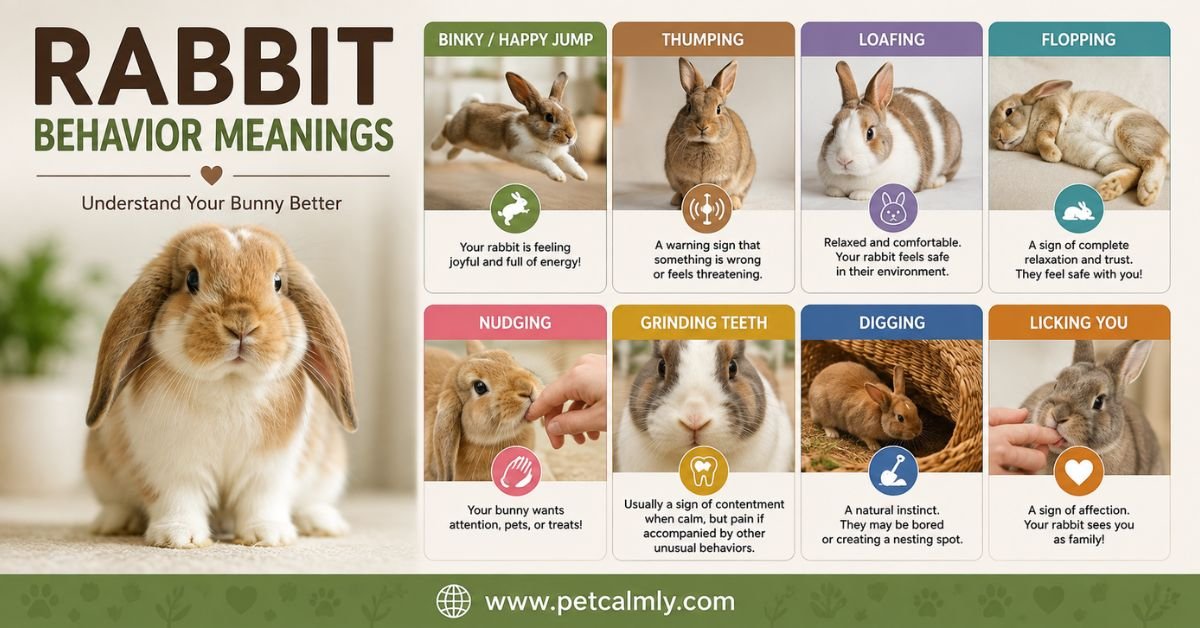
Rabbit behavior meanings, in short: most rabbit behaviors fall into a few clear categories contentment (flopping, soft teeth grinding, chinning), fear or stress (thumping, freezing, flattening), affection (licking, nudging, circling your feet), and irritation or territory-marking (grunting, lunging, spraying, nipping). Reading a behavior correctly usually depends on the rabbit’s body posture and the situation around it, not the action alone. A thump during a thunderstorm means fear; a thump right before dinner just means “hurry up.”
This guide walks through what rabbits are actually communicating, why they evolved to “talk” this way, and just as importantly how to tell the difference between a rabbit that’s simply being a rabbit and one that might need a vet visit.
Why Rabbit Behavior Is So Easy to Misread
Rabbits are prey animals. In the wild, a rabbit that visibly panics, cries out, or draws attention to itself is a rabbit that gets caught. That evolutionary pressure shaped almost every domestic rabbit you’ll ever meet even one that’s never seen a predator in its life. They default to stillness, silence, and subtle body language instead of the obvious signals dogs and cats give us.
This is exactly why new owners get caught off guard. A rabbit in real pain often goes quiet and hides rather than crying out, while a rabbit that’s just mildly annoyed might thump the floor hard enough to shake the room. The intensity of a behavior doesn’t always match the seriousness of what’s behind it you have to read the context, not just the action.
Reading Rabbit Body Language: The Fast Reference
Before diving into each behavior individually, here’s a quick-reference table for the most commonly searched rabbit behaviors and what they typically mean.
| Behavior | Most Likely Meaning | Context That Changes It |
|---|---|---|
| Binky (jump + twist) | Pure joy, excitement | None — this one is almost always happy |
| Flopping onto side | Deep relaxation, trust | Sudden flop after lethargy could signal weakness |
| Thumping back feet | Alarm, warning, frustration | Repeated thumping with hiding = fear |
| Chinning objects | Scent-marking territory | Normal, especially in unspayed/unneutered rabbits |
| Circling your feet | Courtship or attention-seeking | More common in unneutered males |
| Grunting or growling | Annoyance, guarding space | Common around food bowls or nest boxes |
| Teeth grinding (soft, quiet) | Contentment (“purring”) | Happens while being petted |
| Teeth grinding (loud, with hunched posture) | Pain | Needs veterinary attention |
| Nose bonking/nudging | “Move” or seeking attention | Can also mean “pet me” |
| Freezing in place | Fear response | Often paired with flattened ears |
| Digging at carpet or your leg | Nesting instinct or boredom | More frequent in unspayed females |
| Nipping (gentle) | Communication, “pay attention” | Different from a hard bite, which signals fear or pain |
Happy and Relaxed Rabbit Behaviors
Binkying: The Clearest Sign of Rabbit Happiness
If you’ve seen a rabbit leap straight up, twist mid-air, and kick out its back legs before landing, you’ve seen a binky. It looks chaotic, almost like a seizure to first-time owners, but it’s actually the rabbit equivalent of a happy dance. Rabbits binky when they feel safe, playful, and physically good it’s most common right after being let out to run, during evening “zoomies,” or after a treat.
There’s no real downside to a binky. If anything, a rabbit that never binkies in a space it’s had time to settle into might be telling you it doesn’t feel fully secure there yet.
Flopping: Trust in Its Purest Form
A flop happens when a rabbit drops suddenly onto its side, sometimes so abruptly it looks alarming the first time you see it. New owners frequently panic, thinking their rabbit has collapsed. In reality, flopping is one of the strongest signs of comfort a rabbit can show it means the rabbit feels safe enough to fully expose its belly and become briefly vulnerable, something a prey animal only does when it trusts its environment completely.
The one distinction worth knowing: a healthy flop is loose and deliberate, often followed by stretching out and relaxed breathing. A rabbit that suddenly collapses, struggles to right itself, or flops and stays rigid or breathes rapidly afterward needs to be checked by a vet that’s not relaxation, that’s a possible medical event.
Soft Teeth Grinding (“Tooth Purring”)
Quiet, gentle teeth grinding while you’re petting a rabbit is often called tooth purring, and it’s the rabbit version of a cat’s purr. You’ll usually notice it around the same time the rabbit’s eyes go half-closed and its body relaxes into your hand.
This is different from loud, audible teeth grinding paired with a hunched posture, which is discussed further down — that version is a pain response, not contentment. The distinction matters, and it’s one of the most common things owners confuse.
Chinning: Marking You (and Everything Else) as “Theirs”
Rabbits have scent glands under their chin, and they rub that chin against furniture, doorways, their favorite toys, and often your hand or leg. This is called chinning, and it’s a form of territorial marking that humans can’t smell but other rabbits absolutely can.
If your rabbit chins you regularly, it’s not a negative sign it means the rabbit has claimed you as part of its territory, which in rabbit language is closer to affection than possessiveness.
Fearful and Stressed Rabbit Behaviors
Thumping: Not Always a Bad Sign, But Always a Message
Thumping is one of the most talked-about rabbit behaviors, and it genuinely has more than one meaning depending on context.
- A single thump followed by the rabbit running to hide usually signals fear a loud noise, an unfamiliar smell, or a sudden movement.
- Repeated thumping paired with an alert, upright posture often signals a warning this is the rabbit telling other rabbits (or you) that something feels off.
- A quick, almost impatient thump near feeding time is frequently just frustration “you’re late.”
The context around the thump tells you more than the thump itself. A rabbit that thumps once during a fireworks show and then resumes normal behavior is fine. A rabbit that thumps repeatedly, refuses to come out from hiding, and shows a hunched or tense body for hours afterward may be experiencing ongoing stress that’s worth addressing — sometimes with quieter housing, more hiding spots, or a calmer routine.
Freezing and Flattening
When a rabbit suddenly goes completely still, flattens its body against the ground, and pulls its ears back, it’s responding the same way its wild ancestors did to an overhead predator freezing to avoid detection. This is a fear response, not stubbornness or disobedience, and it’s most commonly triggered by loud sounds, sudden movement, unfamiliar animals, or being picked up too quickly.
If a rabbit freezes often in situations that shouldn’t be frightening a quiet room, a familiar person it may be worth evaluating whether something in its environment (a new pet, a rearranged room, a loud appliance) is creating chronic low-level stress.
Hiding for Extended Periods
Occasional hiding is completely normal rabbit behavior, especially in a new home or after a change in routine. What matters is duration and whether it’s paired with other symptoms. A rabbit that hides for a few hours after a stressful event but still eats, drinks, and produces normal droppings is behaving typically. A rabbit that hides for most of the day, stops eating, or won’t come out even for favorite treats is showing a pattern that crosses from normal shyness into a potential health concern — rabbits are known for hiding illness rather than displaying it openly, which is precisely why appetite and litter box habits matter more than mood alone.
Territorial, Irritated, and Attention-Seeking Behaviors
Grunting and Growling
A short grunt, especially one paired with a quick lunge or a stomp, usually means “back off” it’s common around food bowls, nest boxes, or a favorite hiding spot. Growling is rarer and more intense, typically reserved for moments when a rabbit feels genuinely cornered or threatened.
Neither behavior is aggression in the way people usually think about it with dogs. It’s almost always about resource guarding or feeling trapped, and it tends to improve significantly once a rabbit has consistent, predictable access to food, space, and a hiding spot it fully controls.
Nipping and Biting
Rabbits nip for a surprising number of reasons, and telling them apart makes a real difference in how you respond.
- A light, quick nip followed by the rabbit moving away is usually communication “I want attention” or “move your hand, that’s my spot.”
- A nip during petting that stops the moment you pause often means the rabbit has had enough affection for now.
- A hard bite that breaks skin is different from the behaviors above and typically signals fear, pain, or a rabbit that has been repeatedly startled or mishandled in the past.
Punishing a rabbit for nipping yelling, flicking its nose, tapping it tends to backfire and can make a rabbit more fearful and more likely to bite defensively in the future. Redirecting attention and giving the rabbit space usually works better than correction.
Circling and Mounting
Circling your feet, especially paired with soft grunting, is common courtship behavior, particularly in unneutered males, but it also shows up in spayed and neutered rabbits as an attention-seeking habit. Mounting behavior (toward another rabbit, a stuffed toy, or even a person’s foot) is similarly tied to hormones and territory rather than true aggression, though it can look alarming the first time.
Spaying or neutering recommended by most rabbit-savvy veterinarians for both health and behavioral reasons — typically reduces circling, mounting, spraying, and chinning intensity significantly, usually within a few weeks to a couple of months after the hormones fully clear the system.
Urine Spraying
Spraying is different from normal litter box use it’s a deliberate marking behavior, most common in unneutered males and unspayed females, and it’s one of the clearest signs that a rabbit is establishing or defending territory. It often appears around a new pet, a new person in the home, or a change in the household layout. Spaying and neutering is the most effective long-term solution; in the meantime, consistent litter box placement and limiting territorial triggers can help reduce it.
Affectionate and Bonding Behaviors
Licking
A rabbit that licks your hand, arm, or face is grooming you the same way it would groom a bonded rabbit companion. This is one of the clearest, most reliable signs of trust and affection in rabbit body language, and it often develops only after a rabbit has been in a home long enough to feel fully secure.
Nudging and “Bonking”
A rabbit nudging your hand or leg with its nose usually means one of two things: “move, you’re in my way” or “pet me, please.” You can usually tell which one it is by what happens next if the rabbit stays and leans in, it wanted attention; if it hops past you the moment you move, it just wanted the path cleared.
Following You Around
Rabbits that follow their owner from room to room are displaying a form of social bonding similar to how they’d stay near a trusted rabbit companion. It’s a good sign of attachment, though it’s worth noting some rabbits do this out of food-motivation as much as affection both are perfectly normal.
Behavior Changes That Signal a Health Problem
This is the section most competing articles skip over, and it’s often the most important one for owners. Rabbits are experts at masking illness, so behavior changes are frequently the only early warning sign an owner gets.
Watch closely for:
- Sudden lethargy or reluctance to move, especially paired with a hunched posture
- Loud, harsh teeth grinding combined with a tense body — this is a pain signal, not the soft contentment grinding described earlier
- Loss of appetite or ignoring favorite treats, even briefly, since rabbits should be eating almost constantly
- Reduced or absent fecal droppings, which can indicate gastrointestinal stasis, a serious and potentially life-threatening condition in rabbits
- Hiding far more than usual, especially if it’s a shift from the rabbit’s normal personality
- Aggression that’s new or out of character, which can sometimes be linked to underlying pain rather than a behavioral issue
According to the Merck Veterinary Manual and VCA Animal Hospitals, gastrointestinal stasis and dental disease are among the most common serious health issues in pet rabbits, and both frequently present first as behavior changes — reduced appetite, hunching, teeth grinding, and lethargy before any other obvious symptom appears.
When Should You Worry? A Practical Checklist
Not every unusual behavior is an emergency, but a few combinations should prompt a same-day or next-day vet call rather than a “wait and see” approach:
- No droppings for more than 12 hours
- Refusing food and water for more than a few hours
- Loud teeth grinding with a hunched, still posture
- Labored or rapid breathing
- Head tilt, circling, or loss of balance
- A flop that doesn’t resolve into normal relaxed breathing
- Sudden aggression with no clear behavioral trigger
If you’re seeing any of these, it’s worth contacting an exotic or rabbit-savvy veterinarian rather than a general practice, since rabbit physiology particularly their digestive system is different enough from cats and dogs that specialized knowledge genuinely matters here.
What Pet Owners Should Actually Do With This Information
Understanding rabbit behavior isn’t just interesting it changes how you respond day to day. A few practical habits make a real difference:
- Learn your individual rabbit’s baseline. Every rabbit has its own normal amount of thumping, hiding, and grunting. Once you know that baseline, deviations become much easier to spot.
- Respond to fear behaviors by reducing the trigger, not the rabbit. If your rabbit freezes or thumps at a specific sound, address the sound (move the litter box away from a noisy appliance, for example) rather than trying to train the fear away.
- Don’t punish communication behaviors like nipping or grunting. These are information, not disobedience. Redirecting or giving space works better than correction.
- Track appetite and litter box output daily, even loosely. Because rabbits mask illness so well, changes in eating and droppings are often your earliest and most reliable warning system.
- Consider spaying or neutering if you haven’t already it meaningfully reduces spraying, mounting, circling, and territorial aggression, and has documented health benefits as well.
Conclusion
Once you start reading rabbit behavior in context rather than in isolation, most of it stops feeling mysterious. A thump isn’t automatically bad news, a flop isn’t automatically a health scare, and a nip usually isn’t aggression it’s information, delivered in the only language a prey animal evolved to use safely. The real skill isn’t memorizing every behavior individually; it’s learning your own rabbit’s patterns well enough to notice when something shifts, because that shift is almost always the thing worth paying attention to.
More Information About Pets, Please Visit Our Website: How Long Do Pet Rabbits Live Indoors?
Can Rabbits Eat Strawberries?
Why Is My Rabbit Suddenly Biting Me?
How to Care for a Pet Rabbit Indoors
How to Bond Two Rabbits
How Often Should I Clean My Rabbit Cage?
Frequently Asked Questions
1: Why does my rabbit thump and then run away?
This combination usually means fear rather than a warning. Something in the environment a sound, a smell, a sudden movement startled the rabbit, and it’s retreating to safety after signaling alarm. If it happens occasionally, it’s normal; if it’s frequent, look for a recurring trigger in the room.
2: Is it normal for rabbits to grind their teeth?
Yes, but the type matters. Soft, quiet grinding during petting is contentment, similar to a cat’s purr. Loud grinding paired with a hunched, tense posture is a pain signal and should be evaluated by a veterinarian, especially if the rabbit is also eating less or hiding more.
3: Why does my rabbit circle my feet and grunt?
This is typically courtship or attention-seeking behavior, most common in unneutered rabbits but not exclusive to them. It’s generally harmless, though it often decreases in frequency and intensity after spaying or neutering.
4: What does it mean when a rabbit flops on its side?
Flopping is one of the clearest signs of trust and relaxation in rabbit behavior. It looks dramatic the first time you see it, but a healthy flop is followed by normal, relaxed breathing and stretching not distress.
5: Why is my rabbit suddenly nipping me when it never used to?
New nipping is worth paying attention to. It can mean the rabbit wants space, is guarding territory, or if it’s paired with other changes like reduced appetite or hiding could be linked to underlying discomfort. If the change is sudden and out of character, a vet check is a reasonable first step.
6: How do I know if my rabbit is stressed versus just naturally shy?
Shy rabbits are consistently cautious but still eat, use the litter box normally, and gradually relax over time. A stressed rabbit tends to show a sudden shift increased hiding, reduced appetite, more frequent thumping, or tense body language compared to its own usual baseline.