Short direct answer
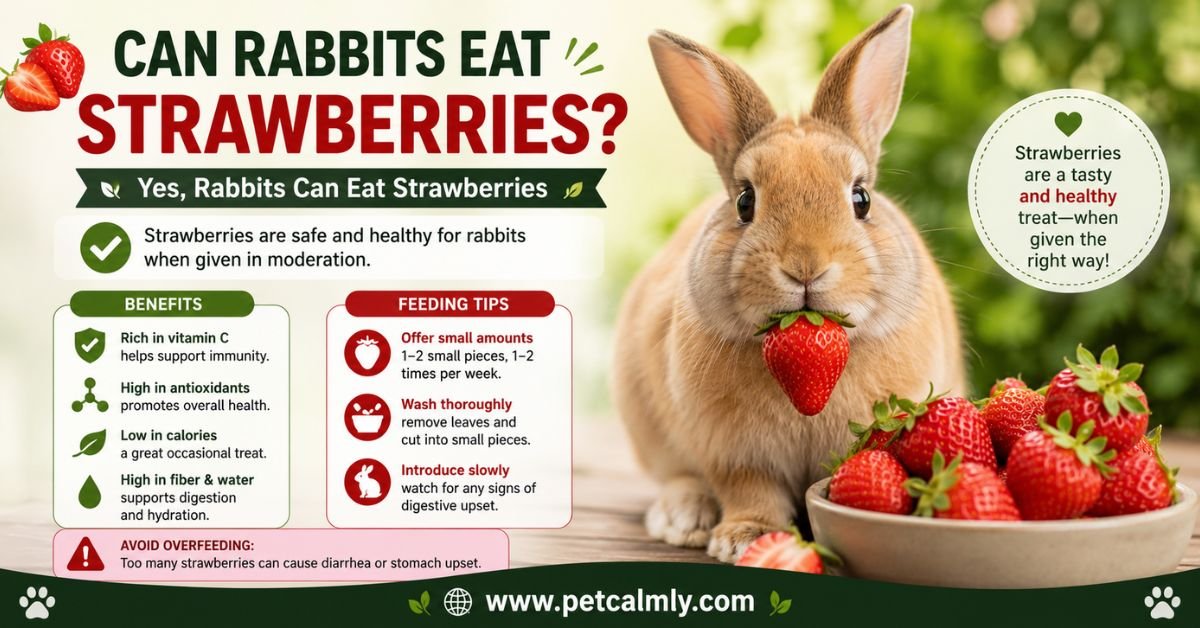
Yes, rabbits can eat strawberries but only in small amounts and only as an occasional treat. Strawberries are safe for healthy adult rabbits when given in moderation, roughly one to two medium-sized berries per week for an average-sized rabbit. They should never replace hay, which must make up the bulk of a rabbit’s diet. Because strawberries are high in natural sugar, feeding too many too often can upset your rabbit’s sensitive digestive system and contribute to weight gain over time.
If you’ve ever caught your rabbit eyeing the strawberry on your plate with that unmistakable “just one bite” stare, you’re not alone. It’s one of the most common questions new rabbit owners ask, and for good reason rabbits are notoriously particular about what agrees with their stomachs, and fruit sits in a gray zone that’s easy to get wrong.
This guide walks through exactly how much is safe, how to introduce strawberries the right way, which parts of the plant are fine (and which aren’t), and what to watch for if your rabbit’s tummy doesn’t handle it well. By the end, you’ll know precisely how to work strawberries into your rabbit’s routine without second-guessing yourself every time treat time rolls around.
Are Strawberries Safe for Rabbits?
Strawberries are generally safe for rabbits, but “safe” doesn’t mean “unlimited.” Rabbits evolved to eat a fiber-heavy diet of grasses and leafy plants, not sugary fruit. Their digestive system relies on a delicate balance of gut bacteria to break down fibrous plant material, and that balance is easy to throw off with foods that don’t fit the natural pattern.
A small piece of strawberry now and then isn’t going to hurt a healthy adult rabbit. The concern isn’t toxicity strawberries aren’t poisonous to rabbits the way onions or chocolate would be. The concern is quantity and frequency. Think of strawberries the way you’d think of dessert for a toddler: fine occasionally, problematic if it becomes a habit.
Why Rabbits Need to Be Careful With Fruit
Rabbits have what’s called a hindgut fermentation system. Their cecum (a pouch near the junction of the small and large intestine) houses bacteria that ferment fiber into usable nutrients. This system works beautifully with hay and leafy greens. It works far less well with sugar.
When a rabbit eats too much sugary food, the bacterial balance in the cecum can shift, allowing harmful bacteria to multiply. This can lead to a serious condition called GI stasis, where the digestive tract slows down or stops moving altogether. GI stasis is one of the most common emergency conditions in pet rabbits, and it’s exactly why moderation with fruit isn’t just a suggestion it’s a genuine safety measure.
Strawberry Nutrition Facts Rabbit Owners Should Know
Understanding what’s actually in a strawberry helps explain why portion control matters so much.
| Nutrient (per 100g strawberries) | Amount | What It Means for Your Rabbit |
|---|---|---|
| Sugar | ~4.9g | Main reason to limit intake |
| Fiber | ~2g | Lower than hay or leafy greens |
| Water content | ~91% | Can contribute to loose stool if overfed |
| Vitamin C | ~59mg | Rabbits synthesize their own; not essential from diet |
| Calcium | Low | Won’t significantly affect bladder sludge risk |
The takeaway here is simple: strawberries offer very little that a rabbit actually needs nutritionally. Rabbits produce their own vitamin C internally, so unlike guinea pigs, they don’t rely on fruit or vegetables for it. That means strawberries are purely a treat food — enjoyable for your rabbit, but not something their body is asking for.
How Many Strawberries Can a Rabbit Eat?
A good general guideline is one to two medium strawberries per week, cut into smaller pieces, for an average adult rabbit weighing around 4 to 6 pounds. Smaller breeds should get proportionally less sometimes just a single small piece is plenty.
A simple way to think about portioning:
- Small rabbits (under 4 lbs): One or two small pieces, once a week
- Medium rabbits (4–7 lbs): One medium strawberry, split across the week
- Large rabbits (over 7 lbs): Up to one whole strawberry, once or twice a week
It helps to picture the portion relative to your rabbit’s body size rather than treating “one strawberry” as a fixed rule. A single strawberry is a much bigger deal for a two-pound Netherland Dwarf than it is for a nine-pound Flemish Giant.
A Simple Rule of Thumb Many Rabbit Owners Use
Rabbit-savvy owners often follow a general treat guideline: treats, including fruit, shouldn’t make up more than about 5% of a rabbit’s total daily diet, with the remaining 85–90% coming from hay and the rest from fresh leafy greens and a small measured portion of pellets. Strawberries fall into that small treat allowance, not into the daily “food” category.
Which Parts of the Strawberry Plant Are Safe?
This is where a lot of owners get tripped up, because rabbits can actually eat more of the strawberry plant than just the fruit itself.
Strawberry Fruit
Safe in small, occasional amounts. Wash thoroughly and remove the green leafy cap before serving, mostly to remove any pesticide residue rather than because the cap itself is unsafe.
Strawberry Leaves
Perhaps surprisingly, strawberry leaves are often better tolerated than the fruit. They’re lower in sugar and higher in fiber, making them a gentler option. Many rabbits enjoy nibbling fresh, pesticide-free strawberry leaves as part of a varied greens rotation.
Strawberry Stems
Stems are generally fine in small quantities too, though most rabbits show far less interest in them compared to the leaves or fruit.
Unripe or Rotten Strawberries
Avoid both. Unripe strawberries can be harder to digest, and any fruit showing mold or spoilage should never be offered — mold on fruit can produce toxins that are harmful regardless of species.
How to Introduce Strawberries to Your Rabbit Safely
If your rabbit has never had strawberries before, don’t hand over a whole one and hope for the best. Rabbits’ digestive systems respond poorly to sudden dietary changes, even changes toward foods that are technically safe.
- Start with a tiny piece — about the size of a pea or smaller.
- Wait 24 hours and watch for any changes in stool consistency, energy level, or appetite.
- If everything looks normal, you can offer a small piece again a few days later.
- Gradually work up to the full recommended weekly portion over a couple of weeks, never rushing the process.
- Keep a mental note (or a written one, if you’re tracking multiple new foods) of how your rabbit responds, since individual sensitivity varies quite a bit between rabbits.
This slow approach isn’t overcautious it’s simply how experienced rabbit owners introduce any new food, because a rabbit that seems perfectly healthy can still have a sensitive gut that reacts unpredictably to something new.
5 Common Mistakes Owners Make When Feeding Strawberries
A few patterns show up again and again with new rabbit owners, and they’re worth flagging directly.
- Treating fruit as a daily snack. Strawberries feel harmless because they’re “natural,” but daily fruit intake is one of the most common contributors to soft stool and excess weight in pet rabbits.
- Using strawberries as a training reward too often. It’s tempting to use a sweet treat for litter training or recall, but this can quickly exceed the weekly limit without you realizing it. Small pieces of leafy greens or a tiny bit of plain oat make gentler training rewards.
- Skipping the wash. Store-bought strawberries can carry pesticide residue. Always rinse thoroughly, even if your rabbit is only getting a small piece.
- Ignoring portion size relative to the rabbit’s weight. A treat portion appropriate for a large rabbit can be excessive for a dwarf breed.
- Feeding strawberries to rabbits with known digestive sensitivity without checking with a vet first. Some rabbits, particularly those with a history of GI stasis, do better avoiding sugary fruit altogether.
What Happens If a Rabbit Eats Too Many Strawberries?
An occasional overindulgence say, your rabbit sneaks an extra piece off the counter usually isn’t an emergency, but it’s worth watching your rabbit closely for the next day or two. Overfeeding sugary fruit can lead to:
- Soft or loose stool, sometimes with visible cecotropes (the softer nutrient-rich droppings rabbits normally reingest) left uneaten
- Reduced appetite for hay, since sugary foods are more palatable and can make rabbits less interested in their fiber-rich staples
- Bloating or mild discomfort, which a rabbit might show through reduced movement or a hunched posture
- Gradual weight gain if the pattern continues over weeks or months
None of these are usually dangerous from a single incident, but they’re a sign to scale back and return to a stricter treat schedule.
When Should You Worry? Signs That Need Veterinary Attention
This is the section that matters most, because knowing the difference between “keep an eye on it” and “call the vet now” can genuinely make a difference for your rabbit’s health.
Contact a veterinarian promptly if your rabbit shows any of the following after eating strawberries or any new food:
- Complete loss of appetite for more than 12 hours
- No fecal output at all, or noticeably smaller and fewer droppings than usual
- Visible signs of pain, such as teeth grinding, a hunched posture, or reluctance to move
- Bloated or firm abdomen
- Lethargy that doesn’t improve
- Diarrhea (distinct from normal soft cecotropes) that continues for more than a few hours
According to the Merck Veterinary Manual and clinical guidance from exotic-animal veterinarians, GI stasis in rabbits can become life-threatening within 24–48 hours if left untreated, because rabbits can’t vomit and rely entirely on gut motility to process food. This is not a wait-and-see condition if you notice these signs, same-day veterinary care is strongly recommended rather than a home remedy.
It’s worth being clear here: general dietary upset from too much fruit is usually mild and short-lived, but true GI stasis is a medical emergency regardless of what triggered it. If you’re ever unsure which one you’re looking at, treat it as the emergency and call your vet.
What Should Pet Owners Do to Feed Strawberries Responsibly?
Bringing this all together, here’s a practical checklist you can actually use:
- ✅ Offer strawberries no more than once or twice a week
- ✅ Cut portions small — roughly the size of your thumbnail for a medium rabbit
- ✅ Wash thoroughly and remove the leafy cap before serving the fruit
- ✅ Introduce new food slowly and watch for 24 hours
- ✅ Prioritize hay first — it should always make up the majority of your rabbit’s diet
- ✅ Rotate treats rather than relying on strawberries every week
- ✅ Skip strawberries entirely for rabbits with diabetes-like sensitivity, obesity, or a history of GI stasis, unless your vet says otherwise
- ✅ Keep an eye on stool consistency for a day or two after any new treat
Strawberries vs. Other Fruits: A Quick Comparison
If you’re weighing strawberries against other fruit options, here’s how they stack up for rabbit feeding purposes.
| Fruit | Sugar Level | Recommended Frequency | Notes |
|---|---|---|---|
| Strawberries | Moderate | 1–2x per week | Leaves are a good bonus option |
| Blueberries | Moderate | 1–2x per week | Very small portions due to size |
| Banana | High | Occasional, tiny amounts | Easy to overfeed due to density |
| Apple (no seeds) | Moderate | 1–2x per week | Remove seeds and core entirely |
| Watermelon | Low-moderate | Occasional | High water content, good in small pieces |
This kind of comparison is useful because owners often assume “fruit is fruit,” when really the sugar density and portion size vary quite a bit between options.
A Realistic Example: Introducing Strawberries the Right Way
Consider a fairly typical scenario: a two-year-old Holland Lop who’s never had fruit before. A cautious approach would look like offering a piece about the size of a fingernail on day one, checking litter box output the next morning, and if everything looks normal, offering a slightly bigger piece a few days later. Within two or three weeks, that rabbit could comfortably handle a modest weekly portion without any digestive upset as long as the rest of the diet stays hay-focused and the treat doesn’t creep upward in frequency.
This kind of gradual, observant approach is really the whole strategy in a nutshell. Rabbits don’t need fruit, but there’s nothing wrong with sharing a small piece as an occasional bonding moment, as long as it stays exactly that occasional.
More Information About Pets, Please Visit Our Website: Why Is My Rabbit Suddenly Biting Me?
How to Bond Two Rabbits
How Often Should I Clean My Rabbit Cage?
How to Care for a Pet Rabbit Indoors
Conclusion
Strawberries aren’t dangerous for rabbits, but they’re also not a health food. The safest approach is to treat them the way you’d treat any sugary treat: enjoyable in small amounts, unnecessary in large ones. Keep hay as the foundation of your rabbit’s diet, introduce any new food slowly, and pay attention to how your individual rabbit responds because rabbits, like people, don’t all handle the same foods identically.
If you’re ever uncertain whether your rabbit’s digestion is behaving normally after a new treat, a quick call to your vet is always the safer choice over guessing.