Short direct answer
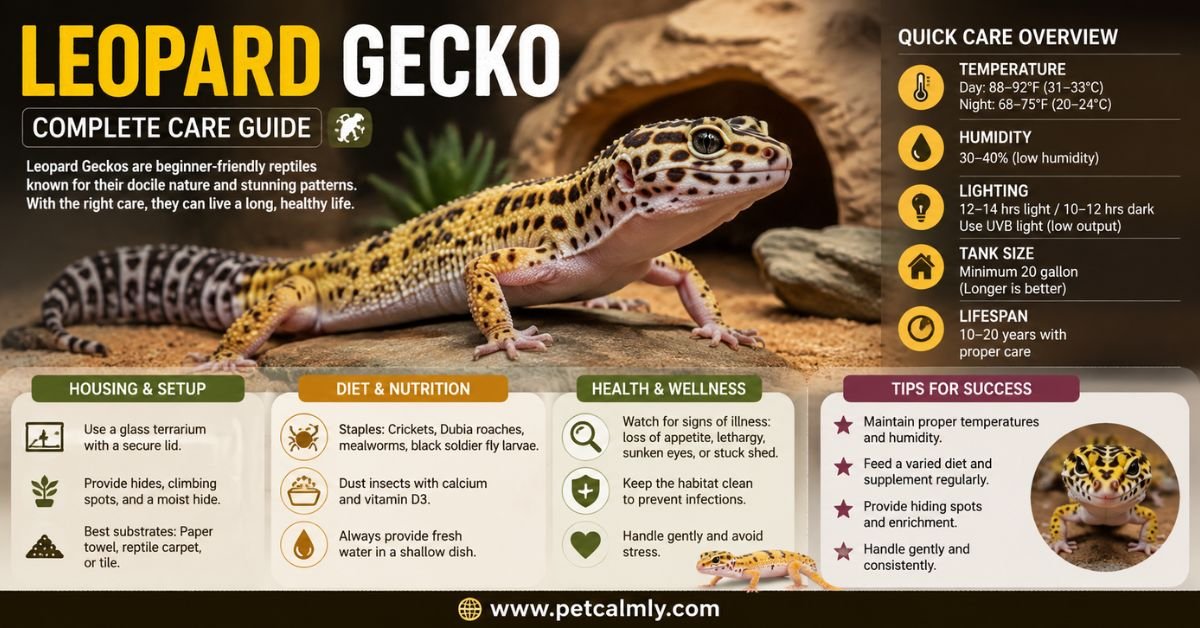
Leopard gecko care comes down to five essentials: a properly heated enclosure with a warm and cool side, a secure hide with moist substrate for shedding, a diet of gut-loaded live insects dusted with calcium, low humidity around 30–40%, and gentle, low-stress handling. Get these right and leopard geckos are one of the hardiest, longest-living reptile pets you can own often reaching 15 to 20 years with consistent care.
If you’re a first-time owner, that single paragraph covers the basics. But leopard geckos are creatures of habit, and small mistakes in setup or feeding tend to show up weeks or months later as stress, poor appetite, or shedding problems. This guide walks through everything in more depth not just what to do, but why it matters, so you can actually troubleshoot problems instead of guessing.
Why Leopard Geckos Make Such Forgiving First Reptiles
Leopard geckos (Eublepharis macularius) come from the rocky, arid grasslands of Pakistan, Afghanistan, India, and Iran. That background matters because it explains almost everything about how they behave in captivity they’re crepuscular (most active at dawn and dusk), they tolerate a wide temperature range better than many reptiles, and unlike most geckos, they have movable eyelids and no toe pads, so they can’t climb glass. That’s part of why they’re considered a beginner-friendly species: they stay put, they’re not prone to escaping through small gaps in the same way arboreal geckos are, and their body language is easy to read once you know what to look for.
That said, “beginner-friendly” doesn’t mean low-maintenance. It means the learning curve is gentler, not that there isn’t one.
Setting Up the Right Enclosure
Tank Size and Layout
A single adult leopard gecko needs a minimum of a 20-gallon long tank (36″ x 12″ x 16″), though many keepers now recommend 30–40 gallons for more natural behavior and enrichment space. Floor space matters more than height here, since leopard geckos are ground-dwellers that rarely climb.
Inside the enclosure, you want three functional zones:
- A warm hide directly over the heat source
- A cool hide on the opposite side
- A humid hide (a small box with damp moss or paper towel) placed on the warm side to help with shedding
This “three-hide rule” solves a problem a lot of new owners run into without realizing it: a gecko that only has one hide is forced to choose between thermoregulation and feeling secure. Given that choice, most geckos will pick the wrong one and end up either too cold or too stressed to eat normally.
Substrate: What’s Safe and What Isn’t
Loose sand and calcium-sand products are marketed heavily for leopard geckos, but most experienced keepers and several reptile veterinarians advise against them, particularly for juveniles, because of the risk of impaction if sand is accidentally ingested during feeding. Safer, well-tested options include:
- Paper towels or newspaper (easiest to monitor and clean, ideal for young geckos)
- Reptile carpet
- Fine, sifted topsoil or a bioactive substrate blend for bioactive setups
- Slate or ceramic tile
If you want a more naturalistic look, a bioactive substrate with springtails and isopods as a cleanup crew can work well for adult geckos, but it takes more research to set up correctly than a simple paper-towel enclosure does.
Temperature and Lighting: Getting the Gradient Right
This is where most leopard gecko health problems actually start. Leopard geckos are ectothermic, meaning they rely entirely on their environment to regulate body temperature and digest food. Without correct heat, digestion slows down, appetite drops, and immune function weakens.
Target temperatures:
| Zone | Temperature |
|---|---|
| Warm side (basking surface) | 88–92°F (31–33°C) |
| Cool side | 75–80°F (24–27°C) |
| Nighttime drop | Down to 70°F (21°C) is acceptable |
Use an under-tank heat mat controlled by a thermostat never plug a heat mat directly into an outlet without one, since uncontrolled mats can overheat and burn a gecko that presses against the glass. A digital thermometer with a probe (not a stick-on dial) is the only reliable way to confirm your actual surface temperature, because ambient air temperature and surface temperature can differ significantly.
Leopard geckos don’t need UVB to survive, but low-level UVB (roughly 2–7%) is now recommended by many reptile vets and keepers because it supports natural vitamin D3 synthesis and appears to contribute to better bone density and longevity, mirroring the low-level UV exposure they’d get at dawn and dusk in the wild. If you use UVB, provide a shaded retreat so your gecko can opt out of exposure when it wants to.
Leopard Gecko Diet: What, How Much, and How Often
Leopard geckos are strict insectivores they don’t eat vegetables or fruit the way bearded dragons do. A varied insect diet is essential because no single feeder insect provides complete nutrition on its own.
Core Feeder Insects
- Crickets – a staple, but can be noisy and bite if left in the tank uneaten
- Dubia roaches – increasingly popular; low odor, high nutrition, don’t jump or climb out
- Mealworms – fine as an occasional feeder, not a staple due to a tougher exoskeleton
- Waxworms and superworms – high fat, best used sparingly as treats
Gut-Loading and Dusting
“Gut-loading” means feeding your insects nutritious food for 24 hours before offering them to your gecko, so the nutrition passes through. Before every feeding, dust insects with a calcium powder (without D3 for geckos that get UVB, with D3 if they don’t), and use a multivitamin powder once or twice a week. This step matters more than most new owners expect — calcium deficiency is one of the most common preventable health issues in pet geckos.
Feeding Schedule by Age
| Age | Frequency | Portion |
|---|---|---|
| Juveniles (under 6 months) | Daily | 4–6 appropriately sized insects |
| Sub-adults (6–12 months) | Every 1–2 days | 5–7 insects |
| Adults (12+ months) | Every 2–3 days | 6–8 insects |
A useful rule of thumb: insects should be no longer than the width of the gecko’s head, to reduce impaction risk. A shallow dish of fresh water should always be available, even though geckos get some hydration from food.
Handling and Bonding Without Causing Stress
New geckos need a settling-in period most keepers recommend waiting 5 to 7 days after bringing a gecko home before attempting to handle it, giving it time to acclimate to the new environment and start eating reliably. Rushing this step is one of the more common reasons a new gecko goes off food in the first week or two.
When you do start handling:
- Let the gecko walk onto your open hand rather than grabbing it from above (which can trigger a predator response)
- Keep sessions short at first a few minutes is plenty
- Support the body fully; never hold or restrain by the tail
- Watch for tail-waving or barking sounds, which usually signal stress or agitation, not aggression
One thing worth understanding early: leopard geckos can drop their tails as a defense mechanism (called autotomy) if they feel seriously threatened or are grabbed too roughly. It’s not dangerous on its own and the tail typically regrows, but it’s a clear sign that handling needs to be gentler and slower going forward.
Shedding: What’s Normal and What’s a Problem
Leopard geckos shed their skin regularly more often in younger, growing geckos, and roughly every 4–8 weeks in adults. Normal shedding looks patchy and a little messy for a day or two, and most geckos eat their own shed skin, which is completely normal behavior.
Retained shed becomes a genuine concern when it’s left on the toes or tail tip, because it can cut off circulation over time. This is almost always a humidity problem if your humid hide is dry or your overall humidity is too low, shed can stick instead of coming off cleanly. If you notice stuck shed around the toes after 48 hours, a warm, shallow soak followed by gentle assistance (never pulling or peeling) usually resolves it.
When Should You Worry: Signs That Need Attention
General care mistakes are common and fixable. But certain signs point to something that goes beyond husbandry and needs a veterinarian who treats reptiles:
- Persistent loss of appetite lasting more than 2 weeks (outside of normal brumation behavior)
- Sunken eyes, wrinkled skin, or a noticeably shrinking tail (signs of dehydration or malnutrition)
- Swelling in the jaw or limbs, or difficulty moving normally possible signs of metabolic bone disease
- Discharge from the nose, mouth, or eyes
- Diarrhea or unusually foul-smelling stool over multiple feedings
- Lethargy combined with an unwillingness to move even when handled
- A tail that looks unusually thin (leopard geckos store fat in their tails, so a thin tail often signals they haven’t been eating enough)
None of these are things to wait out. A reptile-experienced veterinarian can rule out parasites, metabolic bone disease, or infection early, when treatment tends to be far more straightforward.
What Pet Owners Should Actually Do Day to Day
Care advice is only useful if it fits into a routine you’ll actually keep up. In practice, that looks like:
- Check both hot and cool side temperatures once a day, ideally at the same time
- Refresh the water dish daily
- Spot-clean waste as soon as you see it, rather than letting it sit
- Feed on schedule based on age, dusting insects each time
- Do a full substrate change and enclosure wipe-down every 2–4 weeks depending on substrate type
- Watch weight and tail thickness over time a small kitchen scale works fine for tracking trends
Keeping a simple log (even just a note on your phone) of feeding, weight, and shedding dates makes it much easier to notice small changes before they become real problems.
A Quick Word on Brumation
Some adult leopard geckos, particularly during cooler months, go through a period of reduced activity and appetite called brumation a natural, hibernation-like slowdown, not illness. It’s more common in geckos kept in setups with a natural seasonal light or temperature shift. If your gecko is eating less but otherwise alert, maintaining normal weight, and showing no other symptoms above, this is often just brumation. If you’re unsure whether reduced appetite is brumation or something else, a vet check is the safer call, especially for younger geckos that shouldn’t yet be brumating.
Conclusion
Leopard gecko care isn’t complicated once you understand the reasoning behind it: a proper temperature gradient so digestion works correctly, a varied and properly supplemented insect diet, low humidity with one humid hide for shedding, and handling that respects how a small prey animal actually experiences the world. Most problems that come up with pet geckos trace back to one of these basics slipping not bad luck. Get the fundamentals right and stay consistent, and a leopard gecko can be a genuinely low-drama, long-lived companion for well over a decade.
More Information About Pets, Please Visit Our Website: Leopard Gecko Tank Setup
Leopard Gecko Diet
Leopard Gecko Not Eating and Sleeping All the Time?
Common Leopard Gecko Diseases
Leopard Gecko Shedding Tips
Frequently Asked Questions
1: How long do leopard geckos live as pets?
With consistent care, leopard geckos commonly live 15 to 20 years, and some well-cared-for individuals live even longer. Their lifespan is one of the longest among commonly kept pet reptiles.
2: Do leopard geckos need a heat lamp?
Not necessarily a bulb most keepers use an under-tank heat mat controlled by a thermostat as the primary heat source, since leopard geckos absorb heat from the ground in the wild. A low-level UVB light is optional but increasingly recommended for long-term bone health.
3: Can leopard geckos live together?
Adult male leopard geckos should never be housed together, as they’re territorial and will fight. Females can sometimes cohabit, but even that carries risks like resource competition and stress, so most experienced keepers recommend housing leopard geckos individually.
4: Why is my leopard gecko not eating?
Common causes include incorrect temperatures, recent stress from handling or a new environment, brumation in cooler months, or shedding. If loss of appetite continues beyond two weeks, or comes with other symptoms like lethargy or a thinning tail, it’s time to see a reptile vet.
5: Do leopard geckos need a water bowl?
Yes. Even though they get some hydration from prey, a shallow dish of clean, fresh water should be available at all times and changed daily.
6: Is leopard gecko sand safe to use?
Loose sand carries a real risk of impaction, particularly for young or underweight geckos, so most keepers and reptile vets recommend safer alternatives like paper towel, reptile carpet, tile, or a properly researched bioactive substrate instead.