Short direct answer
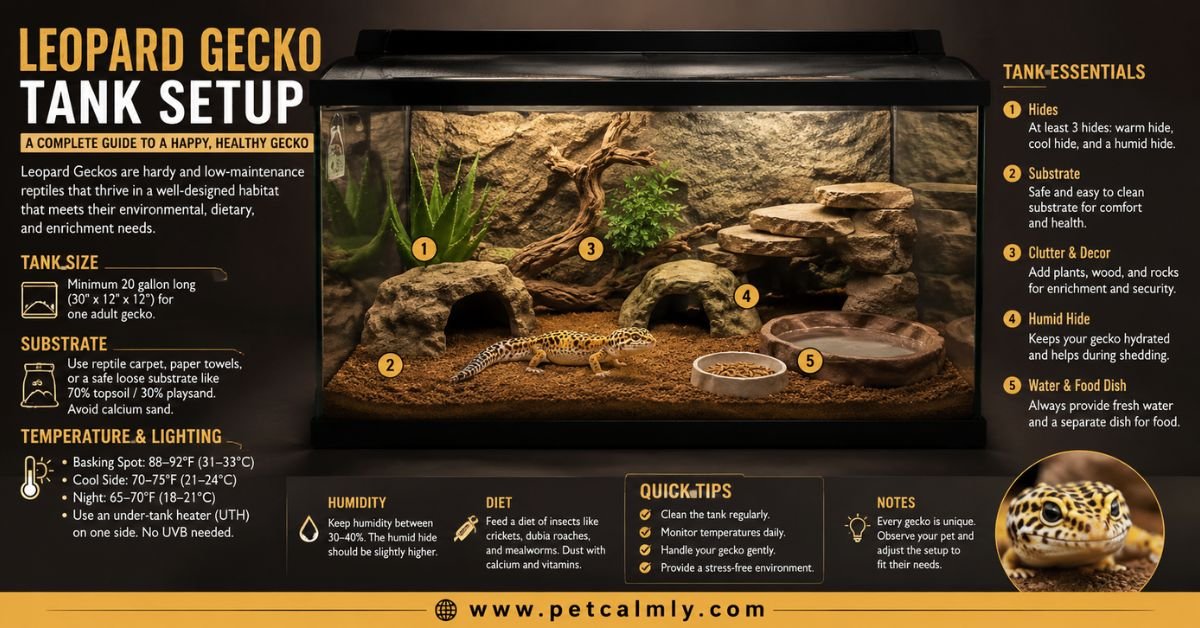
A proper leopard gecko tank setup needs a 20-gallon long enclosure (minimum for adults), a temperature gradient of 88–92°F on the warm side and 70–75°F on the cool side, low-to-moderate humidity around 30–40% with one humid hide, a paper towel or tile substrate for beginners, and three hides (warm, cool, and humid). Get these five elements right and almost everything else in leopard gecko care becomes easier.
If you’re reading this, you’ve probably already brought home a gecko or you’re about to and you want to get the setup right the first time instead of rebuilding it three times like most of us did when we started out. That’s fair. Leopard geckos are forgiving animals in a lot of ways, but their tank is not the place to guess. A wrong heat source or the wrong substrate can quietly cause problems for months before you even notice something’s off.
This guide walks through every piece of a leopard gecko enclosure size, heating, lighting, humidity, substrate, hides, decor, and the exact order to set it all up with the reasoning behind each choice, not just a list of rules to follow blindly.
What Size Tank Does a Leopard Gecko Need?
A single adult leopard gecko needs at least a 20-gallon long tank (36″ x 18″ x 18″), which gives enough floor space to create a real temperature gradient. Floor space matters far more than height for these geckos, since they’re ground-dwelling and don’t climb the way crested geckos or other arboreal species do.
For a hatchling or juvenile, a 10-gallon tank works temporarily, but most owners end up buying the 20-gallon anyway within a few months — so many experienced keepers just start there and use dividers or extra hides to make the space feel less exposed for a small gecko.
A few sizing notes worth knowing before you buy:
- Bigger is generally better, but a tank that’s too large for a baby gecko can make it harder for them to find food and feel secure.
- Bin-style enclosures (like PVC or plastic tub setups) are popular among breeders because they hold heat and humidity more efficiently than glass, though they’re less common for pet owners who want visibility.
- Height doesn’t need to be tall these geckos aren’t jumpers or climbers, and extra vertical space just makes heat harder to manage.
Best Substrate for a Leopard Gecko Tank (And What to Avoid)
The safest substrates for leopard geckos are reptile carpet, paper towels, or non-adhesive shelf liner for beginners, and fine excavator clay or a bioactive soil blend for more experienced keepers who manage humidity carefully.
Substrate is one of the most debated topics in the leopard gecko community, and it’s worth understanding why. Loose substrates like sand or calcium sand carry a real risk of impaction if a gecko accidentally swallows particles while hunting this is especially common in young or underweight geckos with weaker digestion. That’s why most reptile vets and experienced keepers steer beginners toward solid, easy-to-clean substrates first.
Substrates to avoid:
- Calcium sand or reptile sand marketed as “digestible”
- Walnut shell bedding
- Wood shavings (pine or cedar especially, due to aromatic oils)
- Gravel or small decorative rocks
Safer beginner options:
- Paper towels (easiest to monitor and replace)
- Reptile carpet (reusable, but needs regular washing)
- Non-adhesive shelf liner
More advanced options once you’re confident in humidity control:
- Excavator clay (great for burrowing behavior)
- Bioactive substrate blends with isopods and springtails as a cleanup crew
If you want your gecko to display natural digging behavior, a bioactive setup is genuinely rewarding to watch just don’t rush into it your first month. Get comfortable with temperature and humidity control on a simple substrate first.
Leopard Gecko Tank Temperature and Heating Setup
Leopard geckos need a warm side of 88–92°F on the floor (measured with a probe thermometer, not a stick-on strip) and a cool side of 70–75°F, with nighttime temperatures allowed to drop into the mid-60s.
Unlike many reptiles, leopard geckos rely heavily on belly heat, which is why an under-tank heater (UTH) placed under one-third of the tank is the standard heating method not overhead heat bulbs alone. This mimics how they’d absorb warmth from sun-heated rocks in the wild.
A basic heating setup includes:
- An under-tank heating pad, positioned under the warm-side hide
- A thermostat wired to the heating pad (non-negotiable heaters without thermostats are a leading cause of burns and overheating)
- A digital probe thermometer placed directly on the warm-side floor
- A second thermometer on the cool side to confirm the gradient exists
Why the thermostat matters so much: an unregulated heat mat can climb well past safe temperatures, and leopard geckos don’t always move away from heat that’s hurting them the way you’d expect. Thermal burns from unregulated heat mats are one of the most common preventable injuries reported in pet leopard geckos, which is why every major reptile care resource treats a thermostat as essential equipment, not an optional upgrade.
If your room stays consistently below 65°F at night, a low-wattage ceramic heat emitter can supplement warmth — but it should also run through its own thermostat.
Lighting Requirements for Leopard Gecko Enclosures
Leopard geckos don’t strictly need UVB to survive, since they’re crepuscular (most active at dawn and dusk) and historically kept without it but low-level UVB (around 2–7%) is now widely recommended by reptile veterinarians because it supports natural vitamin D3 synthesis and healthier bone density over the gecko’s lifetime.
A practical lighting setup looks like this:
- A low-output UVB bulb (5.0 or similar) positioned on the warm side, with a hide available so your gecko can choose to bask or retreat
- A 12-hour light/dark cycle, ideally on a timer
- No heat-emitting “night light” bulbs leopard geckos don’t need light at night, and red or purple bulbs can still disrupt their natural rhythm and stress them
If you already have a gecko that’s never had UVB, you don’t need to panic but adding a low-level UVB tube during your next enclosure refresh is a reasonable, low-risk upgrade most keepers now consider standard practice.
Humidity Levels and the Humid Hide
Leopard geckos need overall tank humidity around 30–40%, with a dedicated humid hide kept closer to 70–80% to support shedding.
This is where a lot of new owners get confused, because leopard geckos come from arid regions and don’t want a swampy tank but they absolutely need a humid microclimate for shedding, or they risk retained shed, especially around the toes and tail tip, which can cut off circulation if it’s not resolved.
A humid hide is simple to build:
- A small enclosed container or hide box
- Damp sphagnum moss or paper towel inside
- Placed on the warm side for the best shedding results
Check it every couple of days and re-dampen as needed. You’ll usually notice your gecko spending more time in there in the day or two before a shed — that’s completely normal and a sign the setup is working as intended.
Hides, Decor, and Enrichment for a Calmer, Healthier Gecko
Every leopard gecko tank needs a minimum of three hides one on the warm side, one on the cool side, and one humid hide so your gecko never has to choose between feeling secure and being at a comfortable temperature.
Hides aren’t decoration; they’re a core part of stress management for a prey animal that instinctively wants cover. A gecko without enough hiding spots often shows it through pacing, glass-surfing, or reduced appetite behaviors that are frequently mistaken for illness when the real issue is an under-furnished tank.
Beyond hides, a few enrichment additions make a real difference:
- Cork bark or slate rock for texture and shelter variety
- A shallow water dish, shallow enough that a gecko can’t accidentally get trapped or drown
- Climbing pieces kept low to the ground, since leopard geckos aren’t strong climbers but do enjoy some elevation change
- Artificial or safe live plants to break sightlines and reduce the feeling of open exposure
A tank that looks “too empty” from a human decorating perspective is often exactly right from a gecko’s sense of security — resist the urge to overcrowd it just for aesthetics.
Water and Feeding Setup Inside the Tank
Fresh water should be available at all times in a shallow, stable dish, changed every one to two days even if it looks untouched, since bacteria builds up quickly at warm-side tank temperatures.
For feeding, most keepers use a shallow feeding dish for staple insects like mealworms or crickets, which keeps escaped bugs from stressing your gecko or hiding in the substrate. Live feeders left loose in the tank overnight can actually nibble on a sleeping gecko in rare cases, so removing uneaten insects after 10–15 minutes is a good habit to build early.
Calcium and vitamin supplementation happens at feeding time, not as part of the tank itself but it’s worth mentioning here because a well-set-up tank still needs consistent dusting of feeder insects with calcium (with D3 if UVB exposure is limited) to prevent metabolic bone disease over time.
Step-by-Step: How to Set Up a Leopard Gecko Tank
Here’s the order experienced keepers actually follow, which saves you from rearranging a finished tank:
- Place the tank in a low-traffic area away from direct sunlight and drafts.
- Add substrate to the base of the enclosure.
- Install the under-tank heater beneath the warm side, then plug it into the thermostat.
- Add thermometers to both the warm and cool sides before adding anything else.
- Place the three hides — warm, cool, and humid — based on where the heat mat sits.
- Add the UVB fixture across the top, positioned over the warm side.
- Add the water dish on the cool side, away from the heat source.
- Add décor — cork bark, rock, low climbing pieces — to break up open space.
- Run the empty tank for 24–48 hours, checking that temperatures hold steady before adding your gecko.
- Add your gecko last, once the gradient is confirmed and stable.
That 24–48 hour test run is the step most new owners skip and it’s the one that prevents the most problems, because it lets you catch a miscalibrated thermostat or a hide in the wrong spot before your gecko is stressed by it.
Common Leopard Gecko Tank Setup Mistakes New Owners Make
Most tank-related health issues trace back to a small handful of repeated mistakes:
- Skipping the thermostat to save money, which risks both overheating and underheating
- Using loose sand substrate for a baby gecko, increasing impaction risk
- Not enough hides, leading to chronic stress behaviors
- Guessing temperatures instead of using a probe thermometer
- Placing the tank near a window, where sunlight can cause dangerous temperature spikes even with a thermostat installed
- Forgetting the humid hide, resulting in stuck shed around the toes
None of these are signs of a bad owner they’re just the setup details competitors tend to gloss over. Getting them right from day one saves you from having to problem-solve a stressed gecko later.
When Should You Worry: Signs Your Tank Setup Needs Attention
Most tank-related issues show up as behavior or physical changes rather than obvious enclosure problems, which is why it helps to know what to watch for:
- Retained shed around the toes, tail tip, or eyes that doesn’t come off within a day or two on its own
- Persistent glass-surfing or pacing, suggesting the gecko doesn’t feel secure or the gradient isn’t working
- Refusing food for more than a week in an adult gecko (juveniles have different feeding needs and this window is shorter)
- Lethargy paired with a soft or bent jaw or limbs, which can point to metabolic bone disease
- Visible burns or unusual behavior around the heat mat, suggesting a thermostat failure
If you see any of these signs especially retained shed that isn’t resolving, or symptoms suggesting metabolic bone disease that’s the point to move from tank adjustments to a call with an exotic or reptile veterinarian rather than trying to fix it entirely at home. Setup changes help prevent these issues, but they aren’t a substitute for veterinary care once a health problem is already underway.
What Should Pet Owners Do Next
If your tank is already set up and something on this list doesn’t match say, you’re missing a thermostat or running loose sand — you don’t need to rebuild everything today. Prioritize in this order: verify temperatures with a real probe thermometer first, add a thermostat if you don’t have one, then work through substrate and hides as your next upgrade. Small, steady improvements are safer for your gecko than tearing down and rebuilding the whole tank in one stressful afternoon.
If you’re setting up a tank for the first time, resist the urge to buy every accessory in one trip. Get the tank, heating, and thermometers right first, run your test period, and add enrichment once you know the core environment is stable.
Conclusion
A good leopard gecko tank setup isn’t about having the most decorated enclosure it’s about giving your gecko a reliable gradient, a place to feel secure, and the humidity support they need to shed properly. Once those fundamentals are in place, everything else feeding, handling, watching your gecko’s personality come out gets a lot more enjoyable for both of you.
If you’re still deciding between enclosure types or want a deeper look at feeding schedules, our guides on leopard gecko diet and feeding schedules and choosing between glass and PVC reptile enclosures cover those next steps in more detail.
More Information About Pets, Please Visit Our Website: Leopard Gecko Diet
Leopard Gecko Not Eating and Sleeping All the Time?
Common Leopard Gecko Diseases
Leopard Gecko Shedding Tips
Frequently Asked Questions
1: Do leopard geckos need a heat lamp or just an under-tank heater?
An under-tank heater is the primary heat source, since leopard geckos absorb most of their warmth through their belly. A heat lamp isn’t required for warmth, but a low-level UVB light is recommended for long-term bone health.
2: Can I use sand for my leopard gecko’s tank?
Loose sand isn’t recommended, especially for young or underweight geckos, due to impaction risk if it’s accidentally ingested during feeding. Paper towels, reptile carpet, or excavator clay are safer choices.
3: How often should I clean a leopard gecko tank?
Spot-clean waste and remove uneaten insects daily, do a partial substrate or liner clean weekly, and do a full deep clean with reptile-safe disinfectant every 4–6 weeks.
4: Why does my leopard gecko keep glass-surfing?
Glass-surfing usually points to feeling exposed or an uncomfortable temperature gradient. Adding more hides and confirming your warm and cool side temperatures with a probe thermometer often resolves it.
5: Is a 10-gallon tank ever okay for a leopard gecko?
A 10-gallon tank can work temporarily for a hatchling, but adult leopard geckos need at least a 20-gallon long tank for proper temperature gradients and enrichment space.
6: Do leopard geckos need a humid hide if they’re a desert species?
Yes — even though they’re arid-region animals, a humid hide kept around 70–80% humidity is essential for healthy shedding and prevents retained shed around the toes and tail.