Short direct answer
To cut an uncooperative dog’s nails, work in short sessions, desensitize your dog to the clippers before you ever squeeze them, trim only one or two nails at a time if needed, use high-value treats throughout, and stop the moment your dog shows real stress. If your dog is aggressive, in pain, or has black nails you can’t safely judge, a groomer or vet tech can do it more safely while you rebuild trust at home.
If you’re reading this with a squirming dog on your lap and clippers in hand, take a breath. This is one of the most common struggles dog owners deal with, and it’s rarely about the dog being “bad” it’s almost always about fear, a past bad experience, or simply never having learned that nail trims aren’t dangerous. The good news is that this is a trainable, fixable problem for the vast majority of dogs, and you don’t need to wrestle your dog to the ground to get it done.
This guide walks through why dogs fight nail trims in the first place, how to actually do it safely when your dog won’t sit still, how to retrain a nail-shy dog step by step, and when it’s smarter to bring in professional help instead of forcing it.
Why Some Dogs Hate Having Their Nails Cut
Before you can fix the behavior, it helps to understand what’s actually driving it. Dogs don’t resist nail trims out of stubbornness there’s almost always a reason underneath it.
Fear of the tool itself. Clippers make a distinct sound and a pinching sensation, and if a dog was ever nicked, cut too short, or startled during a trim, that memory sticks. Dogs generalize fast: one bad clip and the sight of clippers alone can trigger panic weeks or months later.
Sensitivity in the paws. Dog paws are packed with nerve endings. Many dogs simply don’t like their feet handled at all, regardless of what you’re doing to them nail trims just happen to be the most invasive version of foot-touching they experience.
Restraint anxiety. Some dogs aren’t afraid of the clippers at all they’re afraid of being held still. Being pinned down, even gently, can trigger a fight-or-flight response, especially in dogs with a history of being restrained during vet visits.
Pain from a previous quick cut. If you’ve ever cut into the quick (the blood vessel inside the nail), your dog remembers that pain vividly. This is one of the most common root causes of nail-trim resistance, and it explains why dogs who were previously fine with trims suddenly start fighting them.
Lack of early exposure. Puppies who weren’t handled and desensitized to paw touching early on often grow into adult dogs who see nail trims as a threat simply because the experience is unfamiliar and overwhelming.
Understanding which of these applies to your dog changes how you approach the fix. A dog who’s scared of restraint needs a very different plan than a dog who’s scared of the clipper sound.
How to Cut an Uncooperative Dog’s Nails: Step-by-Step
If you need to get nails trimmed now, and full retraining isn’t realistic today, here’s how to do it as safely and calmly as possible.
Step 1: Set Up Before You Even Pick Up the Clippers
Prep work matters more than the actual cutting. Choose a quiet room without other pets or distractions, and have everything within arm’s reach: clippers or a grinder, styptic powder (in case you hit the quick), and small, soft treats your dog rarely gets otherwise.
Trim after a walk or play session, not before. A dog with some pent-up energy already burned off is naturally calmer and easier to handle.
Step 2: Get Your Dog Comfortable With Being Touched First
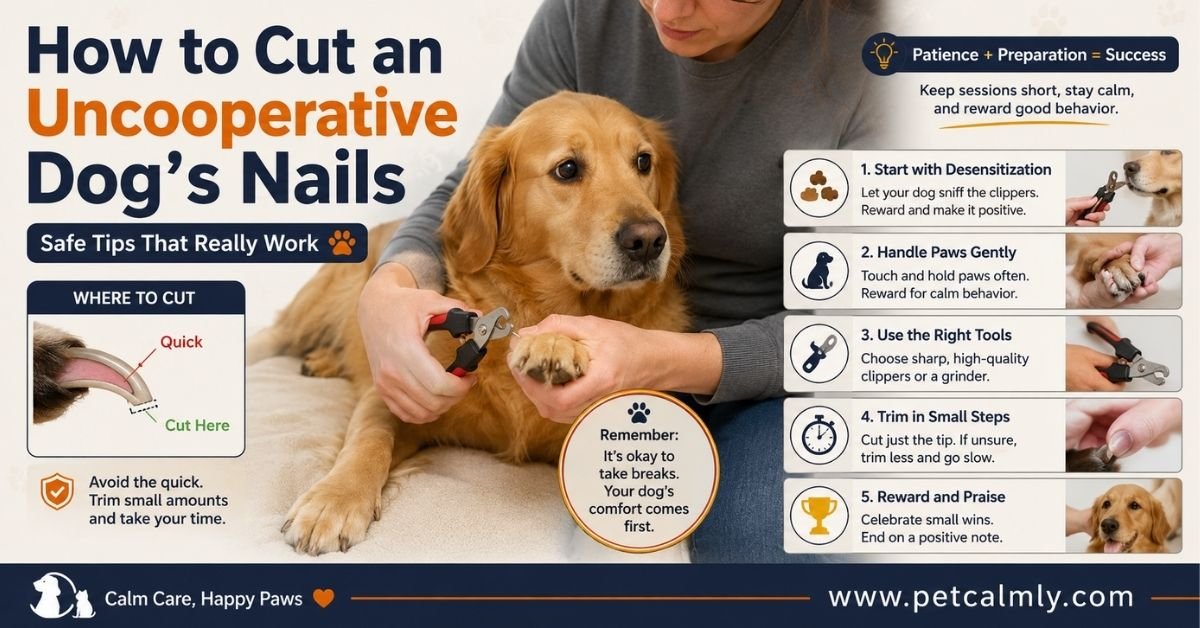
Don’t go straight for the clippers. Spend a minute just touching and gently squeezing each paw, rewarding calm behavior with a treat after each one. If your dog pulls away, stop, wait a few seconds, and try again more gently. This single step resolves a surprising amount of resistance because it separates “my human is touching my feet” from “something scary is about to happen.”
Step 3: Introduce the Clippers Without Cutting Anything
Let your dog sniff the clippers. Touch the clippers to a paw and reward. Click or squeeze the clippers near (not on) the paw so your dog hears the sound without any pressure on the nail itself, then reward again. This sounds slow, but it’s often the fastest route to a cooperative dog long-term, because you’re removing the surprise factor.
Step 4: Trim in Small, Manageable Sessions
You do not need to finish all four paws in one sitting. If your dog is uncooperative, cutting two or three nails and stopping while things are still calm is a win — it’s far better than pushing through to finish all 18 nails while your dog becomes increasingly panicked.
A simple approach that works for many resistant dogs:
- Trim one paw, then take a break
- Reward after every single nail, not just at the end
- Watch your dog’s body language constantly (see the section below)
- End the session the moment stress signs appear, even mid-paw
Step 5: Use the Right Cutting Technique
Hold the paw firmly but gently, isolating one toe at a time. Identify the quick if the nail is light-colored (you’ll see a pinkish area inside the nail). For dark nails where the quick isn’t visible, trim in small increments — a few millimeters at a time — rather than one large cut, and stop as soon as you see a small dark or grayish dot appear in the center of the cut surface, which signals you’re getting close to the quick.
Cut at a slight angle, following the natural curve of the nail, rather than straight across.
Step 6: Have a Plan for Accidents
Even experienced owners occasionally hit the quick. If it happens, stay calm your dog will take cues from your reaction. Apply styptic powder (or in a pinch, cornstarch or flour) directly to the nail with firm pressure for about 30 seconds. A single quick nick is not an emergency, but staying composed matters, because a panicked reaction from you teaches your dog that nail trims really are dangerous.
Reading Your Dog’s Body Language During a Trim
Uncooperative behavior rarely comes out of nowhere dogs usually telegraph their discomfort well before they pull away, growl, or snap. Learning to spot these signs lets you pause before things escalate.
| Sign | What It Usually Means |
|---|---|
| Lip licking, yawning | Early stress signal, not tiredness |
| Whale eye (whites of eyes showing) | Anxiety or feeling trapped |
| Paw pulling or stiffening | Discomfort with handling |
| Low growl | Clear warning — stop immediately |
| Panting when not hot or active | Stress response |
| Trying to leave or hide | Wants the situation to end |
If you see any of these, that’s your cue to pause, take a breath, reward calm behavior with a treat once your dog settles slightly, and either continue more slowly or stop the session entirely. Pushing through a growl in particular is where a lot of owners get bitten a growl is communication, not defiance, and punishing it tends to remove the warning without removing the underlying fear.
6 Common Mistakes That Make Nail Trims Worse
Many well-meaning owners accidentally reinforce the exact behavior they’re trying to fix. Watch for these patterns:
- Rushing through it. Trying to “just get it over with” usually increases panic rather than reducing it.
- Restraining too tightly. Firm holding is sometimes necessary, but forceful pinning almost always backfires and increases fear for next time.
- Only bringing out clippers for trims. If clippers only ever appear right before something unpleasant, your dog learns to dread the sight of them. Leaving them out in view during calm moments helps break that association.
- Skipping the reward for calm behavior. Treats work best when they’re tied to specific calm moments, not handed out randomly.
- Doing it only once a month. Infrequent trims mean your dog never gets comfortable with the process, and nails often grow too long between sessions, making trims more urgent and more painful if the quick has grown out too.
- Punishing resistance. Scolding a scared dog adds another layer of anxiety on top of the original fear, making the next attempt harder, not easier.
Long-Term Fix: Retraining a Nail-Shy Dog
If your dog is chronically uncooperative, the real solution isn’t a better cutting technique it’s rebuilding trust around the whole process. This takes patience, but it’s genuinely effective for most dogs, including many who “hate” nail trims after years of resistance.
Start With Cooperative Care Training
Cooperative care is the concept of teaching your dog to voluntarily participate in handling, rather than being physically managed through it. A simple version:
- Teach a “chin rest” or “paw target” cue using treats, unrelated to nail trims at first
- Practice touching paws daily for a few seconds, rewarding calm acceptance
- Introduce the clippers as a neutral object your dog sees regularly, not just during trims
- Gradually build up to a single nail clip, then stop and reward heavily
- Slowly increase the number of nails per session as tolerance builds
This process can take anywhere from a few days to several weeks depending on how deep the fear runs, but it produces a dog who genuinely tolerates or even relaxes during trims, rather than one who’s simply overpowered each time.
Consider a Grinder Instead of Clippers
Some dogs who panic at the clipper’s pinching sensation do noticeably better with a nail grinder (Dremel-style tool), since it files the nail down gradually rather than applying pressure all at once. The trade-off is the vibration and noise, which some dogs find equally alarming — so this is worth testing in a calm moment before committing to it as your main method.
Build a Predictable Routine
Dogs generally do better with routines they can anticipate. Trimming on a consistent schedule (weekly for small trims, or every two to three weeks for full sessions) tends to work better than sporadic, high-stakes trims that only happen when nails are already uncomfortably long.
When Nail Trims Are More Than a Behavior Problem
Most uncooperative behavior is fear-based and manageable at home with patience. But there are situations where it’s worth stepping back and involving a professional rather than pushing through on your own.
Reach out to your veterinarian or a professional groomer if:
- Your dog shows aggression (growling, snapping, biting) rather than just avoidance
- Nails are severely overgrown, curling, or already causing visible pain when walking
- You’ve hit the quick repeatedly and your dog now panics at the sight of clippers
- Your dog has an underlying medical condition (arthritis, injury, or anxiety disorder) that makes handling genuinely painful, not just unpleasant
- You’re not confident identifying the quick, especially on dark nails
- Your dog is elderly, very small, or has a bleeding disorder, where even a minor nick carries more risk
There’s no shame in outsourcing this. Many groomers and vet techs handle dozens of resistant dogs a week and have techniques, tools, and confidence that take time to build at home. Using a professional for the trim itself while you separately work on desensitization at home is often the most realistic path forward it keeps your dog’s nails healthy now while you fix the underlying fear for the long run.
What to Do If You Can’t Trim at All Right Now
If your dog is too distressed for any trimming today and the nails are getting long, here’s a practical short-term plan:
- Walk your dog on pavement or concrete more often, which naturally files nails down
- Book a same-week appointment with a groomer or vet clinic rather than forcing it yourself
- Ask if your vet clinic offers a quick “nail trim only” visit with a technician many do, and it’s usually inexpensive
- In the meantime, begin the paw-touching desensitization steps above, even for just a minute a day
This buys time without putting your dog through a traumatic forced trim that sets your training back further.
Why Regular Nail Care Matters for Your Dog’s Health
It’s worth understanding why this is worth the effort in the first place. Overgrown nails don’t just look untidy — veterinary organizations like the AVMA and VCA Animal Hospitals note that keeping nails at a proper length helps prevent pain, gait changes, and paw injuries. Long nails can force a dog’s foot into an unnatural position, alter their gait over time, and in severe cases curl inward and grow into the paw pad. Regular trims are genuinely a comfort and mobility issue, not just a grooming preference which is exactly why it’s worth putting in the effort to make trims tolerable rather than skipping them altogether.
Frequently Asked Questions
1: Why does my dog suddenly hate getting their nails trimmed when they used to be fine?
This is usually linked to a specific bad experience a nail cut too short, a slip during handling, or even an unrelated scare (like a loud noise) that happened during a trim. Dogs form strong associations quickly, so one negative event can undo months of previous cooperation.
2: Is it okay to trim nails while my dog is stressed, just to get it done?
Occasionally trimming through mild stress isn’t harmful, but making a habit of pushing through high stress teaches your dog that resistance doesn’t work but also doesn’t stop the scary thing from happening, which tends to increase fear over time rather than reduce it. It’s better to do fewer nails calmly than all of them under distress.
3: How often should I actually be trimming my dog’s nails?
Most dogs need a trim every three to four weeks, though active dogs who walk regularly on hard surfaces may need it less often. A good rule of thumb: if you can hear nails clicking on hard flooring, they’re due for a trim.
4: Can two people make it easier to trim an uncooperative dog’s nails?
Yes, having one person gently support and comfort the dog while the other handles the clippers can help, especially for larger or stronger dogs. Just make sure the “support” person isn’t restraining tightly, since that can add to the stress rather than ease it.
5: What should I do if my dog growls when I touch their paws?
Stop immediately rather than pushing forward. A growl is a warning, not defiance, and working through desensitization training (starting with simple paw touches, not clipping) is the safer long-term fix. If growling is frequent or paired with snapping, involve a professional trainer or your vet to rule out pain as the cause.
6: Are nail grinders safer than clippers for nervous dogs?
Not universally some dogs prefer grinders because there’s no pinching sensation, while others find the noise and vibration more frightening than clippers. It’s worth testing both in a calm, low-pressure moment to see which your specific dog tolerates better.
More Information About Pets, Please Visit Our Website: How to Remove Matted Dog Hair Without Cutting
Best Protein Food for Dogs
Can Dogs Eat Rice Every Day?
Best Dog Food for Skin Allergies
What Human Food Can Dogs Eat Safely?
Homemade Food for Dogs With Allergies
Conclusion
An uncooperative dog during nail trims is a common, solvable problem not a sign you’re doing something fundamentally wrong. Most resistance comes down to fear, past pain, or lack of gradual exposure, all of which respond well to patience, smaller sessions, and consistent positive association-building over time. Some dogs will always need extra care and slower sessions, and that’s okay. What matters most is that your dog’s nails stay at a healthy length and that the process, however long it takes to get there, doesn’t become something either of you dreads.