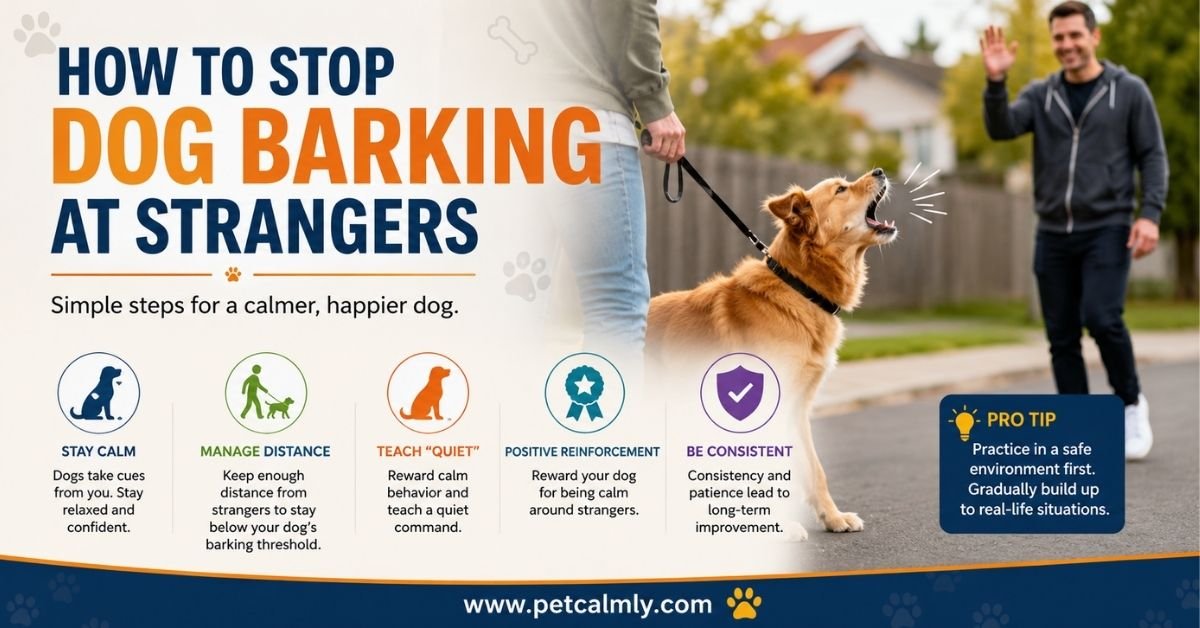
Short direct answer
To stop a dog from barking at strangers, you need to change how your dog feels about strangers first, then teach a new response. Most dogs bark at unfamiliar people out of fear, territorial instinct, or overexcitement, not defiance. The fastest, most lasting fix combines controlled distance from triggers, positive association (pairing strangers with treats or calm rewards), and consistent training cues like “quiet” or “watch me,” rather than yelling or punishment, which usually makes barking worse.
If you’re reading this at 6 a.m. after another morning of your dog exploding at the mail carrier, you already know the drill. The doorbell rings, or a jogger passes the window, and suddenly your calm living room turns into chaos. It’s stressful for you, embarrassing with neighbors, and honestly, it’s stressful for your dog too even if it doesn’t look that way from the outside.
The good news is that barking at strangers is one of the most common behavior issues dog owners deal with, and it’s also one of the most trainable. It’s rarely about “bad” behavior. It’s almost always about an underlying emotion fear, alertness, excitement, or a learned habit that’s been accidentally reinforced. Once you understand what’s actually driving the barking, the training becomes a lot less confusing and a lot more effective.
This guide walks through why dogs bark at strangers, the mistakes that quietly make it worse, and a step-by-step approach you can start using today whether your dog is a nervous rescue, a protective guard-breed type, or a young dog who just hasn’t learned better manners yet.
Why Do Dogs Bark at Strangers in the First Place?
Barking is communication. Dogs don’t have hands to point or words to explain, so barking is one of the main tools they have to say “something is happening and I’m not sure how I feel about it.” Understanding the reason behind the barking matters more than the barking itself, because the fix is different depending on the cause.
Fear or Anxiety-Based Barking
This is the most common reason dogs bark at unfamiliar people. A fearful dog barks to create distance essentially saying “stay back.” You’ll often see this paired with a lowered body, tucked tail, backing away while barking, or hackles raised along the spine. Dogs who were under-socialized as puppies, rescued from unclear backgrounds, or who had a scary encounter with a stranger in the past are especially prone to this.
Territorial or Protective Barking
Some dogs bark because they consider the home, yard, or car “theirs,” and a stranger approaching feels like an intrusion. This type of barking tends to happen at doors, windows, gates, and fences and it usually stops once the stranger is let inside and accepted by the owner.
Alert Barking
This is a shorter, sharper bark meant to notify you that something has changed. Many dogs will alert-bark once or twice and then stop on their own, especially if the owner acknowledges it. Alert barking becomes a problem when it doesn’t stop, or when it escalates into sustained barking or lunging.
Excitement or Frustration Barking
Not all barking is negative. Some dogs bark at strangers because they’re overly excited and want to greet them, especially dogs who don’t get much exposure to new people. This barking usually comes with a loose, wiggly body, a wagging tail, and forward movement toward the person rather than away.
Learned or Reinforced Barking
Sometimes barking sticks around simply because it “works.” If a dog barks at a delivery person and the person leaves, the dog learns that barking makes strangers go away even though the person was leaving anyway. Over time, this accidental reinforcement can turn a mild behavior into a strong habit.
5 Common Mistakes That Make Stranger Barking Worse
Before getting into solutions, it helps to know what not to do, because a few very common owner reactions unintentionally reinforce the exact behavior they’re trying to stop.
- Yelling “no” or “stop barking.” To your dog, a raised voice can sound like you’re barking along with them, adding excitement or reinforcing the alert.
- Punishing the bark itself without addressing the emotion behind it. If a dog is barking from fear, punishment adds more fear, and often more barking or worse, a bite risk down the line.
- Avoiding strangers altogether. Skipping walks or visitors to “avoid the problem” prevents your dog from ever learning that strangers aren’t a threat.
- Only reacting after the barking has already escalated. By the time a dog is in full bark-and-lunge mode, their brain is too aroused to learn anything. Timing matters far more than most owners realize.
- Inconsistent responses. Ignoring the barking one day and scolding it the next confuses the dog and slows progress.
Recognizing your own patterns here isn’t about blame almost every dog owner has done at least one of these. It’s just useful to notice, because undoing an accidental habit is part of the training process too.
How to Stop Dog Barking at Strangers: A Step-by-Step Training Approach
This approach works whether your dog barks at strangers on walks, at the door, through the window, or in the car. The core idea is simple: change the emotional response first, then layer in a trained cue.
Step 1: Identify the Distance Where Your Dog Stays Calm
Every dog has a “threshold distance” the point where they notice a stranger but can still take treats, listen, and think clearly. Too close, and your dog is too aroused to learn anything. Find that comfortable distance first, even if it means standing across the street or staying inside with the blinds partly closed.
Step 2: Pair Strangers With Something Good
When your dog notices a stranger at a distance they can handle, immediately follow with a high-value treat, calm praise, or a favorite toy. You’re not rewarding the bark you’re rewarding the sight of the stranger. Over repeated, short sessions, your dog starts to associate strangers with good things instead of threat.
Step 3: Teach a “Watch Me” or “Look” Cue
Teaching your dog to check in with you when they see something unfamiliar gives them an alternative behavior to barking. Practice this in low-distraction settings first, then slowly introduce it around strangers at a safe distance.
Step 4: Gradually Decrease the Distance
Once your dog is consistently calm and food-motivated at one distance, move slightly closer over several sessions not in a single day. This is where most owners rush, and rushing is the number one reason progress stalls.
Step 5: Practice the “Quiet” Cue for Existing Barking
For dogs who already have a barking habit, teach a “quiet” cue by waiting for a natural pause in barking, marking that pause with a word like “quiet” or “yes,” and rewarding immediately. This teaches silence as the behavior that earns rewards, rather than the bark itself.
Step 6: Manage the Environment While You Train
Training takes time, and management prevents the behavior from being practiced (and reinforced) in the meantime. This might mean:
- Using window film or furniture placement to block direct sightlines to the street
- Keeping your dog on a leash or in another room during deliveries
- Walking during quieter times while training is still in progress
Practical Guide: What to Do in the Moment a Stranger Appears
When a stranger shows up unexpectedly at the door, on a walk, or in a parking lot you often don’t have time for a full training session. Here’s a simple in-the-moment approach:
- Stay calm yourself. Dogs pick up on tension in your body and voice.
- Create distance if possible. Step back, turn a corner, or move behind a car.
- Use your trained cue (“watch me,” “quiet,” or “let’s go”) rather than reacting to the bark directly.
- Reward any moment of quiet or attention, even briefly.
- Avoid tightening the leash suddenly, which can signal alarm to your dog and increase reactivity.
Over time, these in-the-moment responses become second nature for both of you.
Training Tools That Can Help (and Ones to Avoid)
| Tool | How It Helps | Notes |
|---|---|---|
| High-value treats | Builds positive association with strangers | Use small, soft, easy-to-eat pieces for fast rewards |
| Front-clip harness | Reduces pulling during reactive moments | Improves handler control without added pressure |
| Long training leash | Allows distance-based training in open areas | Useful for gradual desensitization |
| Window film or baby gates | Limits visual triggers at home | A management tool, not a fix on its own |
| Shock, prong, or citronella collars | Suppress the bark without addressing the cause | Often increases fear and anxiety long-term; many trainers and behaviorists advise against them for fear-based barking |
If you’re unsure which tools fit your dog’s temperament, a certified force-free trainer can help tailor the plan especially for dogs with a bite history or intense reactivity.
Real-Life Example: A Common Scenario Owners Recognize
Picture a dog who’s fine on quiet streets but explodes into barking the moment a stranger appears near the front gate. The owner starts by working at a distance where the dog can still take treats calmly maybe from the porch instead of the sidewalk. Every time someone walks by, the dog gets a treat the instant they notice the person, before any barking starts. Within a few weeks, the dog begins glancing at the owner instead of barking, because that’s what’s earned rewards. The gate is still exciting, but it’s no longer alarming.
This kind of gradual shift is typical of well-applied desensitization and counter-conditioning, two of the most evidence-based approaches used in modern dog behavior work.
When Should You Worry? Signs That Need More Than Basic Training
Most stranger-directed barking is manageable with consistency and time. However, some signs suggest the behavior needs professional support rather than a DIY approach:
- Barking is paired with lunging, snapping, or attempts to bite
- Your dog cannot calm down even at a distance where strangers are barely visible
- The behavior has escalated over time despite consistent training
- Your dog shows signs of chronic stress: pacing, panting when not hot, loss of appetite, or excessive drooling
- Barking happens alongside destructive behavior or self-injury (like excessive licking or chewing)
These patterns can indicate a deeper anxiety disorder or a genuine bite risk, and they’re best addressed with a certified veterinary behaviorist or a professional force-free trainer rather than general online advice. According to the American Veterinary Medical Association, aggression and severe reactivity in dogs often have layered causes medical, environmental, and behavioral that benefit from individualized assessment.
It’s also worth mentioning: sudden-onset barking or reactivity in a previously calm dog can sometimes be linked to pain, vision or hearing changes, or other medical issues, particularly in older dogs. If the barking appeared suddenly and out of character, a veterinary check-up is a reasonable first step before assuming it’s purely behavioral.
What Should Pet Owners Do? A Simple Action Checklist
- Identify whether the barking is fear-based, territorial, alert, excitement, or learned
- Find your dog’s calm distance threshold around strangers
- Practice pairing strangers with treats at that distance, several short sessions a week
- Teach “watch me” and “quiet” as alternative behaviors
- Manage the environment (window visibility, leash control, timing of walks)
- Avoid yelling, punishment, or forced greetings with strangers
- Track progress weekly rather than expecting overnight change
- Reach out to a professional trainer or veterinary behaviorist if barking includes lunging, snapping, or doesn’t improve after consistent effort
Consistency matters more than intensity here. Five short, calm sessions a week will get you further than one long, stressful one.
How Long Does It Take to Stop a Dog From Barking at Strangers?
For mild alert or excitement barking, many owners see noticeable improvement within two to four weeks of consistent daily practice. Fear-based or deeply ingrained territorial barking often takes several months, especially in adult dogs who’ve practiced the behavior for years. Puppies and younger dogs typically respond faster because the habit hasn’t had time to become deeply reinforced. Progress isn’t always a straight line a stressful week or an unexpected encounter can cause a temporary setback, and that’s normal, not a sign that training has failed.
Conclusion
Stopping a dog from barking at strangers isn’t about silencing your dog completely some alert barking is normal and even useful. The real goal is helping your dog feel safe enough, and trust you enough, that a stranger walking by stops feeling like an emergency. That shift takes patience, consistent short training sessions, and a willingness to slow down when your dog needs it.
If you’ve been struggling with this, know that it’s an incredibly common issue, not a reflection of bad ownership or a “broken” dog. With the right approach and professional support if things escalate most dogs make real, lasting progress.
More Information About Pets, Please Visit Our Website: How to Stop Dog Digging Under Fence
Does My Dog Know I Love Him?
How to Train a Stubborn Dog
Best Natural Dog Calming Treats
Frequently Asked Questions
1: Why does my dog only bark at certain strangers and not others?
Dogs often react to specific visual or behavioral cues hats, sunglasses, uniforms, umbrellas, unsteady walking, or loud voices can all make a stranger seem more unpredictable. This is usually about specific triggers rather than randomness.
2: Should I let strangers give my dog treats to stop the barking?
Only if your dog is relaxed enough to approach voluntarily. Forcing an interaction with a fearful or barking dog can backfire and increase anxiety. It’s safer to let the dog choose to approach in their own time.
3: Is it normal for puppies to bark at strangers?
Yes, especially during fear periods around 8–11 weeks and again around 6–14 months. Early, gentle, positive socialization during these windows makes a significant difference in adult behavior.
4: Can barking at strangers turn into biting?
It can, particularly if the underlying fear or frustration isn’t addressed and the dog is repeatedly pushed past their comfort threshold. This is one of the clearest signs it’s time to involve a professional trainer or behaviorist.
5: Does breed affect how much a dog barks at strangers?
Breed tendencies can play a role some breeds were historically developed for guarding or alert work but individual temperament, early socialization, and training history usually matter more than breed alone.
6: What’s the difference between barking at strangers and separation anxiety barking?
Stranger-directed barking happens when a specific trigger (a person) is present. Separation anxiety barking happens when the dog is alone, often paired with pacing, destruction, or house-soiling, and stops once the owner returns. They require different training approaches.