Short direct answer
Cycling a fish tank establishes beneficial bacteria colonies that convert fish waste into less harmful compounds, a process essential before adding fish. The most common method fishless cyclingtakes 4–6 weeks using ammonia, while fish-in cycling is faster but puts your fish at risk. Both require patience, regular water testing, and understanding the nitrogen cycle.
Why Tank Cycling Matters Before You Add Fish
The single most important thing you can do before adding fish to a new aquarium is something you can’t see: establishing a stable, beneficial bacterial ecosystem. Many new aquarium owners skip this step, eager to see their fish swimming, and end up with dead or sick fish within days. This isn’t because they neglect their tanks it’s because they unknowingly introduced fish into toxic water conditions.
Tank cycling isn’t complicated, but it does require patience. This guide walks you through exactly what happens during the cycle, why it matters, and how to do it right whether you choose the safer fishless method or the faster fish-in approach.
The good news? Once you understand the process, you can confidently set up your tank and avoid the frustration and heartbreak that comes with an uncycled aquarium.
What Is the Nitrogen Cycle, and Why Does Your Tank Need It?
Before we talk about how to cycle your tank, let’s understand what’s actually happening inside it.
Every time a fish eats, it produces waste—just like any living creature. That waste contains ammonia, which is highly toxic to fish even in small amounts. In the wild, fish live in large bodies of water where ammonia dilutes quickly, making it harmless. In your aquarium, there’s no such escape. Ammonia accumulates, poisoning your fish.
This is where beneficial bacteria come in.
Two types of bacteria transform ammonia step by step:
- Nitrosomonas bacteria convert ammonia (NH₃) into nitrite (NO₂⁻)
- Nitrobacter bacteria convert nitrite into nitrate (NO₃⁻)
Nitrate is far less toxic than ammonia or nitrite. While it does accumulate over time, regular water changes keep nitrate at safe levels. This three-stage transformation—ammonia → nitrite → nitrate is the nitrogen cycle, and it’s what makes the difference between a thriving aquarium and a deadly one.
During your tank’s “cycling period,” you’re essentially building up enough of these bacteria colonies to handle your fish’s waste. Once established, these invisible workers maintain your water quality indefinitely (as long as you keep up with water changes).
Fishless Cycling vs. Fish-in Cycling: Which Method Should You Choose?
This is where aquarium advice diverges, and it’s important to understand your options honestly.
Fishless Cycling: The Safer, Slower Method
What it is: You establish beneficial bacteria without exposing any fish to toxic water conditions. Instead, you add ammonia directly to the tank (either pure ammonia, fish food, or a commercial cycling product), feed the bacteria until they’re established, then add fish to water that can safely handle their waste.
Why it’s recommended: Fish are completely safe. Ammonia and nitrite levels never reach the dangerous point they do during fish-in cycling.
Timeline: 4–6 weeks on average, sometimes longer depending on water temperature and other factors.
Difficulty: Moderate. You need to test water regularly and maintain consistent ammonia levels, but the process is predictable.
Cost: Slightly higher upfront (cycling products, more frequent test kit use), but you won’t lose any fish.
Fish-in Cycling: The Faster, Riskier Method
What it is: You add hardy fish immediately and let their waste naturally generate ammonia, which cycles while they live in it. Your fish are exposed to ammonia and nitrite throughout the process.
Why some people choose it: It’s faster—sometimes 2–3 weeks—and feels more natural since fish are creating the waste.
The honest trade-off: Even with daily water changes and careful monitoring, your fish will experience some level of ammonia and nitrite poisoning. Some fish recover; others develop permanent damage or don’t survive. Fin rot, cloudy eyes, lethargy, and gill damage are common during fish-in cycles.
Which fish can handle it: Only hardy species like danios, barbs, and some plecos. You absolutely cannot use fish-in cycling for sensitive species like tetras, bettas, or discus fish.
When to consider it: Really only if your local fish store has already cycled their tanks and you trust their water quality. Most true beginners should avoid this method.
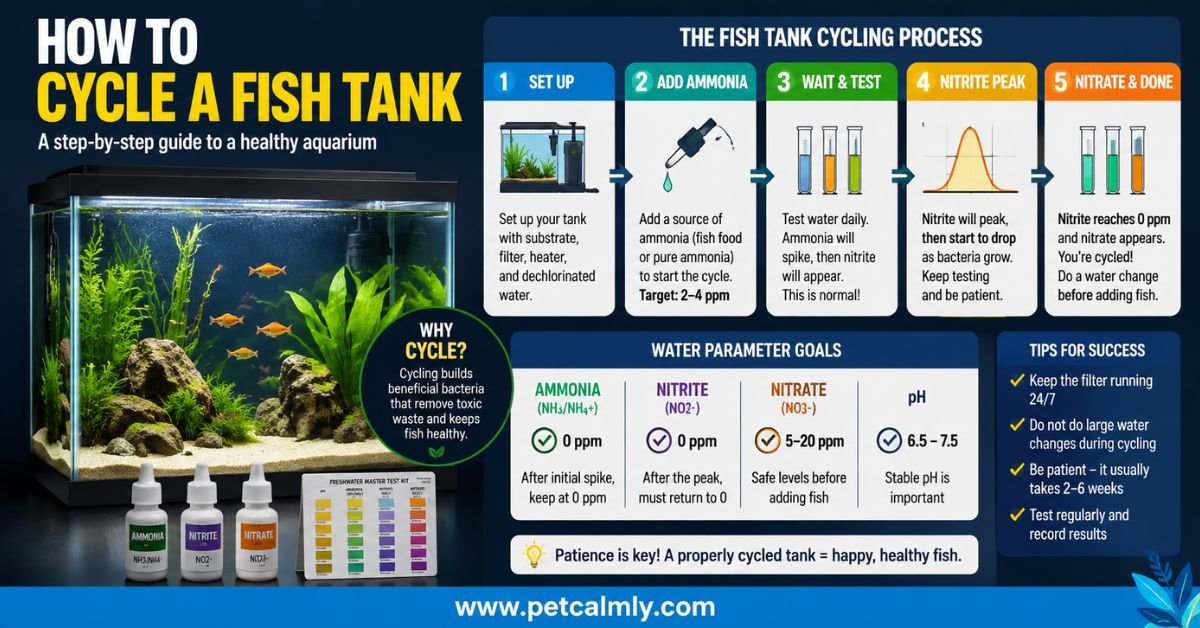
How to Fishless Cycle Your Tank: The Step-by-Step Process
If you’ve decided on fishless cycling (the recommended approach), here’s exactly how to do it.
Step 1: Set Up Your Tank
Before you start the cycle, your aquarium needs to be fully assembled and running:
- Fill the tank with dechlorinated water (let tap water sit 24 hours or use a water conditioner)
- Install the filter and turn it on—it must run continuously during cycling
- Add substrate (gravel or sand) if you’re using it
- Install a heater and set it to 75–78°F (bacteria cycle faster in warm water, though it works at any temperature)
- Add decorations but leave space for testing and maintenance
Don’t add your cycling medium yet. First, make sure everything is working—your filter is running smoothly, the heater is maintaining temperature, and there are no leaks.
Step 2: Choose Your Ammonia Source
You need to feed the bacteria with ammonia. There are three reliable options:
Option A: Pure Ammonia (Most Predictable)
- Buy ammonia from a hardware or cleaning supply store (make sure it’s pure, unscented ammonia with no additives)
- Dose the tank to reach 2–3 ppm (parts per million) of ammonia
- Use an online calculator to determine how much to add based on your tank size
This is the most precise method because you control the ammonia level exactly.
Option B: Fish Food (Most Accessible)
- Add a small pinch of flake food daily and let it decompose
- The food decaying creates ammonia naturally
- Less precise but works if you’re patient and willing to wait 1–2 weeks longer
Option C: Bottled Cycling Products (Most Convenient)
- Products like Tetra SafeStart, Seachem Stability, or Dr. Tim’s One and Only contain pre-cultured bacteria
- Still requires ammonia source, but speeds up the cycle
- More expensive but effective for beginners who want faster results
Most reliable beginner approach: Use pure ammonia dosed to 2 ppm, then maintain that level daily.
Step 3: Test Your Water and Establish a Baseline
Before you add anything, test your tank water to know your starting point:
- Ammonia: Should read 0 ppm
- Nitrite: Should read 0 ppm
- Nitrate: Should read 0 ppm
Use a liquid test kit (not strips—they’re less accurate). API Master Test Kit is the standard recommendation because it’s reliable and affordable.
Write down these baseline readings. You’re about to change this dramatically.
Step 4: Add Your Ammonia Source
Add ammonia to reach 2–3 ppm (if using pure ammonia) or start your fish food additions (if using decomposition method).
This is day 1 of your cycle. Mark it on a calendar.
What to expect right now: Your ammonia reading should be elevated. Nitrite and nitrate should still be 0.
Step 5: Daily Monitoring for 5–10 Days
Every single day, add enough ammonia to maintain 2–3 ppm, and test your water parameters.
For the first week or so, nothing dramatic happens—your ammonia stays high, nitrite and nitrate stay at 0. This is normal. You’re waiting for bacteria to colonize your filter media.
By day 5–10: You might start seeing nitrite appear, a sign that Nitrosomonas bacteria are colonizing and converting ammonia into nitrite.
Step 6: Watch for the Nitrite Peak
Around week 2–3, something important happens: Your ammonia starts dropping, but your nitrite spikes dramatically.
This is actually a good sign—it means the nitrogen cycle is working. The first bacteria colony is thriving. Your nitrite readings might reach 5–8 ppm, which feels alarming, but remember: no fish are in the tank.
Keep dosing ammonia to maintain 2–3 ppm. The bacteria need to eat.
Step 7: The Pivotal Moment—Nitrate Appears
This is when you know the cycle is working: You’ll see nitrate (NO₃⁻) appearing in your tank for the first time, usually around week 3–4.
This means Nitrobacter bacteria have colonized and are converting nitrite into nitrate. You now have a complete nitrogen cycle.
At this point:
- Ammonia drops to near 0
- Nitrite is still high but starting to decline
- Nitrate is building up (maybe 20–40 ppm)
Continue dosing ammonia daily to maintain 2–3 ppm. The bacteria need to keep eating to maintain their population.
Step 8: The Final Phase—Waiting for Stability
For the next 1–2 weeks, test your water every other day. You’re watching for two critical signs:
- Ammonia processes within 24 hours: You dose to 2–3 ppm, and by the next day, it reads close to 0 (0–0.5 ppm)
- Nitrite drops to 0: This is the most important milestone. Nitrite should be undetectable (0–0.25 ppm)
When both of these things happen consistently for 3 days in a row, your tank is cycled.
Typical timeline: 4–6 weeks, sometimes longer in cold water (bacteria work slower below 70°F)
How to Fish-in Cycle (If You Must): Minimizing Harm
If you’ve decided to fish-in cycle despite the risks, here’s how to reduce the danger to your fish:
Choose Your Fish Carefully
Only use hardy species: danios, barbs, plecos, corydoras catfish, or loaches. Never use sensitive fish like tetras, bettas, gourami, or discus.
Start with no more than 25% of your tank’s intended stocking level. If your final goal is 10 fish, start with 2–3.
Test Water Every Single Day
Fish-in cycling requires obsessive monitoring. Test ammonia, nitrite, and nitrate daily without fail. You need to catch dangerous buildups before they kill your fish.
Ammonia should never exceed 1 ppm. Nitrite should never exceed 1 ppm.
If either exceeds these levels, perform immediate water changes (25–50% of the tank).
Do Large, Frequent Water Changes
- Week 1–2: 25% water change daily
- Week 2–3: 25% water change every other day
- Week 3+: 25% water change twice weekly until cycle completes
Water changes reduce ammonia and nitrite but also slow the cycle slightly because you’re removing the bacteria food. It’s a necessary evil.
Never Add Medications or Treatments
Medications kill beneficial bacteria. Avoid them even if your fish look stressed. The cycle will end soon.
Watch for Signs of Stress
Even hardy fish show signs of ammonia/nitrite poisoning:
- Lethargy or lack of appetite
- Clamped fins
- Rapid gilling
- Unusual behavior
If you see these signs, perform an immediate 50% water change and increase change frequency.
Timeline: 2–3 weeks usually, but water changes often extend this to 4–5 weeks.
How to Test Your Water: Getting Accurate Readings
You can’t cycle a tank without testing water. Strip tests are convenient but unreliable. Use a liquid test kit.
The API Master Test Kit (Best Option)
This is the industry standard for good reason:
- Add 5 mL of tank water to each test tube (they come in a kit)
- For ammonia test: Add 8 drops of ammonia reagent A, add 8 drops of ammonia reagent B, shake for 10 seconds, wait 3 minutes
- For nitrite: Add 5 drops of nitrite reagent, shake for 10 seconds, wait 3 minutes
- For nitrate: Add 5 drops of nitrate reagent 1, shake for 10 seconds, add 5 drops of nitrate reagent 2, shake for 10 seconds, wait 5 minutes
Compare each test tube to the color card included in the kit. The shade of yellow, pink, or red tells you your reading.
Cost: Around $30–35, but each kit tests 100+ times.
Alternative Tests
pH test: Not essential during fishless cycling but good to know. Most fish prefer pH 6.5–7.5.
High-range pH test: Useful if you’re experiencing slow cycling—sometimes pH drops too low (below 6), which slows bacteria growth.
Testing Frequency During Cycling
- Fishless cycle: Every other day once you’ve added ammonia; daily once you see nitrite appear
- Fish-in cycle: Every single day, without exception
Troubleshooting: Why Your Tank Isn’t Cycling
If weeks pass and your tank isn’t cycling, something’s wrong. Here are the most common reasons and fixes.
The Cycle Isn’t Starting (No Nitrite After 2 Weeks)
Possible causes:
Temperature too low: Bacteria work slowly below 70°F and barely at all below 60°F. Raise your heater to 75–80°F. Cycling can happen in cooler water, but expect it to take 8–12 weeks instead of 4–6.
Ammonia too high: Over 4 ppm actually inhibits bacteria. Reduce your ammonia dose to 2 ppm.
Ammonia too low: Under 1 ppm starves the bacteria. Ensure your daily ammonia is reaching 2–3 ppm.
pH too low or too high: Bacteria prefer neutral pH (7.0). If your pH is below 6.0 or above 8.0, they’ll struggle. Add pH buffer if needed (consult your test kit for dosing).
Filter not running: Your filter must run 24/7. If it’s off even a few hours daily, bacteria colonies won’t establish.
Filter media is wrong: If your filter uses activated carbon, it might inhibit bacteria growth. Switch to sponge or ceramic media if possible.
Ammonia and Nitrite Are Both High (Stuck Cycle)
This usually means nitrite-converting bacteria (Nitrobacter) aren’t established yet, or something is inhibiting them.
Wait longer: Some cycles stall for a few weeks before progressing. This is frustrating but normal.
Increase aeration: Add an air stone to increase oxygen. Nitrobacter bacteria specifically prefer higher oxygen levels. Turn on an air pump if you have one.
Reduce ammonia slightly: If ammonia is above 3 ppm, reduce it to 2 ppm. High ammonia can delay nitrite conversion.
Check pH: Nitrite-converting bacteria are sensitive to pH. If it’s drifting below 6.5 or above 8.0, adjust it.
Nitrite Won’t Drop to Zero (Cycle Never Completes)
You have ammonia-converting bacteria (evidenced by nitrite appearing), but nitrite-converting bacteria aren’t working fast enough.
Do a partial water change: Change 25% of the water to remove some nitrite and give bacteria a “reset.” Then resume normal cycling.
Add bacteria starter: Use a bottled culture like Seachem Stability or Dr. Tim’s to directly add Nitrobacter bacteria. This often unsticks stalled cycles.
Increase temperature: Slightly warmer water (up to 80°F) boosts Nitrobacter activity.
Wait and be patient: Some cycles just take longer. If your nitrite is dropping slowly but steadily, you’re not truly stuck.
6 Common Mistakes That Ruin Tank Cycles
Mistake 1: Changing or Cleaning the Filter During Cycling
Your filter media is where bacteria colonies live. Cleaning it disrupts the colony growth. If your filter becomes clogged, only rinse it in a bucket of old tank water (never tap water—chlorine kills bacteria).
Don’t touch the filter cartridge for at least 4 weeks.
Mistake 2: Adding Fish Food or Decorations for Ammonia
Some people assume fish food will create ammonia. Yes, it will—eventually. But decomposing food creates ammonia slowly and unpredictably. You can’t monitor the process. Stick to measurable ammonia dosing.
Mistake 3: Testing Only Once Per Week
You’ll miss critical turning points. Test at least every other day during fishless cycling. During fish-in cycling, test daily without exception.
Mistake 4: Assuming Your Tank Is Cycled Too Early
The most common mistake is declaring the cycle complete after 3 weeks when you see nitrate appearing. Just because nitrate exists doesn’t mean your bacteria colonies are strong enough to handle fish. Wait until ammonia and nitrite both process to near-zero consistently.
Mistake 5: Adding Too Many Fish at Once
Even after cycling is complete, your beneficial bacteria colonies are still fragile. Adding 10 fish at once can overwhelm the bacteria and cause an ammonia spike. Add fish gradually—5–6 at a time with a week between additions.
Mistake 6: Performing Large Water Changes During Cycling
You’re removing the ammonia the bacteria need to eat. Small 10–15% changes during cycling are okay if ammonia spikes dangerously high, but avoid large water changes until after cycling completes.
How to Know When Your Tank Is Fully Cycled
Your tank is truly cycled when this happens:
✓ You dose ammonia to 2 ppm on day 1
✓ By day 2, ammonia reads 0–0.5 ppm (it processed)
✓ Nitrite reads 0–0.25 ppm or undetectable
✓ Nitrate is building (20–40+ ppm)
✓ This happens consistently for 3 days in a row
When you see this pattern, your bacterial colonies are mature and stable. You can now add fish.
Do one final 80% water change to remove excess nitrate and ammonia, bringing nitrate down to 5–10 ppm. Then add your fish.
Adding Fish to a Cycled Tank: The Safe Way
Your tank is cycled and waiting. Now comes the exciting part but still with caution.
Start with Fewer Fish Than You Think You Need
Even in a cycled tank, your bacteria colonies can become overwhelmed if stocked too heavily too fast. If your 20-gallon tank can eventually hold 15 fish, start with 5–6. Add more every 7–10 days as you monitor water parameters.
Test Your Water for the First Two Weeks
Your first batch of fish is a test. Watch ammonia and nitrite readings every other day for two weeks. They should remain at 0 ppm. If ammonia starts rising above 0.5 ppm, it’s a sign you’ve added too many fish or aren’t feeding the right amount.
Continue Your Water Change Schedule
Even in a cycled tank, nitrate builds up. Perform 20–30% water changes weekly to keep nitrate below 40 ppm.
Don’t Overfeed
Overfeeding is the #1 cause of ammonia spikes in established tanks. Feed only what your fish can eat in 2–3 minutes, once or twice daily. Uneaten food becomes ammonia.
What If You Fail the Cycle? Starting Over
If something goes catastrophically wrong your power went out, your heater broke, you accidentally cleaned the filter media in tap water your cycle can reset partially or completely.
Signs your cycle has crashed:
- Ammonia won’t drop after 3 days of no water changes
- Nitrite is spiking again
- No nitrate is being produced
- Multiple fish died suddenly
How to recover:
- Don’t panic. This happens. Your tank isn’t “broken.”
- Check temperatures: Make sure your heater is working and water is 75–78°F
- Check ammonia dosing: If you’ve been inconsistent, resume daily 2 ppm dosing
- Add a bacterial culture: Seachem Stability or Dr. Tim’s can revive damaged colonies
- Wait 1–2 weeks: Your cycle will rebuild, though it won’t take as long as the first cycle (your substrate and filter retain some bacteria even if populations crashed)
Most cyclists rebuild in 2–3 weeks rather than the original 4–6.
More Information About Pets, Please Visit Our Website: Why Is My Betta Fish Not Eating or Moving?
Cory Catfish Care
Neon Tetra Care Guide
How Often to Feed Goldfish
Why Is My Goldfish Turning Black?
Common Goldfish Tank Size
Frequently Asked Questions
1: Can I cycle a tank in 2 weeks?
A: Only with aggressive use of bottled bacterial cultures and perfect conditions (warm water, ideal pH, consistent ammonia dosing). Even then, 3–4 weeks is more realistic. Don’t trust anyone claiming a 1-week cycle. Your fish will pay the price.
2: Do I need a filter to cycle a tank?
A: Absolutely. Bacteria colonize your filter media. A tank without a filter can’t establish a proper nitrogen cycle. You need mechanical and biological filtration running 24/7.
3: Can I cycle multiple tanks at once?
A: Yes. Take filter media from an established tank and put it in your new tank. The bacteria transfer directly, and your new tank can cycle in 1–2 weeks instead of 4–6. This is called “seeding.”
4: What if I use bottled bacterial cultures? Do I still need to cycle?
A: Bottled cultures speed up cycling but don’t eliminate it. You still need to add ammonia and monitor water parameters for 2–4 weeks. The culture jump-starts the bacteria population but doesn’t instantly create a mature colony.
5: Is drift wood or gravel from a friend’s tank safe?
A: Yes. Used substrate and wood carry beneficial bacteria. They won’t fully cycle your tank, but they’ll significantly speed up the process. Rinse everything in old tank water (not tap water) before adding.
6: What if my tap water has chloramine instead of chlorine?
A: Chloramine inhibits beneficial bacteria more severely than chlorine. Use water conditioner specifically designed for chloramine, or let water sit for 24 hours (chloramine takes longer to dissipate than chlorine).
7: Can I use tap water directly if I treat it with conditioner?
A: Yes, as long as you use a quality water conditioner. API Stress Coat or Seachem Prime remove chlorine and chloramine instantly. Always treat tap water before adding it to your cycling tank.
8: Why does my tank smell bad during cycling?
A: Decomposing food (if using that method) and bacterial die-off create sulfur-like smells. This is normal and isn’t harmful to bacteria. It usually fades once the cycle completes. If it’s overwhelming, check for dead snails or fish stuck in your filter.
Conclusion
Tank cycling feels like the slowest part of starting your aquarium, but it’s actually an investment in everything that comes next. A properly cycled tank with stable water parameters is a thriving ecosystem where fish genuinely flourish.
The alternatives rushing to add fish to an uncycled tank or relying on shortcuts—rarely end well. Dead fish, expensive medications, frustration, and the mistaken belief that you’re “bad at keeping fish” follow quickly.
You’re not bad at keeping fish. You just need to let the invisible workers—beneficial bacteria—do their job first.
Whether you choose fishless cycling (4–6 weeks) or fish-in cycling (2–3 weeks, with risk), the process is straightforward: establish ammonia, monitor water parameters, and wait for nitrate to appear. Once your ammonia and nitrite both drop to zero consistently, you’re done.
Then you get to enjoy the best part: watching your fish thrive in clean, stable water.