Short direct answer
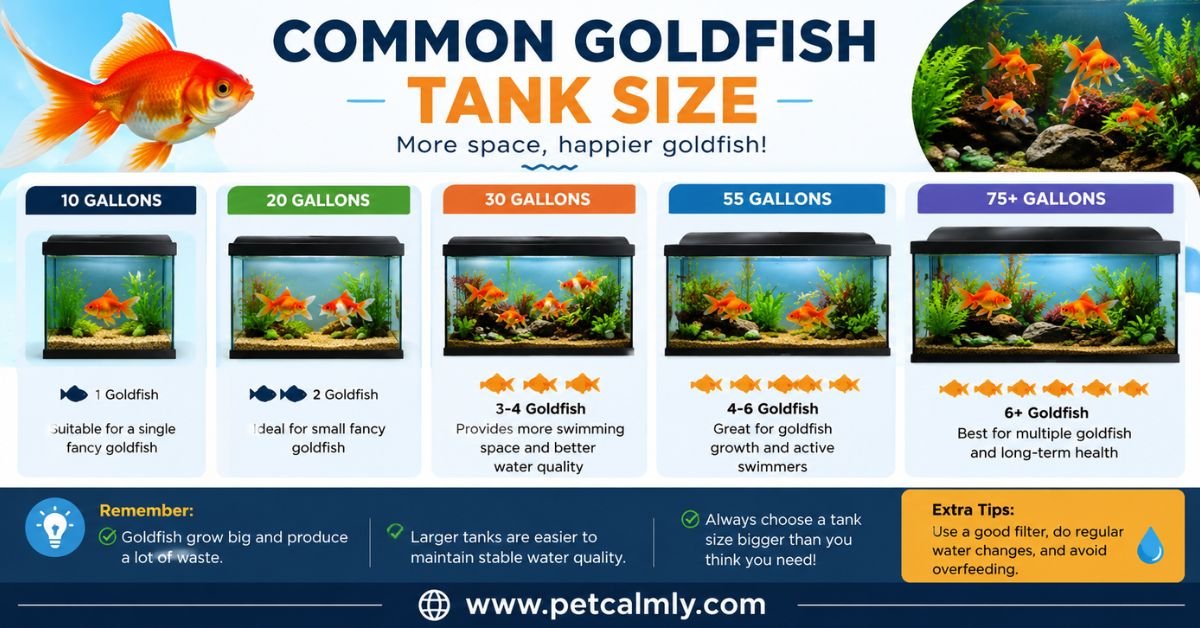
A single common goldfish needs a minimum tank size of 30 gallons, with 10–20 extra gallons for each additional fish. Common goldfish (also called comet goldfish) can grow to 10–12 inches long and produce a surprising amount of waste, so they need far more room than the small bowls or tanks often sold for them. If you’re planning ahead for growth, bigger is always safer than “just enough.”
If you’ve ever brought home a goldfish in a tiny bag from a fair or pet store, you’ve probably wondered how big a tank it actually needs once it settles in. It’s a fair question and one that trips up even experienced pet owners, because goldfish are so often marketed as “easy” starter pets that don’t need much space. In reality, common goldfish are one of the most misunderstood fish in the hobby. They’re hardy, yes, but they’re also large-bodied, long-living, and messy in ways that most small tanks simply can’t keep up with.
This guide walks through exactly how much space common goldfish need, why tank size matters more than most people realize, and how to set your fish up for a long, healthy life instead of a slow decline in a tank that was never big enough to begin with.
Why Tank Size Matters More for Goldfish Than Most Fish
Goldfish get a reputation for being low-maintenance, but that reputation is mostly built on myths. In truth, they’re one of the more demanding freshwater species when it comes to space and water quality for three main reasons.
They grow much larger than people expect. A common or comet goldfish bought at an inch or two long can reach 10 to 12 inches as an adult, sometimes more in a pond setting. That’s roughly the size of a small trout. A tank that looked spacious for a baby goldfish becomes cramped within a year.
They produce a lot of waste. Goldfish eat almost constantly and have relatively inefficient digestion, which means they release more ammonia into the water than most fish their size. In a small tank, that waste builds up fast, stressing the fish and putting them at risk of ammonia burns or illness.
They live a long time. With good care, common goldfish regularly live 10–15 years, and some live over 20. That’s a long-term commitment, which is exactly why the tank you choose early on matters so much undersized housing has years to cause slow, cumulative harm.
Put together, these traits mean a goldfish kept in a bowl or small tank isn’t just “less comfortable” it’s living in conditions that actively shorten its life.
Minimum Tank Size for a Common Goldfish
For a single common or comet goldfish, most experienced keepers and goldfish-specific care guides recommend starting at 30 gallons, with many suggesting even more once the fish reaches full size. This isn’t an arbitrary number it’s based on how much filtration, oxygen, and swimming room a fish of that eventual size actually needs to stay healthy.
Here’s a simple breakdown for common (single-tail) goldfish:
| Number of Goldfish | Minimum Tank Size |
|---|---|
| 1 common goldfish | 30 gallons |
| 2 common goldfish | 50 gallons |
| 3 common goldfish | 70–75 gallons |
| Each additional fish | +20 gallons |
Fancy goldfish (the rounder, shorter-bodied varieties like orandas, ranchu, or fantails) grow a bit smaller and are sometimes kept starting at 20 gallons for one fish, with 10 extra gallons per additional fish. But common and comet goldfish the classic single-tailed, torpedo-shaped variety most people picture when they hear “goldfish” need noticeably more room because of their larger adult size and more active swimming style.
If you’re working with a shoal (goldfish are social and genuinely do better with company), plan your tank size around your fish’s adult size, not their current size. This single mindset shift prevents most of the rehoming, stunting, and health problems that come from starting too small.
Why the “1 Gallon Per Inch” Rule Doesn’t Work for Goldfish
You may have heard the old rule of thumb: one gallon of water per inch of fish. It’s a reasonable starting point for some small community fish, but it badly underestimates what goldfish need, for a few reasons.
- It doesn’t account for how much waste a fish produces, only its length.
- It doesn’t scale for body mass a stout-bodied fancy goldfish displaces far more water (and produces more waste) than a slim fish of the same length.
- It ignores swimming behavior. Goldfish are active swimmers that need horizontal space, not just water volume.
A more useful way to think about it: goldfish need enough water volume that their waste can be diluted and filtered before it becomes dangerous, and enough physical space to swim, forage, and turn around comfortably without constantly bumping into decor or other fish. That’s why the 30-gallon starting point exists it’s based on real bioload and behavior, not a length-to-water ratio.
Why Goldfish Bowls and Small Tanks Cause Problems
Goldfish bowls are still sold as “starter kits” in many pet stores, which understandably confuses new owners. Here’s what actually happens inside a bowl or small tank over time:
Ammonia builds up quickly. Bowls typically have no filtration, or very weak filtration, which means waste accumulates between water changes. Even with frequent changes, ammonia and nitrite spikes are common and these are directly toxic to fish gills and organs.
Oxygen levels drop. Small, still water bodies have a low surface area relative to their depth, which limits oxygen exchange. Goldfish gasping at the surface is often a sign of poor oxygenation, not just poor water quality.
Growth becomes stunted but internal organs don’t stop growing. This is one of the most misunderstood issues in goldfish care. In cramped conditions, goldfish can appear to “stay small,” which some owners mistake for a sign the tank is fine. In reality, restricted growth in the body doesn’t always stop internal organs from developing, which can lead to organ damage and a shortened lifespan. A goldfish that looks small for its age isn’t necessarily healthy it may be a fish whose body has adapted to survive in too little space.
None of this means goldfish are fragile. It means they’re resilient enough to survive poor conditions for a while, which unfortunately hides the problem until health issues show up later.
How Much Space Do Goldfish Actually Use Day to Day?
It helps to picture what a goldfish’s day actually looks like. In a properly sized tank, goldfish spend much of their time cruising along the bottom and mid-level of the tank, foraging in substrate, investigating plants or decor, and interacting with tankmates. They’re curious, food-motivated fish that recognize their owners and often “beg” at the glass at feeding time.
In an undersized tank, that natural behavior gets replaced with something more limited: hovering in one spot, repetitive pacing along the glass, or staying near the surface. If you’ve noticed a goldfish that seems to just “sit” rather than explore, tank size not personality is often the reason.
Setting Up a Goldfish Tank the Right Way
Once you’ve settled on a tank size, a few setup choices make a real difference in how well that space actually functions for your fish.
Filtration Needs to Match the Bioload, Not Just the Tank Size
Because goldfish produce so much waste, most keepers run filtration rated for a tank larger than the one they actually have for example, a filter rated for 40–50 gallons on a 30-gallon goldfish tank. This gives extra buffer for the higher ammonia load goldfish create compared to smaller community fish.
The Nitrogen Cycle Needs to Be Established Before Fish Go In
New tanks need beneficial bacteria to build up before they can safely process fish waste — a process often called “cycling.” Adding goldfish to an uncycled tank is one of the most common reasons new fish get sick in their first few weeks, regardless of how big the tank is. If you’re setting up a new tank, it’s worth researching the nitrogen cycle specifically before adding any fish.
Substrate and Decor Should Leave Open Swimming Room
Goldfish appreciate places to explore, but dense decor can work against a tank’s usable space. Leaving open areas for swimming, alongside a few safe hiding spots, tends to suit their behavior better than a heavily packed aquascape.
Consider a Pond for Long-Term Common Goldfish Keeping
Because common and comet goldfish get so large, many experienced keepers eventually move them to an outdoor pond once they outgrow even a large tank. This isn’t necessary for every owner, but it’s worth knowing as an option if you’re planning to keep goldfish long-term and want to avoid repeatedly upgrading tanks.
When Should You Worry About Your Goldfish’s Tank Size?
Some signs point clearly to a tank that’s too small or a bioload that’s outpacing filtration. Watch for:
- Gasping at the surface — often linked to low oxygen or poor water quality
- Clamped fins or lethargy — can indicate stress from cramped conditions or poor water parameters
- Cloudy or smelly water shortly after cleaning — usually a sign the tank is overstocked for its filtration
- Aggression or fin-nipping between goldfish — frequently related to overcrowding rather than personality
- Slow or stalled growth paired with a rounded, less active body — can point to stunting rather than a naturally small fish
- Red streaks on fins or body — may signal ammonia or nitrite exposure and should prompt an immediate water test
Occasional odd behavior isn’t necessarily a red flag fish have off days like any pet. But if you’re seeing several of these signs together, or they persist for more than a day or two, it’s worth testing your water parameters right away and consulting an aquatic veterinarian or experienced local fish store if ammonia, nitrite, or nitrate levels are high and don’t come down with water changes.
What Should Pet Owners Do If Their Current Tank Is Too Small?
If you’re reading this because your goldfish is already in a tank that’s smaller than recommended, you’re not alone this is one of the most common situations goldfish owners find themselves in, usually because of how these fish are marketed when sold. Here’s a realistic path forward:
- Test your water parameters now. Knowing your current ammonia, nitrite, nitrate, and pH levels gives you a baseline before making changes.
- Increase water change frequency in the short term. More frequent partial water changes (25–30%, a few times a week) can buy time and reduce stress while you plan an upgrade.
- Budget for an upgrade rather than a replacement tank of the same size. Aim for the 30-gallon-per-fish guideline as your target, not the size you’re currently working with.
- Add filtration before adding a bigger tank, if possible. Improving filtration can meaningfully reduce stress even before the tank itself is upgraded.
- Rehome responsibly if an upgrade isn’t possible. Local aquarium clubs, goldfish-specific rescues, or pet stores with take-back programs are usually better options than releasing goldfish into local waterways, which can seriously harm local ecosystems.
There’s no shame in starting with the wrong setup most goldfish owners did, often because of how these fish are sold. What matters is adjusting course once you know better.
Conclusion
Common goldfish are wonderful, personable pets, but they need considerably more space than their reputation suggests. A single common or comet goldfish does best starting at 30 gallons, with more water volume and filtration added for each additional fish or as they grow toward their full adult size. Skipping the bowl, cycling your tank properly, and matching filtration to your goldfish’s actual bioload are the three changes that make the biggest difference in long-term health. Set the space up right from the start, and a common goldfish can be a genuinely long-lived, engaging companion for well over a decade.
More Information About Pets, Please Visit Our Website: Guppy Fry Care
How Many Babies Do Guppies Have in a Year?
Best Food for Guppy Fish
How Often to Feed Betta Fish?
Best Food for Aquarium Fish
Betta Fish Water Temperature Range
Frequently Asked Questions
1: Can a goldfish live in a 10-gallon tank?
A 10-gallon tank is only appropriate as very short-term or quarantine housing for a young goldfish. It’s too small for long-term keeping, since common goldfish quickly outgrow it and produce more waste than a tank that size can safely filter.
2: How big of a tank does one goldfish need?
One common or comet goldfish needs a minimum of 30 gallons. Fancy goldfish varieties can sometimes start slightly smaller, around 20 gallons, due to their smaller adult size.
3: Do goldfish need a filter, or can they live in still water?
Goldfish need filtration. They produce a high amount of waste relative to their size, and still water can’t process ammonia and nitrite fast enough to keep the water safe without a filter.
4: Can two goldfish live in the same tank?
Yes, and goldfish are generally social fish that do well with company. Two common goldfish need at least 50 gallons combined, following the guideline of 30 gallons for the first fish plus 20 for each additional one.
5: Why is my goldfish not growing?
Slow or stalled growth is often linked to tank size, water quality, or diet rather than genetics alone. A cramped tank can lead to stunted growth, which doesn’t always mean the fish is healthy it can indicate ongoing stress.
6: Is a goldfish bowl ever okay?
Bowls generally aren’t recommended for long-term goldfish care because they lack filtration, limit oxygen exchange, and can’t hold enough water volume to dilute waste safely. They’re better avoided even for young goldfish, since fish grow quickly and needs change fast.