Short direct answer
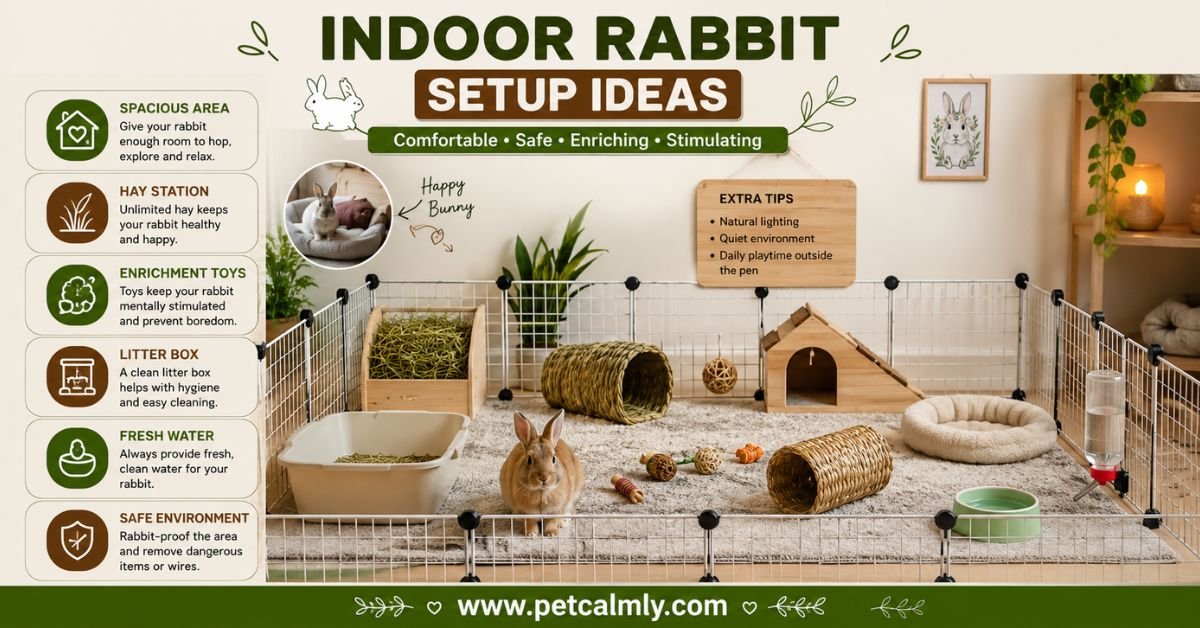
The best indoor rabbit setup combines a spacious pen or free-roam area, safe non-slip flooring, a litter box in the corner your rabbit naturally chooses, hideouts for security, and constant access to hay, water, and chew-safe enrichment. A well-planned space keeps your rabbit physically healthy, mentally stimulated, and confident enough to become a real part of your household.
If you’ve just brought a rabbit home, or you’re rethinking a setup that clearly isn’t working, you’ve probably noticed something: most pet store starter kits are nowhere near big enough. Rabbits aren’t low-maintenance cage animals they’re active, curious, floor-dwelling creatures who need room to run, binky, and investigate. Getting the setup right the first time saves you money on gear you’ll outgrow, and it saves your rabbit from the boredom and stress that come with cramped quarters.
This guide walks through everything from choosing the right enclosure size to rabbit-proofing your walls, picking a location, and avoiding the mistakes that trip up most first-time owners.
Why an Indoor Setup Works Better Than a Hutch
Rabbits kept indoors, as members of the household, tend to live noticeably longer and healthier lives than rabbits housed in outdoor hutches, partly because indoor rabbits are protected from temperature extremes, predators, and the isolation that comes with being tucked away in a backyard. Indoor rabbits also benefit from daily social contact, which matters more to their wellbeing than most new owners expect rabbits are social, emotionally responsive animals who form real bonds with the people (and other rabbits) they live with.
There’s a practical side too. An indoor space is easier to monitor. You’ll notice right away if your rabbit stops eating, starts limping, or is chewing something they shouldn’t be subtle signs that are easy to miss when a rabbit lives outside.
How Much Space Does a Rabbit Actually Need?
This is where most starter setups fall short. A small wire cage marketed as a “rabbit hutch” at a pet store is almost never adequate as a full-time home.
As a general guideline, the House Rabbit Society recommends a minimum of 8 square feet of enclosure space for one rabbit, plus at least 24 square feet of separate exercise space, and the organization strongly encourages free-roam or pen-style setups over traditional cages. In the UK, the Rabbit Welfare Association & Fund recommends a single enclosed living area of at least 3m x 2m with 1m of height for a pair of average-sized rabbits, and notes that this footprint matters because it lets rabbits run rather than just hop.
Some practical takeaways from these guidelines:
- Bigger is always better. No published guideline treats a small cage as sufficient on its own.
- A 4×4 foot exercise pen is commonly cited as a workable “home base” size for one or two rabbits, provided they also get supervised free-roam time.
- Height matters. Most rabbits do fine with a 30–36 inch pen wall, though occasionally you’ll need a taller pen for adventurous jumpers or climbers.
- A cage is a bedroom, not a home. Think of any small enclosed space as somewhere your rabbit can retreat to rest — not the whole of their world.
If space is tight, don’t panic. A smaller footprint combined with several hours of supervised free-roam time each day can absolutely work it’s the total daily space and activity that matters, not just the enclosure dimensions.
Choosing the Right Type of Indoor Enclosure
There are three common approaches, and most experienced owners eventually land on some version of the third.
1. Exercise Pens (X-Pens)
Collapsible metal pens, originally sold for dogs, are the most popular choice among rabbit-savvy owners. They’re modular, easy to reconfigure, and can be expanded as your budget or space allows. Look for a pen with a door built into one panel you’ll be grateful for it every time you need to carry a litter box in and out.
2. Rabbit Playpens or Puppy Pens with a Cage Attached
Many owners combine a smaller enclosed sleeping area (a cage, crate, or covered corner) with a larger attached pen. The rabbit can retreat to the enclosed section to rest, then has the run of the pen for hopping, digging, and playing during the day.
3. Free-Roam or Room-Based Setups
Some owners dedicate an entire rabbit-proofed room, or allow supervised free-roam of the house, with a base area (litter box, food, hideout) as “home.” This is the gold standard for enrichment but requires the most rabbit-proofing work upfront.
What to avoid: Aquariums, plastic storage bins, and other solid-walled enclosures. Airflow matters — ammonia from urine builds up quickly in an enclosed tank-style container and can irritate a rabbit’s respiratory system.
Step-by-Step: Setting Up Your Rabbit’s Indoor Space
Step 1: Pick the Location First
Choose the spot before you buy anything. This decision affects almost every choice that follows, so it deserves its own section below but as a starting principle, aim for a space that’s part of your daily foot traffic, away from direct heating/cooling vents, and free of loose cables.
Step 2: Lay Down Protective Flooring
Rabbits’ feet aren’t built for wire or slick tile. Wire flooring can cause sore hocks, and smooth surfaces like hardwood or laminate make rabbits slip, which discourages them from running and binkying (the joyful little jumps rabbits do when they’re happy). A simple, budget-friendly base is a waterproof layer a tarp, vinyl remnant, or shower curtain topped with a washable rug, fleece blankets, or interlocking foam mats cut to size.
Step 3: Set Up the Pen or Enclosure Walls
Assemble your pen directly on top of the flooring layer. If you’re using a hybrid cage-plus-pen setup, position the cage door so it opens directly into the pen, giving your rabbit free movement between the two areas at all times never lock a rabbit into the smaller section for long stretches.
Step 4: Place the Litter Box
Rabbits typically choose one or two corners as their bathroom spot fairly quickly. Rather than fighting this instinct, work with it: watch where your rabbit tends to go during the first few days, then place a litter box there. A box that’s too small is a common reason litter training fails — many owners find that a box roughly one and a half times the length of their rabbit, with low sides for easy hopping in and out, works best. Fill it with paper-based or hay-based litter (never clumping cat litter or clay litter, both of which are dangerous if ingested), and tuck a small handful of hay right into or beside the box, since rabbits like to eat while they eliminate.
Step 5: Add Food and Water Stations
Use heavy ceramic bowls that resist tipping, or a securely mounted water bottle plus a shallow water bowl as a backup (some rabbits strongly prefer drinking from a bowl). Keep the hay supply — which should make up the bulk of a rabbit’s diet — in a rack or pile away from the litter box’s “toilet” end, even if it’s inside the same general area.
Step 6: Build in Hideouts
Rabbits are prey animals, and they often feel safer with a secure space to retreat to inside their enclosure. A cardboard box with two openings cut into it, a fabric tunnel, or a commercial hidey-house all work well. Having more than one hideout reduces stress in multi-rabbit households, since it means no one gets cornered.
Step 7: Add Enrichment
An indoor space that’s just four walls and a litter box will bore a rabbit quickly, and a bored rabbit is far more likely to develop destructive chewing habits. Rotate in:
- Untreated willow or apple-wood chew sticks
- Cardboard tubes and boxes for digging and shredding
- A dig box filled with shredded paper (avoid sand it can upset digestion)
- Cat tunnels for zooming through
- Low platforms or ramps for vertical interest
Step 8: Do a Final Safety Sweep
Before your rabbit ever sets foot (or paw) in the finished space, get down at floor level and check for anything within nose or paw reach that could cause harm. The next section covers this in detail.
Rabbit-Proofing: What to Fix Before Move-In Day
Rabbits chew it’s not a behavior problem, it’s a biological need, since their teeth grow continuously throughout their lives. A setup that doesn’t account for this will get damaged, and worse, your rabbit could be seriously hurt.
- Electrical cords: Route them out of reach or encase them in hard plastic cord protectors. A chewed live cord is one of the most common causes of emergency vet visits for house rabbits.
- Baseboards and furniture legs: Rabbits allowed to free-roam will often target these. Clear plastic guards or furniture corner protectors can save both your rabbit and your deposit.
- Houseplants: Many common houseplants are toxic to rabbits. Move anything within hopping distance out of the space entirely rather than trying to identify which ones are “probably fine.”
- Small gaps and openings: Check behind furniture, under cabinets, and around appliances for gaps a rabbit could squeeze into and get stuck.
- Toxic cleaning products: Store anything used near the rabbit’s area well out of reach, and let floors dry fully before your rabbit is allowed back into the space.
Choosing the Best Room or Spot in Your Home
Where you put the setup affects your rabbit’s comfort just as much as the setup itself.
Living rooms and family rooms tend to work well because rabbits are social and benefit from being where the household activity happens, rather than isolated in a spare room. Placing the enclosure in an active, busy room allows a rabbit to interact with the family and truly become part of it.
Avoid placing a setup:
- Directly under an air vent or near a drafty window, since rabbits are sensitive to temperature swings
- In direct, unbroken sunlight for hours at a time, which can cause overheating (rabbits are far more prone to heat stress than cold)
- In a high-noise area like right next to a TV speaker or a washing machine
- In a room that gets shut off from the household for long stretches of the day
If you have other pets, especially dogs or cats, plan the location with sightlines in mind. Many rabbits do fine living alongside calm, well-supervised cats and dogs, but a first introduction should always happen with the rabbit safely inside their pen, not out in the open.
Budget-Friendly Indoor Rabbit Setup Ideas
A generous, enriching setup doesn’t have to be expensive.
- Use dog exercise pens instead of rabbit-branded ones. They’re usually cheaper for the same (or more) square footage.
- Cut foam interlocking tiles to fit, rather than buying rabbit-specific flooring, which is often marked up.
- Free cardboard boxes from grocery stores or online orders make excellent, replaceable hideouts and chew toys just remove tape and staples first.
- Repurpose baby gates or dog crates you already own as a base structure, adding pen panels around them to expand the footprint.
- Buy hay in bulk rather than small pet-store bags; it’s almost always cheaper per pound and stays fresher if stored properly in a breathable container.
- Watch local buy-nothing or rehoming groups for used pens, which are frequently given away when a previous rabbit passes or a family downsizes.
6Common Mistakes Owners Make With Indoor Setups
Choosing a cage that’s marketed for rabbits but is actually too small. Many commercial “rabbit cages” don’t meet even minimum size guidelines. If it looks like something you’d hesitate to spend a full day in yourself, it’s probably too small for a full-time home.
Using the wrong flooring. Wire-bottomed cages and bare tile or hardwood both cause problems the former can injure feet over time, and the latter makes rabbits too nervous to move confidently.
Skipping the litter box corner test. Forcing a litter box into a “logical” spot instead of watching where the rabbit naturally goes leads to accidents that aren’t really the rabbit’s fault.
Under-estimating chewing. Assuming a rabbit will “leave things alone” without any deterrents almost always ends in a chewed cord, baseboard, or piece of furniture.
Isolating the setup in a back room. A rabbit tucked away out of daily contact tends to become more skittish over time, not less.
Forgetting exercise time outside the pen. Even a generous enclosure benefits from supervised time outside it each day the pen is a home base, not a permanent boundary.
When Should You Worry?
Most setup-related issues are fixable with small adjustments, but a few signs point to something that needs closer attention, sometimes from a veterinarian:
- Sudden appetite loss or reduced fecal output can indicate gut stasis, which is a genuine emergency in rabbits and shouldn’t wait to be monitored at home.
- Sores on the feet (hocks), often from wire flooring or damp bedding, need a vet check and an immediate flooring change.
- Persistent hiding and refusal to come out, especially if it’s a change from your rabbit’s usual behavior, can signal pain, illness, or a setup that feels unsafe.
- Repeated litter box accidents after weeks of consistent training are sometimes behavioral, but can also point to a urinary issue and are worth mentioning at a checkup.
- Overgrown or discolored front teeth, since a lack of appropriate chew material can allow teeth to grow unevenly.
None of these mean your setup is a failure rabbits, like any pet, sometimes need a vet’s input regardless of how good their environment is. The point of a good setup is to reduce the odds of preventable problems, not to guarantee against every possible one.
What Should Pet Owners Do Next?
Once the physical space is in place, the setup isn’t really “done” it’s the start of an ongoing process:
- Observe for the first week. Watch which corners your rabbit uses for what, and adjust litter box placement or hideout positioning accordingly.
- Introduce enrichment gradually. Rotate two or three toys at a time rather than filling the whole pen at once; rabbits often engage more with novelty than abundance.
- Build daily free-roam time into your routine, even if it’s just 30–60 minutes of supervised access to a rabbit-proofed room.
- Keep a simple health checklist — appetite, droppings, and energy level so you notice small changes early.
- Revisit the setup every few months, especially as your rabbit ages or if you notice signs of boredom, since needs can shift over time.
Conclusion
A great indoor rabbit setup isn’t about buying the fanciest cage it’s about giving your rabbit enough room to move like a rabbit, a safe spot to feel secure, and a home that fits naturally into your daily life together. Start with generous space, rabbit-proof thoroughly, place the litter box where your rabbit actually wants it, and build in enrichment from day one. Adjust as you learn your rabbit’s habits, and the setup will keep earning its keep for years of happy, confident living.
More Information About Pets, Please Visit Our Website: Signs of a Happy Rabbit
Rabbit Teeth Trimming Cost
How to Trim Rabbit Nails
Rabbit Poop Normal vs Unhealthy
Can Rabbits Eat Lettuce?
How to Calm a Scared Rabbit
Frequently Asked Questions
1: Do rabbits need a cage if they have a pen?
Not necessarily. A pen alone can serve as a full-time home as long as it includes a covered hideout for resting. Some owners still like offering a small enclosed cage section within the pen for extra security, but it isn’t a strict requirement.
2: Can I keep a rabbit’s setup in my bedroom?
Yes, as long as the room is rabbit-proofed and stays at a comfortable, stable temperature. Just keep in mind that rabbits are naturally most active at dawn and dusk, so a light sleeper might notice some early-morning rustling.
3: How big should a litter box be for an indoor rabbit?
Generally, big enough for your rabbit to turn around comfortably and sit with room to spare often around one and a half times their body length. Low sides make it easier for young, elderly, or less mobile rabbits to hop in and out.
4: Is carpet safe for a rabbit’s play area?
Some rabbits do fine on carpet, but a subset will dig at or chew it. Washable rugs or interlocking foam mats are a safer bet, since they’re easier to replace and less likely to cause blockages if nibbled.
5: How much floor space does one rabbit really need indoors?
Guidelines vary, but a commonly cited minimum is around 8 square feet of enclosure space plus roughly 24 square feet of separate exercise access, with bigger always considered better.
6: What’s the fastest way to litter train a rabbit in a new setup?
Watch where your rabbit naturally starts eliminating in the first few days, then place the litter box there instead of a spot you chose in advance. Adding a handful of hay to the box also encourages regular use, since rabbits like to nibble while they go.