Short direct answer
The best dog anxiety toys give your dog something calming to do. Good options include lick mats, stuffable rubber toys like the KONG Classic, snuffle mats, slow puzzle feeders, and soft comfort toys. Licking, chewing, and sniffing help many dogs settle because they give the brain a focused, rewarding job. The right pick depends on what triggers your dog’s worry and how your dog chews. Toys can ease mild anxiety, but they don’t cure it, and severe cases need a vet’s help.
Watching your dog pace by the door, pant at the first rumble of thunder, or shred a cushion the moment you pick up your keys is hard. Most owners simply want to know what will help.
Toys can be part of the answer. They can’t remove the fear underneath, but the right one gives a worried dog a calmer way to spend the next half hour. This guide covers the best dog anxiety toys by type, shows you how to match them to your dog’s triggers, and explains the safety rules that matter. It also points out the signs of a bigger problem that no toy can solve.
What Makes the Best Dog Anxiety Toys Different from Regular Toys?
There is no official category called “anxiety toy.” Brands and owners use the label for any toy that nudges a dog toward calm behavior instead of frantic behavior. Because the term is loose, a “calming” claim on the packaging guarantees nothing. What matters is what the toy makes your dog do.
The best dog anxiety toys usually do one or more of three jobs:
- They give the brain a task. Sniffing out food or working a puzzle takes focus, which leaves less room for worry.
- They offer a safe outlet. Chewing and licking are natural, repetitive behaviors, and many dogs find them soothing.
- They build a positive link. When a special toy only appears at stressful moments, such as when you leave, those moments start to feel less scary.
A fetch ball or squeaky toy does none of this. In fact, it often raises excitement, which is the opposite of what a nervous dog needs. That’s why the type of toy matters more than the brand.
Why Dogs Get Anxious and Why It Changes Which Toy Works
Anxiety isn’t one single problem. A dog who panics when left alone needs something different from a dog who trembles at fireworks. So before you shop, it helps to know what drives the behavior.
5 Common Causes of Anxiety in Dogs
Vets and behaviorists usually group canine anxiety into a few familiar patterns:
- Separation-related distress. The dog becomes upset when left alone or apart from a specific person.
- Noise sensitivity. Thunderstorms, fireworks, vacuum cleaners, and even smoke alarm beeps can trigger fear.
- Fear of new things. Strangers, unfamiliar places, vet visits, or car rides can overwhelm a dog, especially one with limited early socialization.
- Life changes. A move, a new baby, a schedule shift, or the loss of another pet can unsettle a dog.
- Age-related changes. Senior dogs may grow anxious as hearing loss, pain, or cognitive decline sets in.
Rescue dogs often carry extra baggage, because nobody knows what they lived through before adoption. Sometimes there’s no obvious reason at all, since genetics and temperament play a role too.
Signs Your Dog May Need Calming Help
Dogs rarely announce anxiety with one dramatic sign. More often, a cluster of small ones shows up:
- Panting, drooling, or pacing when nothing physical explains it
- Trembling or hiding behind furniture
- Whining, barking, or howling, especially when alone
- Destructive chewing or digging near doors and windows
- Indoor accidents in a house-trained dog
- Lip licking, yawning, or showing the whites of the eyes (often called “whale eye”)
- Clinginess, or following you from room to room
- Refusing food or treats
Some of these signs also point to pain or illness. A new pattern deserves a vet’s attention before you assume it’s purely emotional.
How the Best Anxiety Toys for Dogs Calm a Worried Brain
Nobody can promise a toy will calm every dog. Still, the reasoning behind these toys is sound, and three mechanisms do most of the work.
First, licking and chewing are repetitive, self-soothing behaviors. Many trainers and behavior professionals describe them as calming for dogs, much like a person fidgeting when stressed.
Second, sniffing and problem solving use mental energy. A dog working out how to free kibble from a puzzle can’t fully focus on the storm outside. That doesn’t erase the fear, but it can lower the intensity.
Third, food toys create a positive association. If a stuffed toy appears every time you leave, your dog may start to treat your departure as the cue for something good. Behavior professionals call this counterconditioning, and they often use it as one piece of a larger plan for separation anxiety.
That’s why the best dog anxiety toys are usually food-based or scent-based rather than simply cute.
There’s a catch, though. Panic can shut down appetite and curiosity. Dogs in severe distress commonly ignore toys and treats completely. If that sounds like your dog, the toy isn’t failing. It’s telling you the anxiety is beyond what enrichment can handle alone, and that is useful information.
Best Dog Anxiety Toys by Type
Below are the best dog anxiety toys sorted by type, with honest notes about which dogs each one suits. Brand names are common examples, not endorsements. Always check the size guide and materials before you buy.
Best Lick Mats for Dog Anxiety
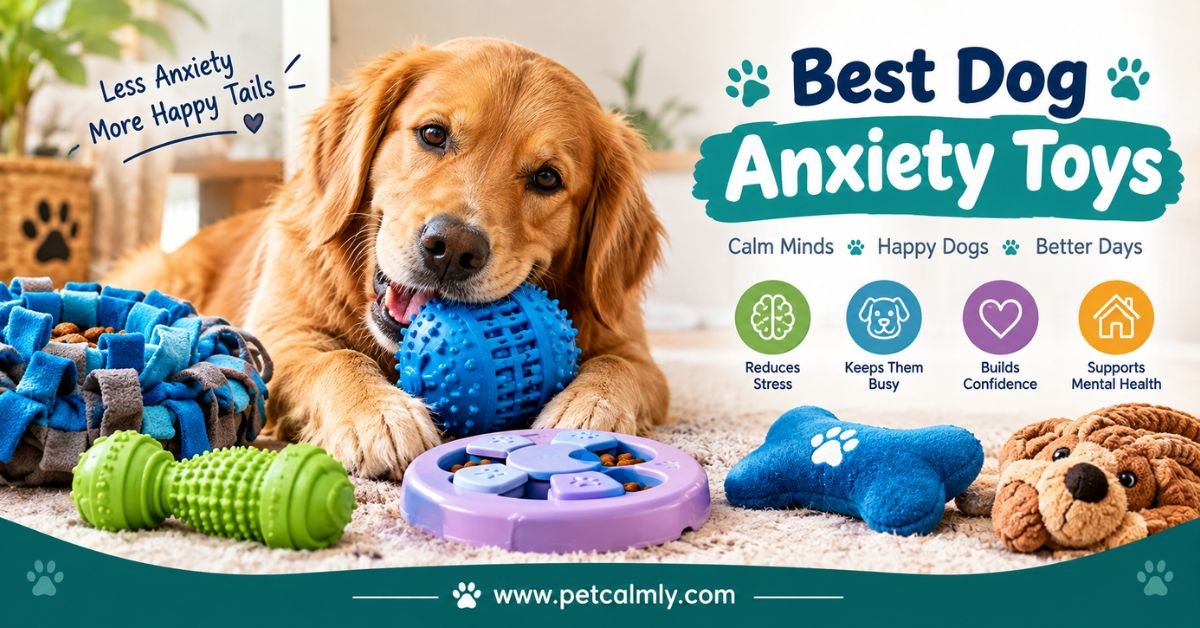
Lick mats are textured silicone or rubber pads. You spread them with something soft, like wet dog food, plain canned pumpkin, or a thin layer of dog-safe peanut butter. Licking is slow, so a smeared mat can keep a dog busy far longer than a bowl of food would.
They suit dogs who get worked up at predictable moments, such as before a bath, during nail trims, or right after you leave. Freezing the mat stretches the time and adds a cooling effect some dogs enjoy.
However, lick mats aren’t chew toys. A determined chewer may tear one apart, so supervise and take the mat away once the food is gone. LickiMat is the best-known brand, but many similar mats exist.
Stuffable Rubber Toys Like the KONG Classic
A hollow rubber toy you fill with food is probably the most familiar option. The KONG Classic and similar designs, such as the West Paw Toppl, give dogs something to lick, chew, and work at.
The trick is to match the difficulty to your dog. Start easy, with loosely packed soft food, so your dog succeeds quickly and builds confidence. As your dog improves, freeze the stuffing or pack it tighter. Layering kibble, wet food, and a few treats makes a satisfying puzzle.
Stuffable toys fit separation anxiety routines well, because you can prepare one ahead of time and hand it over as you walk out the door. Watch the calories, though. Stuffing counts as food, so trim your dog’s regular meal a little if weight is a concern.
Snuffle Mats and Scent Games
Snuffle mats are fabric bases with fleece strips, and you hide dry kibble or small treats in the folds. Your dog sniffs through them to find the food. Foraging like this is slower and calmer than a game of fetch, and it uses your dog’s strongest sense.
Scent games extend the same idea. Scatter a few treats across the lawn, or hide some around the living room, then let your dog search. Both work well for anxious dogs who don’t chew much, and they make a good wind-down before visitors arrive.
Skip snuffle mats for dogs who shred fabric and swallow it. Fleece strips can cause a blockage if eaten, so supervise closely or choose another toy.
Puzzle Feeders and Treat Dispensers
Puzzle feeders make a dog think. Options range from wobble toys like the KONG Wobbler, which drop kibble as your dog knocks them around, to sliding-block boards like the Outward Hound Nina Ottosson line, where your dog lifts or slides pieces to reveal treats.
They work well for bored, energetic, or mildly anxious dogs who enjoy problem solving. Keep the level beginner-friendly at first. A puzzle that’s too hard can frustrate an already stressed dog, which defeats the purpose.
Also consider noise. Many puzzles rattle, so test whether your noise-sensitive dog is comfortable with the sound before you rely on one during a stressful event.
Comfort Toys and Heartbeat Plushies
Some plush toys, such as the Snuggle Puppy, contain a device that mimics a heartbeat, plus a warm pack. The idea is to recreate the comfort of a mother or littermates. New puppy owners often describe them as helpful during the first nights at home.
Honestly, the evidence is mostly anecdotal. Some dogs cuddle up and settle. Others ignore the toy entirely. Try one if your dog already loves soft toys, but don’t count on it for serious anxiety.
Never leave a plush toy with a dog who rips out stuffing or squeakers. Heartbeat units and stuffing are real hazards if swallowed.
Durable Chews for Dogs Who Need to Bite
Some dogs relieve stress by chewing hard. Sturdy rubber chews and nylon chews, such as Benebone, give strong chewers an acceptable outlet for that urge.
Pick something firm but not rock-hard. Many vets suggest a simple thumbnail test: if you can’t press a dent into the surface, it may be hard enough to damage teeth. Nylon chews also wear down into small pieces, so check them regularly and replace them when worn.
Antlers, hooves, and cooked bones can crack teeth or splinter. Ask your vet before offering any of them.
How to Choose the Best Anxiety Toy for Your Dog
Choosing well saves money and frustration. Ask yourself four questions:
- What triggers the anxiety? Being alone, noise, and new places call for different toys.
- How does your dog chew? Gentle mouthers can use softer toys, while power chewers need heavy-duty rubber.
- What size and age is your dog? A toy must be too big to swallow, and puppies and seniors have very different mouths.
- Does your dog love food? Food-motivated dogs often thrive with stuffable toys and lick mats. Others prefer a soft toy or a sniffing game.
Here’s a quick way to match the situation to the toy:
| Your dog’s situation | Toy types to try first | Why it helps |
|---|---|---|
| Mild worry when left alone | Frozen stuffed rubber toy, lick mat | Lasts a while and pairs easily with departures |
| Thunder or fireworks | Lick mat, snuffle mat, plush comfort toy | Quiet and lick- or scent-based |
| Vet visit or grooming | Lick mat with spreadable food | Keeps the mouth busy during handling |
| New puppy’s first nights | Soft plush, puppy-safe chew | Comfort plus a proper chewing outlet |
| Power chewer | Heavy-duty rubber toy, Toppl | Stands up to strong jaws |
| Bored with nervous energy | Puzzle feeder, snuffle mat | Gives the brain a real workout |
In other words, the best dog anxiety toys are the ones your dog actually uses, safely and calmly. Start with one or two rather than a big haul, and notice which one your dog reaches for first.
Best Toys for Dog Separation Anxiety vs. Noise Fear
Separation anxiety and noise phobia both make dogs miserable, but they call for different tactics.
For separation anxiety, timing is everything. Give the special toy only when you leave, and put it away when you return. That way it becomes a signal that good things happen while you’re gone. Frozen stuffed toys and lick mats do this well. Pair them with short, gradual absences so your dog practices being alone in small steps.
Be realistic, however. Dogs with true separation anxiety are often too distressed to eat while alone. Suppose your dog ignores the stuffed toy the second you leave but eats it happily when you get home. That’s a strong clue the anxiety is significant, and a toy alone won’t fix it. At that point, bring in your vet or a qualified behavior professional.
For noise fear, start before the trigger, not during it. Offer a lick mat or snuffle mat when the first hints of a storm or fireworks appear. Add a quiet, cozy space, closed curtains, and some background sound. Some dogs can still eat during moderate noise, but others panic once it gets loud. Toys are a helpful layer, yet many noise-phobic dogs also need a vet-guided plan.
Introducing Your Dog to Anxiety Toys the Right Way
A new toy won’t calm anyone who is already in full panic, so introduce it when things are quiet.
- Start on a calm day. Let your dog sniff and explore the toy with no pressure.
- Make it easy. Fill it with something soft and tasty so your dog wins right away.
- Choose a safe spot. A mat, crate, or quiet corner works, as long as your dog already feels comfortable there.
- Practice short absences. Hand over the toy, step outside for a moment, and return before your dog gets upset. Then build up slowly.
- Add the trigger gradually. For noise, play a recording at a very low volume while your dog enjoys the toy. Raise it only if your dog stays relaxed.
- Rotate the toys. Keep two or three in circulation so none gets boring, and wash them after use.
Take it slowly. If your dog shows stress at any step, go back to the last step that felt easy.
Mistakes That Make Anxiety Toys Less Effective
Even the best dog anxiety toys fail when owners use them in ways that work against the dog. These are the most common slips:
- Offering the toy mid-panic. A dog in full fear can’t learn a new routine. Introduce toys before the stress starts.
- Leaving the toy out all day. A toy that’s always available loses its “special” status.
- Picking a puzzle that’s too hard. Frustration adds to stress, so begin with easy wins.
- Skipping supervision at first. You need to see how your dog treats a toy before leaving it alone with one.
- Ignoring calories. A daily stuffed toy adds up, so adjust meals to match.
- Expecting the toy to replace exercise and training. Walks, sniffing time, and a predictable routine matter just as much.
- Scolding destruction. Punishing a scared dog for chewing or accidents usually increases the fear rather than reducing it.
Real-Life Examples of Anxiety Toys in Action
The two scenarios below are composites of situations owners often describe. They aren’t individual case studies.
The door-watcher. Picture a two-year-old rescue mix who whines and paces whenever her owner grabs the keys. The owner starts freezing a stuffed rubber toy and handing it over only at departure. At first, the dog eats a few licks and goes back to the door. After a couple of weeks of very short outings, she starts heading for the toy as soon as the keys jingle. The toy didn’t remove her fear. It gave her a better first response while the gradual practice did the deeper work.
The fireworks dog. Now picture a ten-year-old terrier who trembles when fireworks start. His owner sets up a quiet room, closes the curtains, and offers a lick mat as the first bangs begin. He licks for a while, but once the noise peaks he stops eating and shakes. That’s the moment to stay calm, keep him company, and call the vet before the next holiday. Toys helped with the mild part, and the vet can help with the rest.
Safety Rules Before You Buy the Best Dog Anxiety Toys
Anxiety toys only help if they’re safe. Follow these rules every time:
- Size up. A toy that fits behind your dog’s back teeth can become a choking hazard.
- Read the filling labels. Some peanut butters contain xylitol, which is toxic to dogs. Also avoid chocolate, grapes, raisins, onions, and garlic.
- Go easy on fat. Very rich fillings can upset the stomach and may be a concern for dogs prone to pancreatitis. Ask your vet if you’re unsure.
- Supervise the first few sessions. Learn how your dog treats a toy before you leave one behind.
- Inspect regularly. Throw away toys with cracks, loose pieces, or chunks missing.
- Keep them clean. Wash food toys after each use to prevent bacteria and mold.
- Separate dogs in multi-dog homes. Food toys can spark guarding or fights.
When Should You Worry About Your Dog’s Anxiety?
Toys suit mild to moderate worry. Book a vet visit if you notice any of these:
- Anxiety appears suddenly or worsens quickly, especially in a senior dog, since pain or cognitive changes could be behind it
- Your dog hurts themselves while trying to escape, such as broken teeth, torn nails, or bloody paws
- Drooling, heavy panting, vomiting, or diarrhea whenever you leave
- Your dog refuses food every time they feel stressed
- Your dog seems panicked rather than just nervous and can’t settle even with help
- Aggression appears alongside the fear
- Things get worse despite consistent effort
Your vet can rule out medical causes and discuss behavior modification. When appropriate, they may also talk about medication. A veterinary behaviorist or qualified trainer can then build a step-by-step plan.
Treat this as an emergency: if your dog swallowed part of a toy and starts vomiting, retching, seems lethargic, or has a painful belly, call your vet or an emergency clinic right away.
What Should Pet Owners Do Next?
If you’re not sure where to begin, this simple order works for most households:
- Track triggers for a week. Note when your dog gets upset and what happened just before.
- Check health first. Book a vet visit if the anxiety is new, sudden, or severe.
- Pick one or two toys. Match them to the trigger and your dog’s chewing style.
- Introduce them calmly. Use the step-by-step approach above and keep sessions short.
- Cover the basics. Exercise, sniffing time, a steady routine, and a cozy safe space all lower baseline stress.
- Reassess in a few weeks. If little changes, ask a professional to help.
Progress with anxious dogs rarely runs in a straight line. A good week can follow a rough one, so judge the trend rather than a single day.
Conclusion
The best dog anxiety toys work because they give a worried dog something soothing to do: lick, sniff, chew, or solve a puzzle. Lick mats, stuffable rubber toys, snuffle mats, and comfort plushies each have a place, and the right one depends on your dog’s trigger, chewing style, and size.
Just remember what a toy can and can’t do. It can take the edge off mild anxiety and make hard moments easier. It can’t replace patient training, and it can’t treat severe distress. If your dog ignores food, hurts themselves, or keeps getting worse, that’s your cue to involve a vet. Start small, stay consistent, and let your dog’s reaction guide each choice.
More Information About Pets, Please Visit Our Website: Why Does My Dog Destroy Toys?
How to Stop Dog From Barking at Delivery Drivers
Why Does My Dog Pace at Night?
How to Create a Calm Environment for Dogs
Why Is My Dog Not Eating But Acting Normal?
Does My Dog Know I Love Him?
How to Teach a Dog to Stay Home Alone
Frequently Asked Questions
1: What is the best toy for a dog with separation anxiety?
A frozen, stuffed rubber toy such as a KONG Classic or West Paw Toppl is a popular first choice, because it keeps a dog busy and pairs well with your departure. Give it only when you leave. If your dog refuses to touch it while you’re gone, the anxiety likely needs professional support.
2: Do dog anxiety toys really work?
They can help with mild to moderate anxiety by giving your dog a calming activity and a positive link to stressful moments. They don’t cure the underlying fear. For lasting change, combine them with gradual training and, when needed, veterinary guidance.
3: Is a KONG good for dog anxiety?
For many dogs, yes. A stuffed KONG offers licking, chewing, and problem solving in one toy. It works best when you match the difficulty to your dog and use it as part of a routine. Some dogs are too upset to eat when stressed, and a KONG won’t help those dogs on its own.
4: Are calming toys safe to leave with my dog alone?
It depends on the toy and the dog. Durable rubber toys are often fine once you’ve watched your dog use them. Plush toys, fabric mats, and nylon chews carry more risk for dogs who tear or swallow pieces, so use them only under supervision.
5: Can toys help during fireworks or thunderstorms?
They can help with mild noise anxiety, especially if you offer a lick mat or snuffle mat before the noise begins. Dogs with severe noise phobia often stop eating once the sound gets loud. If that’s your dog, ask your vet about a broader plan.
6: Should a new puppy have a heartbeat toy?
It’s optional. Some puppies seem comforted by a heartbeat plush during the first nights at home, and others ignore it. Choose one that suits your puppy’s size, supervise at first, and remove it if your puppy starts chewing it apart.