Short direct answer
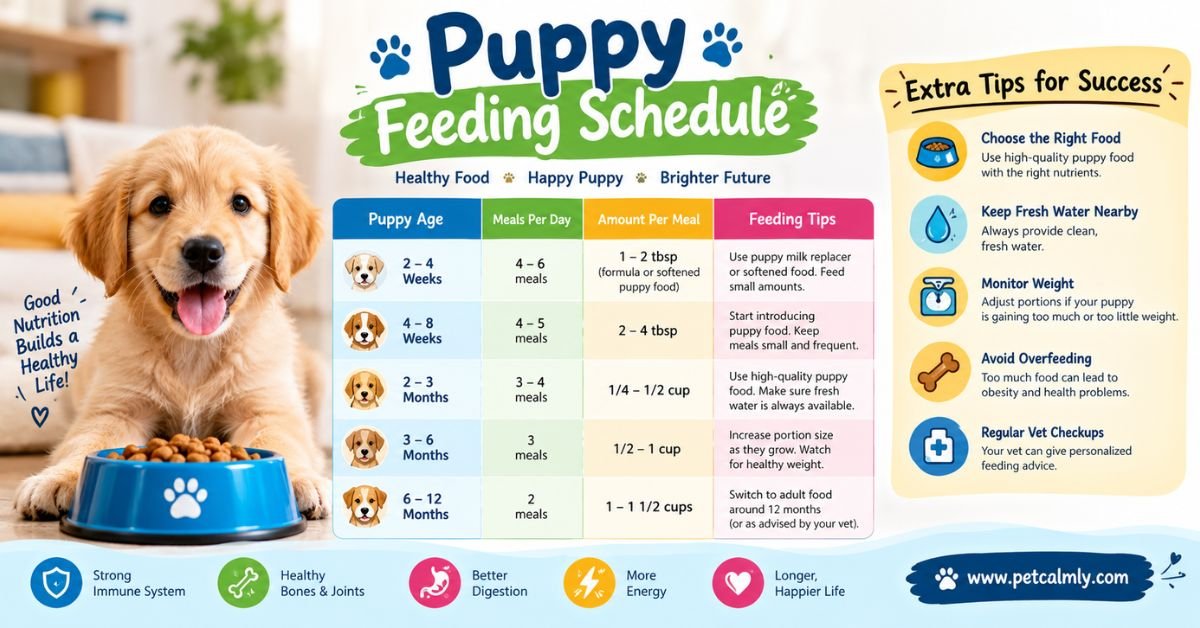
A healthy puppy feeding schedule generally means four meals a day from 8–12 weeks, three meals a day from 3–6 months, and two meals a day from 6 months onward, spaced evenly with 4–6 hours between meals. The right schedule depends on your puppy’s age, breed size, and metabolism, but the goal is always the same steady energy, stable blood sugar, and a routine your puppy can predict and trust.
That’s the short version. But if you’ve ever stood in your kitchen at 6 a.m., measuring cup in hand, wondering if you’re overfeeding, underfeeding, or just doing it wrong you know the real question is more layered than a single number. Let’s walk through it properly.
Why Your Puppy’s Feeding Schedule Matters More Than You’d Think
New puppy owners usually assume feeding is the simple part of puppy care the hard stuff is potty training and chewing. In practice, feeding sets the tone for almost everything else.
Puppies under six months old don’t regulate blood sugar as efficiently as adult dogs. Small and toy breeds especially can develop hypoglycemia (low blood sugar) if meals are spaced too far apart, which can show up as trembling, weakness, or unusual lethargy. A predictable feeding schedule protects against this, and it also does something less obvious: it regulates digestion, which makes potty training dramatically easier because you can anticipate when your puppy needs to go outside.
There’s also a behavioral piece nobody mentions in the pet store. Puppies who eat on a consistent schedule tend to settle into house routines faster. They know food is coming, so they’re less anxious around mealtimes, less prone to guarding behaviors, and easier to crate train because their bodies aren’t guessing when the next meal will show up.
None of this means you need to be rigid to the minute. It means consistency matters more than precision.
Puppy Feeding Schedule by Age: What to Expect at Each Stage
Here’s where most guides get vague. Puppies don’t follow one static schedule — their needs shift dramatically between 8 weeks and 12 months, and getting the timing wrong at each stage causes different problems.
| Puppy Age | Meals Per Day | Approximate Spacing | Why |
|---|---|---|---|
| 8–12 weeks | 4 meals | Every 4–5 hours | Small stomach capacity, high energy needs, risk of low blood sugar |
| 3–6 months | 3 meals | Every 5–6 hours | Growth is rapid but stomach capacity is increasing |
| 6–12 months | 2 meals | Morning and evening | Growth slows; adult-style digestion begins |
| 12 months+ (varies by breed) | 1–2 meals | Morning and evening | Most dogs transition to adult feeding around this point |
A note on that last row: large and giant breeds (think Labradors, German Shepherds, Great Danes) often don’t finish growing until 18–24 months, so many vets recommend staying on puppy food and a twice-daily schedule longer than you’d expect for a smaller breed. If you’re unsure when your specific breed should transition, this is a good conversation to have at a routine vet visit rather than guessing from a bag label.
8 to 12 Weeks: The Four-Meal Stage
This is the stage owners find most exhausting, and understandably so — you’re essentially on a puppy’s schedule, not your own. A typical day might look like:
- 7:00 a.m. — breakfast
- 11:00 a.m. — midday meal
- 3:00 p.m. — afternoon meal
- 7:00 p.m. — dinner
The last meal should generally happen 3–4 hours before bedtime so your puppy has time to digest and do a final potty break before settling for the night.
3 to 6 Months: Dropping to Three Meals
Somewhere around three months, you’ll likely notice your puppy starting to leave food in the bowl at one of the four sittings, or seeming uninterested at a particular meal. That’s usually your cue not a fixed date to drop to three meals a day. Watch the puppy’s behavior over the calendar.
6 to 12 Months: Settling Into Two Meals
By six months, most puppies (small and medium breeds especially) are ready for a twice-daily schedule that will likely stay with them for life. This is also a good time to start syncing mealtimes with your own routine morning before work, evening after since your puppy’s digestive system is now stable enough to accommodate it.
How Feeding Schedule and Potty Training Actually Connect
If you’re mid-house-training, your feeding schedule is quietly doing a lot of the work for you, whether you’ve noticed it or not.
Puppies typically need to relieve themselves within 15–30 minutes of eating, thanks to something called the gastrocolic reflex eating triggers movement in the digestive tract fairly quickly, especially in young puppies. That means a fixed feeding time gives you a fixed, predictable potty window. A puppy fed at 7 a.m. sharp will usually need a trip outside around 7:15–7:30 a.m., every single day.
This is exactly why irregular feeding a meal at 7 a.m. one day and 9 a.m. the next makes house-training feel harder than it needs to be. You’re not just changing when your puppy eats; you’re scrambling the one predictable signal you had for when they’ll need to go outside. Owners who tighten up their feeding schedule often report house-training progress speeding up within a week or two, not because anything else changed, but because they can finally anticipate the pattern instead of reacting to accidents.
Special Situations: Picky Eaters, Small Breeds, and Multi-Pet Households
Not every puppy fits neatly into a standard schedule, and a few common situations deserve their own approach.
Picky or slow eaters. Some puppies graze rather than eat with enthusiasm, especially during the 8–12 week stage when everything is new and slightly overwhelming. Rather than leaving food down indefinitely (which reinforces grazing), offer the meal for 15–20 minutes, then pick up the bowl regardless of how much was eaten. Most puppies adjust their pace within a few days once they learn the bowl won’t stay out forever.
Toy and small breeds. Chihuahuas, Yorkies, and other small breeds are more prone to hypoglycemia than larger puppies, simply because they have less stored energy reserve. If you have a toy breed, err on the side of more frequent, smaller meals for longer than the general guidelines suggest, and keep a close eye on energy dips between meals.
Multi-pet households. When a new puppy joins a home with an existing dog or cat, feed them separately, at least initially. This prevents resource guarding from developing and lets you track exactly how much your puppy is eating, rather than guessing whether the resident pet is stealing bites.
How Much Should You Actually Feed at Each Meal?
Timing is half the equation. Portion size is the other half, and it’s the part where owners tend to either wing it or over-rely on the feeding chart printed on the food bag.
Those charts are a reasonable starting point, but they’re calculated for an “average” puppy of a given weight not your specific puppy’s metabolism, activity level, or body condition. A few things that should adjust your portions up or down:
- Body condition, not just weight. You should be able to feel (not necessarily see) your puppy’s ribs with light pressure, and there should be a visible waist when viewed from above. If ribs are hard to feel, portions are likely too generous.
- Activity level. A puppy in daily obedience class or with an active family will burn more than a bag chart assumes.
- Treats and training rewards. Training treats count toward daily calories. If you’re doing a lot of positive reinforcement training (which is great), reduce meal portions slightly to compensate.
- Spay/neuter status. Metabolism often slows slightly after the procedure, so portions may need a small downward adjustment afterward.
If you’re ever unsure whether your puppy’s weight gain is on track, a veterinarian can plot it against breed-specific growth curves at a wellness visit this is far more reliable than comparing your puppy to a neighbor’s dog of the “same” breed and age.
Reading Your Puppy’s Hunger Cues (Not Just the Clock)
A schedule gives you structure, but the puppy in front of you still gives you information worth paying attention to. Over the first few weeks, most owners start noticing patterns that are worth tracking alongside the clock rather than instead of it.
A puppy who’s genuinely hungry at mealtime usually shows it clearly hovering near the food storage area, more vocal than usual, or noticeably more focused once the bowl comes out. A puppy who sniffs at food and walks away, day after day at the same meal, is telling you something different: maybe that meal’s portion is too large relative to appetite, maybe the timing needs a small shift, or maybe it’s simply not hungry yet at that stage of digestion from the previous meal.
This is also where a lot of owners second-guess themselves unnecessarily. A single low-appetite meal, especially during teething (which typically runs from about 12 to 24 weeks) is rarely worth changing anything about. What’s worth acting on is a pattern the same meal being skipped or under-eaten for three or four days running. At that point, a small schedule adjustment, like shifting that meal’s time by 30–60 minutes, often resolves it without needing to change the food itself.
Wet, Dry, or Mixed: Does Food Type Change the Schedule?
Not dramatically, but it does affect a few practical details.
Dry kibble is the easiest to schedule around because it doesn’t spoil sitting in a bowl for 20–30 minutes while your puppy eats at their own pace.
Wet food should generally be picked up within 20–30 minutes if uneaten, both for hygiene and to avoid teaching your puppy to graze rather than eat proper meals.
Mixed feeding (kibble plus a wet topper) works well for picky eaters, but keep the topper portion small and consistent — it’s easy for a “just a spoonful” topper to quietly become a significant chunk of daily calories.
Regardless of food type, avoid free-feeding (leaving food out all day) during the puppy stage. It removes your ability to notice appetite changes early, which are often the first sign something’s wrong.
6 Common Feeding Schedule Mistakes New Puppy Owners Make
Most feeding problems aren’t about the food itself they’re about the pattern around it.
- Feeding immediately after high-energy play. This increases the risk of bloat, particularly in deep-chested breeds. Give your puppy 20–30 minutes to settle before a meal, and avoid vigorous play for about an hour after eating.
- Changing food abruptly. A sudden switch in brand or protein source is one of the most common causes of puppy diarrhea. Transition over 7–10 days, gradually increasing the new food’s ratio.
- Using the feeding chart as gospel. As covered above, it’s a starting point, not a prescription.
- Inconsistent meal timing on weekends. Puppies notice. Irregular schedules on days off can undo weeks of house-training progress.
- Free-feeding “just to make life easier.” It often creates the opposite more accidents, less predictable appetite, and a harder time spotting illness early.
- Feeding right before a car ride or vet visit. This raises the risk of motion sickness and vomiting; aim to feed at least 2 hours before travel when possible.
When Should You Worry About Your Puppy’s Eating Habits?
Most feeding hiccups are normal teething discomfort, a day of pickiness, a slightly smaller appetite during a growth plateau. But there are a few patterns worth taking seriously enough to call your veterinarian:
- Refusing food entirely for more than 24 hours (or more than 12 hours in toy breeds, given their blood sugar risk)
- Vomiting after most or all meals, not just an occasional isolated incident
- Diarrhea lasting more than a day or two, or diarrhea combined with lethargy
- A visibly distended, hard, or painful abdomen, especially after eating
- Sudden weight loss or a puppy who seems to be losing muscle despite eating normally
- Extreme lethargy, trembling, or weakness around mealtimes, which can point to hypoglycemia
None of these symptoms need to be dramatic to matter a puppy quietly skipping meals for two days in a row is just as worth a call as one vomiting visibly. When in doubt, a quick call to your vet’s office costs you five minutes; waiting costs you nothing if it’s fine, but can cost a great deal if it isn’t.
What Should You Actually Do to Build a Reliable Feeding Routine?
Here’s a practical checklist you can put into action today:
- Pick 2–4 set mealtimes based on your puppy’s current age (see the table above)
- Feed at roughly the same times every day, including weekends
- Measure food with a proper measuring cup, not “eyeballing” it
- Reassess body condition every 2 weeks during rapid growth phases
- Pick up uneaten wet food after 20–30 minutes
- Avoid vigorous exercise for 30–60 minutes around mealtimes
- Transition any food changes gradually over 7–10 days
- Track appetite changes in a simple notes app — patterns are easier to spot in writing than memory
- Bring feeding questions to scheduled vet visits rather than waiting for a problem
This routine does double duty: it keeps your puppy’s body predictable, and it gives you an early-warning system. Once you know what “normal” looks like for your specific puppy, you’ll notice deviations quickly — which is exactly what you want.
A Realistic Example
Consider a fairly typical case: a 10-week-old Labrador puppy eating three cups of kibble a day, split across four meals. Around week 13, the owner notices the puppy leaving a little food at the 3 p.m. sitting most days. Rather than forcing the fourth meal, they shift to three meals — 7 a.m., 1 p.m., and 6 p.m. — redistributing the same daily total. Within a few days, the puppy is finishing each meal eagerly again, and the schedule sticks well into the six-month mark, at which point it naturally narrows to two meals as the puppy matures. Nothing dramatic happened here just a schedule that adjusted with the puppy instead of against them, which is really the whole approach in miniature.
Conclusion
A puppy feeding schedule doesn’t need to be complicated to work well. What it needs is consistency the same rough times each day, portions that match your specific puppy rather than a generic chart, and enough attention that you’d notice if something changed. Puppies grow through these feeding stages quickly, often faster than owners expect, so revisit the schedule every few weeks rather than setting it once and forgetting it. Get the rhythm right, and a surprising number of other puppy-raising challenges house training, energy management, even some behavioral issues tend to get a little easier alongside it.
More Information About Pets, Please Visit Our Website: How to Crate Train a Puppy During the Day
Puppy Not Eating After Deworming
Puppy Sleeping After Vaccination
Best Food for German Shepherd Puppy
How to Stop Puppy Biting
Puppy Separation Anxiety Training
How to Calm Puppy Separation Anxiety
12 Week Old Puppy Crying at Night?
Frequently Asked Questions
1: How many times a day should I feed my puppy?
It depends on age: four times a day from 8–12 weeks, three times from 3–6 months, and twice a day from 6 months onward for most breeds.
2: Should I feed my puppy on a schedule or leave food out all day?
A set schedule is recommended over free-feeding during puppyhood. It supports house-training, helps you catch appetite changes early, and prevents overeating.
3: What time should a puppy’s last meal be?
Aim to finish the last meal 3–4 hours before bedtime, giving enough time to digest and have a final potty break before settling in for the night.
4: Is it normal for a puppy to skip a meal occasionally?
An occasional skipped meal, especially during teething or a stressful day, is usually not a concern. Skipping food for more than 24 hours (or 12 hours in toy breeds) warrants a call to your veterinarian.
5: Can I switch my puppy’s feeding schedule as they grow?
Yes — and you should. Most puppies naturally signal readiness to drop a meal by leaving food behind at one sitting. Shift gradually rather than on a fixed calendar date.
6: Do small and large breed puppies need different feeding schedules?
The meal-frequency stages are similar, but large and giant breeds often stay on puppy food and a twice-daily schedule longer, since their growth period extends well past a year.