Short direct answer
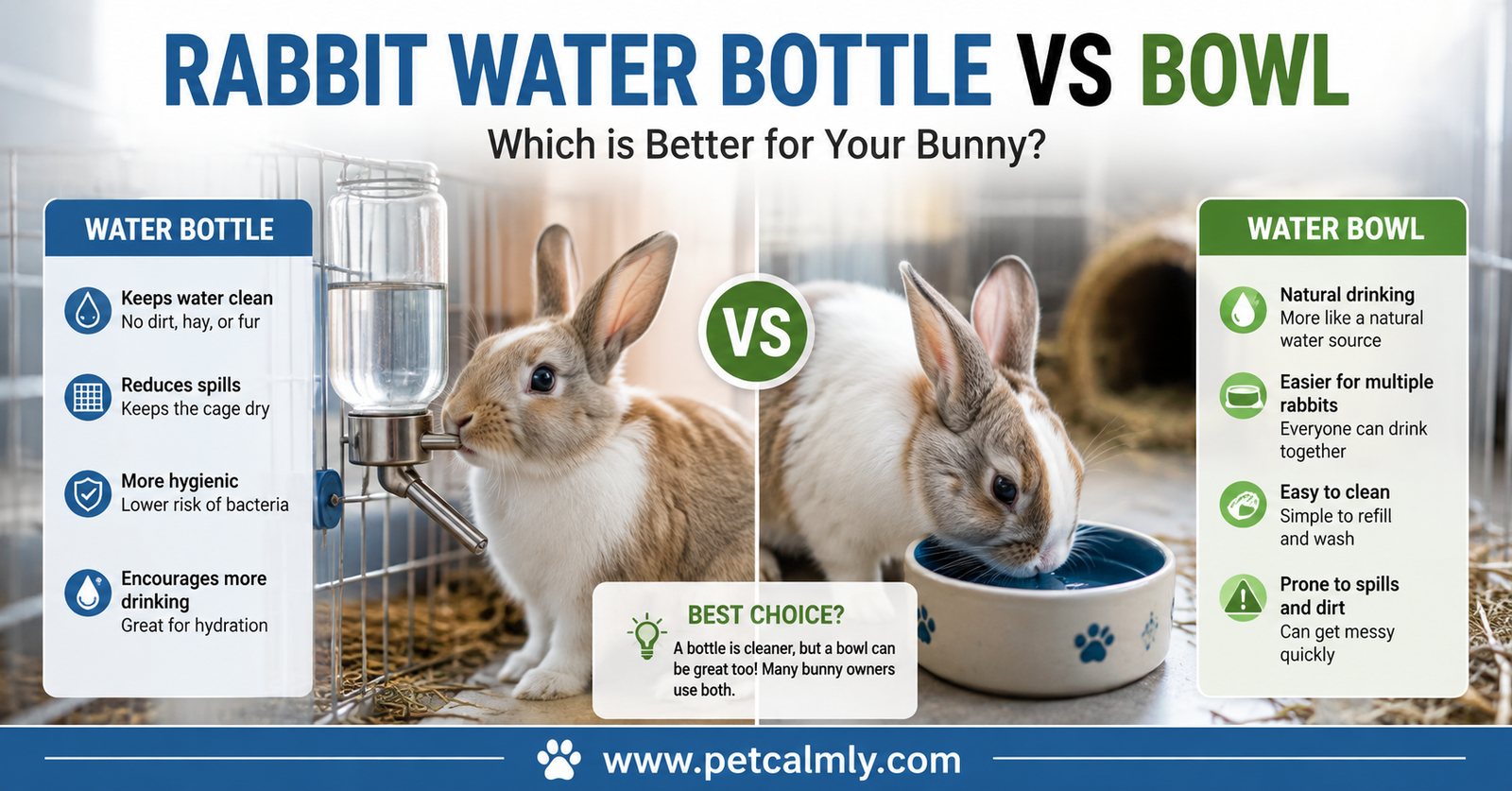
A water bowl is generally the better choice for most pet rabbits. Rabbits drink more water from open bowls than from sipper bottles, since bottles require awkward neck positioning and slower drinking through a small ball-valve. However, bottles reduce spills and bedding contamination. The safest, most reliable setup for most homes is a heavy ceramic bowl as the main water source, with a bottle kept as a backup not the other way around.
If you’ve been standing in the pet aisle turning a water bottle over in your hands, wondering whether your rabbit will actually drink from it, you’re not alone. This is one of the most common questions new rabbit owners ask, and the honest answer is a little more nuanced than “just pick one.” Your rabbit’s health, hydration habits, cage setup, and even dental comfort all play a role in which option works better for your specific bunny.
This guide walks through exactly how bottles and bowls compare, what rabbits genuinely prefer based on their anatomy and behavior, the mistakes owners make with each, and how to build a hydration setup that actually keeps your rabbit drinking enough because for rabbits, water intake isn’t just a comfort issue. It’s tied directly to gut motility, urinary health, and preventing life-threatening digestive slowdowns.
Why Water Intake Matters So Much for Rabbits
Rabbits have a digestive system that depends on constant movement. Fiber needs water to pass through the gut smoothly, and even a short dip in water intake can slow things down enough to trigger GI stasis a condition where the digestive tract stalls out and food stops moving. This is one of the leading emergency reasons rabbits end up at the vet, and dehydration is frequently part of the picture.
Rabbits also lose more water than owners expect through their diet. A rabbit eating mostly dry hay and pellets needs steady water access all day, not just a quick sip here and there. If a rabbit is reluctant to drink because the water source is uncomfortable, hard to access, or simply unfamiliar, that reluctance can quietly snowball into a bigger health problem before you notice anything is wrong.
This is really the heart of the bottle-versus-bowl debate. It’s not about which container looks tidier in the hutch it’s about which one actually gets your rabbit drinking consistently, every single day.
Rabbit Water Bottles: What They Get Right and Where They Fall Short
Water bottles became the default rabbit accessory for a simple reason: they keep water clean. A bottle mounted to the side of a cage can’t be knocked over, kicked full of hay, or used as an impromptu litter box. For owners dealing with messy cage setups, that alone feels like a win.
The Real Benefits of a Bottle
- Water stays free of bedding, droppings, and food debris
- No risk of a rabbit tipping the container and soaking the enclosure
- Easier to monitor exactly how much water is being consumed, since the level drops visibly
- Convenient for wire-cage setups where a bowl has nowhere stable to sit
Where Bottles Struggle
The problem is anatomical. To drink from a sipper bottle, a rabbit has to tilt its head back and press its tongue against a small metal ball-valve repeatedly to release drops of water. That’s a fine mechanism for a hamster, but it’s an unnatural posture for a rabbit, whose neck and mouth are built for grazing at ground level, not drinking upward from a fixed point.
Several rabbit-focused welfare organizations, including the House Rabbit Society, have noted that this drinking position can be uncomfortable for rabbits, particularly those with dental issues, arthritis, or spinal sensitivity, and that bottle-drinking is generally slower and less efficient than bowl-drinking. Over time, a rabbit that finds the bottle awkward may simply drink less than it needs, without ever giving an obvious sign that something’s wrong.
There’s also a mechanical failure risk. Ball-valve tips can stick, freeze in cold weather, or clog with mineral buildup, silently cutting off your rabbit’s entire water supply while the bottle still looks full from the outside. This is one of the more dangerous hidden risks of relying on a bottle alone — the rabbit appears to have water, but nothing is actually coming out.
Rabbit Water Bowls: What They Get Right and Where They Fall Short
A bowl lets a rabbit drink the way its body is designed to head down, tongue lapping freely, no valve to fight against. This usually translates into rabbits drinking more total water from a bowl than from a bottle, which matters enormously for gut health.
The Real Benefits of a Bowl
- Matches natural rabbit drinking posture
- Easier and faster to drink from, especially for older rabbits or those with jaw or tooth pain
- No mechanical parts that can jam or freeze
- Simple to clean and refill
Where Bowls Struggle
Bowls are messier. Rabbits dig, flip, and sometimes sit in things they shouldn’t, and a lightweight plastic bowl can end up upside down within minutes, leaving your rabbit without water until you notice. Bedding, hay, and droppings can also fall into an open bowl, meaning water needs to be checked and refreshed more often than a bottle would require.
There’s also a spatial consideration. In a multi-level hutch or a wire-bottom cage, a bowl doesn’t always have a flat, stable surface to sit on, which is part of why bottles became popular for cage-style housing in the first place.
Rabbit Water Bottle vs Bowl: Side-by-Side Comparison
| Factor | Water Bottle | Water Bowl |
|---|---|---|
| Matches natural drinking posture | No | Yes |
| Typical water intake | Often lower | Often higher |
| Mess and spill risk | Low | Moderate to high |
| Risk of hidden failure (clog/freeze) | Yes | No |
| Ease of drinking for rabbits with dental pain | Harder | Easier |
| Cleaning frequency needed | Lower | Higher |
| Best suited for | Wire cages, travel carriers | Pens, hutches, free-roam setups |
What Do Rabbits Actually Prefer, Bottle or Bowl?
If you give a rabbit the choice, most will drink more consistently from a bowl. This isn’t a matter of stubbornness or pickiness it comes down to comfort and effort. Drinking from a bottle takes more repeated motion for less water per lick, while a bowl delivers water freely with almost no physical effort.
That said, individual rabbits do vary. A rabbit raised from a young age exclusively on a bottle may never have learned to associate a bowl with water and might ignore it at first. This is a behavioral habit, not a preference rooted in comfort and it’s exactly why a gradual transition matters if you’re switching your rabbit’s setup (more on that below).
Common Mistakes Owners Make With Rabbit Water Bottles
- Assuming a full-looking bottle means water is flowing. Always test the tip daily by pressing it gently to confirm a drop forms.
- Mounting the bottle too high for a growing or smaller rabbit. The spout should be at a height the rabbit can reach without straining its neck upward.
- Not checking for algae or mineral buildup inside the tube. This narrows the passage and can eventually block it entirely.
- Relying on a single bottle with no backup. One clog, and your rabbit is without water until you catch it.
- Ignoring reduced drinking after a bottle switch. If a rabbit suddenly seems to drink less after being moved to a new bottle brand, the flow rate or valve stiffness may be the cause.
Common Mistakes Owners Make With Rabbit Water Bowls
- Using a lightweight plastic bowl. These tip constantly. A heavy ceramic or ceramic-ish ballast bowl designed to resist flipping is worth the investment.
- Placing the bowl directly under a hay rack. Hay debris falls straight into the water, and most rabbits won’t drink water full of soggy hay.
- Not refreshing water often enough. Bowls need at least one full water change daily, sometimes twice in warm weather or messy cages.
- Choosing a bowl that’s too shallow or too deep. A young or small-breed rabbit may struggle with a deep bowl, while a very shallow one empties or gets contaminated fast.
- Placing the bowl somewhere the rabbit sits in it. Bowls set at floor level in tight spaces sometimes double as an accidental seat, which nobody wants.
How to Choose the Best Water Setup for Your Rabbit
Think of this less as “bottle or bowl” and more as “what does my rabbit’s specific setup need.”
- Start with a bowl as the primary source, ideally a heavy, tip-resistant ceramic bowl placed away from the hay rack and litter area.
- Add a bottle as backup, especially useful during travel, vet visits, or if your rabbit’s enclosure has a wire floor where a bowl can’t sit securely.
- Check both daily — bottle tip for flow, bowl for cleanliness and water level.
- Watch your specific rabbit’s habits. Some rabbits genuinely do fine with a bottle alone, particularly if they were raised on one and drink steadily. The goal isn’t a universal rule — it’s making sure your rabbit is actually getting enough water, however that happens.
- Adjust for the season. In hot weather, a bowl allows faster drinking when a rabbit needs to rehydrate quickly; in cold weather, bottle tubes are prone to freezing, so a bowl checked regularly can be more reliable.
Using Both a Bottle and a Bowl Together
Offering both isn’t overkill for many households, it’s the smartest approach. A bowl covers the rabbit’s natural drinking preference and higher intake, while a bottle acts as insurance if the bowl gets knocked over, contaminated, or emptied while you’re out of the house. If your rabbit already has a strong bottle habit, don’t remove it abruptly. Introduce a bowl alongside it for a week or two, refresh both daily, and let your rabbit choose. Most will start favoring the bowl once they realize it’s there and it’s easier.
Signs Your Rabbit Isn’t Drinking Enough Water (When to Worry)
Reduced water intake in rabbits can be subtle at first, but a few signs are worth taking seriously:
- Smaller, drier, or less frequent fecal pellets
- Reduced appetite or picking at food without really eating
- Lethargy or a rabbit that seems less active than usual
- Skin that doesn’t spring back quickly when gently tented (a rough at-home hydration check, though not a substitute for a vet exam)
- A water bottle or bowl that hasn’t visibly gone down in level over a full day
Any one of these on its own might mean nothing. Together, or lasting more than a day, they’re a signal to act rather than wait and see.
What Pet Owners Should Do If a Rabbit Stops Drinking
If your rabbit appears to be drinking little or nothing, don’t assume it will resolve on its own. Rabbits can decline quickly once GI motility slows down, and this is genuinely one of the situations where “wait and monitor” is the wrong instinct.
At home, right away:
- Offer fresh water in both a bowl and a bottle in case the container itself is the issue
- Offer water-rich vegetables like romaine lettuce or cucumber if your rabbit already eats these regularly
- Check that hay and food are still available and appealing
- Confirm the bottle tip is actually releasing water, not just appearing full
Contact a veterinarian promptly if:
- Your rabbit hasn’t produced fecal pellets in 12–24 hours
- It seems hunched, grinding its teeth loudly (a pain sign), or unwilling to move
- It’s refusing both food and water together
- Reduced drinking is paired with any other symptom, including diarrhea or bloating
This is not a situation for general home remedies. Rabbit GI stasis and dehydration can escalate into a medical emergency within a day, and a veterinarian experienced with rabbits (sometimes called an “exotic” or “rabbit-savvy” vet) is the right resource once these signs appear.
Conclusion
If you only take one thing from this guide, let it be this: bowls tend to encourage more natural, higher-volume drinking, while bottles offer cleanliness and convenience at the cost of drinking comfort. For most rabbits, a sturdy bowl as the primary water source, backed up by a bottle, gives you the best of both steady hydration with a safety net if the bowl gets messy or knocked over.
There’s no single “correct” setup that works for every rabbit and every home. What matters is paying attention to your own rabbit’s habits, checking water levels daily, and adjusting when something isn’t working. A few minutes of daily observation is really all it takes to catch a hydration problem long before it becomes a health emergency.
More Information About Pets, Please Visit Our Website: What Are the Best Pellets for Rabbits
How Often Should I Clean My Rabbit Cage?
Rabbit Behavior Meanings
How Long Do Pet Rabbits Live Indoors?
Can Rabbits Eat Strawberries?
Why Is My Rabbit Suddenly Biting Me?
Frequently Asked Questions
1: Do rabbits drink more from a bowl or a bottle?
Most rabbits drink more total water from a bowl, since it matches their natural head-down drinking posture and requires far less effort than pulling water through a bottle’s ball-valve.
2: Is it safe to give a rabbit only a water bottle?
It can work if the bottle is checked daily and flows reliably, but it carries more risk of unnoticed clogs or reduced drinking. A bowl as a backup is safer.
3: Why won’t my rabbit drink from its new water bottle?
It may be positioned too high, the flow rate might be too stiff, or your rabbit may simply prefer bowl drinking and hasn’t learned to use the bottle. Try offering a bowl alongside it.
4: How often should I clean a rabbit’s water bowl?
At minimum once a day, more often if hay, droppings, or food regularly fall into it. Bacteria and algae can build up quickly in standing water.
5: Can a rabbit go a full day without water?
No. Rabbits need consistent daily water access, and even short gaps can contribute to digestive slowdown. If a rabbit goes a day with little to no water, contact a vet rather than waiting it out.
6: What’s the best type of bowl for a rabbit?
A heavy, tip-resistant ceramic bowl is generally best. It resists flipping, doesn’t hold odors like plastic can, and is easy to clean thoroughly.