Short direct answer
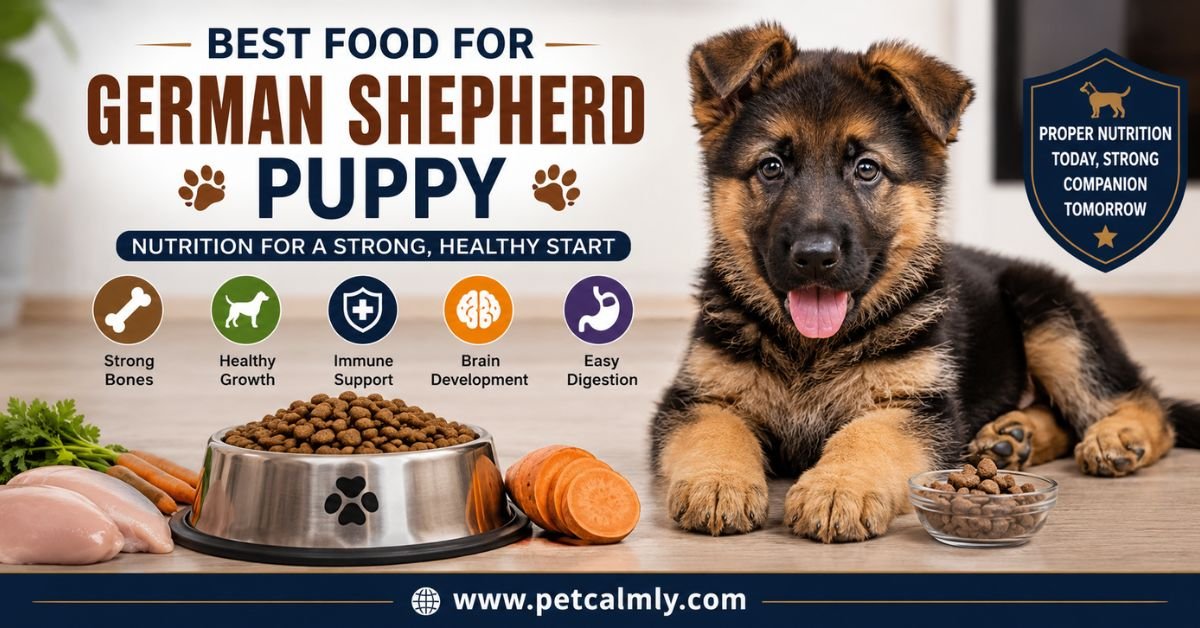
The best food for a German Shepherd puppy is a large-breed puppy formula that meets AAFCO nutrient profiles for growth, with moderate calcium and phosphorus levels (roughly a 1.2:1 to 1.4:1 ratio), controlled fat content, and a named animal protein as the first ingredient. German Shepherds grow fast and are prone to joint problems later in life, so a food designed to slow bone growth slightly rather than accelerate it protects their hips and elbows for the long run. Skip anything labeled “all life stages” or “for all breeds” unless a vet has confirmed it’s appropriate for a large-breed puppy specifically.
That’s the short version. But if you’ve just brought home an eight-week-old German Shepherd puppy, you probably have a dozen more questions how much to feed, when to switch foods, whether raw diets are safe, what “large breed” actually means on a label. Let’s go through all of it properly.
Why German Shepherd Puppies Need a Different Kind of Food
If you’ve owned smaller dogs before, the feeding advice you’re used to won’t fully apply here. A German Shepherd puppy can grow from roughly 1 kg at birth to over 30 kg by their first birthday. That’s an enormous rate of skeletal growth packed into twelve months, and it puts real stress on developing joints, growth plates, and bones.
This is the part a lot of new owners miss: feeding a large-breed puppy too much energy-dense food, or food with too much calcium, doesn’t make them healthier or bigger in a good way it can make their bones grow faster than their joints can structurally support. Over time, that imbalance is linked to a higher risk of developmental orthopedic issues, including hip and elbow dysplasia, which German Shepherds are already genetically predisposed to.
This is why “large breed puppy” formulas exist as their own category, and why they matter more for a German Shepherd than they would for, say, a Chihuahua or a Cavalier King Charles Spaniel. It’s not marketing it’s a real formulation difference in calcium level, calorie density, and mineral ratios.
What to Look for in the Best Food for a German Shepherd Puppy
You don’t need a nutrition degree to read a dog food label well you just need to know which four or five things actually matter.
1. An AAFCO Statement for Growth (or Growth and Large Breed)
Flip the bag over and look for a line that says the food is “formulated to meet the nutritional levels established by the AAFCO Dog Food Nutrient Profiles for Growth” ideally with a note for large breed puppies specifically. This single sentence tells you the food has been calculated to support puppy development, not just adult maintenance.
2. Controlled Calcium and Phosphorus Levels
For large-breed puppies, calcium is generally kept in a moderate range with a calcium-to-phosphorus ratio close to 1.2:1–1.4:1. Too much calcium even from well-meaning owners adding supplements has been associated with skeletal problems in growing large breeds. This is one area where more is not better, and it’s a big part of why homemade diets can go wrong without professional guidance.
3. Moderate Fat and Calorie Density
Puppy food is naturally calorie-dense to support growth, but for large breeds, that density needs to be moderate rather than maximal. The goal is steady, controlled growth not the fastest possible weight gain.
4. Named Animal Protein as the First Ingredient
Look for “chicken,” “lamb,” “beef,” or “salmon” rather than vague terms like “meat meal” or “animal by-product.” This isn’t about chasing a trend a clearly named protein source is generally a marker of a more transparent, higher-quality formulation.
5. Joint-Supportive Ingredients
Many large-breed puppy formulas include glucosamine and chondroitin. The evidence on how much this helps during the growth phase itself is mixed, but it’s a reasonable, low-risk addition not something to specifically seek out at the expense of the basics above.
Dry Food, Wet Food, Raw, or Homemade: What Actually Works for a German Shepherd Puppy
Owners often assume there’s one “correct” format. In reality, each has trade-offs, and the right choice depends on your puppy, your budget, and your comfort level with the work involved.
Dry kibble (large-breed puppy formula) This is the most common and, for most first-time owners, the most practical option. It’s nutritionally complete when it carries an AAFCO growth statement, easy to store, supports dental chewing, and simple to portion accurately which matters a lot for a breed prone to joint issues from overfeeding.
Wet or canned puppy food Higher in moisture, often more palatable for picky eaters or puppies recovering from illness, but usually more expensive per calorie and less convenient for free-feeding schedules. Some owners mix a small amount into dry kibble to boost appeal without changing the overall nutrient balance.
Raw diets (BARF, prey-model, or commercial raw) Raw feeding has a devoted following, and some owners report good results. But for a growing large-breed puppy, raw diets carry real risks if they aren’t properly balanced particularly around calcium-phosphorus ratios and the risk of bacterial contamination (Salmonella, E. coli) for both the puppy and the household. If you want to feed raw, work with a veterinary nutritionist to formulate it correctly rather than following a general online recipe.
Homemade cooked diets Same core issue as raw: homemade meals are very difficult to balance correctly for a growing large-breed puppy without professional formulation. A board-certified veterinary nutritionist can create a recipe that’s actually appropriate; a recipe from a blog or forum usually isn’t tested for growth-stage large-breed needs.
For most families, a quality large-breed puppy kibble possibly supplemented with a spoonful of wet food for enthusiasm — is the simplest way to get this right without needing to become a canine nutritionist yourself.
How Much to Feed a German Shepherd Puppy by Age
Every brand’s feeding chart differs slightly because calorie density varies between formulas, so the numbers on your specific bag should always be your primary guide. That said, here’s a general shape of how feeding typically changes as your puppy grows:
| Age | Meals per day | What tends to matter most |
|---|---|---|
| 8–12 weeks | 4 meals | Small, frequent meals; blood sugar dips are common at this age |
| 3–6 months | 3 meals | Rapid growth phase; monitor body condition closely |
| 6–12 months | 2 meals | Growth slows but continues; watch for overfeeding as activity increases |
| 12+ months | 2 meals | Transition to adult food once growth has largely leveled off, usually 12–24 months for large breeds — ask your vet for timing specific to your dog |
A more reliable method than sticking rigidly to a chart is checking your puppy’s body condition every couple of weeks. You should be able to feel (not see) the ribs with light pressure, and there should be a visible waist when viewed from above. If you can’t feel ribs at all, or your puppy looks like a barrel from above, it’s time to reduce portions and speak with your vet — not just cut back on treats and hope it fixes itself.
Common Feeding Mistakes German Shepherd Puppy Owners Make
Free-feeding all day. Leaving a full bowl out constantly makes it hard to track how much your puppy is actually eating, and it removes one of your best early warning signs appetite changes if something’s wrong.
Adding calcium or vitamin supplements “just in case.” This is one of the more common well-intentioned mistakes. Unless a vet has specifically recommended a supplement, adding extra calcium to an already-complete large-breed formula can push mineral levels higher than is safe for developing joints.
Switching foods too abruptly. A sudden diet change is one of the most frequent causes of puppy diarrhea. Even a food that’s objectively “better” can cause a rough few days if it’s introduced all at once.
Overfeeding because a bigger breed “must need more.” German Shepherd puppies do need more total food than a small breed, but the same overfeeding rules apply extra weight during the growth phase adds mechanical stress to joints that are still developing.
Using treats without adjusting meals. Training treats add up fast, especially during the early months when you’re rewarding constantly. As a rough guide, treats shouldn’t exceed about 10% of daily calorie intake — reduce the regular meal slightly on heavy training days.
How to Transition to a New Puppy Food Safely
If you’re switching from what a breeder or shelter was feeding, do it gradually over 7–10 days rather than all at once:
- Days 1–2: 75% old food, 25% new food
- Days 3–4: 50% old food, 50% new food
- Days 5–6: 25% old food, 75% new food
- Days 7 onward: 100% new food
Watch stool consistency throughout. Mild softness for a day or two is common and not usually a concern. If diarrhea, vomiting, or refusal to eat lasts more than 48 hours, slow the transition down or pause it and check in with your vet.
Signs Your German Shepherd Puppy’s Food Might Not Be Working
Not every puppy thrives on every formula, even a good one. Watch for:
- Chronic loose stool or gas that doesn’t resolve after the transition period
- Excessive itching, paw licking, or ear infections (possible food sensitivity)
- Dull coat or flaky skin despite adequate feeding
- Low energy that isn’t explained by normal puppy nap cycles
- Slow or excessive weight gain relative to their littermates or breed growth charts
A single off day rarely means the food is wrong. A pattern that persists for two or more weeks is worth discussing with your vet, ideally before you start swapping brands on your own — food-hopping can make it harder to identify the actual cause of a sensitivity.
When Should You Worry? Signs That Need Veterinary Attention
General feeding guidance can only take you so far. Contact your vet not a forum or a search engine if your puppy shows:
- Vomiting or diarrhea lasting more than 24–48 hours, or containing blood
- Sudden refusal to eat for more than one day
- Visible weight loss despite normal or increased feeding
- Bloated, hard, or painful abdomen (large, deep-chested breeds like German Shepherds are at elevated risk of bloat/GDV as adults, and it’s worth understanding the warning signs early)
- Limping, reluctance to rise, or a bunny-hopping gait, which can sometimes relate to growth-related joint stress
- Signs of an allergic reaction: facial swelling, hives, sudden intense itching
None of these are things to wait out at home. Puppies can decline quickly, and early veterinary input is almost always easier to act on than a delayed one.
What Should Pet Owners Do? A Practical Checklist
- Choose a food with an AAFCO growth (or growth/large breed) statement on the label
- Confirm the calcium-phosphorus ratio is appropriate for large-breed growth if that information is available from the manufacturer
- Feed measured meals on a schedule rather than free-feeding
- Recheck body condition every 2–3 weeks and adjust portions accordingly
- Transition any new food gradually over 7–10 days
- Keep treats under roughly 10% of daily calories
- Avoid supplementing calcium or vitamins without veterinary guidance
- Schedule regular vet check-ins during the first year to track growth against breed expectations
- Keep a simple log of appetite, stool quality, and energy patterns are easier to spot in writing than in memory
Conclusion
There isn’t a single “best” bag of food that’s right for every German Shepherd puppy but there is a clear, simple standard to measure any option against: a large-breed growth formula, sensible calcium and calorie levels, a named protein source, and a feeding routine that keeps growth steady rather than rushed. Get those fundamentals right, feed consistently, and keep an eye on your puppy’s body condition and energy, and you’re giving them the best possible foundation for the joints and health they’ll rely on for the next decade.
If you’re ever unsure whether a specific food or feeding amount is right for your puppy, your vet can review it against your dog’s actual growth curve which is something no article, including this one, can do for you.
More Information About Pets, Please Visit Our Website: Best Food for Senior Dogs
Best Natural Dog Calming Treats
Best Pet Hygiene Products Expert Reviews
Best Dog Shampoos for Sensitive Skin
Puppy Separation Anxiety Training
How to Calm Puppy Separation Anxiety
Puppy Still Crying at Night After 3 Weeks?
Best Calming Treats for Dogs With Separation Anxiety
Why Is My Dog Not Eating But Acting Normal?
Frequently Asked Questions
1: Is grain-free food better for German Shepherd puppies?
Not necessarily. Grain-free isn’t inherently healthier, and grain-inclusive diets are perfectly appropriate for most puppies unless a vet has diagnosed a specific grain allergy, which is actually uncommon. Choose based on the AAFCO growth statement and ingredient quality, not the presence or absence of grain.
2: Can I feed my German Shepherd puppy adult dog food?
It’s best avoided. Adult food isn’t formulated for the calorie and mineral needs of a growing large-breed puppy, and it typically won’t carry the growth-stage AAFCO statement your puppy needs during this period.
3: How long should a German Shepherd puppy stay on puppy food?
Most large breeds, including German Shepherds, benefit from staying on a large-breed puppy formula until growth has largely leveled off often somewhere between 12 and 24 months. Your vet can help you time the switch based on your individual dog rather than a fixed calendar date.
4: Why is my German Shepherd puppy always hungry?
Rapid growth genuinely does drive a big appetite, so some of this is normal. But constant, intense hunger can also signal that portions are too small for their current growth stage, or occasionally point to an underlying issue — if it’s a sudden change or paired with weight loss, it’s worth a vet visit rather than just adding more food.
5: Should I add supplements like fish oil or joint chews?
Only with veterinary guidance. A complete large-breed puppy food is already formulated to meet growth needs, and stacking supplements on top especially anything containing calcium or vitamin D can throw off the careful mineral balance the food was designed around.
6: What’s the safest way to switch my puppy’s food brand?
Transition gradually over 7–10 days, mixing increasing amounts of the new food into the old. Watch stool consistency and appetite throughout, and slow the process down if you notice digestive upset.