Short direct answer
Siamese cats aren’t inherently “problem” cats they’re intelligent, people-oriented pets with communication styles that often puzzle owners. Most Siamese personality challenges stem from their need for constant interaction, high sensitivity, strong vocal tendencies, and genetic predisposition toward social attachment. These traits are features, not flaws, but they do require understanding and appropriate management to create a harmonious household.
Why Siamese Cats Feel Different (And What That Really Means)
If you’ve recently brought a Siamese cat into your home or you’re considering it you might have heard warnings. Friends mention they’re “too demanding.” Online forums fill with stories about incessant meowing. A neighbor warns that Siamese cats are “needy” or “destructive.” You may even wonder if your specific cat’s behavior is a personality problem or just typical Siamese territory.
Here’s what’s important to understand: What many owners perceive as Siamese personality problems are actually the result of a mismatch between what these cats need and what typical cat care provides.
Siamese cats, more than most domestic cat breeds, thrive on human interaction. They were developed over centuries in Thailand (formerly Siam) as companions to Buddhist monks and royalty not as independent mousers left alone all day. This heritage created a breed that is neurologically wired for social connection in ways that other cats simply aren’t.
That doesn’t make them difficult. It makes them different.
Understanding Siamese Genetics and Temperament
The Siamese breed carries distinct genetic and physiological traits that directly influence behavior. Understanding these traits isn’t about excusing unwanted behavior it’s about recognizing what’s hardwired and what can be shaped through environment and training.
The Vocal Gene
Siamese cats produce more vocalizations than most cat breeds, and this isn’t accidental. Their larynx structure, combined with selective breeding for vocal communication, makes Siamese cats naturally chattier. They didn’t develop this trait because previous generations of owners reinforced meowing they developed it because vocal cats were preferred by breeders and owners who valued interactive pets.
This means your Siamese isn’t “complaining” constantly because something is wrong. They’re communicating because communication is their default language. They talk when they’re happy, when they want food, when they notice you’ve been away, when they see a bird outside, and sometimes just because they feel like having a conversation.
The Social Bond Factor
Research into cat behavior shows that Siamese cats have a stronger attachment to their owners than many other breeds. Feline behaviorists have documented that Siamese cats are more likely to follow their owners room-to-room, greet them at the door, and display behaviors similar to secure attachment in human infants. This isn’t neediness in the pathological sense—it’s a genuinely different baseline for social bonding.
This attachment is why isolation is particularly hard on Siamese cats. A Siamese left alone for 8+ hours regularly doesn’t just get bored like a less social cat might they experience actual stress because of the separation from their primary social partner.
The Intelligence Factor
Siamese cats have a reputation for being exceptionally intelligent, and the evidence supports this. They learn routines quickly, respond to training better than many cat breeds, and can figure out how to open doors, turn on lights, and solve simple problems. This intelligence becomes a “problem” only when it combines with boredom or insufficient mental stimulation.
The Main Siamese Personality Traits That Owners Call “Problems”
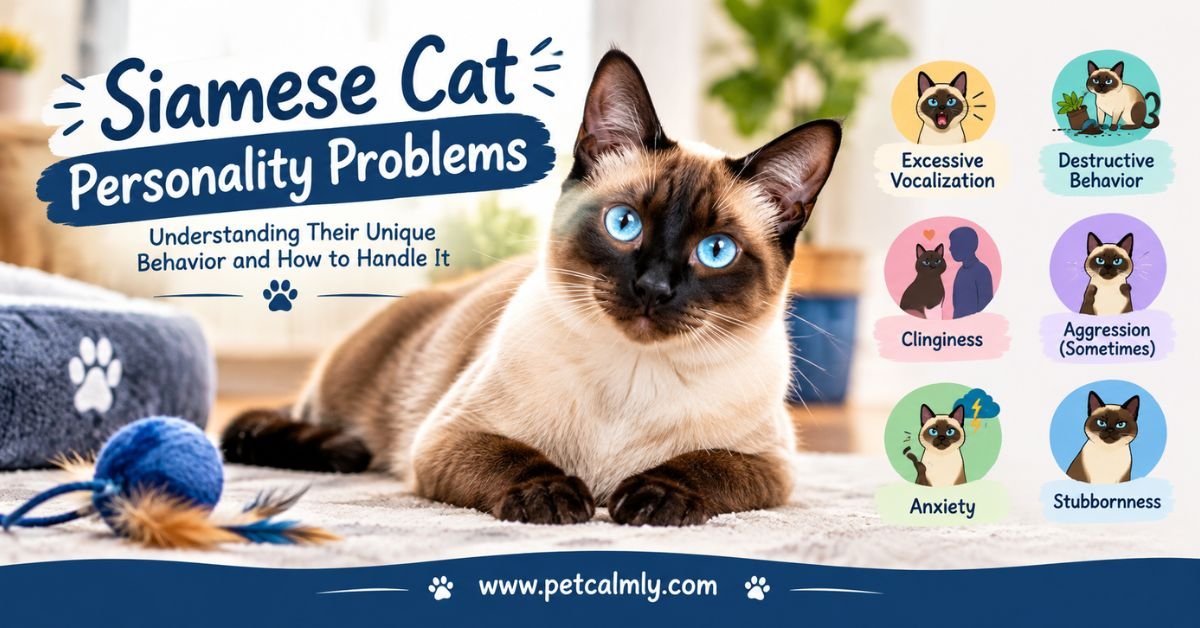
Excessive Vocalization and “Demanding” Meowing
What owners describe: A Siamese cat that won’t stop meowing, follows you around the house vocalizing, meows at night, or demands constant attention through sound.
What’s actually happening: Your Siamese is doing exactly what Siamese cats do communicating their needs and preferences clearly. The volume and frequency might genuinely be higher than you expected, but this is breed-typical behavior, not a defect.
The reality check: Not all Siamese meow equally. Some Siamese are chattier than others based on individual personality. If you have a particularly vocal Siamese, this is partly breed genetics and partly individual variation. What you can control is how you respond.
Common owner mistake: Rewarding meowing with attention teaches your cat that meowing works. If your Siamese meows and you respond even to say “stop” you’ve reinforced the meowing. Siamese are smart enough to figure out that noise gets results.
Better approach: Create a schedule. Siamese cats respond well to predictable interactions. Spend dedicated time playing with your cat (15-20 minutes, twice daily minimum), provide enrichment throughout the day, and then establish a “quiet time” where you don’t respond to vocalizations. When your cat is quiet, that’s when you initiate affection. Most Siamese owners find that their cat’s excessive meowing drops by 50-70% once they establish a consistent interaction routine.
Destructiveness and Hyperactivity
What owners describe: A Siamese that knocks things off shelves, tears up furniture, climbs everything, or seems unable to settle down.
What’s actually happening: An intelligent, high-energy cat that doesn’t have enough mental and physical stimulation.
Siamese cats have higher activity levels than many cat breeds. They’re not hyperactive in the clinical sense—they’re appropriately active for their genetics. The problem arises when owners provide a sedentary environment and then expect the cat to be calm.
The outlet gap: Imagine being a marathon runner trapped in an office with no exercise option. You’d find outlets—pacing, fidgeting, creating problems. Your Siamese is doing the same thing.
Better approach:
- Invest in interactive toys: Wand toys, laser pointers (used properly), and automated toys that move unpredictably engage their hunting instincts
- Create vertical space: Siamese love climbing, so cat trees, wall shelves, and high perches give them appropriate outlets
- Rotate toys: A new toy every few days maintains novelty and interest
- Play before bed: An exhausted cat is a calm cat. A 20-minute play session before sleep dramatically improves nighttime behavior
- Provide puzzle feeders: Siamese respond well to food-dispensing toys that make them “work” for meals
Aggression or “Mean” Behavior
What owners describe: A Siamese that bites, swats, or seems aggressive during play, or that can’t handle being petted without turning aggressive.
What’s actually happening: Either overstimulation during petting, play aggression (which is normal in cats), or a cat that hasn’t learned appropriate boundaries.
Siamese cats can have lower tolerance for extended petting sessions. Their skin is quite sensitive, and many Siamese will tolerate 30-60 seconds of petting before becoming overstimulated. The trick isn’t that they’re mean—it’s that they need you to notice the warning signs before they escalate to biting.
Warning signs of overstimulation:
- Tail twitching or lashing
- Ears rotating backward
- Skin rippling on the back
- Sudden staring or eye dilation
- Slowed blinks followed by quick head turns
These are your stop signs. If you’re petting your Siamese and see any of these, stop immediately. Your cat isn’t being rude—they’re politely asking you to respect their boundary.
Play aggression: Siamese often play intensely, and this can feel aggressive to owners. Pouncing, grabbing your hand, or ambushing your feet are normal cat play behaviors, not signs of aggression or meanness.
Better approach:
- Learn your individual cat’s petting tolerance
- Use interactive toys instead of hands for play
- If your cat bites during petting, stop and wait 5+ minutes before resuming (this teaches that aggression ends the interaction)
- Provide appropriate prey outlets through toys so hunting aggression isn’t directed at hands
Separation Anxiety and Clinginess
What owners describe: A Siamese that won’t leave you alone, follows you everywhere, cries when you leave, or seems genuinely distressed when you’re away.
What’s actually happening: Your cat has a strong attachment bond and hasn’t learned that your departures are temporary.
Siamese separation anxiety is real and different from typical cat independence. Where a regular cat might be mildly annoyed by your absence, a Siamese can experience genuine distress. Some Siamese will stop eating properly, over-groom, eliminate outside the litter box, or destroy furniture specifically when left alone.
This isn’t manipulation. This is anxiety.
Better approach:
- Practice departure training: Leave for 5 minutes, return before your cat gets anxious, and reward calm behavior with treats or play
- Gradually extend departure time over weeks or months
- Create a safe space for when you’re gone: A room with food, water, litter, toys, and a window view reduces anxiety
- Consider a cat camera: Watching your cat on a video feed often reveals that they calm down 15-20 minutes after you leave, which can reassure you
- Interactive toys and puzzle feeders provide distraction during your absence
- If separation anxiety is severe, consult a feline behaviorist about whether medication or professional training is appropriate
What Gets Misdiagnosed as Personality Problems
Normal Breed Behavior Interpreted as Problems
Many Siamese traits that owners label as “problems” are actually breed standards. A Siamese that:
- Follows you everywhere is being typical Siamese
- Meows frequently is being typical Siamese
- Plays intensely is being typical Siamese
- Demands interaction is being typical Siamese
The issue isn’t the cat. It’s often a mismatch between expectations and reality. If you’ve never owned a Siamese before, their baseline for social interaction and communication might genuinely shock you. This doesn’t mean something is wrong with your cat—it means your cat is a Siamese.
Medical Issues Hiding Behind Behavioral Labels
Sometimes what looks like a personality problem is actually a health issue. Before assuming your Siamese’s behavior is a character flaw, rule out:
Hyperthyroidism: Common in older Siamese cats, this causes excessive vocalization, hyperactivity, and behavioral changes. A simple blood test identifies this, and treatment transforms behavior.
Urinary issues: Excessive vocalization, inappropriate elimination, and aggression can indicate bladder or urinary tract problems.
Pain: A cat in pain might be aggressive during petting or reluctant to play.
Neurological conditions: Some behavioral changes relate to neurological health.
Allergies and skin conditions: Itching can make cats irritable and aggressive.
If your Siamese’s behavior suddenly changes or seems extreme, a veterinary check should happen before behavior modification training.
Training and Management Strategies That Actually Work
Establishing Predictable Interaction Schedules
Siamese cats thrive on routine. Rather than trying to avoid interaction, establish a structured schedule:
Morning routine:
- 10-15 minutes of interactive play before you leave for work
- Puzzle feeder with breakfast to keep them occupied
Evening routine:
- 20 minutes of active play when you arrive home
- 10-15 minutes of petting or play before bedtime
- A final puzzle feeder before sleep
This scheduling serves two purposes: It provides the interaction your Siamese craves, reducing constant demand-meowing, and it makes departures easier because your cat knows interaction is coming at a predictable time.
Environmental Enrichment That Reduces Behavioral Issues
A well-enriched environment prevents 60-70% of common Siamese behavioral problems.
Window perches: Siamese love watching outside activity. A window perch with bird feeders outside provides hours of entertainment.
Vertical territory: Install cat shelves or a large cat tree. Siamese love being up high.
Interactive feeders: Rather than feeding in a bowl, use puzzle feeders, slow feeders, or hide small portions around the house so your cat “hunts” for meals.
Clicker training: Siamese respond remarkably well to clicker training for tricks like sit, high-five, or come. This provides mental stimulation and strengthens your bond.
Rotating toys: Keep 3-4 toys out and rotate them weekly. A “new” toy is more engaging than one that’s always available.
Window clings or bird feeders: A window that shows outside activity keeps a Siamese entertained for significant stretches of time.
The Power of Consistent Boundaries
Siamese are intelligent and will test boundaries. The key is consistency—if you’re sometimes okay with behavior and sometimes not, your cat learns that persistence pays off.
Example with scratching furniture:
- First time: Move cat to scratching post, reward with treats
- Second time: Same response, no exceptions
- 10th time: Same response, no exceptions
Siamese cats learn quickly when rules are consistent. They also respect boundaries set calmly and consistently much better than harsh corrections.
When to Consult a Professional
Not every Siamese behavior issue requires professional help, but some situations absolutely do:
Aggression escalation: If your cat’s biting or swatting is worsening despite your efforts, or if you’re worried about injury, consult a feline behaviorist.
Severe separation anxiety: If your cat is self-injuring, refusing to eat, or eliminating outside the litter box when alone, medication combined with behavior modification (not just one or the other) might be necessary.
Sudden behavioral changes: If your confident, friendly Siamese suddenly becomes withdrawn or aggressive, veterinary evaluation is the first step.
Elimination outside the litter box: This can indicate medical issues or behavioral problems, but distinguishing between them requires professional assessment.
Excessive vocalization that’s worsening: While normal Siamese vocalization is expected, if your cat’s meowing is increasing dramatically or sounds different, veterinary evaluation should happen first.
Siamese Personality Traits as Strengths, Not Problems
Why Some Owners Love These “Problems”
If Siamese personality traits are actually problems, explain why Siamese cats have such devoted fans.
Siamese owners often describe their cats as:
- More like dogs than typical cats in their loyalty
- Fascinating conversationalists
- Deeply affectionate and bonded
- Highly trainable
- Entertaining and engaging
- Responsive to their emotional state
The same vocalization that frustrates some owners delights others who see it as constant conversation. The same clinginess that exhausts some owners feels like unconditional companionship to others. The same intelligence that causes destruction in understimulated cats creates learning opportunities for owners willing to train and engage.
Is a Siamese Right for Your Lifestyle?
Before adopting a Siamese or deciding yours is a “problem” cat, honestly assess whether your lifestyle suits the breed.
Siamese thrive when:
- They have substantial daily interaction (2+ hours ideally)
- They live with someone who’s home frequently or have multiple pets
- Their owners enjoy interactive play and training
- They have access to vertical space and environmental enrichment
- They’re not left alone for extended periods regularly
- Their owners appreciate constant communication
Siamese struggle when:
- They’re left alone 8+ hours daily
- Their owners prefer independent, aloof cats
- They live in small spaces with no enrichment
- They’re expected to be low-maintenance pets
- They receive minimal interaction or play
This isn’t a failing on the Siamese’s part. It’s a breed-lifestyle mismatch that’s often undiagnosed.
Managing Siamese Behavior: A Practical Checklist
Before concluding your Siamese has a personality problem, work through this checklist:
Daily interaction:
- 30+ minutes of interactive play (in sessions, not all at once)
- Environmental enrichment (toys, perches, puzzle feeders)
- Dedicated petting/affection time
- Opportunities for climbing and exploring
Environmental setup:
- Multiple scratching posts or scratchers
- Cat trees or climbing shelves
- Window perches
- Toys available in multiple rooms
- Access to vertical space
Behavioral management:
- Consistent response to meowing (reward quiet, not vocalization)
- Appropriate play outlets (toys, not hands)
- Clear boundaries on petting tolerance
- Scheduled departure practice for separation anxiety
- Attention given on your schedule, not just when cat demands
Health considerations:
- Recent veterinary checkup
- Appropriate diet for age and health status
- Thyroid screening if over 10 years old
- Dental health checked
- Urinary health assessed if elimination issues exist
Individual personality:
- Recognition of your specific cat’s petting tolerance
- Understanding of your cat’s specific triggers
- Awareness of your cat’s communication style
- Adaptation to your cat’s needs, not just breed traits
If you’ve worked through this checklist and your Siamese’s behavior is still problematic, you have real data to bring to a feline behaviorist or your veterinarian.
When Siamese Behavior Indicates a Serious Problem
Health-Related Behavioral Changes
Cats can’t tell us when something hurts, so they show us through behavior. Behavioral changes that warrant veterinary attention include:
Excessive vocalization that’s new or changing: Hyperthyroidism, pain, or cognitive dysfunction can cause sudden changes in meowing patterns. Schedule a vet visit.
Litter box avoidance: Urinary tract infections, bladder issues, or intestinal problems often manifest as elimination outside the litter box before you’d notice other symptoms.
Aggression escalation: A cat that’s becoming increasingly aggressive might have an underlying medical issue.
Withdrawal or lethargy: A Siamese that’s unusually quiet or inactive needs veterinary evaluation.
Changes in appetite or water consumption: Weight loss, increased eating, or increased thirst signal metabolic changes that need assessment.
Behavioral Issues Requiring Professional Intervention
Some behavioral concerns go beyond normal Siamese traits and need professional help:
Obsessive behaviors: Excessive grooming, tail chasing, or repetitive behaviors can indicate psychological distress or neurological issues.
Aggression toward people: Biting hard enough to cause injury, or aggressive behavior that’s escalating, needs professional assessment.
Severe separation anxiety: Inability to be alone without significant distress requires behavioral intervention combined with possible medication.
Multi-cat aggression: If your Siamese is aggressive toward other cats despite introductions being appropriate, professional help can prevent injury.
Frequently Asked Questions
1: Can Siamese cats learn to be quieter?
Short answer: Somewhat, but don’t expect silence. You can reduce demand-vocalization through ignoring meows and rewarding quiet, but the breed remains naturally talkative. If absolute quiet is a requirement, Siamese might not be the right breed for you. If you can accept a chatty cat and manage the vocalization through training, success is possible.
2: Why does my Siamese follow me everywhere?
Short answer: Because they’re deeply attached to you and see you as their primary social partner. This is breed-typical. Rather than seeing it as a problem, many owners eventually appreciate the constant companionship. If it bothers you, ensure your Siamese has other outlets—interactive toys, other pets, and enrichment so following you isn’t their only entertainment option.
3: Is it normal for Siamese cats to be aggressive during play?
Short answer: Intense play is normal. Hard biting or swatting that causes injury is not. The difference is learning whether your cat is playing hard or crossing into actual aggression. Most Siamese play intensely but stop before causing harm. If your cat’s play behavior includes hard biting or seems out of control, redirect to toys and take breaks to establish boundaries.
4: What’s the difference between a Siamese personality problem and a behavioral disorder?
Short answer: A personality problem is a trait that’s typical for the breed but inconvenient for the owner (excessive meowing, constant following, intense play). A behavioral disorder is behavior that’s not typical even for Siamese—severe aggression, compulsive behaviors, or inability to function normally. Most “Siamese personality problems” are actually normal traits meeting untrained owners. Real behavioral disorders need professional assessment.
5: Should I rehome my Siamese if they’re too demanding?
Short answer: Before rehoming, honestly assess whether you’ve optimized their environment and your interaction schedule. Most Siamese behavior challenges improve dramatically with appropriate enrichment and consistent interaction. Rehoming should be a last resort after you’ve genuinely tried to meet the cat’s needs. If you’ve made real efforts and the match is wrong, rehoming to someone whose lifestyle suits the breed is better than prolonged struggle—but this is rarely necessary.
6: How do I know if my Siamese has separation anxiety versus normal independence?
Short answer: Normal Siamese cats might greet you enthusiastically when you return home, but they don’t show signs of distress while you’re gone. Separation anxiety involves self-injury, elimination outside the litter box while alone, refusing to eat, or excessive vocalization specifically triggered by your departure. If your Siamese seems fine when you leave but is thrilled when you return, that’s normal attachment. If they’re showing distress signals, that’s anxiety requiring intervention.
More Information About Pets, Please Visit Our Website: How to Keep a Cat Happy Indoors
How to Remove Fleas from Cats
How Often Should You Groom a Long Haired Cat?”
Kitten Feeding Schedule
How to Reduce Cat Shedding Hair
How to Clean Cat Ears at Home
How to Bathe a Cat Safely at Home
Can Cats Drink Milk Safely Veterinary Advice
Cat Sleeping Positions Meaning
Why Does My Cat Bite Me?
Conclusion
The most important thing to understand about “Siamese personality problems” is that they’re rarely problems with the Siamese. They’re usually mismatches between breed characteristics and owner expectations, gaps in environmental enrichment, or normal behavior being interpreted as defects.
Siamese cats are exactly what they were bred to be: intelligent, social, communicative companions who form deep bonds with their owners. These traits require appropriate management and understanding, but they’re not flaws to be fixed—they’re features to be appreciated or, if they don’t suit you, understood as reasons the breed might not be the right match.
Before labeling your Siamese as having a personality problem, consider whether the problem is actually the cat or the gap between what the cat needs and what the environment provides. In most cases, when owners bridge that gap through enrichment, training, and appropriate interaction, the “problem” cat becomes a deeply rewarding, fascinating companion.
Your Siamese isn’t trying to be difficult. They’re just being Siamese. The question is whether you’re willing to understand and work with that.