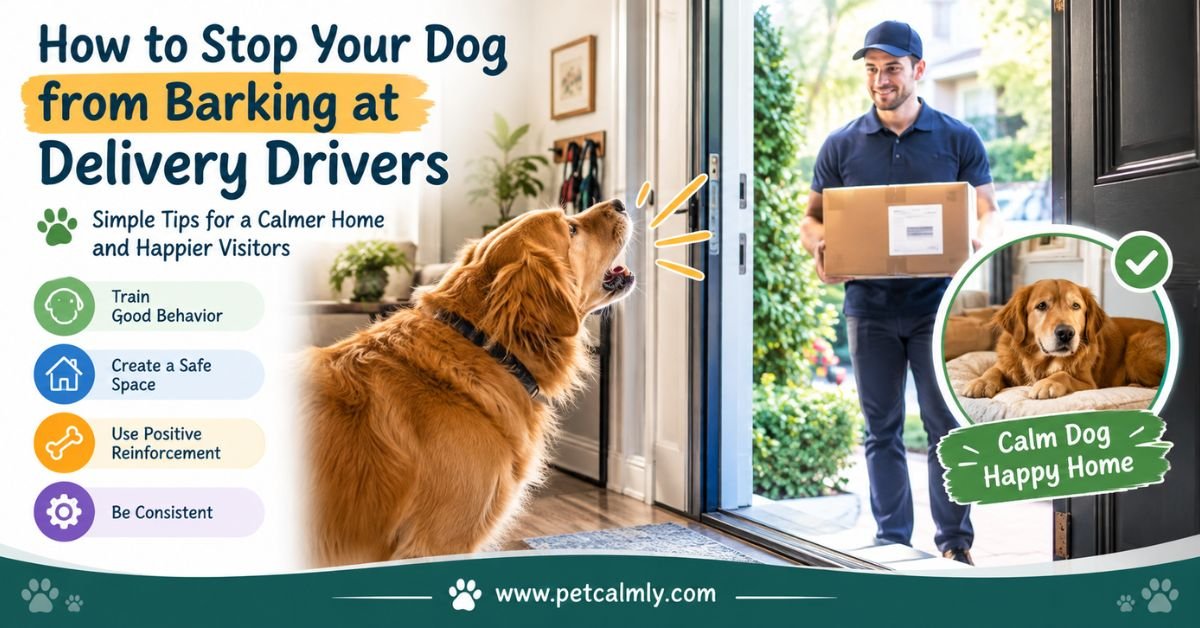
Short direct answer
The most effective way to stop your dog from barking at delivery drivers is to teach a “place” or “mat” command combined with high-value treats during delivery times. Set up a designated spot (like a bed or crate) away from the door, reward your dog heavily for staying there when the doorbell rings or knock occurs, and gradually reduce the reward frequency as the behavior becomes automatic. Most dogs respond well to this method within 2-4 weeks of consistent practice, though some anxious dogs may need 6-8 weeks or professional help.
Why This Happens: Understanding Your Dog’s Behavior
Before you can fix the problem, you need to understand what’s actually driving it.
Your dog isn’t being a jerk when the delivery driver arrives. They’re doing exactly what their instincts tell them to do: protect their territory and investigate an unfamiliar person approaching the home. This behavior makes sense from your dog’s perspective, even though it’s frustrating for you.
The Root Causes:
Protective instinct is the primary driver. Dogs are naturally territorial animals. Your home is their territory, and when a stranger approaches especially at the door they feel obligated to sound the alarm. This is hardwired behavior that doesn’t mean your dog is aggressive or broken.
Lack of exposure amplifies the response. If your dog doesn’t regularly meet different people coming to your house, delivery drivers become unpredictable and therefore concerning. The dog hasn’t learned that these strangers are normal, non-threatening visitors.
Excitement and arousal play a huge role too. The doorbell or knock creates a sudden stimulus that floods your dog’s system with adrenaline. Their brain goes into high alert. For some dogs, this is genuinely thrilling they’re not anxious; they’re amped up and ready to engage.
Learned behavior makes it worse over time. If your dog barks and the delivery driver leaves (which they will, because they’re delivering packages, not waiting out a barking dog), your dog has just learned that barking works. From the dog’s perspective, they scared away the intruder. You’ve unintentionally reinforced the exact behavior you want to stop.
Anxiety and insecurity is less common than the other causes, but it matters in some cases. Some dogs bark frantically at delivery drivers because they’re genuinely stressed about strangers entering their space. You’ll notice these dogs are also reactive to other situations maybe they’re nervous on walks, jumpy at loud noises, or anxious when you leave home.
Understanding which of these (or which combination) is driving your dog’s behavior will help you choose the right solution. A protective, confident dog needs a different approach than an anxious, insecure dog.
The Place or Mat Command Method: Step-by-Step Training
This is the most reliable solution because it gives your dog a job to do instead of barking at the door.
What You’ll Need:
- A comfortable bed, mat, or crate your dog already likes or will quickly learn to like
- High-value treats your dog goes crazy for (small pieces work best—you’ll use many)
- Realistic expectations (this takes practice)
- A second person to help (or a doorbell simulator)
The Basic Protocol:
Phase 1: Build the Foundation (Days 1-3)
Start in a calm, quiet moment when your dog is already relaxed. This isn’t a punishment or a drill—it’s a game.
- Place the bed or mat in a neutral location in your living room
- Toss a high-value treat onto the mat
- Let your dog naturally find it and eat it
- Repeat this 3-4 times in a row
- Stop and do something else
Repeat this sequence 2-3 times per day for the first few days. You’re teaching your dog that the mat is a rewarding place to be.
Then add a verbal cue: “Place” or “Mat.” Say the word right before tossing the treat onto the mat. Do this 10-15 times per session, twice a day.
Phase 2: Add Duration (Days 4-7)
Now your dog needs to learn that staying on the mat for longer periods is rewarded.
- Say “Place”
- Your dog goes to the mat
- Wait 2 seconds before giving a treat
- Gradually increase the wait: 2 seconds, then 3, then 5, then 10
- If your dog leaves the mat, calmly say “Uh-uh” or “Nope,” wait a moment, then reset
The goal here is that your dog learns the mat is a stationing point—they’re supposed to stay there until released.
Phase 3: Add Distractions (Days 8-14)
Now introduce mild distractions while your dog is on the mat.
- Say “Place” and your dog goes to the mat
- You walk around the room, touch doorways, create noise
- Reward your dog for staying put
- Gradually increase the “distraction level”
Phase 4: Introduce the Doorbell Sound (Weeks 2-3)
Have someone outside ready to ring the doorbell or knock. Here’s the critical part: have them do it at a low volume first, or simulate it with your phone.
- Say “Place”
- Your dog goes to the mat
- Mild doorbell sound happens
- Immediately reward your dog for staying in place
- No barking = jackpot reward
If your dog barks, reset the training. Have your helper wait and try again in a few minutes. Don’t punish—just don’t reward the bark.
Gradually increase the realism: louder doorbell sounds, more convincing knocking, the sound of a car door outside.
Phase 5: Real Delivery Drivers (Weeks 3-4+)
Once your dog is reliably staying on the mat during sound simulations, set up the real thing.
Contact a friend or neighbor to come to your door. Brief them on the protocol:
- You give the “Place” command before they arrive
- Your dog settles on the mat
- Your friend knocks or rings the bell
- Your dog ideally stays put (you heavily reward this)
- Your friend leaves
- Your dog gets a celebration reward
If your dog does bark during this real-world test, it’s okay. You’re still in training. Have your friend leave, reset, and try again in a few minutes.
After 2-3 weeks of this real-world practice, most dogs start to make the connection: doorbell or knock = I go to my mat, good things happen.
Managing Delivery Day: Practical Strategies
While you’re training, you still need to survive actual deliveries. Here are tactics that work right now.
Preemptive Confinement
If you know when a package is arriving, put your dog in a separate room before the delivery driver arrives. This isn’t cruel—it’s humane management while you’re training.
Close your dog in a bedroom, bathroom, or quieter space where they can’t see the delivery driver. Many dogs don’t bark if they can’t see the action. Use a baby gate instead of a full closure if you want your dog to maintain visual connection but still be safely separated from the door.
Some owners use a crate for deliveries, which works fine if the crate is already a positive space for the dog. Never use confinement as punishment.
Create a “Delivery Station”
Set up a puzzle feeder, stuffed Kong toy, or sniff mat in the designated area where you want your dog to be during deliveries. Stuff it with peanut butter, wet food, or treats. A busy, engaged dog is a quiet dog.
Set this up 10-15 minutes before the expected delivery window. Your dog’s brain will be focused on working the toy, not on the stranger at the door.
Manage the Sound
That doorbell is a starter gun for excitement. Consider:
- Turning off the visual and audio doorbell during delivery windows
- Using a Ring camera or video doorbell to see deliveries without your dog hearing it
- Playing calming music or white noise to mask outside sounds
This isn’t training, but it buys you peace while the real training is working.
Limit Visual Access
If possible, close curtains, blinds, or doors so your dog can’t see the delivery driver moving around outside. The “threat” they perceive becomes less real.
Why Your Dog Might Still Be Barking: Common Training Mistakes
This is where most dog owners get stuck—and it usually comes down to one of these issues.
Inconsistency
You’re training your dog to go to the mat for deliveries, but Tuesday you just close the door and shrug, Wednesday you punish barking, and Thursday you ask a neighbor to help with training. Your dog is confused about what you actually want.
Dogs learn through consistency and repetition. Pick one method and stick with it for at least 2-3 weeks before deciding it’s not working. Inconsistent training is why most dogs never improve.
Accidental Reward
You tell your dog to “Place,” they bark, you then let them run to the door because you’re annoyed. Congratulations—you just rewarded barking. Or the delivery driver leaves right when your dog is barking, and your dog thinks they won.
Every interaction teaches your dog something. Make sure you’re not teaching them that barking pays off.
Punishment-Based Approaches
Yelling “Stop!” or “No!” at a barking dog doesn’t teach them what TO do. It often escalates anxiety and makes the problem worse. Some dogs get excited by the attention and yelling (even negative attention is attention), so the barking increases.
Punishment also damages trust between you and your dog. Training works better with positive reinforcement.
Expecting Too Much Too Fast
Your dog didn’t develop this habit overnight, and they won’t unlearn it overnight either. If your dog has been barking at delivery drivers for 2 years, you shouldn’t expect perfect silence by week 2 of training.
Progress looks like: reduced barking duration, barking that stops faster, fewer alert barks, more interest in treats instead of the door. Celebrate these wins.
Not Addressing the Emotional Undercurrent
If your dog’s barking is rooted in genuine anxiety—not just territorial protection—training alone might not be enough. An anxious dog needs both behavioral training and stress reduction. This might include:
- Creating a safe space away from the door
- Using calming supplements (discuss with your vet)
- Desensitization to the stimuli that trigger anxiety
- In some cases, consulting a veterinary behaviorist
Desensitization: For Dogs With Anxiety-Driven Barking
Not all barking at delivery drivers is the same. If your dog’s barking seems panicked, frantic, or accompanied by panting, pacing, or whining, anxiety is likely the driver.
Standard training helps, but desensitization can accelerate the process.
What Desensitization Looks Like:
It’s a slow, repeated exposure to the trigger at a low enough level that your dog doesn’t react, followed by a positive association.
The Process:
- Start far from the trigger (e.g., far from the door)
- At that distance, simulate the doorbell sound at very low volume
- The moment your dog hears it without reacting, reward heavily
- Repeat 5-10 times
- Very gradually increase the volume or realism over weeks
This teaches your dog’s nervous system that the stimulus isn’t dangerous.
The key word is gradual. If you jump from a whisper doorbell sound to a full-volume knock, you’ve triggered the anxiety response again, and you’ve actually made progress harder.
When to Call a Professional: Signs You Need More Help
Training works for most dogs, but some need professional guidance.
Consider hiring a certified professional dog trainer or veterinary behaviorist if:
- Your dog’s barking has been extreme or worsening for months despite consistent training
- Your dog shows signs of severe anxiety (panic, destructive behavior, self-injury)
- Your dog has been aggressive toward delivery drivers or other people approaching the house
- You’ve implemented the training protocol exactly but seen no improvement after 6 weeks
- You’re exhausted and don’t have the bandwidth for a structured training plan
A professional can:
- Assess whether anxiety, fear, or other medical issues are involved
- Design a customized training plan for your specific dog
- Help you recognize progress you might be missing
- Rule out underlying health issues (some barking problems have medical roots)
Look for trainers with certifications from reputable organizations like the Certification Council for Professional Dog Trainers (CCPDT) or the International Association of Canine Professionals (IACP). Avoid trainers who rely heavily on punishment, prong collars, or shock collars.
A veterinary behaviorist (DVM with board certification in behavior) is particularly valuable if you suspect anxiety. They can evaluate whether anti-anxiety medication might help during the training process.
Preventing the Problem in Future Dogs
If you’re raising a puppy or bringing home a new dog, here’s how to prevent barking at delivery drivers from ever becoming a serious problem.
Early Exposure
Puppies have a “socialization window” (roughly 3-14 weeks) where they’re naturally curious and less fearful of new things. Exposing them to various people including people approaching the door normalizes it.
Invite friends over. Have neighbors ring the doorbell. Teach the doorbell to mean “something good happens,” not “a threat appears.”
The Doorbell = Treats Protocol
Start when your dog is young:
- Ring the doorbell yourself
- Immediately give a treat
- Repeat until your dog’s eyes light up at the doorbell sound
- Have visitors ring and do the same
- Your dog learns doorbell = rewards arrive, not threats
This takes just a few weeks with a young dog and can prevent years of problems.
Early “Place” Training
Teach puppies to go to a spot away from the door as a normal behavior, not as a special training protocol. Make it part of daily life.
Realistic Exposure to Strangers
The more different people your dog meets in normal, positive contexts, the less reactive they’ll be to strangers approaching the house.
Frequently Asked Questions
1. Is it normal for dogs to bark at delivery drivers?
Yes, absolutely. Territorial barking at strangers approaching the home is normal dog behavior. It doesn’t mean your dog is aggressive, anxious, or broken it means your dog is a dog. That said, just because it’s normal doesn’t mean you should accept it. Training works, and most dogs can learn to manage this response.
2. Will my dog bite a delivery driver?
Barking doesn’t predict biting. A dog that barks extensively at the door may have zero intention of biting anyone. Many delivery drivers understand that dogs bark and aren’t concerned. That said, if you notice signs of genuine aggression (growling, snapping, lunging at the door), contact a professional trainer or veterinary behaviorist. That’s a different issue that needs professional assessment.
3. What’s the fastest way to fix this?
Consistency and high-value rewards. The “Place” method combined with desensitization to doorbell sounds works fastest for most dogs (2-4 weeks of visible improvement). Medication-assisted training (with a vet’s guidance) can help anxious dogs respond better to training. Punishment-based approaches are slower and often backfire.
4. My dog still barks after 2 weeks of training. Did I do something wrong?
Two weeks is early. Most dogs need 3-4 weeks minimum to show real progress. Check that you’re being truly consistent—every single delivery, every doorbell. Also double-check you’re not accidentally rewarding the barking. If your dog is still barking frantically after 6 weeks of solid, consistent training, professional help is worth considering.
5. Can I use a shock collar or prong collar to stop the barking?
We don’t recommend it. These tools teach suppression (your dog stops barking because they’re afraid), not actual behavior change. Dogs trained this way often develop other problems increased anxiety, aggression in other contexts, or unpredictable responses. Positive reinforcement training is slower initially but creates lasting change with fewer side effects.
6. What if my dog has severe anxiety about delivery drivers?
Start with the desensitization protocol using very quiet sounds and gradual exposure. Talk to your vet about whether anti-anxiety medication might help during training it can make your dog’s brain more receptive to learning. A veterinary behaviorist is particularly valuable here because they can rule out medical causes and design a customized plan.
More Information About Pets, Please Visit Our Website: How to Stop Dog Barking in Seconds
Puppy Losing Fur Around Eyes
Puppy Not Eating After Deworming
Puppy Sleeping After Vaccination
How to Stop Reverse Sneezing in Dogs
Dog Allergy Symptoms Eyes
Dog Constipation
Dog Vomiting Yellow Foam Treatment at Home
Dog Yeast Infection Treatment
Cat Ear Infection Symptoms
How to Treat Dog Ear Infection Without Vet
Conclusion
Your dog is barking at delivery drivers because they’re doing exactly what their instincts tell them to do. Fixing it requires teaching them a different response one that gets rewarded through consistent, patient training.
The “Place” command combined with desensitization to doorbell sounds works for the vast majority of dogs within 3-6 weeks. Manage the behavior in the meantime through confinement, enrichment toys, and strategic sound management. Stay consistent, avoid punishment, and adjust your expectations based on your dog’s timeline, not an arbitrary deadline.
Most importantly, remember that your dog isn’t being difficult on purpose. They’re responding to instinct and learning history. With the right approach, they’ll learn that delivery drivers are boring, normal visitors not threats requiring frantic alarm.