Short direct answer
Yes, you can crate train a dog with separation anxiety but it requires patience and a slower approach than standard crate training. The key is to make the crate feel safe, not punishing. Start with short, positive sessions and gradually build up time. Never force your dog in, and pair the crate with high-value treats and calm praise.
Why This Is One of the Hardest Things Dog Owners Face
Picture this: you leave for work, and your dog starts howling the moment the door closes. You come home to scratched walls, a chewed crate door, and a dog that looks like it ran a marathon panting, shaking, and desperate for your return.
That is separation anxiety. And it is heartbreaking for both you and your dog.
Many owners assume crate training will make things worse. And honestly, if done wrong, it can. But when crate training is introduced correctly and gently, the crate can become your dog’s personal safe space the one place where they feel calm, even when you are not home.
This guide walks you through everything: what separation anxiety really looks like, why crates help (when used right), and a step-by-step plan you can start today.
Understanding Separation Anxiety in Dogs First
Before you place your dog near a crate, you need to understand what is actually happening in their brain.
Separation anxiety is not your dog being dramatic or badly behaved. It is a genuine panic response. When your dog is separated from you their attachment figure their nervous system goes into overdrive. Think of it like a fear of heights, but the trigger is simply being alone.
Common Signs of Separation Anxiety
Your dog may be dealing with separation anxiety if you notice:
- Excessive barking, whining, or howling when you leave
- Destructive behavior near doors or windows
- Pacing, drooling, or trembling before you even leave
- Accidents indoors, even in a house-trained dog
- Refusing to eat or drink while alone
- Frantic greetings when you return (jumping, spinning, crying)
Some dogs show one or two of these signs. Others show all of them. The severity matters when planning your training approach.
Mild vs. Severe Separation Anxiety Why It Changes Everything
A dog with mild separation anxiety might settle after 20–30 minutes of you being gone. A dog with severe separation anxiety may panic within seconds of the door closing and that panic does not stop until you return.
Why does this matter? Because your training pace depends on it. Rushing a dog with severe anxiety into a crate is like throwing someone with a fear of water straight into the deep end. It backfires. Progress has to be slow, deliberate, and tied to the dog’s comfort level not your schedule.
Why Crate Training Can Actually Help (When Done Right)
Many anxious dog owners hear “crate training” and immediately worry they are locking their dog in a cage. That instinct is understandable. But think of the crate differently.
Wild dogs naturally seek out dens small, enclosed spaces where they feel protected. A well-introduced crate taps into that instinct. Instead of your dog roaming a large, empty house feeling lost and overwhelmed, the crate gives them a defined, cozy space with a predictable boundary.
That predictability is actually soothing for an anxious dog.
The crate is not a solution on its own. But it is a powerful tool especially when combined with gradual desensitization and positive association.
Choosing the Right Crate for an Anxious Dog
Not all crates are equal, and for an anxious dog, the wrong crate can cause more harm than good.
Size Matters More Than You Think
The crate should be large enough for your dog to stand up, turn around, and lie down comfortably. But not so large that your dog feels exposed or lost inside it.
For anxious dogs especially, a crate that feels too big can actually increase anxiety. Snug (not cramped) often feels safer.
Wire vs. Plastic vs. Soft-Sided Crates
Wire crates offer visibility and airflow. Some anxious dogs like seeing their surroundings; others find it more stressful. You can drape a blanket over three sides to create a more den-like feel.
Plastic crates (the airline-style ones) have solid walls and a smaller visual field. Many anxious dogs actually prefer these because they feel more enclosed and secure.
Soft-sided crates are generally not ideal for dogs with separation anxiety especially if your dog tends to scratch or chew when stressed. Safety first.
The Den Trick
Once you choose your crate, cover it with a blanket on the top and sides. Leave the front open. Put your worn t-shirt inside. The familiar scent of you can calm a dog more than any expensive product.
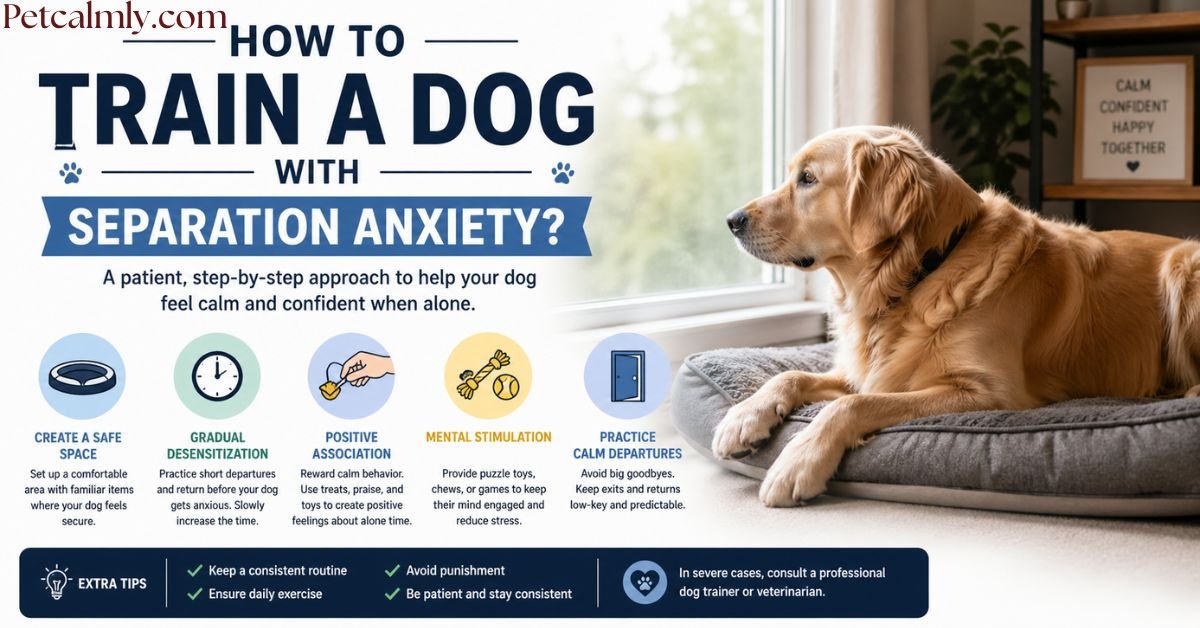
Step-by-Step: How to Crate Train a Dog with Separation Anxiety
This is where most guides fail they give you a general plan and skip the nuance. Here is a slow, realistic plan built for anxious dogs specifically.
Step 1: Introduction Without Pressure (Days 1–3)
Do not push your dog into the crate. Do not even encourage them to go in yet.
Place the crate in a room where your dog spends most of their time. Leave the door open. Let them sniff it, walk past it, ignore it entirely. That is fine.
Drop a few high-value treats near the crate then just inside the entrance. Do not lure them in. Just let the good things appear near the crate. Repeat several times a day.
By day three, most dogs are at least sniffing inside on their own.
Step 2: Create Positive Associations (Days 4–7)
Start feeding meals near the crate. Then place the bowl just inside the entrance. Over a few days, move it further back inside.
The goal here is simple: the crate starts meaning good things. Food. Treats. Sometimes a chew toy or a Kong stuffed with peanut butter.
Do not close the door yet. Not even for a second.
Step 3: First Door Closures Seconds, Not Minutes (Week 2)
Once your dog is comfortable walking in and out of the crate, try this: after they go inside for a treat, gently close the door then immediately open it. Do not latch it. Just touch it closed and swing it back open.
Repeat this many times over several days. Then begin counting: close the door for 3 seconds. Then 5. Then 10. Always calm, always paired with a treat or a Kong.
If your dog shows any sign of stress panting, pawing, whining you have moved too fast. Go back a step.
Step 4: Build Up to Short Absences (Weeks 3–4)
Now the real work begins. This is the phase most owners rush, and it is where anxious dogs get set back.
Start sitting beside the crate with the door closed. Then move slightly away. Then leave the room briefly five seconds and come back calmly. No big reunions. No “good boy!” explosions. Just calm, matter-of-fact re-entry.
Gradually increase your out-of-sight time: 30 seconds, 1 minute, 3 minutes, 5 minutes. This might take a full week to get to 5 minutes without stress. That is completely normal.
Step 5: Practice Real Departures (Week 4 Onward)
Begin practicing your actual leaving routine but in small doses. Pick up your keys. Walk to the door. Come back. Put on your shoes. Sit down again.
These “false departures” help break the pattern of pre-departure anxiety, where dogs start panicking the moment they see you reaching for your coat.
Once your dog can handle 10–15 minutes in the crate without distress, begin extending time slowly: 20 minutes, 30 minutes, 45 minutes, 1 hour.
Never jump from 30 minutes to 4 hours. That is a stress spiral waiting to happen.
Mistakes That Make Separation Anxiety Worse
Even well-meaning owners make these errors. Knowing them saves weeks of setbacks.
Using the crate as punishment.
If the crate is where your dog goes after doing something wrong, they will associate it with stress and fear. The crate should always be a positive place.
Crating for too long, too soon.
Dogs with separation anxiety cannot simply “get used to it” through forced exposure. Flooding them with alone time backfires.
Making departures emotional.
Long, emotional goodbyes (“Mommy loves you, please be good”) actually heighten anxiety. Your sadness signals to your dog that your departure is something to worry about. Keep it calm and brief.
Punishing crate-related behaviors.
If your dog howls in the crate and you yell at them, you have just added another stressor to an already scary situation. Ignore the behavior when safe to do so, or go back a step in training.
Skipping mental and physical exercise.
A dog that is already wound up with excess energy will struggle much more in a crate. A good walk or play session before crating makes a real difference.
When Should You Be Concerned?
Crate training a dog with separation anxiety can be managed at home in many cases. But there are times when professional help is genuinely necessary.
Seek guidance from a vet or certified animal behaviorist if:
- Your dog injures themselves trying to escape the crate (broken teeth, bloody paws)
- Your dog refuses to eat for more than 24 hours during training
- There is no improvement after 4–6 weeks of consistent, patient training
- Your dog shows signs of panic within 30 seconds of being alone, regardless of crate comfort level
- Your dog is also showing aggression or other behavioral changes
In some cases, a veterinarian may recommend anti-anxiety medications alongside behavioral training. This is not a failure it is the same as treating any other anxiety disorder. Medication can lower the baseline panic enough for training to actually take hold.
There are also certified separation anxiety trainers (CSATs) who specialize in exactly this problem and work with you and your dog over video sessions. They are worth looking into if you are stuck.
What Else Helps Alongside Crate Training?
Crate training is powerful, but it works best as part of a wider approach.
Puzzle feeders and Kongs. Giving your dog a stuffed Kong when they go in the crate gives them something to focus on. A frozen Kong can keep them occupied for 20–30 minutes.
Calming music or TV. Leaving low background noise like a classical music station or a TV with calm programming can reduce the sharp contrast of sudden silence when you leave.
Sniff walks before crating. A slow, sniff-focused walk (letting the dog lead and smell everything) is mentally exhausting for dogs in the best way. It can take the edge off anxiety before crating.
Adaptil diffusers or calming collars. These use synthetic dog-appeasing pheromones (DAP) and have shown modest benefits in anxious dogs. Not a magic fix, but a useful support tool.
Consistent routine. Anxious dogs thrive on predictability. Feeding, walking, crating, and returning at similar times each day gives your dog a sense of control over their world.
Conclusion
Crate training a dog with separation anxiety is not a two-week project. For many dogs, it takes 6–12 weeks of consistent, compassionate work. For some, it takes longer.
But the results are worth it. A dog that has learned to feel safe in their crate is a dog that can finally relax when you are not home instead of spending every minute in panic.
The most important things to remember:
- Go slower than you think you need to
- Never use the crate as punishment
- Match your pace to your dog’s comfort, not your timeline
- Get professional help if progress stalls
- Pair everything with positive experiences
Your dog is not trying to make your life difficult. They are scared. With the right approach, the crate becomes the one thing that tells them: you will be okay, and they will come back.
More Information About Pets, Please Visit Our Website: How Long Can a Dog Stay Alone at Home?
Frequently Asked Questions
1: How long does it take to crate train a dog with separation anxiety?
It depends on the severity of your dog’s anxiety. Mild cases may see improvement in 3–4 weeks with consistent training. Severe cases can take 3–6 months or longer. The key is never rushing progress at your dog’s pace, not yours.
2: Should I ignore my dog when they cry in the crate?
It depends on why they are crying. If you have moved too fast in training and they are genuinely panicking, ignoring them can make things worse. Step back to an easier level. If they are doing mild fussing to test the situation, staying calm and not responding is appropriate.
3: Can I crate train an older dog with separation anxiety?
Absolutely. Older dogs can learn new habits it may just take a little more time and patience than with a younger dog. The same steps apply. Be extra attentive to any physical discomfort (like arthritis) that might make the crate uncomfortable.
4: Is it cruel to crate a dog with separation anxiety?
Not when done correctly. A crate introduced with patience and positive association is a safe, calm space not a punishment. The cruelty comes from forcing an unprepared dog into a crate for long periods. Done right, the crate reduces stress rather than causing it.
5: What can I put in the crate to help my anxious dog?
A soft blanket or dog bed, a worn item of your clothing (your scent is comforting), a stuffed Kong or chew toy, and optionally a Snuggle Puppy or heartbeat toy for dogs that like company. Keep the space cozy but not cluttered.
6: Should I use medication for a dog with severe separation anxiety?
If your dog’s anxiety is severe and training alone is not making progress, talk to your vet. Medications like fluoxetine or trazodone are sometimes prescribed alongside behavioral therapy. They are not a permanent fix, but they can reduce panic enough for training to work. There is no shame in using every tool available to help your dog feel better.