Short direct answer
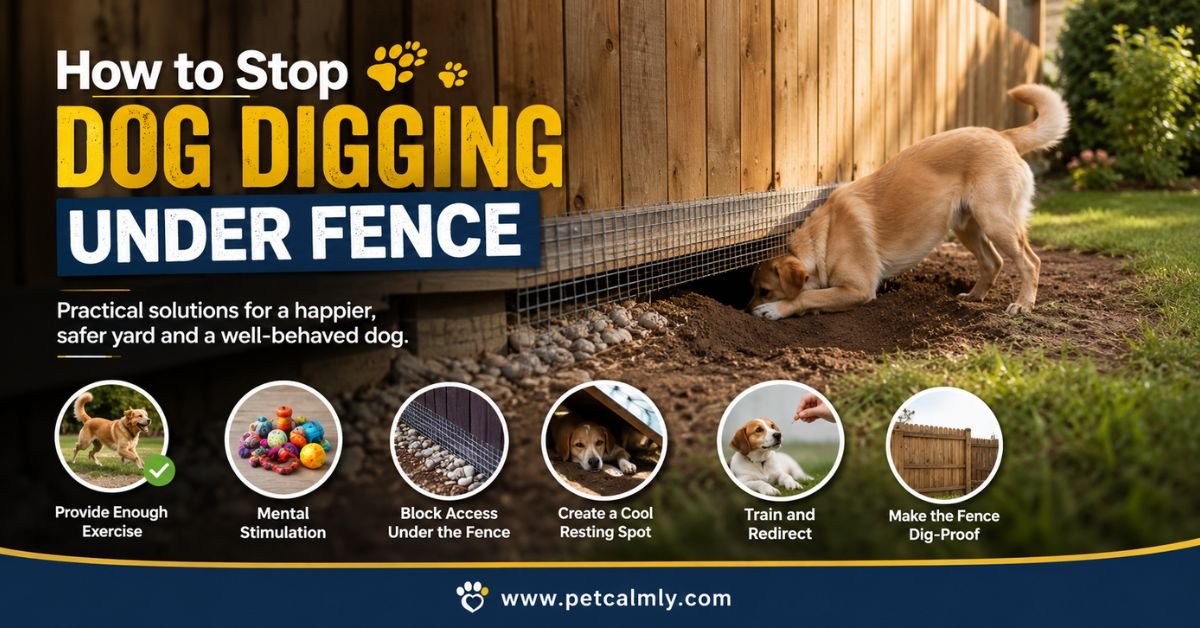
To stop a dog from digging under the fence, you need to address the reason behind the digging not just the hole itself. The fastest fix is usually a combination of a physical barrier (buried L-footers, pavers, or rocks along the fence line) and removing the motivation, whether that’s boredom, escape-seeking, prey drive, or separation anxiety. Blocking access alone often just moves the digging a few feet over, so pair barriers with more exercise, mental stimulation, and if needed supervised yard time until the habit fades.
Why Is My Dog Digging Under the Fence in the First Place?
Before you buy a single bag of gravel, it helps to sit with this question for a minute: what is your dog actually trying to accomplish?
Digging under a fence isn’t random. It’s almost always goal-directed behavior, even if the goal seems silly to us. A dog pawing at the base of a fence post at 6 a.m. isn’t being “bad” they’re solving a problem in the only way they know how.
Here are the most common drivers, and how to tell them apart.
Boredom and Excess Energy
This is the big one, especially for working breeds, herding dogs, and terriers bred to dig for a living. If your dog is under-exercised or spends long stretches alone in the yard with nothing to do, digging becomes the entertainment. You’ll usually notice it happens most during the hours you’re away, and the holes tend to be scattered rather than concentrated near a specific spot.
Escape Motivation
Some dogs dig under the fence because they want to get somewhere not away from anything in particular. This is common with intact males who can smell a female in heat, dogs chasing squirrels or cats on the other side, or social dogs who see people or dogs walking by and want to join in. These digs tend to be focused at one weak point in the fence line, often facing the street or a neighbor’s yard.
Separation Anxiety or Fear
If the digging happens specifically when you leave, and it’s paired with other signs pacing, whining, destroyed door frames, escape attempts at gates this isn’t about the fence at all. It’s an anxiety response. In these cases, physical barriers matter less than addressing the underlying distress, and this is one of the situations where a conversation with your vet or a certified dog behaviorist is genuinely worth having.
Prey Drive or Curiosity
Moles, voles, and burrowing insects under your lawn are basically a dinner bell for a dog with a strong nose and a hunting instinct. If the digging follows a wandering trail rather than a straight line toward the fence, and you notice your dog sniffing intently before they start, wildlife is likely the trigger not the fence itself.
Temperature Regulation
On hot days, dogs sometimes dig shallow pits to reach cooler soil and lie in them. This kind of digging is usually shallow, wide, and located in shaded or damp areas not urgently focused on the fence line but it can still create a weak point that turns into an escape route over time.
The Fastest Way to Stop the Digging: A Two-Part Approach
Trying to solve fence-digging with just a training fix, or just a physical barrier, tends to fall short. Dogs are persistent, and a determined digger will often just try a new spot if the motivation is still there. The combination that actually works long-term looks like this:
- Block the current dig site and reinforce weak points so the behavior can’t succeed right now.
- Address the root cause so your dog stops wanting to dig there in the first place.
Skipping either half tends to mean you’re back outside with a shovel in a few weeks.
Physical Barriers That Actually Hold Up
Bury an L-Footer Along the Fence Line
An L-footer is exactly what it sounds like: chicken wire, hardware cloth, or welded wire mesh bent into an L-shape, buried so the vertical part runs along the base of the fence and the horizontal part extends outward (or inward) underground. When a dog tries to dig, they hit wire mesh a few inches down instead of open dirt, and most dogs give up fairly quickly once digging stops being productive.
This is one of the more labor-intensive fixes, but it’s also one of the most reliable, especially for persistent diggers.
Lay Pavers, Rocks, or Concrete Along the Base
For shorter fence runs or specific trouble spots, a row of large pavers, flat stones, or a poured concrete curb along the base of the fence can be enough. The key is making sure there are no gaps a paw can get purchase in dogs are surprisingly good at finding the one loose edge.
Use Chicken Wire Anchored at the Base
If burying an L-footer feels like too big a project, securing a strip of chicken wire flat along the ground at the base of the fence (weighted down with landscape staples or rocks) can work as a lower-effort version of the same idea.
Install a Dig-Proof Fence Extension or Concrete Footer
For homes with chronic diggers, some owners invest in a poured concrete footer along the entire fence perimeter. It’s the most expensive option, but it’s also close to permanent, and it’s worth considering if you’ve already tried lighter fixes and keep finding new holes.
Comparing Barrier Options
| Barrier Type | Best For | Effort Level | Approximate Longevity |
|---|---|---|---|
| Buried L-footer (wire mesh) | Persistent, strong diggers | High | Long-term |
| Pavers or flat rocks | Small yards, specific weak spots | Medium | Long-term |
| Chicken wire at base | Mild diggers, quick fix | Low–Medium | Medium-term |
| Concrete footer | Chronic escape artists | Very High | Permanent |
| Rock or gravel border | General deterrent | Low | Medium-term |
Training Approaches That Reduce the Urge to Dig
Barriers stop the behavior in the moment. Training and enrichment change whether your dog wants to dig at all.
Give Your Dog a Legal Place to Dig
This sounds counterintuitive, but it’s one of the most effective tools for breeds with a strong digging drive, like terriers and dachshunds. Set up a designated digging pit a sandbox or a loose-soil corner of the yard and bury toys or treats there to encourage use. When you catch your dog digging in the “right” spot, praise generously. Redirecting a natural instinct tends to work better than trying to suppress it entirely.
Increase Physical Exercise Before Alone Time
A dog who’s genuinely tired is far less likely to dedicate energy to escape projects. If your dog is left in the yard while you’re at work, a solid walk, run, or play session beforehand makes a noticeable difference for boredom-driven diggers specifically.
Add Mental Enrichment, Not Just Physical Exercise
Physical tiredness fades fast; mental tiredness lasts longer. Puzzle feeders, snuffle mats, frozen KONGs, and scent-work games give your dog a job to do that isn’t digging. For food-motivated dogs, this is often the missing piece.
Supervise and Interrupt Early
If you can catch the digging in progress, a calm redirect calling your dog over, tossing a toy elsewhere, or leading them to the designated dig zone teaches the behavior without punishment. Yelling or scolding after the fact usually just teaches your dog to dig when you’re not watching, which makes the problem harder to catch, not easier.
Address Anxiety Directly, Not Just the Symptom
If the digging is tied to separation anxiety, barriers and exercise will only get you so far. This is a case where working with your veterinarian or a certified behaviorist on a desensitization plan matters more than fence repairs.
Real-Life Examples: What Fence-Digging Actually Looks Like
It helps to see how these categories play out in ordinary backyards, because the “why” is rarely obvious just from looking at a hole.
The Bored Herder. A three-year-old Australian Shepherd left alone in the yard for eight-hour workdays develops a habit of digging a new hole every afternoon, usually in a different spot each time. There’s no pattern pointing toward the street or a neighbor’s yard it’s scattered, restless energy with nowhere to go. Adding a 30-minute run before work and a frozen puzzle toy during the day cuts the digging by more than half within two weeks.
The Determined Escape Artist. An intact male Beagle mix digs at the exact same corner of the fence, week after week, no matter how many times the hole gets filled. The corner happens to face a yard with a female dog in heat. Neutering, combined with a buried L-footer at that one corner, resolves it but the barrier alone, without addressing the underlying motivation, likely would have just shifted the digging a few feet down the fence line.
The Anxious One. A rescued Labrador retriever digs specifically at the gate, and only when left alone never when someone’s home, even if they’re just in another room. The digging is paired with drooling on the crate door and scratched paint near the front entry. This isn’t a fence problem at all; it’s separation anxiety, and the family’s vet recommends a gradual desensitization plan alongside management changes, which is where the real progress happens.
The Heat-Seeker. An elderly Golden Retriever starts digging shallow, wide pits under a shaded tree near the fence line every summer afternoon. The holes aren’t an escape attempt they’re a cooling strategy. Adding a raised cot bed in the shade and access to fresh water outdoors solves it without needing a barrier at all.
These examples aren’t meant to diagnose your dog for you, but they’re a useful reminder that the same visible behavior a hole under the fence can come from very different places.
Mistakes That Make Fence-Digging Worse
- Only filling in the hole. Without addressing the motivation, most dogs simply redig the same spot or move a few feet over.
- Punishing after the fact. Dogs don’t reliably connect delayed punishment to the digging itself; it mostly just adds stress.
- Leaving dogs unsupervised for long stretches in a yard with known weak points.
- Assuming all digging is “bad behavior.” Some digging is instinct, some is anxiety, and some is just heat-seeking — the fix is different for each.
- Using barriers alone without addressing boredom or anxiety, which often leads to digging elsewhere in the yard or new escape attempts at gates.
When Should You Worry?
Most fence-digging is a training and management issue, not a medical one. But there are situations where it’s worth pausing and getting professional input rather than just reinforcing the fence line:
- Digging paired with pacing, drooling, or panic when you leave the house (possible separation anxiety)
- Sudden, obsessive, or repetitive digging that wasn’t there before, especially in older dogs (can sometimes be linked to cognitive or medical changes and is worth a vet visit)
- Paw injuries, broken nails, or bleeding from digging
- A dog who successfully escapes and roams near traffic, which is a safety issue that needs addressing immediately, not gradually
If any of these apply, a conversation with your veterinarian is a reasonable next step — they can help rule out underlying anxiety, discomfort, or cognitive changes before you invest more time in physical fixes.
What Should Pet Owners Do Right Now?
If you’re standing in your yard staring at a fresh hole, here’s a reasonable order of operations:
- Identify which category the digging falls into (boredom, escape motivation, anxiety, prey drive, or heat-seeking).
- Block the current hole with a barrier appropriate to your yard and budget.
- Increase exercise and enrichment for a week and watch whether the behavior shifts.
- Set up a designated dig zone if your dog is a natural-born digger.
- If anxiety or a sudden behavior change seems to be the driver, loop in your vet or a certified behaviorist rather than relying on barriers alone.
Does the Type of Fence Matter?
The fence material itself doesn’t cause digging, but it does influence how effective a given barrier will be — and it’s worth thinking about before you start burying wire mesh.
Wood privacy fences tend to have gaps at ground level where boards meet uneven soil, which is often where digging starts. These gaps are usually the easiest to fix with pavers or a buried footer, since you’re working with a relatively straight, defined edge.
Chain-link fences are notorious for digging because dogs can see through them, which means they’re constantly reminded of whatever’s on the other side another dog, a person walking by, wildlife. For chain-link, pairing a physical barrier with a visual block (privacy slats or a strip of landscaping) can reduce the motivation to dig, not just the ability.
Vinyl and composite fences usually sit flush to the ground, but settling over time can create small gaps that a determined dog will widen. These are worth checking seasonally, especially after heavy rain softens the soil.
Invisible or electronic fences don’t involve digging under anything, but they’re worth a mention here because owners sometimes install a physical fence afterward and are surprised when the dog still tries to escape at ground level. An electronic fence trains avoidance of a boundary line, not necessarily comfort with confinement the underlying motivation (boredom, prey drive, escape-seeking) still needs to be addressed the same way.
How Long Does It Usually Take to Stop the Digging?
This varies a lot depending on the root cause, but a reasonable expectation is somewhere between one and four weeks of consistent effort. Boredom-driven digging tends to respond fastest, sometimes within days of adding more exercise and enrichment. Escape-motivated digging tied to a specific trigger (a female in heat, an unaltered dog next door) can resolve quickly once that trigger is removed. Anxiety-driven digging is typically the slowest to change, since it often requires a structured desensitization plan rather than a quick behavioral swap and in more persistent cases, working with your veterinarian on additional support is reasonable rather than a sign that you’ve done something wrong.
Patience matters here. A habit that’s been reinforced for months won’t reliably disappear in a weekend, even with the right barrier in place.
A Quick Checklist Before You Start
- Walked the fence line to find all weak points, not just the obvious hole
- Chosen a barrier method that fits your yard size and budget
- Ruled out (or confirmed) separation anxiety as a factor
- Increased daily exercise, even by 15–20 minutes
- Added at least one enrichment activity (puzzle feeder, snuffle mat, frozen treat)
- Set up a legal digging spot if your dog is a breed with strong digging instincts
- Planned to supervise outdoor time until the habit clearly fades
Conclusion
A dog digging under the fence isn’t stubbornness it’s communication. Somewhere between boredom, instinct, anxiety, or a squirrel that got away, your dog found a solution that works for them, even if it’s not one you love. The good news is that most fence-digging responds well to a combination of a solid physical barrier and a little detective work into what’s actually driving the behavior. Fix the hole, but don’t stop there figure out the “why,” and the digging usually takes care of itself within a few weeks.
More Information About Pets, Please Visit Our Website: Why Do Dogs Get the Zoomies After They Poop?
Does My Dog Know I Love Him?
How to Stop Dog Separation Anxiety Barking
When One Dog Dies Does the Other Grieve?
Why Does My Dog Bark at Strangers on Walks?
How Long Do Dogs Stay Stuck Together After Mating
How Long to Train a Dog to Be Alone? Real Timeline (2026)
How Long Will My Dog Act Weird After Grooming?
How to Stop Dog From Pulling On Leash When Walking
10 Reasons Why Dogs Follow You to the Bathroom (2026)
Frequently Asked Questions
1: Why does my dog only dig under the fence when I’m not home?
This pattern usually points to boredom or separation-related distress rather than curiosity. Dogs who dig mainly during alone time are often trying to reach you, escape isolation, or simply fill unstructured hours with an activity. Watch for other signs of distress at departure, like pacing or vocalizing, which would suggest anxiety rather than boredom.
2: What can I put along the fence line to stop digging without spending a lot of money?
A row of large rocks, pavers, or even heavy patio stones along the base of the fence is one of the more budget-friendly options. It won’t be as permanent as a buried L-footer, but it works well as a first line of defense while you work on the underlying behavior.
3: Will my dog stop digging on their own as they get older?
Some dogs do mellow out with age, but relying on that alone isn’t a reliable strategy, especially for breeds with strong digging instincts. Addressing exercise, enrichment, and any anxiety now tends to produce faster, more consistent results than waiting.
4: Is it true that some dog breeds are just more likely to dig?
Yes. Terriers, dachshunds, and other breeds developed for burrow-hunting or vermin control tend to have digging built into their instincts. This doesn’t mean the behavior can’t be managed, but it does mean a designated digging area often works better than trying to eliminate the instinct entirely.
5: Can citrus or vinegar around the fence line actually deter digging?
Some owners report short-term success with scent deterrents like citrus peels or diluted vinegar, since many dogs dislike the smell. That said, results are inconsistent, and a determined or highly motivated dog will often dig around a scent deterrent rather than being stopped by it. It’s reasonable as a supplement, not a primary fix.
6: Should I use an anti-dig spray or product sold for this purpose?
Commercial anti-dig deterrent products exist and can help as part of a broader plan, but they tend to work best combined with a physical barrier and addressing the root motivation, rather than as a standalone solution.