Short direct answer
If you’re wondering how to give eye drops to a cat, the safest approach is to stay calm, prepare everything before you begin, gently hold your cat in a secure position, and place the prescribed drops into the eye without touching the eye with the bottle tip. Reward your cat immediately afterward with treats, praise, or playtime. Patience is more effective than force, and creating a positive experience can make future treatments much easier.
Introduction
Giving eye drops to a cat sounds simple until you’re faced with a nervous pet who suddenly becomes an escape artist. Many cat owners worry about hurting their cat, missing the eye, or making an already stressful situation worse.
The good news is that most cats can learn to tolerate eye medication when it’s given gently and consistently. The key isn’t wrestling your cat into submission it’s reducing fear, staying organized, and using the right handling techniques.
Whether your cat has an eye infection, allergies, a scratched cornea, dry eye, or is recovering from surgery, this guide will walk you through every step. You’ll also learn common mistakes to avoid, how to handle reluctant cats, and when it’s time to contact your veterinarian if treatment isn’t going as planned.
Why Cats Need Eye Drops
Eye drops are commonly prescribed to treat conditions affecting the surface of the eye. Depending on the diagnosis, your veterinarian may prescribe medication to fight infection, reduce inflammation, relieve dryness, or support healing after an injury.
Some of the most common reasons include:
- Bacterial eye infections
- Viral eye infections
- Conjunctivitis (pink eye)
- Corneal ulcers or scratches
- Dry eye syndrome
- Allergies affecting the eyes
- Glaucoma medications
- Post-surgical care
Each medication works differently, so always use the drops exactly as prescribed. Never use leftover eye drops from another pet or person, as different eye conditions require different treatments.
What You’ll Need Before Giving Eye Drops to Your Cat
Preparing everything in advance makes the process smoother and helps reduce stress for both you and your cat.
Before you begin, gather:
- The prescribed eye drops
- Clean tissues or soft cotton pads
- A clean towel or blanket
- Cat treats or a favorite reward
- Good lighting
- A quiet room without distractions
- Another person to help if needed
Having everything within reach means you won’t have to leave your cat midway through the process.
Check the Medication First
Before opening the bottle:
- Confirm you’re using the correct medication.
- Check the expiration date.
- Read the label carefully.
- Follow any storage instructions.
- Shake the bottle if instructed.
Some eye medications need refrigeration, while others should remain at room temperature. Always follow the directions provided by your veterinarian or pharmacist.
How to Prepare Your Cat Before Giving Eye Drops
Preparation often determines whether the experience goes smoothly or turns into a struggle.
Instead of surprising your cat, spend a few minutes helping them relax.
You can do this by:
- Speaking softly.
- Petting areas your cat enjoys.
- Offering a few treats beforehand.
- Choosing a familiar room.
- Avoiding loud noises.
- Staying calm yourself.
Cats are incredibly sensitive to human emotions. If you’re anxious or frustrated, your cat is more likely to become nervous too.
Choose the Right Time
Avoid giving medication when your cat is:
- Sleeping deeply
- Playing intensely
- Eating
- Watching birds through the window
- Already frightened
Many owners find success after a quiet nap or during a naturally calm part of the day.
Consistency also helps. Giving medication around the same time every day can create a predictable routine.
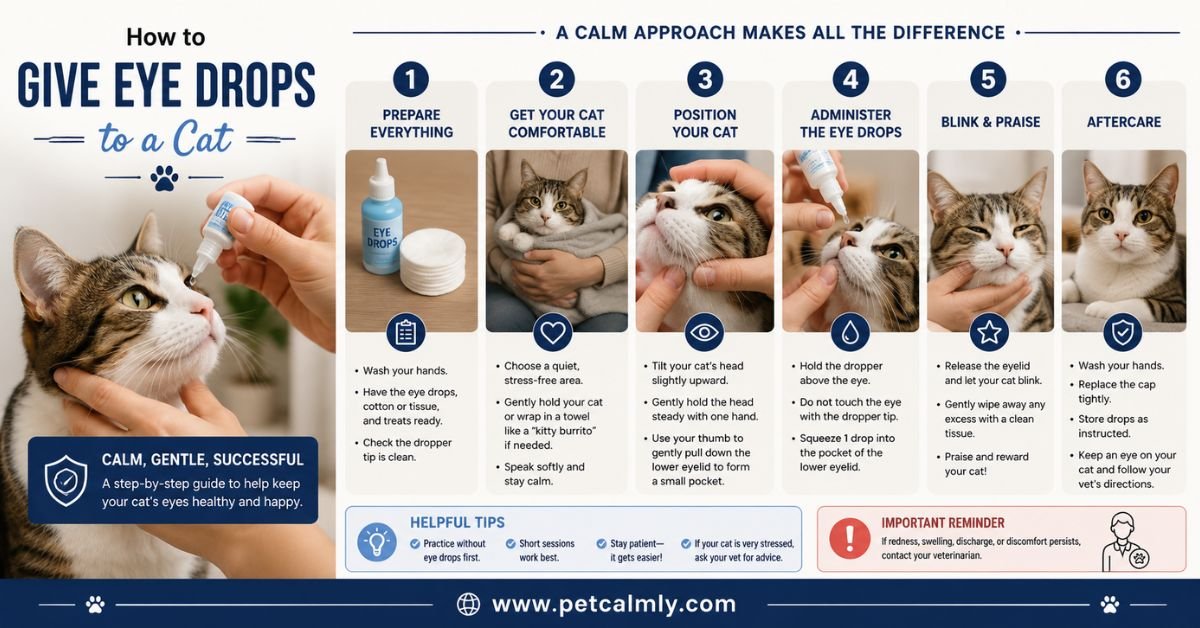
How to Give Eye Drops to a Cat Step by Step
This is the method recommended by many veterinary professionals because it minimizes stress while helping ensure the medication reaches the eye.
Step 1: Wash Your Hands
Clean hands help reduce the risk of introducing bacteria into your cat’s eye.
Dry your hands thoroughly before handling the medication.
Step 2: Position Your Cat Comfortably
Some cats prefer sitting on a table, while others feel safer on your lap.
For calm cats:
- Sit your cat facing away from you.
- Gently hold their shoulders.
- Support their chest if needed.
For wiggly cats:
Wrap your cat loosely in a towel, leaving only the head exposed. Many owners call this a “kitty burrito.”
The towel isn’t meant to restrain harshly it simply prevents sudden scratching and helps your cat feel more secure.
Step 3: Hold the Head Gently
Place one hand under your cat’s chin.
Tilt the head slightly upward.
Avoid bending the neck too far back, as this may make your cat uncomfortable.
Your goal is simply to help the eye face upward.
Step 4: Open the Eye Carefully
Using your thumb or finger, gently lower the lower eyelid.
This creates a small pocket where the medication can be placed.
Avoid pulling too hard.
The movement should be gentle and controlled.
Step 5: Hold the Bottle Correctly
Hold the bottle above the eye.
Keep the tip several millimeters away.
Never let the bottle touch:
- The eye
- Eyelashes
- Fur
- Skin
Touching the eye can contaminate the medication and may also injure the delicate surface of the eye.
Step 6: Apply the Eye Drop
Squeeze the prescribed number of drops into the eye.
One drop is usually enough because the eye can only hold a limited amount of liquid.
Adding extra drops generally doesn’t improve treatment it mostly causes medication to overflow.
Always follow your veterinarian’s instructions regarding dosage.
Step 7: Allow Your Cat to Blink
Once the drop lands, release your cat’s eyelid.
Natural blinking spreads the medication across the eye.
There’s no need to massage the eye unless your veterinarian specifically instructs you to do so.
Step 8: Reward Your Cat Immediately
Positive reinforcement can make future treatments much easier.
Offer:
- A favorite treat
- Gentle praise
- Chin scratches
- A short play session
- A favorite toy
Over time, your cat may begin associating eye drops with something enjoyable instead of something scary.
Best Positions for Giving Eye Drops to a Cat
Every cat is different. Trying a few positions can help you discover which one causes the least stress.
| Position | Best For | Advantages |
|---|---|---|
| Sitting on your lap | Calm cats | Familiar and comforting |
| On a sturdy table | Medium-sized cats | Better visibility |
| Wrapped in a towel | Nervous cats | Reduces scratching and sudden movement |
| Between your knees | Cooperative cats | Keeps hands free for medication |
| With a helper | Very resistant cats | Better control with less force |
Avoid holding your cat upside down or pinning them forcefully. Gentle handling is safer and usually more effective.
How to Keep Your Cat Calm During Eye Drop Treatment
Helping your cat stay relaxed isn’t just about making the process easier it can also improve how well the medication is delivered. A calm cat is less likely to blink excessively, twist away, or accidentally contaminate the dropper.
Here are some simple ways to reduce stress:
Create a Familiar Routine
Cats thrive on routine. Administer the eye drops at roughly the same time each day so your cat begins to expect the process.
Keep Sessions Short
Prepare everything in advance so the treatment only takes a minute or two. Long periods of restraint can increase anxiety.
Use Positive Reinforcement
Reward your cat every single time, even if the session wasn’t perfect. Treats, gentle praise, or a favorite toy can gradually change your cat’s emotional response.
Stay Calm Yourself
If you become frustrated, pause for a few moments before trying again. Cats often react to changes in your voice and body language.
Common Mistakes to Avoid When Giving Eye Drops
Even experienced cat owners can make small mistakes that affect treatment. Avoiding these common problems can make the process safer and more effective.
1: Touching the Eye with the Bottle Tip
This is one of the most common mistakes. It can contaminate the medication and may scratch the surface of the eye.
Always keep the bottle tip just above the eye without making contact.
2: Using Too Many Drops
More is not better. Most feline eyes can only hold one drop at a time, so excess medication usually runs down the face instead of improving treatment.
3: Skipping Doses
Missing doses can slow recovery, especially if your cat is being treated for an infection. If you accidentally miss a dose, follow your veterinarian’s instructions rather than doubling the next one.
4: Forcing Your Cat Too Aggressively
Trying to overpower a frightened cat often leads to scratching, biting, and increased fear during future treatments.
Gentle restraint, patience, and rewards are far more effective over time.
5: Stopping Medication Too Early
Your cat’s eye may look better before the infection or inflammation has fully resolved. Continue treatment for the full prescribed course unless your veterinarian advises otherwise.
Signs You’re Giving the Eye Drops Correctly
Many owners worry that they’ve missed the eye or wasted the medication. In most cases, you’re doing it correctly if:
- The drop lands on the eye or inside the lower eyelid pocket.
- Your cat blinks naturally after the drop.
- Only a small amount of medication runs down the face.
- The bottle tip never touches the eye.
- Your cat remains relatively calm throughout the process.
Don’t worry if your technique isn’t perfect the first few times. With practice, both you and your cat will become more comfortable
What If Your Cat Refuses Eye Drops?
Not every cat sits quietly for medication. Some hide as soon as they hear the medicine bottle, while others squirm, scratch, or run away. This doesn’t mean your cat is being stubborn. Cats naturally protect their eyes, and unfamiliar handling can feel threatening.
The goal isn’t to force your cat into submission. Instead, focus on making each treatment as calm, quick, and predictable as possible.
If your cat refuses eye drops, try these strategies:
- Stay patient and avoid raising your voice.
- Choose a quiet room with fewer distractions.
- Keep treatment sessions under two minutes.
- Reward every successful attempt, even if it wasn’t perfect.
- Give your cat a short break if they become highly stressed.
Remember that consistency often matters more than perfection. Many cats become noticeably easier to medicate after several days of gentle, positive handling.
How to Give Eye Drops to a Cat by Yourself
Many pet owners don’t have someone available to help, but it’s still possible to give eye drops safely on your own.
Follow these steps:
Prepare Everything First
Place the medication, tissues, towel, and treats within easy reach.
Avoid searching for supplies while trying to hold your cat.
Choose a Stable Surface
A sturdy table, countertop, or your lap can work well.
If using a table, place a non-slip towel underneath your cat so they feel more secure.
Secure the Body
Keep your cat facing away from you.
Use your forearm to gently support their body while your free hand positions the head.
Avoid squeezing your cat tightly. Gentle control is usually enough.
Work Efficiently
Once your cat is positioned:
- Tilt the head slightly upward.
- Pull down the lower eyelid.
- Apply the prescribed drop.
- Let your cat blink.
- Reward immediately.
The faster and calmer you complete these steps, the easier future treatments are likely to become.
When Is It Helpful to Have Another Person Assist?
Some cats simply feel safer when one person focuses on comforting them while the other administers the medication.
A helper can:
- Gently support your cat’s body.
- Keep the head steady.
- Offer reassurance.
- Prevent sudden twisting.
- Reduce the chance of dropping the medication.
Your helper should avoid gripping the cat tightly. Calm restraint is much more effective than force.
How to Use the Towel Wrap Safely
The towel technique is one of the most useful tools for nervous cats.
It isn’t meant to trap your cat it simply limits sudden movements while helping them feel contained.
Step-by-Step Towel Wrap
- Spread a soft towel flat.
- Place your cat in the center.
- Fold one side snugly across the body.
- Fold the other side over.
- Leave only the head exposed.
The wrap should feel secure but never tight enough to interfere with breathing.
If your cat begins panting or struggling intensely, stop and allow them to calm down before trying again.
Should You Warm the Eye Drops First?
Some refrigerated eye medications can feel surprisingly cold.
If your veterinarian says it’s safe, you can usually hold the bottle in your hand for a minute or two before use.
Never:
- Microwave the medication.
- Place it in hot water.
- Leave it in direct sunlight.
Always follow the storage instructions provided with the prescription.
What If Your Cat Closes Their Eye?
This is one of the most common challenges.
Instead of trying to pry the eye open forcefully:
- Wait until your cat relaxes slightly.
- Gently stroke the head.
- Support the chin.
- Try again with slow movements.
Many cats briefly close their eyes but reopen them after a few seconds.
Patience usually works better than rushing.
What If the Eye Drop Misses?
Don’t panic.
Even experienced veterinary professionals occasionally miss on the first attempt.
If the drop lands:
- On the fur
- On the nose
- On the cheek
Simply try again if your cat will tolerate it.
If your cat becomes highly stressed, it may be better to pause briefly before another attempt rather than creating a frightening experience.
Can You Give Eye Drops While Your Cat Is Sleeping?
It’s generally not recommended.
Although it may seem easier, suddenly waking your cat by touching their eye can cause them to startle and jerk their head unexpectedly.
This increases the risk of:
- Missing the eye
- Touching the eye with the bottle
- Damaging trust between you and your cat
It’s usually better to wait until your cat is awake but relaxed.
Should You Clean the Eye Before Applying Drops?
Sometimes, yes.
If your cat has dried discharge around the eye:
- Moisten a clean cotton pad or soft gauze with sterile saline or warm water, if advised by your veterinarian.
- Wipe gently from the inner corner outward.
- Use a fresh pad for each eye if both eyes are affected.
Never scrub the eye.
Removing crusts gently allows the medication to reach the eye more effectively.
Can You Use Human Eye Drops on Cats?
No—not unless your veterinarian specifically tells you to.
Many human eye drops contain ingredients that:
- Aren’t appropriate for cats.
- Can interfere with veterinary treatment.
- May worsen certain eye conditions.
Even lubricating drops should only be used under veterinary guidance because not every eye problem requires the same treatment.
Using the wrong medication can delay healing or make an eye condition more serious.
How Long Will My Cat Need Eye Drops?
Treatment depends on the underlying condition.
Some mild problems improve within a few days, while others require several weeks of medication.
Examples include:
| Condition | Typical Treatment Length* |
|---|---|
| Mild bacterial infection | 5–10 days |
| Viral eye disease | Often several weeks |
| Corneal ulcer | Depends on healing progress |
| Dry eye syndrome | Sometimes long-term |
| Glaucoma | Often lifelong management |
*Always follow your veterinarian’s treatment plan, even if the eye appears normal before the medication is finished.
How to Tell If the Medication Is Working
Improvement often happens gradually.
Positive signs include:
- Less redness
- Reduced squinting
- Fewer tears
- Less discharge
- Increased comfort
- More normal blinking
- Improved activity level
Some conditions improve within a few days, while others require follow-up examinations before medication can be adjusted.
Signs the Eye Problem May Be Getting Worse
Don’t wait for your next scheduled dose if you notice worsening symptoms.
Contact your veterinarian promptly if your cat develops:
- Thick yellow or green discharge
- Increasing redness
- Severe swelling
- Cloudiness over the eye
- Continuous squinting
- Persistent pawing at the eye
- Bleeding
- A suddenly enlarged eye
- Vision changes
- Obvious pain
- Loss of appetite along with eye symptoms
Eye conditions can progress quickly, and early treatment often leads to better outcomes.
How to Make Future Treatments Easier
Many cats become more cooperative when medication is paired with positive experiences.
Try building a simple routine:
Before Treatment
- Speak calmly.
- Let your cat sniff the towel.
- Offer a small treat.
During Treatment
- Keep movements slow.
- Finish as quickly as possible.
- Avoid repeated failed attempts.
After Treatment
Always reward your cat immediately.
Good rewards include:
- Freeze-dried meat treats
- A favorite canned food
- Gentle brushing
- Play with a feather wand
- Extra affection if your cat enjoys cuddles
Over time, your cat may begin anticipating the reward instead of fearing the medication.
Eye Drop Safety Checklist
Use this checklist before every treatment session.
✔ Wash your hands.
✔ Confirm the correct medication.
✔ Check the dosing instructions.
✔ Remove any discharge if advised.
✔ Keep the bottle tip clean.
✔ Don’t touch the eye with the bottle.
✔ Apply only the prescribed number of drops.
✔ Reward your cat afterward.
✔ Store the medication correctly.
✔ Record doses if multiple medications are being used.
This simple routine helps reduce mistakes and keeps treatment consistent.
When Should You Contact Your Veterinarian?
While many eye conditions respond well to medication, some require immediate professional care.
Arrange a veterinary examination if:
- Your cat won’t open the eye.
- The eye becomes cloudy.
- You suspect an injury.
- The eye appears bulging.
- Symptoms worsen after starting medication.
- Your cat seems to lose vision.
- Your cat repeatedly rubs the eye despite treatment.
- The medication causes a severe reaction.
- You accidentally contaminate the bottle and are unsure whether it is still safe to use.
- There is no noticeable improvement within the timeframe your veterinarian expected.
Because the eyes are delicate organs, delaying treatment can sometimes lead to permanent damage. If you’re ever unsure whether a symptom is serious, it’s safest to ask your veterinary clinic for guidance.
Practical Tips for Multi-Cat Households
If you have more than one cat, treatment can become a little more complicated.
To stay organized:
- Wash your hands between treating different cats if instructed.
- Never share prescription eye medications unless your veterinarian specifically prescribes them for each cat.
- Label medications clearly if multiple pets are receiving treatment.
- Keep treated cats separated briefly if another pet tends to groom around their face immediately afterward.
- Record each dose on a calendar or phone reminder to avoid missed or duplicate treatments.
Real-Life Situations: Solving Common Eye Drop Challenges
Even when you know the correct technique, every cat has a unique personality. Here are some common situations cat owners face and practical ways to handle them.
Scenario 1: “My Cat Runs Away When I Pick Up the Eye Drops”
Many cats quickly learn to associate the medication bottle with an unpleasant experience.
Instead of chasing your cat:
- Keep the medicine out of sight until everything is ready.
- Call your cat using your normal voice.
- Offer a treat before handling.
- Practice gentle handling sessions on days when no medication is needed.
This helps break the negative association and builds trust over time.
Scenario 2: “My Cat Keeps Blinking Before the Drop Goes In”
Blinking is a normal protective reflex.
Rather than trying to rush:
- Hold the bottle steady above the eye.
- Wait for a brief moment when the eyelids relax.
- Place the drop into the lower eyelid pocket instead of aiming directly at the center of the eye.
A drop placed inside the lower eyelid will spread across the eye naturally when your cat blinks.
Scenario 3: “My Cat Shakes Their Head Right After the Drop”
This is completely normal.
Many cats shake their head because the medication feels unusual.
As long as the drop reached the eye first, enough medication usually remains to be effective.
There’s no need to give another dose unless your veterinarian specifically advises you to do so.
Scenario 4: “My Cat Hides After Every Treatment”
Some cats need a few minutes alone after medication.
Allow your cat to retreat if they choose, but continue offering positive experiences afterward.
Over time, many cats become more accepting once they realize the routine always ends with something enjoyable.
Troubleshooting Guide
The table below can help you quickly identify common problems and practical solutions.
| Problem | Possible Cause | What You Can Do |
|---|---|---|
| Cat keeps moving | Fear or discomfort | Use a towel wrap and stay calm. |
| Eye drops miss the eye | Incorrect angle | Aim for the lower eyelid pocket. |
| Medication runs down the face | Head tilted too low | Lift the chin slightly before applying the drop. |
| Cat scratches during treatment | Feeling insecure | Wrap loosely in a towel or ask someone to help. |
| Cat refuses future treatments | Negative experiences | Use treats and gentle practice sessions between medications. |
| Eye isn’t improving | Wrong diagnosis, missed doses, or severe condition | Contact your veterinarian for a recheck. |
Can You Use Treats to Make Eye Drops Easier?
Absolutely.
Positive reinforcement is one of the most effective ways to reduce stress during medical care.
Many cats begin accepting eye drops more willingly when every treatment ends with something they love.
Good rewards include:
- Small pieces of cooked chicken (plain, unseasoned)
- Veterinary-approved cat treats
- Freeze-dried meat treats
- Wet food
- Playtime with a favorite toy
- Gentle brushing for cats that enjoy grooming
Try to give the reward immediately after the medication so your cat forms a positive association.
Tips for Kittens
Giving eye drops to kittens requires extra care because they are smaller, more active, and easily frightened.
Keep these tips in mind:
- Handle kittens gently from an early age.
- Support the entire body.
- Use only medications prescribed specifically for the kitten.
- Never guess the dosage.
- Keep treatment sessions very short.
- Reward calm behavior with praise or kitten-safe treats if age-appropriate.
Early positive experiences with handling can make future veterinary care much easier.
Tips for Senior Cats
Older cats may have arthritis, reduced vision, or hearing loss, making medication more challenging.
Help senior cats by:
- Lifting them carefully.
- Avoiding awkward positions.
- Working on a comfortable surface.
- Allowing extra time.
- Watching for signs of pain when moving the neck or shoulders.
If arthritis makes restraint difficult, ask your veterinarian whether alternative handling techniques are recommended.
Giving More Than One Eye Medication
Some cats need more than one eye drop or a combination of drops and eye ointment.
In these cases:
- Follow your veterinarian’s instructions carefully.
- Wait the recommended amount of time between different medications (often several minutes) so the first medication has time to be absorbed.
- If both drops and ointment are prescribed, ointment is commonly applied after eye drops unless your veterinarian instructs otherwise.
Never mix medications in the same bottle or change the treatment order without veterinary advice.
How to Store Cat Eye Drops Correctly
Proper storage helps keep the medication effective.
Always:
- Read the storage instructions.
- Keep the cap tightly closed.
- Store away from direct sunlight.
- Keep out of children’s reach.
- Avoid contamination by never touching the bottle tip.
Discard medication if:
- It has expired.
- The liquid changes color unexpectedly.
- The bottle becomes damaged.
- Your veterinarian advises replacing it.
Preventing Future Eye Problems
Not every eye condition can be prevented, but good daily care can reduce the risk of many common issues.
Healthy habits include:
- Scheduling regular veterinary checkups.
- Keeping vaccinations up to date.
- Managing allergies with veterinary guidance.
- Keeping your cat indoors or supervising outdoor time when appropriate.
- Monitoring for early signs such as redness, squinting, or discharge.
- Trimming sharp nails if your cat frequently rubs at their face.
- Introducing new cats gradually to reduce fighting and eye injuries.
The earlier an eye problem is recognized, the easier it often is to treat.
Frequently Asked Questions
1: How do you give eye drops to a cat that won’t stay still?
Wrap your cat gently in a towel, choose a quiet room, prepare everything before you begin, and reward them immediately afterward. If your cat becomes extremely distressed, contact your veterinarian for additional handling advice.
2: Can I put eye drops in my cat while they are sleeping?
It’s generally better to wait until your cat is awake but relaxed. Waking them by touching the eye may cause a sudden movement, making the medication harder to administer safely.
3: What happens if I accidentally miss my cat’s eye?
If the drop lands on the fur or face instead of the eye, simply try again if your cat is calm enough. Avoid repeatedly struggling with your cat, as this can increase stress for future treatments.
4: How many eye drops should I give my cat?
Only use the number of drops prescribed by your veterinarian. In most cases, one drop is enough because the eye cannot hold much more than that at one time
5: Can I use over-the-counter human eye drops on my cat?
No. Human eye drops should never be used unless your veterinarian specifically recommends them. Using the wrong product can worsen some eye conditions or delay proper treatment.
6: Why does my cat keep pawing at their eye after eye drops?
A brief reaction may occur because the medication feels unfamiliar. However, persistent rubbing, severe discomfort, swelling, or worsening redness could indicate that the eye condition needs prompt veterinary attention.
More Information About Pets, Please Visit Our Website: Cat Eye Infection Home Treatment
Cat Breathing Fast While Sleeping
Cat Diarrhea Treatment at Home
Why Do Cats Vomit Hairballs?
Why Is My Cat Not Eating But Acting Normal?
Why Is My Cat Hiding Suddenly?
How to Help a Constipated Kitten Naturally
Key Takeaways
If you only remember a few things from this guide, make them these:
- Stay calm your cat will often respond to your body language.
- Prepare everything before bringing your cat over.
- Never let the bottle tip touch the eye.
- Use only the prescribed number of drops.
- Reward your cat after every treatment.
- Complete the full course of medication unless your veterinarian tells you otherwise.
- Seek veterinary advice if the eye worsens, becomes cloudy, or doesn’t improve as expected.
A calm, consistent routine is usually more successful than trying to rush through the process.
Conclusion
Learning how to give eye drops to a cat can feel intimidating at first, but it becomes much easier with patience and practice. Most cats aren’t trying to be difficult they’re simply protecting a sensitive part of their body. By preparing in advance, using gentle handling techniques, and rewarding your cat after each treatment, you can make the experience less stressful for both of you.
Always follow your veterinarian’s instructions regarding dosage, timing, and the full length of treatment. Even if your cat’s eye looks better after a few days, stopping medication too soon may allow the underlying problem to return or worsen.
If your cat develops increasing redness, swelling, severe pain, cloudiness, vision changes, or any symptom that concerns you, contact your veterinarian promptly. Early treatment gives many eye conditions the best chance of healing and helps protect your cat’s long-term vision.
With kindness, consistency, and the right technique, giving eye drops can become just another part of your cat’s care routine rather than a daily struggle.